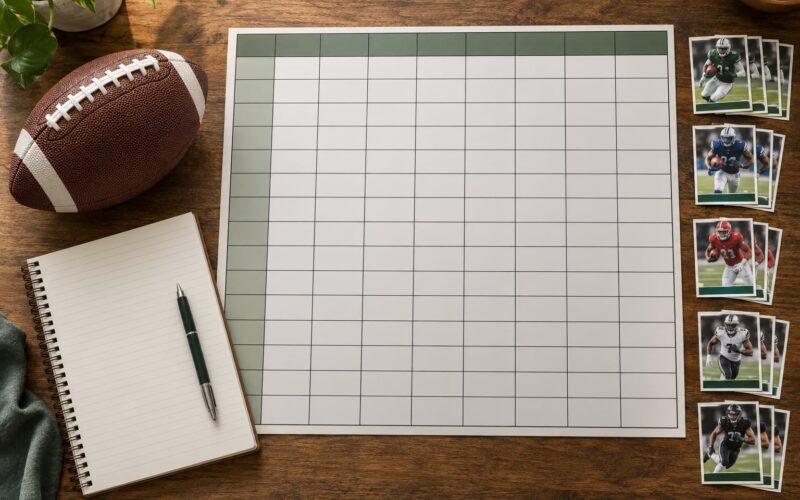
Practicing a draft without a league is simpler than most people expect: you need a current player pool with tiers, a draft board or spreadsheet set to your league’s exact settings, a clock, and a place to log every pick. If you are learning how to practice drafts without a league this offseason, you can run a full snake draft rep in 30 to 60 minutes with no account, no subscription and no leaguemates. The hard part is not the setup. It is running the rep honestly, with a timer on and your rankings locked before you start.
I have built this routine with two leagues in the house, one redraft and one dynasty startup, and the setup takes about twenty minutes once. What changed my drafting was not reading more rankings. It was tracking my own inventory and being honest about why I took a player.
Table of Contents
- What You Need
- A current player pool
- A draft board or spreadsheet
- A league settings sheet
- A clock
- A log column
- Step-by-Step: How to Practice Drafts Without a League
- 1. Lock the league settings before you look at players
- 2. Tier the pool, then hide it
- 3. Set your draft slot and run the timer
- 4. Write the reason, then move on
- 5. Review the board, not just the roster
- 6. Run it three times before changing anything
- How to Practice Drafts Without a League Using a Standard Draft Board
- Running an auction or salary cap draft
- How to Practice Drafts Without a League for Dynasty and Keepers
- How to Practice Drafts Without a League With a Draft Simulator
- Common Mistakes
- Drafting from rankings you did not re-sort
- Ignoring your real league settings
- Drafting without a clock
- Losing track of your inventory
- Reviewing only the final roster
- Chasing consensus instead of reading the board
- Frequently Asked Questions
- Do I need a league to do a practice draft?
- How long should one practice draft take?
- Are free mock draft tools actually useful?
- How many practice drafts should I run before my real draft?
- How do I make a solo mock feel realistic?
- Should I practice on the platform I actually play on?
- The Short Version
What You Need
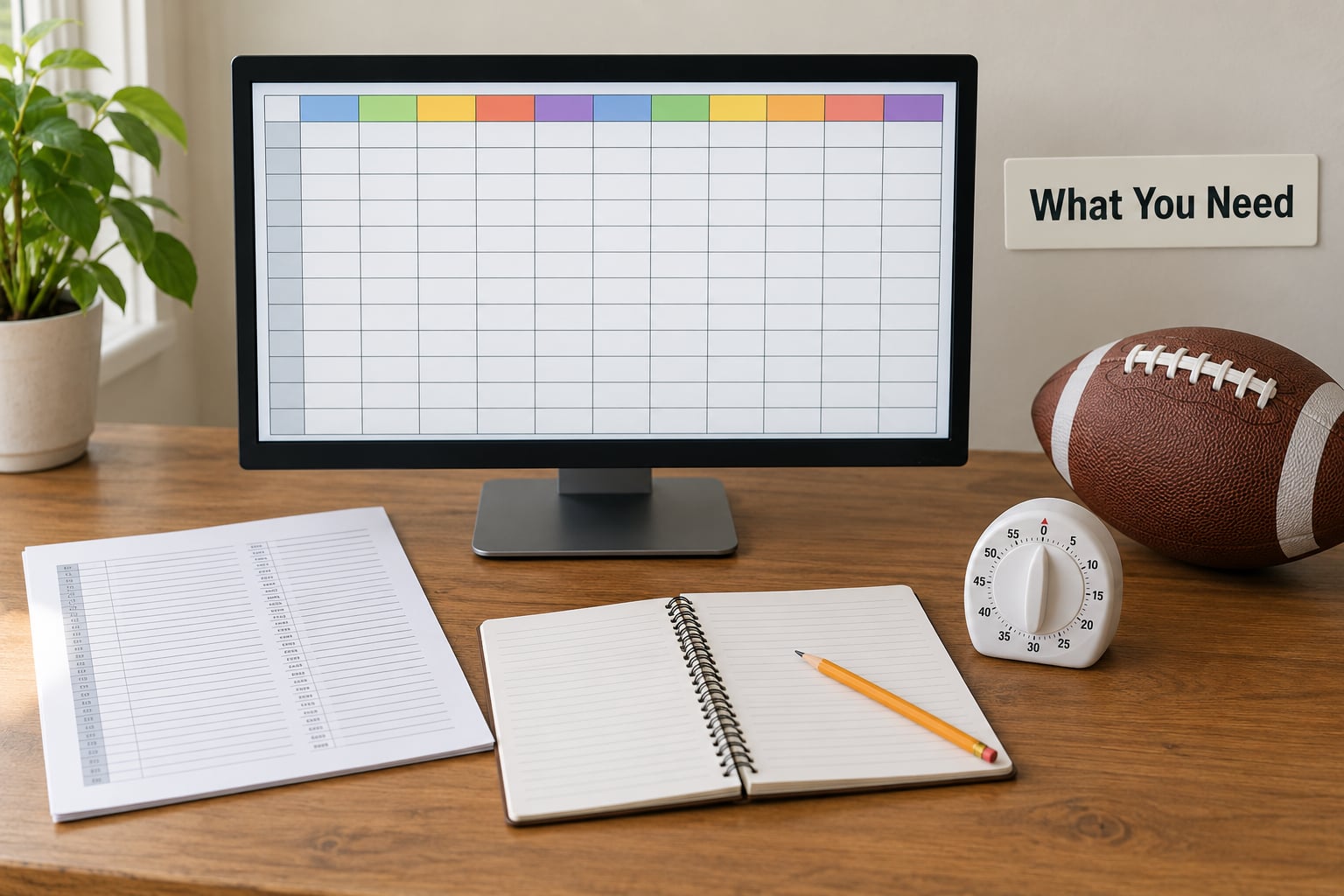
Five things, and only two of them cost anything. Everything else you probably already own.
A current player pool
Not a rankings list you saved months ago. A player pool that you have re-sorted within the last two weeks, because ADP moves every week of the offseason and a stale sheet is the fastest way to practice bad habits. If your league uses a scoring format you play in multiple places, sort by that format’s projection source instead of a general one.
A draft board or spreadsheet
A grid with one column per team and one row per round works. Set the column order so your own column sits where your real draft slot sits, because that single change makes the whole rep feel more real. Keep the team names as other draft slots, not team names. You will not think about who you are dodging when you are dodging slot 3.
A league settings sheet
Write down team count, roster slots, scoring format, flex spots, number of keepers and the auction budget if there is one. Practice against the wrong settings teaches you nothing. A 12-team PPR mock with two flex spots is a different draft from a 8-team half-PPR mock with one flex and a superflex spot.
A clock
Use a five-minute timer per round for a standard snake draft. That is roughly the pace of a real online draft, and it is the whole reason to practice alone. Drafting without time pressure is the difference between knowing who you want and actually getting them.
A log column
Add one column to your sheet labelled reason. Every pick gets a three to five word justification: best available at slot, punt candidate, price on the WR1, ADP steal. After the draft you will have a record of your reasoning, which is the only thing that makes reps compound instead of resetting.
Step-by-Step: How to Practice Drafts Without a League
The full process of how to practice drafts without a league takes about an hour. Here is the order that works, and the reason each step comes before the next.
1. Lock the league settings before you look at players
Write the roster and scoring on a fresh sheet. Then build your board to match. If you skip this, you will unconsciously draft to a league you are not in, and you will not notice until you see your live team was built on a different rulebook.
2. Tier the pool, then hide it
Group players into tiers of roughly six to eight names, from your first-round equivalent down through your punt range. Close the sheet before the draft starts. Practicing with the tier labels visible is the digital version of drafting with the answers printed on your cheat sheet.
3. Set your draft slot and run the timer
Pick the slot you expect in your real league. Start the five-minute timer, and when it goes off, take your best available player whether or not you are thrilled about it. Hesitating at pick 41 is the exact habit you are trying to train out of yourself.
4. Write the reason, then move on
The reason column takes five seconds. It is also the difference between a rep that teaches you something and a rep you repeat in exactly the same way next week.
5. Review the board, not just the roster
Look at who went where in rounds one through four. Most solo drafter losses are not bad picks, they are slow picks. If four running backs went in a row and you sat on your RB1 because you liked a wide receiver, that is the lesson.
6. Run it three times before changing anything
One draft is a sample. Three drafts from different slots is a pattern, and a pattern is what you can adjust for. Change one variable at a time between reps.
How to Practice Drafts Without a League Using a Standard Draft Board
A standard board is the purest version of how to practice drafts without a league, because there is no algorithm helping and nobody to read. You supply every other team’s picks yourself.
The mechanic is simple. You take your pick, then you simulate the picks that come before your next turn. In a snake draft that means taking the top player available on the board at your next slot in the snake order. If you own slot 7 in a 12-team league, your next pick is after slot 6 takes, so you are always drafting to what slot 6 has left rather than to a global best player.
That step is where solo practice quietly gets better. Once you are simulating opponents in order, you stop hoarding your favourite players and start tracking who is left when you come back around. After two reps you will know your real draft slot’s value better than any projection can tell you.
Track the undrafted pool at the end of round six. Real drafts are decided by the players who fall to you in rounds seven through ten, and if you have never scrolled past round eight in a practice session, you have not practiced the part that matters most.
Running an auction or salary cap draft
An auction draft is the one format you genuinely cannot practice well on a snake board. The mechanics you need to train are a budget that decrements on every bid and a willingness to bid on a player you would never take in a snake round.
Set a fixed budget, usually $200 across 16 or 18 spots, and write it in the header. Give every simulated team a personality before you start: one team that will pay up for any receiver under 40 years old, one that hoards quarterbacks, one that only buys running backs late. Without that, you are drafting against yourself and learning nothing about auction patience.
The drill is to set a personal spending ceiling per round and never exceed it to win a single player. Most auction mistakes come from one panicked bid in round four, not from misreading the room. After the draft, check how much of your budget you had left at each round and whether you bought two players in the same position.
How to Practice Drafts Without a League for Dynasty and Keepers
Dynasty and keeper drafts need a different exercise, because the value of a pick is not the points it scores this year. It is the asset you end up holding.
For a keeper league, the first thing to build is a keeper board: your own keepers, their likely cost, and the other teams’ keeper counts even if you do not know who they will keep. That second part is the piece most solo practice skips. Reddit threads on keeper mocks keep circling the same complaint, that practice tools account for your own keepers and not the rest of the league’s, so your rep runs optimistic. Check the league’s keeper settings on the platform or write your best guess beside each team and revisit it after the draft.
For a dynasty startup, score picks by what they are worth in a rebuild rather than by their weekly ceiling. A blocked receiver on a bad offence is worth less than a rookie running back on a good one, even in a redraft setting. Practice by writing the name of the team you drafted the player for, so you are forced to imagine him starting for four years.
For rookie preparation, run a mock that uses last season’s rookie board as a base, then grade the class by role rather than by points. The goal is to see how your league values assets, not to guess which rookie breaks out.
How to Practice Drafts Without a League With a Draft Simulator
A simulator is worth using when you want opponents who pick from real ADP instead of from your own head. That is the honest version of practicing solo: the rest of the board behaves like a market, and you react to it.
The most useful simulators let you set team count, roster slots, scoring format and your own draft slot before you start. Others go further and import your real league’s scoring, roster construction and draft position directly, which removes the most common way reps go wrong. Free tiers usually cap you at a fixed number of drafts per day or per week, so plan two or three serious sessions a week rather than burning the allowance on throwaway reps.
Where simulators fail is in the bots. Forum users complain repeatedly that CPU teams will queue four wide receivers or five running backs back to back, which no league table ever does. You cannot fix the opponent model, but you can compensate. Ignore the run of identical positions and pick the best player on your own board if there is a gap, because the position scarcity is a bot artifact rather than a market signal.
And do not let the post-draft grade replace your own read. A simulator can tell you that you left value on the table against its model. It cannot tell you whether you misjudged a player’s role, and that is the skill the real draft will test.
Common Mistakes
Drafting from rankings you did not re-sort
If your sheet predates the last two weeks of moves, every pick past round three is built on stale information. Re-sort or accept that the rep is only practicing mechanics, not evaluation.
Ignoring your real league settings
A mock with different scoring, flex spots or team count gives you a false read on scarcity. The fix is dull: copy the settings onto the board before you draft, every single time.
Drafting without a clock
Untimed practice makes you a better analyst and a worse drafter. The clock is the variable that simulates the real pressure and the only way to train your snap decision.
Losing track of your inventory
Count your drafted players by position after every round, or keep a simple tally in your notes. Most blown drafts come from a position the manager forgot they were light on.
Reviewing only the final roster
A roster that looks fine at the end hides a bad middle. Scroll back through rounds one to six and check how long you went between picks on your own target position.
Chasing consensus instead of reading the board
When you mock alone, the only signal about the rest of the league is what you feed it. Run a rep where you deliberately take three players ranked well below their slot and see whether the simulated board punishes you. If it does, the model is punishing noise rather than talent.
Frequently Asked Questions
Do I need a league to do a practice draft?
No. A practice draft works completely on its own once you have a player pool, a board set to your league settings and a clock. League-based mock tools add convenience, not necessity. You can simulate every other pick yourself from a standard snake order and still get most of the value, which is why solo board practice is a legitimate offseason routine.
How long should one practice draft take?
Budget 30 to 60 minutes for a full snake draft, plus about 20 minutes of review. Most of that is setup, tiering and the review pass, not the picks themselves. Run three reps in a session rather than one long draft, and change only one variable between them so you know which habit moved.
Are free mock draft tools actually useful?
Yes, for learning the interface and for testing a build. Free tools usually cap how many drafts you can run per day or week, and their CPU opponents sometimes take unrealistic runs at one position. Use them to get reps and to rehearse the draft room UI, then verify your actual strategy on a board with your own settings.
How many practice drafts should I run before my real draft?
Six to ten is a reasonable range spread across the weeks before draft day. Three early drafts to settle your tiers and two from your real draft slot are the baseline, then a few more in the final two weeks once ADP has settled. Diminishing returns kick in fast once you are repeating the same board, so change the slot or the build between reps.
How do I make a solo mock feel realistic?
Match the settings exactly, set yourself in the slot you expect, and run the timer. Simulate the other teams in snake order so you draft against what remains rather than a global best player list. Add the reason column so you can review the decisions, and check the undrafted pool after round six, which is where real drafts are won.
Should I practice on the platform I actually play on?
Yes, at least once. Practicing on the platform you will draft on teaches you the queue, the autopick behaviour and the mobile layout, none of which a generic simulator can show you. Forum managers tend to prefer mocking on the platform they actually play in for exactly that reason, then use third-party simulators for volume.
The Short Version
Start tonight, before you think you are ready. Build tiers from a pool you sorted this week, set the board to your real scoring and roster, put yourself in your expected slot, and run one timed snake draft with a reason column. Then read rounds one through six before you judge the roster. If you are learning how to practice drafts without a league, that single rep is worth more than another hour of reading rankings, and the log will tell you what to fix in rep two.