How to pick your keepers in fantasy football comes down to one idea: treat each keeper as one of your first picks, not as a cheap trick from the back of the draft. Before you compare anyone, write down what each keeper costs you, compare that cost to his average draft position, and then rank him by talent tier first and discount size second. The player you cannot comfortably draft again is usually the one to keep.
The mistake I see most often is a manager keeping two decent players to avoid “wasting” a spot, then using a late pick on a starter because his roster looks full. Keepers are not filler. They are the highest-leverage picks of your draft, and the process below takes about an hour once you have your league settings in front of you.
Table of Contents
- What You Need
- Step-by-Step: How to Pick Your Keepers in Fantasy Football
- Step 1: Review Your League’s Keeper Rules
- Step 2: Build a List of Eligible Players
- Step 3: Estimate Each Player’s Future Value
- Step 4: Compare Players by Opportunity and Risk
- Step 5: Rank the Final Keeper Targets (How to Pick Your Keepers When You Have Too Many)
- Step 6: Submit or Negotiate Your Keepers
- Common Mistakes
- Frequently Asked Questions
- How many players should I keep in fantasy football?
- Should I keep an injured player?
- Is it better to keep a star or a younger player?
- Can I change my keeper selections later?
- Should I trade for a keeper instead of drafting one?
- When should I finalize my keeper decisions?
- Conclusion
What You Need
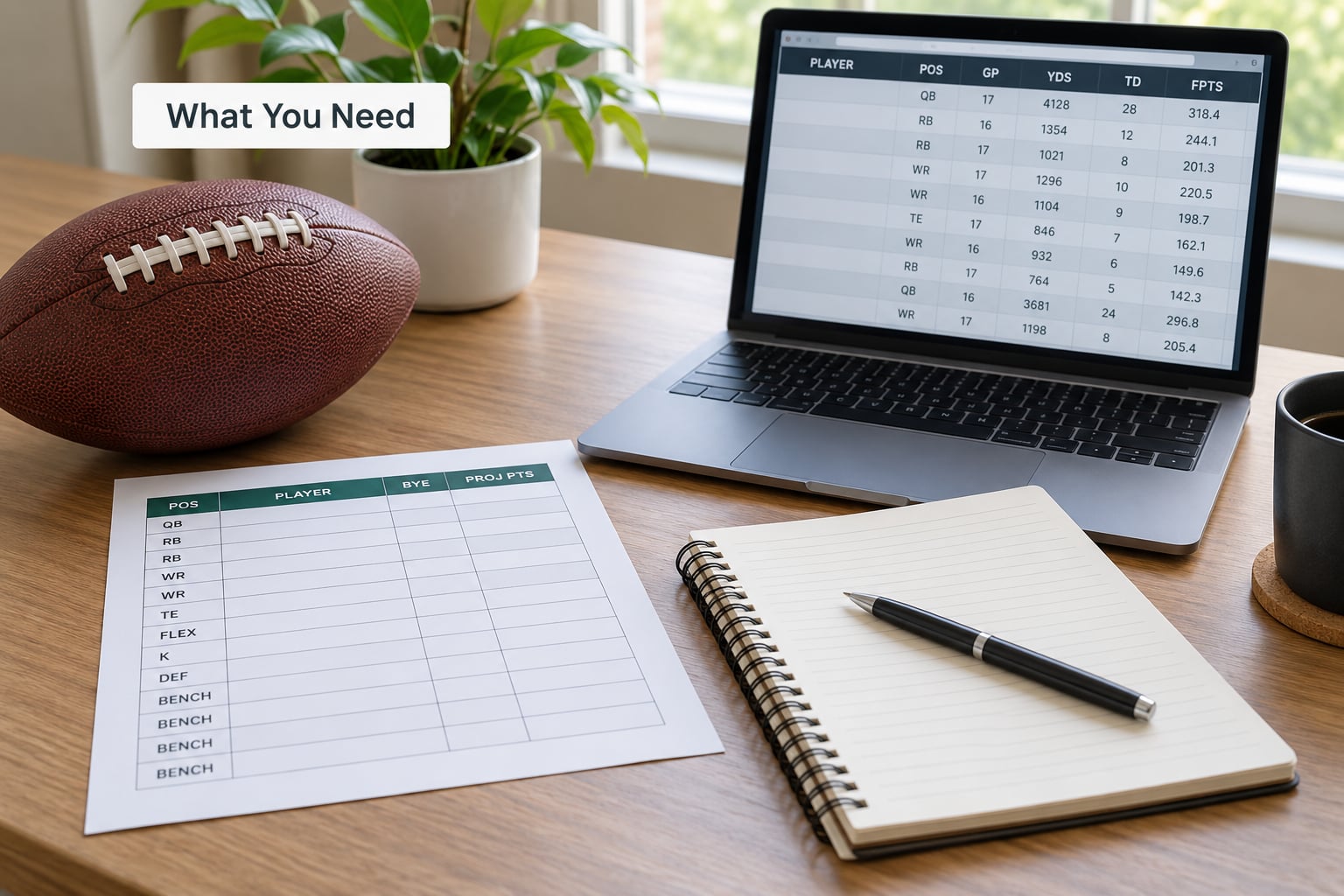
Three things, and none of them cost money:
- Your league settings. Screenshot or print the keeper section: how many spots you get, what each keeper costs in draft rounds or auction dollars, the deadline, and whether kept players can be traded.
- A ranking and ADP source you trust. A consensus keeper ranking and a current ADP board. Use one of each, not six tabs arguing with each other.
- Your roster with acquisition notes. Add a column recording when and how you got each player: draft round, waiver priority, trade, free agent pool. That one column prevents most keeper regret.
Also settle the eligibility question before you fall in love with a pickup: players added on the waiver wire or out of the free agent pool are usually keepable, but some commissioner-configured leagues restrict it. Check your settings rather than assuming.
Step-by-Step: How to Pick Your Keepers in Fantasy Football
Six steps, in order. Skipping step one is how people end up keeping a quarterback they would never draft in round two.
Step 1: Review Your League’s Keeper Rules
Start here, because the rules decide what a good keeper even looks like. Four things matter: how many keepers you have, what each one costs, which years of eligibility you have left, and whether the decision can be undone.
Cost structures fall into a few shapes. A fixed round penalty charges the same round every year. An escalating penalty grows the cost each year, so a player kept twice may now cost a third-round pick. Auction-draft leagues charge the salary you paid last year. No-cost leagues charge nothing, which makes the decision pure talent ranking.
Escalating costs change strategy the most. If you are on the hook for a bigger pick next year, a thirty-one-year-old tight end stops being an interesting keeper even if his discount looks huge.
Step 2: Build a List of Eligible Players
List every player you can legally keep, with three columns: times kept, next year’s cost, and how you acquired him. Then cross out anyone ineligible. In most leagues a player with a contract year remaining before he hits free agency becomes ineligible for another keep, so check that now, not on draft night.
Note which of your players already used their eligibility. Several managers lose a keeper they assumed was available because a second year was burned on a player they barely used.
Step 3: Estimate Each Player’s Future Value
This is where age and role beat last season’s numbers. Three things move future value more than a stat line.
- Opportunity. Is he a defined starter, a competition, or a player holding a roster spot behind a name? A running back with three seasons of 15 touches a game is a different asset from a rookie with one good game.
- Availability. Guessing games missed is the least reliable part of the exercise. Build in a haircut: a player with a recent soft-tissue history gets valued at roughly eight to ten percent below his projection, and an aging player gets valued at two seasons, not five.
- Age curve. Running backs and tight ends fall off a cliff in their late twenties. Receivers hold value a few years longer. That difference decides a lot of tiebreakers.
Contract and team context come next. A quarterback on a rookie deal with a stable coaching setup is a safer keeper than one facing an offseason competition, even with identical stats.
Step 4: Compare Players by Opportunity and Risk
Now do the math that separates a keeper from a bad one. Subtract the round your keeper costs from his average draft position. A player going around pick 32 who costs you a second-round pick saves you about 1.5 picks; a player going around pick 78 for a fourth-round slot saves you about four. The bigger number feels better and is usually the wrong call.
That gap between draft position and keeper cost is the keeper-adjusted ADP, and it tells you the discount. Discount size is not value. Tier is value.
One more adjustment matters: every keeper in the league removes a player from the pool before the draft. In a 12-team league with two keepers each, roughly two rounds of picks are gone before anyone picks, so everyone drafts slightly earlier than their redraft ADP. Larger leagues with five keepers inflate the whole board more. Expect to reach a full round or two above your usual spot and stop panicking when it happens.
In PPR, receivers gain a floor from targets alone, which makes a young pass-catcher a safer keeper than a boom-bust runner with the same ADP. In standard scoring, that same runner is more valuable because scoring does not reward volume. Score the format you actually play.
Step 5: Rank the Final Keeper Targets (How to Pick Your Keepers When You Have Too Many)
Rank in this order: talent tier, then opportunity, then risk, then discount. Use the delta as a tiebreaker, never as the opening argument.
| Candidate profile | Position | ADP | Keeper cost | Delta | Verdict |
|---|---|---|---|---|---|
| Top-12 receiver, age 24, new deal | WR | 18 | Round 1 | -0.3 | Keep. Tier wins even with a thin delta. |
| Top-8 running back, age 26, two seasons of 15+ touches | RB | 22 | Round 2 | 1.1 | Strong keep, the best deal on the board. |
| Rookie wideout, age 21, clear target share | WR | 96 | Round 3 | 3.5 | Keep in standard. In PPR, keep only if the floor is real. |
| Top-6 quarterback, age 28, locked starter | QB | 8 | Round 1 | -2.4 | Keep only in superflex or a 2QB league. |
| Third tight end, age 30 | TE | 140 | Round 5 | 4.2 | Do not keep. Replacement-level player at an escalating cost. |
Run that logic across your own roster. The hard case is having four good players and three spots. Pick the top three by tier, then trade the fourth only if the return clears his next-year cost plus a round. Traders repeatedly describe the same rule: keep the best player you can get at a reasonable cost, not necessarily the biggest discount.
For every slot, write three names: your target, your acceptable backup, and the player you would trade for that target. The fallback stops you from flipping on deadline day because a hot waiver wire pickup suddenly looks better.
Step 6: Submit or Negotiate Your Keepers
Submission is usually a two-minute job, but the paths differ by platform and the SERP is full of managers in the wrong menu.
- ESPN (web and app): open your team, tap the Information button next to your team name, tap Edit Keepers, select your players, tap Save.
- Yahoo: on the Home screen, tap your league card, then tap Set in the Set Your Keepers banner, select the players, and confirm.
- NFL.com: if your league has keepers enabled in Settings, go to the My Team tab and use the Select Your Keepers link.
- Sleeper and FantasyPros both place the control in the roster or league settings screen under a keepers option; confirm the deadline on the league page rather than assuming it matches the draft date.
Final checklist: deadline confirmed and blocked out, every keeper eligible, every cost written down, trades negotiated before you submit, and no keeper left unused if you have a better option. Unused spots simply go away in most leagues, so there is no savings for holding back. If you trade a player who has keeper eligibility, check whose round cost it becomes; in several settings the cost follows the player, which is worth knowing before you hand him over.
Common Mistakes
Keeping the biggest discount instead of the best player. This is the single most repeated error in manager threads. A four-round discount on a replacement tight end loses to a one-round discount on a starter.
Drafting like a redraft league. If your keepers filled the running back and wide receiver slots, the draft board still has real players on it. Do not reach two rounds early just because your roster looks tidy.
Keeping a quarterback or tight end in a standard 1QB league. These are onesie positions with easy replacements, and a big discount on a replaceable player is still a replaceable player. Superflex is the exception.
Chasing next year’s value today. A young player you keep for a future cost has to pay for himself this season too. Future value breaks ties; it does not create them.
Forgetting that keeper drafts inflate everything. Adjust your expected draft position before you decide you have to reach.
Panicking on deadline day. A written fallback list from step five removes the panic, and the deadline is rarely as tight as it feels.
A few habits that hold up: keep three candidates per slot instead of one, re-rank after any trade, and re-run the comparison the morning you submit. Two short sessions beat a rushed Sunday-night decision.
Frequently Asked Questions
How many players should I keep in fantasy football?
Keep as many players as your league allows when each one is clearly better than what you could draft at that cost. Two to three is the usual sweet spot. With five or more keepers you are effectively playing dynasty, so lean on age curves and multi-year projections instead of single-season value. If you have more good candidates than spots, keep the best by tier and trade the extras rather than padding the list with mediocre names.
Should I keep an injured player?
Judge the injury on expected games played, not on the diagnosis. One missed game from a minor soft-tissue issue barely dents a season. A player expected to miss six games is a replacement-level asset at any cost, especially when the position has depth behind him. Rule of thumb: value an injury-prone player roughly eight to ten percent below his clean projection, and keep him only if he is still a starter in a scarce position.
Is it better to keep a star or a younger player?
Keep the star unless the younger player has a defined role and you are in a league with escalating keeper costs. Stars win now, and most managers underestimate how quickly a young player stops producing. The exception is a rookie or second-year player with a locked starting job and an aging veteran ahead of him. There, future value is real enough to justify one year of lower production.
Can I change my keeper selections later?
Usually yes, until the keeper deadline or the start of your draft, and some platforms let you edit after submitting but before the draft begins. Settings vary by league, so confirm on the league page rather than assuming. Once a draft starts, selections are locked in nearly everywhere. If you plan to change something, do it before the deadline so you are not negotiating on draft night.
Should I trade for a keeper instead of drafting one?
Only when the price stays under the value of the pick you would give up. If a keeper candidate would cost a third-round pick and trading away a fourth-round pick secures him, that is a good deal. Trading a first to reach a player going in the fifth round is usually a losing move, even if the discount looks large. Set your maximum price in writing before you start negotiating and do not raise it mid-talk.
When should I finalize my keeper decisions?
Two sessions is enough: one to research and rank, one to confirm and submit. Do the first about a month before the draft, then revisit after any significant trade or waiver-wire move. Submit at least two days early so a mistake, a trade, or an eligibility problem does not force you to redo it. If your league locks picks at the draft, treat that deadline as final and ignore everything you hear on the last morning.
Conclusion
Knowing how to pick your keepers in fantasy football is a repeatable process, not a gut call: confirm your rules, list every eligible player, value future production, rank by tier before discount, and submit early. Your first move tonight is to open your league settings and write the cost of every keeper candidate next to his ADP, in 2026 and every year after it. The right keeper is the player you would be upset to lose, at a price you can still build a draft around.