Rookie running backs are the most forecastable prospects in a draft class, and that is exactly why managers get them wrong. Two or three of them will produce top-24 seasons almost every year, the rest fade without a trace, and the gap between those outcomes is decided almost entirely by role and workload before you ever look at a highlight reel. Knowing how to evaluate rookie running backs for fantasy comes down to four inputs, applied in this order: expected draft capital, depth-chart position, projected offensive role, and the college traits that decide whether the back keeps his touches on third down.
That framework takes about 30 minutes per player once you have your data open, and it holds up across redraft, keeper and dynasty formats. The rest of this guide walks through the process step by step, including the two places where most managers tilt too hard: treating combine numbers as talent grades, and pricing a back before you know how many snaps he will actually get.
Table of Contents
- What You Need
- Step-by-Step
- 1. Identify the Rookie’s Expected Role
- 2. Project the Back’s Weekly Touch and Carry Share
- 3. Evaluate the Offensive Line and Blocking Context
- 4. Separate Skill, Efficiency, and Statistical Noise
- 5. Judge Pass-Down and Red-Zone Usage
- 6. Compare the Rookie With NFL-Comparable Prospects
- 7. Adjust for Competition, Injuries, and Opportunity
- 8. Turn the Analysis Into a Draft Plan
- Common Mistakes
- Frequently Asked Questions
- What is the best way to evaluate a rookie running back before the NFL draft?
- How many carries should a rookie running back be expected to get?
- Is yards per carry a reliable way to compare rookie running backs?
- When should I avoid drafting a rookie running back in redraft leagues?
- Is it better to draft a rookie running back in dynasty or redraft leagues?
- How much should I pay for a rookie running back with uncertain role?
- Conclusion
What You Need
You need depth-chart and snap data before you need opinions. Specifically, a current offensive snap count and touch share by running back, split between early-down and passing-down work, and the same numbers for the backfield he is joining.
From there, add four more inputs. First, game-script assumptions: how often the team is favored or trailing, and how the offense leans late in games. Second, blocking quality, ideally an offensive line grade and a run-block win rate. Third, college efficiency data such as yards after contact per attempt, breakaway rate, missed tackles forced and receiving yards per route run. Fourth, the injury and workload history that tells you whether this back has ever taken 250 carries in a season.
Finally, get his expected draft position and current average draft position from a mock database such as Grinding the Mocks, plus every comparable NFL running back you can justify. Recruiting service rankings sit at the bottom of the pile. Film, game logs and up-to-date depth-chart reporting do the real work, and a press conference transcript matters more than people expect.
Step-by-Step
The process below runs in eight steps, and the order matters. Skipping ahead to traits before you know the role is the single most expensive mistake in rookie RB research, because a 6.2 yard-per-carry average in a great offensive line means something completely different than the same number behind a declining unit.
1. Identify the Rookie’s Expected Role
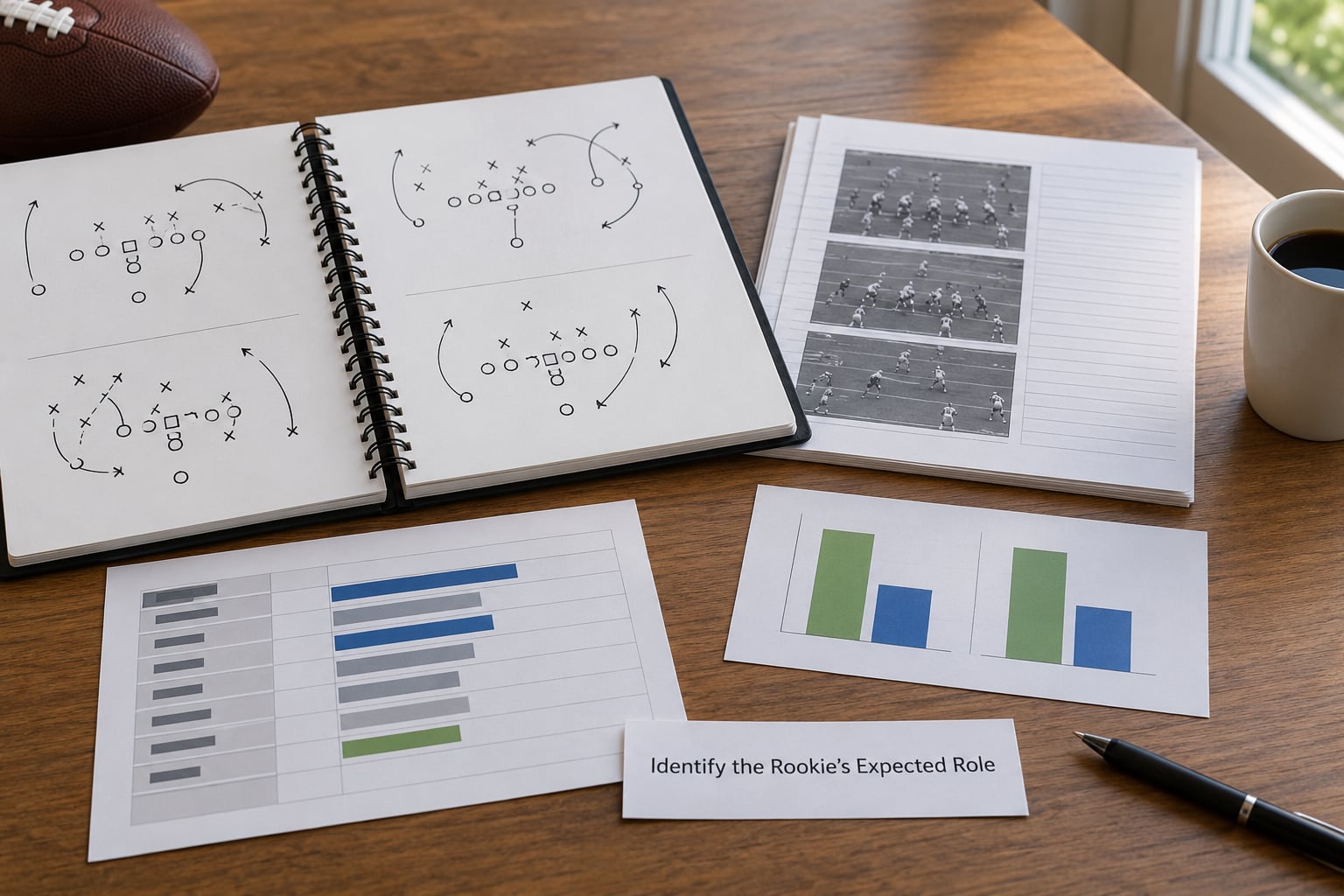
Start by writing down one of four role labels: clear starter, committee back, change-of-pace option, or rotational pass-down specialist. The label is the output of this step, and every number you build afterward hangs off it. A clear starter on a pass-heavy team has a floor near 15 touches per game; a change-of-pace option who loses early-down work has a ceiling near 8.
Build that label from the roster, not from hype. Check whether an incumbent starter is still under contract, whether the team drafted another back behind him, and whether the offensive coordinator runs a lead-back system or a rotation. Coach quotes are a clue, not a verdict, which is why this belongs inside a broader framework for how to evaluate rookie running backs for fantasy rather than at the end of it.
Two draft-capital rules hold up well. A first-round pick who is not the primary back on his college team is a red flag worth investigating. A second-round pick who was a three-year workhorse with 300-plus carries is usually being drafted as a starter no matter what the depth chart currently shows.
You have the role right when you can name the one player most likely to take a carry from him, and say why. If you cannot name anyone, the honest label is committee, and a committee back should be priced like one.
2. Project the Back’s Weekly Touch and Carry Share
Build a range, not a single number. Give yourself a downside, a median and an upside case for touches per game, then multiply by 17. Total opportunity is the most durable fantasy statistic at this position, which is why a low-volume back with heavy receiving work can beat a 15-carry-per-game back you overpaid for.
Use this worksheet as a starting baseline before you do your own research, and adjust each line for the role you assigned in step 1:
| Draft round | Typical role | Touches per game (range) | Receptions per game (PPR) | Top-24 fantasy finish rate |
|---|---|---|---|---|
| Round 1 | Starter, early-down plus passing-down | 13 to 18 | 2 to 4 | Roughly half |
| Round 2 | Starter or lead committee back | 10 to 15 | 2 to 3 | About one in four |
| Round 3 | Committee back, rotational | 7 to 11 | 1 to 3 | Roughly 13% |
| Round 4 and later | Change of pace or special teams | 4 to 8 | 0 to 2 | Low single digits |
Those are historical ranges, not promises, and the distribution is fat at both ends. A third-round back finishing top-24 about 13% of the time is a fact you can plan around, which means you should never build a redraft season around one.
Adjust the range with four inputs: team scoring, offensive line quality, quarterback play, and coaching tendencies on early-down and red-zone snaps. A coach who throws on 60% of first downs caps every back on the roster, and a quarterback with a strong checkdown habit inflates the receiving floor.
3. Evaluate the Offensive Line and Blocking Context
The offensive line sets the opportunity ceiling, and it is the layer most managers skip. Look at run-block grade, projected line continuity, scheme fit and the quality of the front seven, then check whether the line’s decline is structural or just one bad season.
Here is the generic comparison that matters. A rookie with strong interior blocking, a line that returns all five starters, and a reliable pass-protection grade has a higher fantasy floor than a more explosive prospect behind an unstable line, even if the explosive guy has the better college highlight reel. Blocking does not determine production on its own, but it decides how much of the production arrives as yards after contact, which is the part a rookie can repeat.
Two questions tell you most of it. Is there a returning starter at right tackle or center, and did the team add anyone in free agency who changes the run game? If the answers are both no, discount early-down volume for every back on that roster until the preseason says otherwise.
4. Separate Skill, Efficiency, and Statistical Noise
Now check whether the back can convert whatever touches he gets. Review yards per touch, success rate, missed tackles forced, breakaway rate, fumble rate, receiving yards per route run and pass-block win rate next to the volume numbers.
Sample size is the trap. A 300-carry college season in a lower-level defense is a much better sample than two dozen showcase carries against a future pro defense, and a huge breakaway rate in a small sample usually regresses. Normalize the outliers: strip out the long runs behind a 20-yard line, then see if the efficiency survives.
What survives normalization is skill. A back forcing missed tackles at a consistent rate on inside runs is doing something repeatable. A back with a 7.0 yards-per-carry average built on 40% of his carries going the length of the field probably is not, and a 3.8 average in a power-heavy system against top competition probably is.
Guard against two more noise sources. Fumbles are worth real discount, because ball security decides early-down trust in a way yards do not. And a high dominator rating off a quarterback who threw 450 times is telling you about the offense, not the back.
5. Judge Pass-Down and Red-Zone Usage
This is where formats diverge, and where PPR managers gain an edge. Receiving work, third-down responsibilities, pass protection and goal-line usage each add points in a different way depending on your scoring.
| Usage | Standard | Half-PPR | PPR |
|---|---|---|---|
| Early-down carries | Primary value | Primary value | Primary value |
| Checkdown and swing-pass targets | Small bonus | Modest bonus | Major value |
| Goal-line carries | Fewer points, high variance | Fewer points, high variance | Fewer points, high variance |
| Pass protection | Indirect only | Indirect only | Indirect only |
The question to answer is whether this back is competing for touches or has a distinct path to points. A back whose quarterback checks down to him on 40% of third downs has a floor that a comparable runner in a run-first offense does not. A back who is a declared pass protector but not a route target gains only durability, not points, so value him as the insurance policy he is.
Red-zone work deserves its own check. Goal-line carries are worth fewer fantasy points per touch than a long run, so a back who is your goal-line specialist may be your most disappointing weekly producer despite a perfect role. Look for a back with a mix of early-down volume and red-zone targets, which is the rare profile that survives a bad game script.
6. Compare the Rookie With NFL-Comparable Prospects
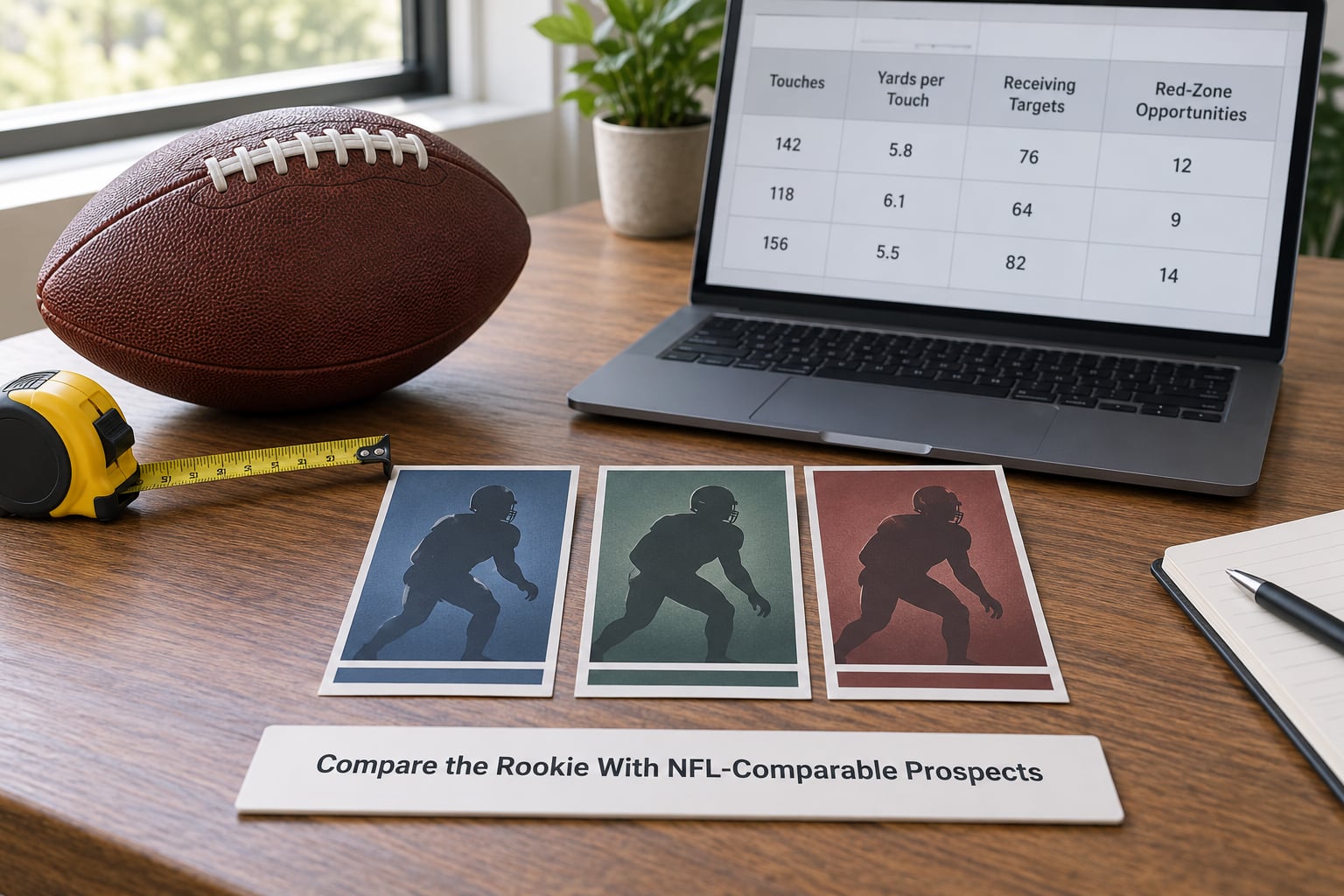
Name comparison is worthless. Build your comp set from college production, size, athletic profile, draft position and offensive context, then compare expected touches, efficiency, receiving volume and actual fantasy outcomes. A 1,800-yard three-year workhorse who went behind a re-signed veteran is not the same player as a committee back with the same college line, even if the recruiting rankings are identical.
Watch what the comparison is telling you. When a rookie’s median projection matches the career year of a journeyman who never held a full-time job, the projection is the problem, not the comp. When it matches a lead back on a pass-heavy team who posted four straight 15-touch weeks, the projection is probably conservative.
Use the comps to make three separate decisions rather than one blended ranking. Set a redraft price, set a dynasty price, and set a trade value. A back can be a good dynasty pick and a bad redraft pick at the same draft slot, and forcing a single number is how managers end up holding the wrong asset for the wrong reason.
7. Adjust for Competition, Injuries, and Opportunity
Opportunity is the variable that moves fastest, so build the downside case explicitly. Assume the incumbent stays healthy, the second drafted back gets the committee work, and the coaching staff keeps the rotation they ran last year. If that scenario leaves your pick with 6 touches per game, you have your fade signal, and no amount of talent talk changes it.
Then layer in the context items that shift a role mid-season: a coaching change, a suspension, an injury to the starter, a scheme switch to zone, or a contract year that changes how patient a front office is. A back drafted by a franchise with no reason to win now is a different bet than one drafted by a team that needs a starter immediately.
Two risk questions deserve a straight answer. How many carries did he absorb in college across his last two seasons, and does the medical history include a knee or ankle that has required multiple procedures? Workload history is the better predictor of a rookie ceiling, and it is still underweighted.
8. Turn the Analysis Into a Draft Plan
Convert the research into four numbers: a price you will pay, a priority tier, a roster fit target, and an acceptable value range. The price is the median projection expressed in ADP, and the value range is where the projection still exceeds the alternative players on the board.
For redraft, that range is narrow, because you only need the back to be a starting-caliber option for one season. For dynasty, widen it and weight the age curve, the offensive line’s expected decline, and whether the player improves on a team that is already good. Year-1 redraft value and long-term dynasty value diverge more at running back than at any other position, and treating them as the same number is a mistake in both formats.
For a first-round pick with a bell-cow projection, the decision is simple: you are buying an RB1, and RB1s are scarce enough to justify the price. For a Day 3 back with a top-24 price, the answer is almost always fade, because the hit rate does not support the expectation. The interesting middle is late Day 2, where the ceiling is still real and the price usually has not caught up.
Your repeatable rule: draft the back when your conservative projection, adjusted for the scoring format and your roster needs, beats the best alternative player available at that pick. Keep the conservative projection, add upside only when the evidence in steps 3, 5 and 6 supports it, and never add upside based on highlights.
Common Mistakes
Ranking on combine speed is the most common error. The 40-yard dash correlates weakly with NFL rushing success, and the 10-yard split tells you more about acceleration than it does about vision. Treat measurables as a tiebreaker, not a grade.
Extrapolating college production is close behind. A dominant season against a weak front seven, in a spread offense that threw the ball 60% of the time, is a fantasy result from a different league. Normalize for competition, scheme and offensive line before you carry any number forward.
Ignoring offensive line context produces the classic disappointment: a talented back on a declining line who never gets clean blocks, while a plodder on a great line keeps posting 4.5 yards per carry. The plodder finishes as your RB8 and the talent finishes as your kicker.
Treating projections as exact is how redraft managers end up on three backs with 7-touch projections. A median projection with a wide confidence interval is the honest answer, and the width of that interval is itself information about the role.
Overvaluing one game is the preseason trap. A showcase run or a fumble in the third preseason game changes a depth chart far more than it should. Judge usage shares across the whole preseason, and treat single-game yardage as noise.
Confusing talent with opportunity is the deeper version of the same error. Both can be true, and only one of them produces fantasy points. Draft capital tells you what a team believes, the depth chart tells you who gets the ball, and the price tells you whether anyone is being paid for the difference.
Buying for positional scarcity rounds out the list. Running back is the thinnest position on most boards, which is exactly why good ones get overpaid. Scarcity is priced in already, and it is not a reason to take a back whose projection you would not otherwise take.
Five habits help with the uncertainty that never fully goes away. Update your projections after the draft, because landing spots resolve more questions than any other event. Keep a written record of your reasoning so a bad Year 1 does not turn into panic selling. Set a price before the board reaches your pick. Separate the redraft and dynasty grades. And re-run the full framework on your own players in October, when real snaps replace projections.
Frequently Asked Questions
What is the best way to evaluate a rookie running back before the NFL draft?
Work in order: expected draft capital, then depth-chart position, then projected role, then college efficiency traits. Draft capital sets your opportunity ceiling, the role decides your share of it, and traits decide whether the back keeps his touches on third down. Skip to traits first and you will fall in love with a player who never touches the ball.
How many carries should a rookie running back be expected to get?
It depends almost entirely on draft round and role. First-round backs who are clear starters typically handle 13 to 18 touches per game, second-round lead backs 10 to 15, third-round committee backs 7 to 11, and Day 3 backs 4 to 8. Always build a downside, median and upside case rather than trusting one number.
Is yards per carry a reliable way to compare rookie running backs?
Not on its own. A 6.2 average behind an elite line means something very different from the same number behind a declining unit, and breakaway-heavy profiles regress hard. Look at yards after contact per attempt, missed tackles forced and success rate next to it, and strip out the long runs before you decide anything.
When should I avoid drafting a rookie running back in redraft leagues?
Avoid them when the role is unclear, when an uninjured veteran starter is already under contract, or when the price implies top-12 production. Third-round and later rookie backs finish top-24 roughly 13% of the time, so redraft value has to come from a specific reason: heavy receiving work, goal-line volume, or an empty depth chart.
Is it better to draft a rookie running back in dynasty or redraft leagues?
Dynasty rewards the same role signals but over a much longer window, so a 21-year-old starter on a good offense is worth drafting well past where redraft would stop. Redraft needs immediate production, which makes early-down volume and pass-catcher usage the deciding factors. Grade them separately; one blended number hurts both formats.
How much should I pay for a rookie running back with uncertain role?
Pay your conservative projection and nothing more. If the role is genuinely unclear, the median projection should already be built on committee-style volume, so paying for the bell-cow ceiling means paying twice. Set a price, write down the alternative players on the board at that pick, and take the back only when he beats them.
Conclusion
The decision rule is short enough to reuse every offseason. Start with a conservative role label and a workload range built from draft round. Add upside only when the offensive line, the passing-down usage and the NFL comps all point the same direction. Compare that projection against the best alternative players on the board, and take the back when the expected value is higher, not when the ceiling is more exciting. That is the whole of how to evaluate rookie running backs for fantasy: role first, workload range second, price last.
Then re-run it three times. Once after training camp, when the depth chart stops being a guess. Once after the draft, when the landing spot is known. Once after two regular-season games, when the snaps are real instead of projected. Most of what separates a good rookie RB manager from a bad one is not the pre-draft research, it is having a rule ready for when the research turns out to be wrong.