Starting a dynasty league takes about an hour of setup plus one long weekend of drafting, and the whole thing rests on five decisions you only make once: platform, roster construction, scoring, waiver type, and a written set of rules. Get those right and the league can still be competitive in year seven. Get them wrong and it usually folds before the second rookie draft. Here is how to start a dynasty league, from the first message in your group chat through the last waiver window of year one.
Most failed leagues do not die from bad drafting. They die from vagueness. Nobody agreed on what a taxi squad spot is, so two managers claimed the same rookie. Nobody set a trade deadline, so a franchise got gutted in September. Those are fixable in an afternoon, and everything below exists to fix them before you invite anybody.
Table of Contents
- What You Need
- Step-by-Step: How to Start a Dynasty League
- Choose Your Dynasty League Platform
- Set the League Size and Roster Structure
- Define Scoring and Tiebreakers
- Create the Draft Plan and Set the Auction or Draft Date
- Invite Managers and Publish the Rules
- Run the Draft and Set the First Transaction Window
- Common Mistakes
- Frequently Asked Questions
- How many teams should be in a dynasty league?
- Which platform is best for dynasty fantasy football?
- Should my first dynasty league use superflex?
- When should I start a dynasty league?
- How do you run a rookie draft in the first season?
- Do you need a constitution for a dynasty league?
- Conclusion
What You Need
You need very little to get going, but you need all of it settled before the league goes live. Here is the checklist.
- A platform account for every manager. Create yours first, then have everyone else sign up before you send the invite link. A manager who has not made an account yet cannot accept.
- A committed manager list. Count the people who will actually set lineups and answer trade offers, not the people who said maybe. Recruiting ten casual friends guarantees nine empty teams by December.
- A league size decision. Ten, twelve, or fourteen teams. This drives draft length, roster depth, and how deep your trade market will be.
- A roster design. Starter slots, bench spots, injured reserve, and taxi squad spots. This is the single most consequential setting in the whole league.
- A scoring preference. PPR, half-PPR, or standard, plus whether you want individual defensive players.
- A draft format and date. Auction budgets or snake rounds, and a calendar date the entire group can block off.
- A shared rules document. A single page everyone can reach, containing the settings, deadlines, trade rules, and the orphan team policy.
- A way to collect money, if there is any. A dedicated league-safe payment site beats six people owing each other cash through a group chat.
My rule of thumb: if a decision cannot be defended with one sentence, it does not belong in the settings. If you cannot explain why you chose 15 bench spots instead of 10 in a sentence, you picked a number you saw somewhere.
Step-by-Step: How to Start a Dynasty League
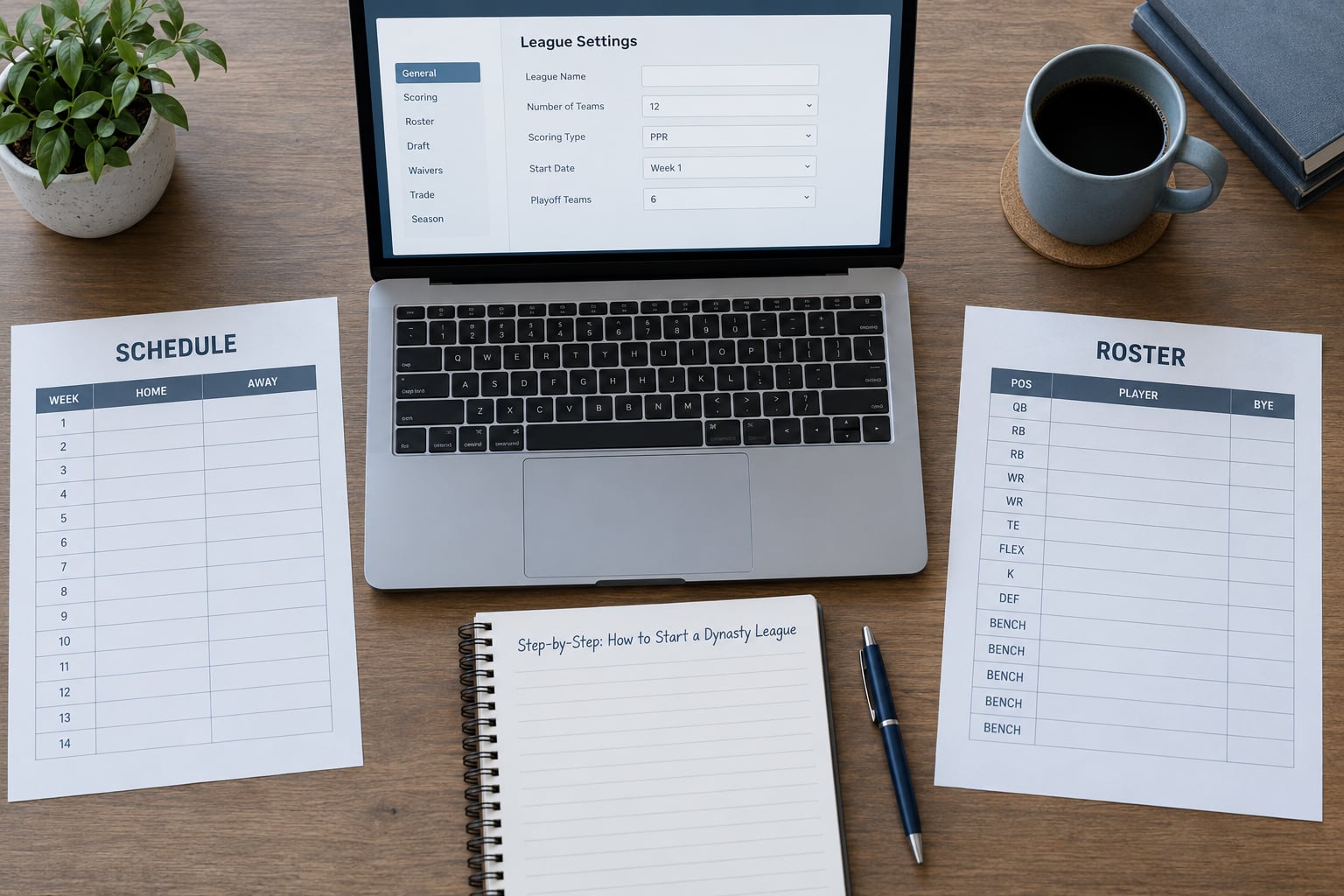
Six steps, and the order matters. Settle the format before you invite anybody, because changing roster settings after players are drafted is painful. Do not begin the draft until the rules are published, because arguments during round nine help nobody.
Choose Your Dynasty League Platform
Sleeper is the default answer for a first dynasty league, and it wins for a boring reason: dynasty is the format it was built around, it is free, and every manager can join without an account approval step. Future pick trading, offseason activity, taxi squads, and rookie draft configuration all work natively, so nobody is stuck building workarounds for a game that was never designed for them.
| Platform | Cost | Future pick trading | Offseason activity | Rookie draft support |
|---|---|---|---|---|
| Sleeper | Free | Native, with pick years tracked | Built in | Native, configurable rounds and order |
| ESPN | Free | Limited | Clunky | No native rookie draft |
| Yahoo | Free | Limited | Clunky | No native rookie draft |
| Fantrax | Paid, tiered | Configurable rules | Configurable | Configurable |
Yes, you can start a dynasty league on ESPN. You do it by treating every player as a keeper, which is why the advice in the Fleaflicker forums is to set the entire roster to keepers and then manually add rookies each spring. It works, but that platform caps rosters at 40 players and forces you to run rookie drafts by hand, which is a lot of admin for something a dedicated platform does automatically.
Fantrax earns its money through customization and commissioner control, which is genuinely useful once a league has grown. It is the harder sell to a group of friends who just want to start playing. Pick Sleeper unless you have a specific reason not to, and if you are migrating an existing league, most major platforms have an import tool that carries over players and settings rather than making you rebuild from scratch.
Set the League Size and Roster Structure
Twelve teams is the sweet spot for most groups. Ten keeps things fast and the trade market thin. Fourteen means a longer startup draft, a deeper bench, and a livelier waiver wire, but it also needs more managers who stay engaged. The middle ground works because it produces roughly 20 bench players per roster, which is enough depth to survive injuries and rebuilds without turning weekly waivers into a full-time job.
| Teams | Startup draft | Typical bench | Trade market | Best for |
|---|---|---|---|---|
| 10 | Shorter, finishes fast | 12 to 15 | Thin, deals get stale | Casual groups, fast setup |
| 12 | Standard length | 15 to 18 | Steady offseason activity | Most friend groups |
| 14 | Long, easier to keep rookies | 18 to 22 | Busy, weekly movement | Committed, trading-first groups |
Here is the roster I would copy for a 12-team league. This is the settings block r/DynastyFF threads converge on, and it is a fine default rather than a law.
| Setting | Recommended | Why |
|---|---|---|
| Starters | 1 QB, 1 Superflex, 2 RB, 3 WR, 1 TE, 2 Flex | One extra RB or WR slot rewards depth |
| Superflex | Yes, as a required lineup spot | Keeps quarterbacks relevant and lengthens careers |
| Defenses and kickers | Drop them | They clutter the waiver wire and go unowned |
| Bench | 15 spots | Roughly 25 players on a roster, starters included |
| Injured reserve | 3 spots, no limit on adds | Stashes a season-ending injury instead of wasting a spot |
| Taxi squad | 3 spots, cannot be started | Developmental room for rookies who will not contribute yet |
| Waivers | FAAB, budget resets each year | Keeps bidding honest without a weekly auction |
Taxi squad spots are the setting people leave at zero and regret within two years. A taxi player cannot be started, which keeps him from stealing a roster slot, but he stays on your team through his development arc. If you start the league with no taxi spots and try to add them in year two, every manager who built a roster without one is suddenly upset, and you are the reason.
Roster size also determines what a season looks like. In a redraft league, everything resets each September and your team is a snapshot. In dynasty, your team is a document with pages. A 25-player roster with three taxi spots and three IR spots gives you room to hold a 22-year-old tight end through his third year instead of cutting him in July because he scored four fantasy points a week.
Define Scoring and Tiebreakers
Point-per-reception scoring is the near-universal default for dynasty because it rewards the volume that makes aging players tradeable. Half-PPR is a reasonable compromise if your group dislikes reception bonuses. Standard scoring works, but it flattens the difference between a good and a great wide receiver, which quietly weakens your trade market.
Two settings get overlooked. TE premium scoring, which gives tight ends extra points per catch, is popular among managers who were burned by the position’s decline and would rather change the math than find replacements. Individual defensive players, which scores points for tackles, sacks, and interceptions, adds offseason activity and makes more players tradeable, but only if your managers will actually read the box scores.
Decide head-to-head matchups or total points. Total points is more common in dynasty because it rewards depth, and depth is the whole point. Head-to-head produces drama and more arguments.
Set your tiebreakers before the draft, not after a disputed week. Common first options are most draft picks, then most points scored, then head-to-head record, then least points against. Write the order down. Two managers trying to invent a fair tiebreaker during an active standings race will not agree on one.
Create the Draft Plan and Set the Auction or Draft Date
The startup draft seeds every roster for the next several years, so it deserves more thought than a weekly redraft draft does. There are two formats worth considering.
Auction gives every manager a budget, usually 200 dollars worth of value across every roster position. It evens out draft luck better than snake and forces managers to value players consistently, which makes the first trade market healthier. The downside is that it takes a full weekend and requires a valuation system everyone trusts.
Snake draft is faster and familiar, but pick order decides too much in year one. If you go snake, use the third round reversal, which undoes the first three rounds of draft order so nobody ends up with three running backs and no identity. The reddit dynasty community treats third round reversal as close to mandatory for snake dynasty drafts.
Three more startup settings matter. Use a slow draft timer, something like four minutes per pick, so fast-food managers do not burn through rookies in a panic. Set a combined player pool for the free agent period after the draft, so the undrafted guys are available to everybody instead of vanishing. Allow future draft picks to be traded, and set how far out picks can travel, because a pick three years down the road is worth nothing in a league that dies in year two.
Now configure the rookie draft, which is the annual event that makes dynasty a dynasty. It should run the summer after the NFL Draft, in reverse standings order, so the last-place team picks first and the playoff champion picks last. Two to four rounds is standard. Draft order can be reverse standings, reverse standings with the champion picking second, or random with a pre-draft ranking. Pick one and set it now, because the league that debates rookie draft order in July is the league that runs it in September.
Finally, set the year-round calendar so everyone knows when activity happens: rookie draft in late summer, a trade window after the NFL Draft, free agent acquisition budget at the start of the NFL season, waivers during the season, and a trade deadline a few weeks before your playoffs. FantasyCalc and similar auction-value tools are worth introducing to your managers on day one, because shared valuations are what make trade conversations fast for the rest of the decade.
Invite Managers and Publish the Rules
Collect firm commitments before you build anything. Say clearly what you expect: weekly lineups during the NFL season, trade activity in the offseason, and roster management year-round. Managers who join casually are the single most common cause of league collapse, and a roster nobody manages is an orphan that will eventually cost you a manager.
Assign teams, or use a random assignment. Then publish the league charter. One page, plain language, covering the settings you chose, the trade deadline, the trade veto rule, the taxi squad and IR rules, the future pick trading policy, the playoff format, and the orphan team policy.
The pay-to-play rule deserves its own line in that document. If a future pick can be traded for a current player with nothing attached, the league becomes a one-team league by year three. The standard guardrail is simple: both managers must be paid for the season a traded pick belongs to. That single clause does more for competitive balance than any settings choice in the list above.
Also decide the trade veto rule. Some leagues let any manager block any trade for any reason, which is a disaster. Some require a two-thirds majority. Some leave it to the commissioner. Pick the one that matches your group’s maturity and write it down.
Run the Draft and Set the First Transaction Window
Run the draft, but manage it. Set a clock for each pick, draft from your list of targets rather than reacting to the board, and take a pause between rounds to reset. Log every selection as it happens, because a draft sheet nobody saved is how a league ends up with a duplicate player three weeks into the season.
Once the draft ends, the first transaction window is where new commissioners make their worst mistake. Do not immediately start trading with half the managers while the other half is still asleep. Do not hit the waiver wire aggressively in week one trying to fix a thin roster. Set a realistic first-year waiver deadline, such as the end of week three or the first trade window of the offseason, and tell everyone it exists.
The rest of year one is best spent letting managers find their rhythm. You are not building a dynasty strategy in October of the founding season. You are making sure every team has a plan and nobody is upset.
Common Mistakes
These six errors account for most of the first-year league wreckage, and every one has a simple correction.
- Overcomplicated rosters. Thirty-five players per roster means nobody bothers to manage the bottom of it. Fix: 15 to 18 bench spots, three IR, three taxi, and no defenses or kickers.
- Unclear scoring. If a manager thinks a tight end is worth a first-round pick because of their scoring setting and nobody else does, that is a settings problem, not a bad manager. Fix: publish the exact scoring settings with the charter.
- Inconsistent waivers. Processing claims on random days, or letting some managers bid first, breeds resentment fast. Fix: publish a weekly processing schedule, such as Tuesdays and Fridays, and run it the same way every week.
- No orphan team policy. When a manager disappears in year three, the league hangs on whether anybody remembers what to do. Fix: state in advance that a team is managed by a nominated substitute, then by the league, and that the roster can be sold to a new manager.
- Unrestricted future pick trading. Fix: adopt pay-to-play before anyone suggests trading a first-round pick. Retroactive rules feel unfair, and they always do.
- Changing everything after the first season. A commissioner who rebuilds the rules in year two resets everyone’s strategy and usually loses half the league. Fix: no setting changes for three years unless the league votes on it and the vote passes by two thirds.
One more that does not show up in the list: starting the league with a manager who joined because the group chat was lively, not because they want to manage a roster. Be direct about expectations before they join, not after.
Frequently Asked Questions
How many teams should be in a dynasty league?
Twelve teams is the most common answer because it balances draft length, roster depth, and trade activity. Ten teams drafts faster but leaves a thin trade market where few players move. Fourteen teams creates more weekly movement but needs more committed managers and a deeper bench. Pick the size you can actually recruit for, then set bench spots so every roster holds roughly 25 players.
Which platform is best for dynasty fantasy football?
Sleeper is the best platform for most first-time dynasty managers. It is free, dynasty is its native format, and future pick trading, offseason trading, taxi squads, and rookie draft configuration all work without workarounds. Fantrax offers more commissioner customization for a fee, which helps a long-running league. ESPN and Yahoo can host dynasty by making every player a keeper, but rookie drafts become manual work.
Should my first dynasty league use superflex?
Yes, most first dynasty leagues use a required superflex lineup spot. It keeps quarterbacks in demand, extends the usable career of aging signal-callers, and creates a natural market for backup quarterbacks that a standard lineup does not. The tradeoff is a deeper bench requirement, since you need two starting quarterbacks plus stashes. If your group hates wasted bench spots, a flex-only roster is a reasonable alternative.
When should I start a dynasty league?
Start early, ideally six to eight weeks before your intended startup draft, so there is time to recruit managers, agree on settings, and publish rules without rushing. Do not start in the middle of an NFL season unless you enjoy a league that begins with an uneven playing field. Setting up in the spring gives you a draft date in late summer and a rookie draft soon after the NFL Draft.
How do you run a rookie draft in the first season?
Hold it the summer after your startup draft, in reverse standings order so the last-place team picks first. Two to four rounds is standard for a 12-team league. Set the order, the round count, and the timer before the season starts, then run it on the same date every year. On platforms without a native rookie draft, import incoming rookies manually and draft them in the same reverse order.
Do you need a constitution for a dynasty league?
You need written rules, though you do not need a formal document with a title. One page covering the settings, trade deadline, veto rule, pay-to-play rule, and orphan team policy prevents most of the arguments that end leagues. Publish it before the startup draft and have every manager acknowledge it. Rules agreed to after a dispute feels like a ruling against someone, even when it is not.
Conclusion
Learning how to start a dynasty league comes down to four actions before you draft anybody. Choose the platform and accept that a dedicated dynasty option beats a workaround. Lock the roster and scoring, then write them down where all managers can read them. Publish the rules, including the pay-to-play clause and the orphan team policy, before the first invite goes out. Set the startup draft date and the rookie draft window, then let the league run.
Everything after that is roster management, and that part is the fun. The setup is a few hours of work that buys you a league you can still be playing in 2026, and several years beyond.