
Most rookie tight ends need two to three seasons to become a dependable fantasy asset. A handful produce as rookies, but only because of unusual circumstances: a vacant depth chart, a quarterback who lives on the checkdown, and a scheme that actually wants a third option. For everyone else, Year 1 is spent learning a route tree, blocking on 60 percent of snaps, and watching a veteran take the targets. If you’re asking how long does it take rookie tight ends to produce, the honest answer is that the position lags structurally, not because of any individual prospect.
That distinction matters more than anything else for dynasty and keeper managers, because a slow Year 1 is exactly when young tight ends get sold for scraps. The same lag that makes the player unbuyable at the draft stage makes him cheap in a trade two weeks into the season.
Table of Contents
- How Long Does It Take Rookie Tight Ends to Produce?
- So, How Long Does It Take Rookie Tight Ends to Produce?
- Rookie Development Timelines by Age and Background
- What Counts as Producing at the Tight End Position?
- Why Some Rookie Tight Ends Break Out Immediately
- Why Some Rookies Need a Change in Opportunity
- How to Judge Production in Your First Rookie Season
- Draft Strategy for Rookie Tight End Projects
- When Tight Ends Peak and When They Fade
- Frequently Asked Questions
- Can a rookie tight end be a reliable fantasy starter in his first season?
- What are the best signs that a rookie tight end will improve in Year 2?
- Should I stash every highly drafted rookie tight end in a redraft league?
- How many targets per game should I expect from a productive rookie tight end?
- Does strong fantasy football preseason production predict regular-season success?
- Is an older rookie tight end a better dynasty investment than a younger prospect?
- What to Do First
How Long Does It Take Rookie Tight Ends to Produce?
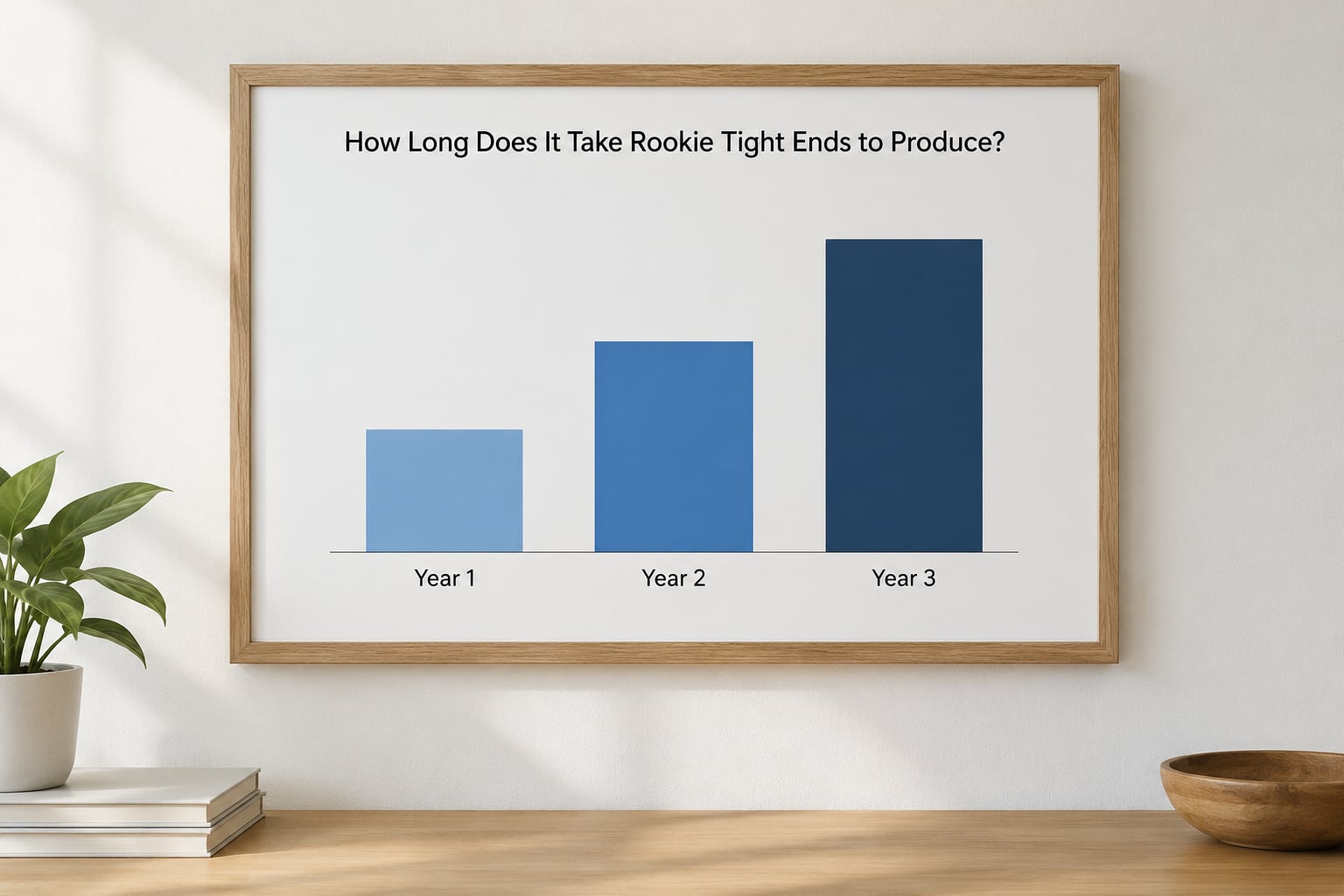
Two to three seasons, for the vast majority of drafted tight ends. A smaller group arrives ready in Year 1, and a meaningful chunk never gets there at all. What changes the timeline is rarely the player’s talent and almost always the opportunity he’s handed on day one.
Here’s the progression most managers see, using PPR points per game as the yardstick:
| Stage | Typical role | What you see | Fantasy output |
|---|---|---|---|
| Year 1 | In-line blocker, situational target | Half the snaps come on run plays; targets arrive mostly in the fourth quarter | Roughly 3 to 6 points per game, with a ceiling around 9 |
| Year 2 | Rotational pass game option | Clears 10 to 15 routes per game, a real red-zone role, more third-down snaps | Around 7 to 11 points per game, occasionally more |
| Year 3 | Primary passing game target, or gone | Top-10 target share at the position, weekly floors replace boom weeks | 11 to 15 points per game when it works |
| Year 4 and beyond | Established asset or replacement-level veteran | Only the ones who earned it in Year 2 or 3 are still producing | Wide spread; the aging curve starts here |
These are evaluation benchmarks, not league averages. The spread inside Year 2 is enormous, which is the whole problem with drafting a rookie tight end on name recognition alone.
The lag has three mechanical causes. First, blocking: a rookie tight end who can’t protect the edge is a liability, and coaches will not put a liability in pass situations for a fourth-down conversion. Second, route complexity: the tight end route tree is the most varied of any skill position, with releases, seams, out-and-runs and combo routes that have to sync with a quarterback’s cadence. Third, quarterback trust, which takes a season to build. Receivers arrive with route-running reps; tight ends arrive with blocking reps.
So, How Long Does It Take Rookie Tight Ends to Produce?
Two answers, because “usable” and “finished” are different milestones. Most immediately useful players can be identified about 12 games into their rookie season, when enough route participation and target data exists to separate a real role from a caretaker role.
A finished weekly starter usually takes two to three seasons. That’s when a player has a quarterback who finds him without a play-action hint, a defined red-zone share, and enough route volume that a bad week doesn’t sink you. A rookie who hits 10 points per game in Year 1 is a genuine exception, not a trend line.
Rookie Development Timelines by Age and Background
Age at draft tells you how much runway the player has; it tells you almost nothing about Year 1 usage. Two rookies drafted in the same round can have completely different first seasons based on what’s blocking them.
| Group | Typical Year 1 role | Time to usable production | Main risk |
|---|---|---|---|
| Under 21, declared early, three-year college starter at TE | Backup with weekly packages, few starting opportunities | Year 2, sometimes Year 3 | Lost off the depth chart by a mid-round veteran signing |
| 21 to 23, converted from WR, RB or FB | Blocking-heavy rookie with red-zone looks already installed | Year 1 to Year 2, faster than pure TEs | Blocking reps eat the offensive snaps |
| Over 23, multi-year college starter, late declaration | Compete for TE1 immediately, no patience from the coaching staff | Year 1 if the role exists | Peak arrives before he ever gets fantasy value |
| Walk-on or small-school background | Scouting report project, limited snaps | Year 3 or never | Development curve outlasts your patience |
Position conversion is the most underrated variable. A converted wide receiver already knows how to separate and how to read a quarterback’s eyes, so the only new skill is blocking, and many teams let a converted player absorb that gradually. A true college tight end has to learn both halves of the job at once.
Special teams work matters too, but not the way people think. Kick coverage is a waste of a pass-catching talent, while a return-man or blocking-unit role keeps the player on the field for third down and keeps the coach comfortable with a substitution package. If your rookie tight end never touches special teams in Year 1, the offense has not bought him yet.
What Counts as Producing at the Tight End Position?
Yardage alone is a bad test. A 500-yard rookie on 40 targets finished ahead of a 380-yard rookie on 70 targets, and the second player is the one worth holding. Production is volume first, efficiency second, and the ordering matters because volume is what arrives late.
| Metric | What it tells you | Year 1 benchmark for a usable asset |
|---|---|---|
| Route participation | Whether the offense is willing to move the pocket around him | At or above 55 percent; under 45 percent means he’s a blocker |
| Targets per game | Raw volume, the least gameable number on this list | 3 or more as a floor, 4.5 or more to project forward |
| Red-zone targets | Where tight end fantasy value actually lives | 1 to 2 per game; zero for a full season is a red flag |
| Yards per route run | Efficiency, separating him from a volume sponge | Around 7 to 9 is healthy for a rookie |
| Fantasy points per game, PPR | The only score that decides your lineup | Under 5 in Year 1 is normal; 10 or more is exceptional |
| Points-per-game floor | Consistency, which separates a starter from a streamer | A 4-point weekly floor by Year 2 |
A high-volume role with poor efficiency is not automatically bad. If a rookie is catching 7 targets a game for 4 yards each, he’s still more valuable than a player with two targets, because the target count tells you the offense is going to keep looking. The efficiency fixes itself once quarterbacks stop forcing him short of the first down.
The reverse is more dangerous. A rookie who scores a touchdown every third game on three targets looks like a breakout and has no foundation underneath him, because touchdowns are the most volatile output at this position. If his route participation and target count drop in a week, the scoring stops immediately.
Why Some Rookie Tight Ends Break Out Immediately
Look at the situations, not the prospect grades. Fast breakouts share a specific set of conditions, and you can identify most of them before the season starts.
- An empty depth chart. A team that lost its starter and has no veteran replacement gives a rookie the TE1 designation out of camp. Nothing else in the league accelerates a timeline like this.
- A quarterback who throws to the tight end on third down. Some quarterbacks are wired to the checkdown. The volume arrives regardless of the offense’s overall efficiency.
- Scheme fit. A spread offense that splits the field into three short areas gives tight ends legitimate snaps as a primary outlet rather than a safety valve.
- A weak division in the red zone. Opponents that defend the run force short passing concepts, and the tight end is the natural answer.
- Continuity on the coaching staff. A coordinator who already knows how to feature that specific player type removes a full season of learning.
- No special teams burden. A player who is a full-time offensive starter from week one gets more practice reps and more game snaps than a blocker split across two phases.
Note that none of these are player attributes. That’s the recurring lesson in dynasty circles: r/DynastyFF managers point out constantly that college receivers walk in and post 1,000-yard seasons while tight ends almost never do the same, and that gap is positional. It’s about the job description, not the talent level.
Why Some Rookies Need a Change in Opportunity

Sometimes the player is fine and the job simply doesn’t exist. Before you write off a rookie tight end, check whether his usage problem is a player problem or a roster problem.
Run it through this sequence, in order:
- Is the depth chart blocked? A veteran signed to a multi-year deal in the offseason means your rookie’s Year 2, not Year 1.
- Is the offense run-first? If more than 55 percent of snaps are run plays, the passing game tree is narrow and your player is inside it. Wait for the offensive coordinator to change, not for the player.
- Is the quarterback a downgrade? Targets depend on who throws them. A rookie quarterback’s accuracy in the middle third is usually the real story, and no amount of route participation fixes a bad throw.
- Is there a path off the bench? The best early opportunity for a blocked rookie tight end is a season-ending injury to the starter. The second best is a coaching change.
If a rookie clears three of those four checks, you are looking at normal positional lag and the timeline stretches to Year 2. If he fails three or more, the honest read is that the opportunity isn’t coming, and the move is to downgrade or sell rather than wait out the contract cycle.
The mistake I see most often is treating a bad offensive environment as a bad player. A tight end with 70 percent route participation and 4 targets a game on a league’s worst passing attack is a buyable asset in Year 2 if the quarterback improves, and he probably won’t get worse in year two.
How to Judge Production in Your First Rookie Season
Judge usage, not outcomes. Points are downstream of opportunity, and opportunity is visible in week one.
After the first four weeks, write down five numbers for your rookie tight end: route participation, targets per game, red-zone targets, snap share on pass plays, and his worst weekly point total. That’s enough to know whether the season is worth tracking closely or not.
Then apply these checkpoints:
- Games 1 to 4: Ignore points entirely. Check whether he’s running real routes or only motion and blocking assignments.
- Games 5 to 8: Targets should be climbing week over week. Flat or falling volume with a healthy quarterback is a genuine concern.
- Games 9 to 12: You now have enough data to set a Year 2 target-share projection. If the red-zone count is still zero, say so and stop hoping.
- Season end: Compare his share of team targets to the share of air yards. Air yards tell you whether quarterbacks are actually looking for him downfield or just dumping off to the tight end.
Signs that a quiet Year 1 is temporary: rising air yard share, at least one game with double-digit targets, a red-zone role in the fourth quarter, and snaps on third down. Signs that it’s predictive: static route participation across sixteen weeks, all targets short of the first down, and no special teams path. The second pattern is a player the offense has decided not to use.
Draft Strategy for Rookie Tight End Projects
Draft capital is the best predictor of how early the payoff arrives. First and second-round tight ends are more likely to be Year 1 assets, not because they’re better athletes but because teams don’t spend that kind of pick on a player they’re happy to bury. Third-rounders and beyond need a full development year, so price them like prospects rather than like players.
In a redraft league, stashing a rookie tight end rarely pays. The opportunity cost of a roster spot is real, and a Year 1 stash is generally a bet on a single injury. The better redraft play is to draft the veteran floor, then add the rookie on the waiver wire in the first two weeks when the depth chart resolves and the stat sheet is free.
In dynasty and keeper formats the math inverts. A second-round pick who reaches a three-year low at week four is cheap relative to what the same player is worth in Year 3, which is when the market reprices the whole position. The whole point of a lag position is that the discount is predictable.
SuperFlex changes one variable: you’re paying for a longer window of relevance, so a young tight end’s value curve is worth more to you than in a one-QB league. A pick made in the back half of round one on a 21-year-old with a clear TE1 path is easier to justify at two starting quarterbacks than at one.
When Tight Ends Peak and When They Fade
You’re not buying an asset, you’re buying a window. Most tight ends don’t reach their ceiling until ages 25 to 27, with the biggest single-year jump coming in Year 2 or 3. The decline usually starts around age 30 to 31, when separation speed goes before the body does, and the dropoff is sharp.
That gives you a useful shape: two to three years of building, three to four at the top, and a short, steep fall. A rookie tight end drafted at 21 is a four-to-five year bet from the day you draft him. One drafted at 24 is a two-year bet, which is a different proposition entirely and should be valued differently in a trade.
Frequently Asked Questions
Can a rookie tight end be a reliable fantasy starter in his first season?
Rarely. A rookie tight end posting 10 or more PPR points per game as a first-year player is a genuine outlier, not something you should plan around. Treat Year 1 as a data-collection season and judge him on route participation, targets and red-zone work rather than on his final line. If you roster him as a starter, do it because the depth chart handed him the job, not because his talent warrants it.
What are the best signs that a rookie tight end will improve in Year 2?
Watch three things: air yard share, red-zone targets, and snaps on third down. A rookie whose air yards climb while his target count stays flat is being looked for downfield and will convert volume into points once accuracy improves. Zero red-zone targets for a full season is the clearest negative signal, because that share rarely appears late. Special teams involvement also signals the offense is starting to buy him.
Should I stash every highly drafted rookie tight end in a redraft league?
No. In redraft, a rookie tight end is usually a waiver-wire pickup, not a draft investment. A Year 1 stash burns a roster spot for a season and pays off only if a veteran ahead of him gets hurt. A better approach is drafting the established floor at the position, then checking the wire in the first two weeks once the depth chart clears and rookie production is still unpriced.
How many targets per game should I expect from a productive rookie tight end?
Three or more targets per game is the floor for a usable Year 1 asset, and 4.5 or more projects forward into a real role. For context, a player clearing 70 targets over a season is usually a redraft starter regardless of efficiency. Targets matter more than catches or yardage at this position because a quarterback who throws to a tight end repeatedly will keep doing it as the offense adjusts.
Does strong fantasy football preseason production predict regular-season success?
Barely. Preseason statistics usually come against defensive depth charts that will not play in the regular season, and quarterbacks who are audibly non-competitive still produce passing numbers. The one thing worth carrying over is usage, not production. If a rookie tight end is splitting the first-team snaps in August, that carries informational value about the depth chart, which is a legitimate reason to draft him a slot earlier.
Is an older rookie tight end a better dynasty investment than a younger prospect?
In Year 1, yes, and that’s the trap. An older rookie can step into an empty TE1 job immediately, which is exactly why the market pays for him. You have already used the first two seasons of the payoff. A younger prospect costs you patience but gives you a longer window. Buy the older player for redraft value and the younger one for dynasty value, and do not pay dynasty prices for an accelerated timeline.
What to Do First
Pull your rookie tight end’s first four weeks of route participation, targets per game, red-zone targets and third-down snaps, then write down his role in one sentence. If the sentence is “our second tight end” and his red-zone count is zero, you have your answer, and it’s a downgrade. If it names a specific job with a route tree attached, you have a Year 2 asset and roughly a two-year wait before he matters.
Do that before you trade, before you panic-drop him on the wire, and before you build next season’s roster around him. Every decision that follows is easier once the role is written down in words.