Fantasy football league rules are the written, agreed-upon guidelines that define how a league operates, covering roster construction, scoring, draft format, waivers, trades, playoffs, fees, payouts, and commissioner authority. Writing them takes an afternoon. It is also the cheapest way to protect a league from the arguments that quietly kill one.
Updated for the 2026 NFL season, this guide walks through how to write fantasy football league rules section by section, with the exact language you can paste into your own constitution. No theory, no 40-page legal treatise. Just the document most commissioners need and nobody publishes.
If you inherited a league that runs on handshake agreements and group-chat memory, this is your weekend project.
Table of Contents
- What You Need
- Decide what kind of league you are running
- Know what your league is competing on
- Decide how much competitiveness the league expects
- Pick the platform and check what it can enforce
- Collect the rules you already have, and the settings you already use
- Step-by-Step
- Choose the League Format and Core Objective
- Set Rosters, Lineups, and Scoring
- Write the Draft Rules
- Define Waivers, Free Agents, and Trades
- Set the Schedule, Playoffs, and Tiebreakers
- Add Division, Playoff, and Championship Prizes
- Add Administration and Exception Rules
- Fix Contradictions, Loopholes, and Last-Minute Changes
- Run a Final Rules Test
- Publish a Clean, Enforceable Rulebook
- Common Mistakes
- Writing contradictory rules
- Leaving definitions undefined
- Choosing an unfair tiebreaker
- Setting transaction limits nobody can follow
- Using unclear scoring units
- Writing rules the platform ignores
- Changing rules mid-season
- Writing more rules than the league needs
- Frequently Asked Questions
- How long should a fantasy football league rules document be?
- Should a commissioner be allowed to change rules during the season?
- What rules should a dynasty league include that a redraft league does not need?
- How do I create custom fantasy football scoring without making the league unfair?
- When should league rules be finalized?
- How should a fantasy league handle a tied game or an inactive team?
- Conclusion
What You Need
Before you type a single rule, you need five decisions settled. Each one shapes everything that comes after it, and changing a decision later means rewriting half the document.
Decide what kind of league you are running
Redraft, keeper, and dynasty leagues share maybe 60 percent of their rules. The other 40 percent is where they fight each other. Fix your format before you draft a rule, because the draft section, roster limits, and trade policy all read differently in each.
Know what your league is competing on
Weekly head-to-head, season-long total points, and dynasty asset building reward different strategies and produce different arguments. A weekly league lives or dies on its waiver rule. A dynasty league lives or dies on its trade and rebuild policy.
Decide how much competitiveness the league expects
A casual league of friends and a group of spreadsheet obsessives both want fairness, but they do not want the same thing. Write down the level of effort you expect from owners: weekly lineups, waiver claims, trade activity, check-ins on message boards.
Pick the platform and check what it can enforce
ESPN, Yahoo, Sleeper, Fantrax, and DynastyLeague each support a different subset of rules. Some leagues can run custom scoring per statistic; others cannot. Some can enforce anti-tanking penalties; others leave that entirely to the commissioner’s manual lineup edits.
This is the step most people skip, and it is the one that generates the most frustration in year two. A rule the platform cannot enforce is not a rule, it is a suggestion. Before you write it, open the league settings page and confirm the option exists.
Collect the rules you already have, and the settings you already use
Existing rules fall into three piles: keep, replace, or delete. Most inherited rule sets contain at least one rule that contradicts another, and a few that nobody remembers agreeing to in the first place. Export your current league settings before you start editing.
Open a new document with a version number and a date in the header. When you finish, that header is what settles arguments in December.
Step-by-Step
The process runs in ten steps. Most commissioners finish it in an afternoon if they follow the order, because each step only depends on the ones above it.
Choose the League Format and Core Objective
Write one sentence that says what winning means in your league. Everything else gets judged against that sentence later, which is how you settle arguments like “should we really start a backup quarterback?”
For a redraft league, the objective is usually the best season record followed by the most total points. For a keeper or dynasty league, the objective is usually a playoff title, and the draft is a tool rather than an event.
Record the league size and the number of owners expected to be active. Both numbers drive your tiebreaker list, your waiver priority, and your payout split.
Set Rosters, Lineups, and Scoring
State the roster size, the number of starting slots, and the position limits in one paragraph each. Name the scoring format explicitly, including whether a flex slot exists and which positions are eligible for it.
Scoring is the single biggest setting choice, and it changes how owners build rosters for the entire year. The four formats most leagues pick between:
- Standard scoring gives no points for receptions. It rewards volume of yards and touchdowns from a short bench, which fits casual leagues with deep rosters.
- Half-PPR gives half a point per catch. It sits between volume and efficiency and suits leagues that want to shorten the bench without cutting passing volume out of the game.
- PPR gives one point per catch, or more. It rewards target volume and receiver depth, and it is the usual choice in competitive 10 and 12 team leagues.
- Custom scoring is whatever the league decides to reward. Use it when the league has a specific scoring philosophy worth writing down.
Write your custom points into the document rather than assuming owners know them. A rule that reads “fumbles lost on a red zone carry cost two points” removes an argument that would otherwise happen in week nine.
Also state whether projections are shown before kickoff and whether the league uses live scoring or final totals. Those two settings decide whether players can be swapped during games, and that single rule causes more weekly disputes than any other.
Write the Draft Rules
Name the draft type, the draft order method, and the deadline for every action. A draft rule that only says “the draft will be held in September” leaves pick times, tie handling, and missed-pick penalties completely open.
For a snake or serpentine draft, say the order reverses each round and list the first two picks so nobody has to remember. For an auction draft, specify whether budgets reset each year, whether ties in bidding break by rank or by a coin toss, and whether there is a minimum bid.
For keeper and dynasty leagues, the two clauses that matter most are how many players each owner may keep and what those players cost. Position limits are worth writing down explicitly: “up to two players at each skill position, no more than one quarterback” prevents the same owner from hoarding every tight end in the league.
Close the section with the pick deadline. When a manager does not make a pick in time, say who selects for them and whether the pick is saved or forfeited.
Define Waivers, Free Agents, and Trades
Write one rule per system: how players are acquired, how they are dropped, how priority works, and what the limits are. Leagues argue most about waivers because nearly every strategy in the game routes through them. The five systems you are most likely choosing between:
- Rolling waiver order means the bottom of the standings picks first and the order resets every week. It rewards struggling owners but creates a wave of claims every week, and it suits leagues that want constant activity.
- Reverse waiver order gives the first pick to the top of the standings. It punishes good teams and discourages add-then-drop churn, which makes it a reasonable anti-tanking tool.
- FAAB means each owner bids blind against a budget that resets weekly. It is flexible and fair, but it requires owners to watch claims closely, so it works best in leagues with a shorter bench.
- Blind bidding waivers collect budget bids at once, with the highest claim winning. Ties and budget mistakes are common in year one, so pair it with a written tiebreak rule. It fits larger leagues with many free agents.
- First-come, first-served simply gives the player to whoever claimed first. It rewards whoever checks in at work rather than whoever manages best, which makes it a poor fit for a competitive league.
Pick one and write it in a single paragraph. If you want a hybrid, describe it exactly, including when the priority resets.
Then add the clause that stops waiver-wire gaming: a limit on adds and drops per week, or a rule that a dropped player cannot be re-added by the same owner for a set number of days. For leagues on platforms that do not enforce drop limits, the commissioner applies them manually.
Trades need four specifics, and they are the four most commonly missing items in real leagues: the submission deadline, the review window, the veto threshold, and who counts as a member for that threshold. Sensible defaults by league size:
- 8 teams works with a 24-hour review window, a veto if two owners object, and a commissioner who facilitates the league chat without voting.
- 10 teams usually gets a 48-hour window and a veto that requires more than half the league to object, with the commissioner resolving disputes of fact only.
- 12 teams works best with the same 48-hour window and simple majority veto, plus a written rule for how the commissioner breaks a deadlocked tiebreaker vote.
A simple majority threshold, defined in the document, is the fairest option. Small veto coalitions are the main reason good trades get rejected, and owners notice when they have no idea why.
Finish with the trade deadline and the treatment of pending trades. If a trade is still under review when the deadline passes, say whether it is allowed to process anyway.
Every league with money in it needs a rule on the league chat itself. One line stating that all league business happens in the league message board, and nowhere else, removes most of the “nobody told me” claims that surface in January.
Set the Schedule, Playoffs, and Tiebreakers
State the number of regular-season weeks, how many teams qualify for the playoffs, and whether the playoff bracket reseeds each round or is fixed at the end of the regular season. Also state whether division winners get a guaranteed playoff spot.
Tiebreakers are where ties are actually settled, so write them as an ordered list from first tiebreaker to last, with no gaps. A standard order that owners rarely argue with runs like this:
- Head-to-head record. It rewards the same thing the standings already show, which keeps the result from looking arbitrary.
- Head-to-head points for against tied opponents. It rewards winning rather than merely surviving a tie.
- Total season points. Simple, and already tracked by most platforms, so it needs no manual calculation.
- Random draw, witnessed by the commissioner. Better than an unstated opinion, and the only version of this step that survives a complaint.
Say whether ties are broken for the regular season, the playoffs, and the championship game separately. A champion decided by a coin flip with money on the line is the fastest way to lose a league.
Add Division, Playoff, and Championship Prizes
If you use divisions, write the number of divisions, how many teams per division, how the winner of each division qualifies, and whether division titles carry a payout. Division rules that do not state the playoff effect produce arguments every season.
For money leagues, decide the split before you collect anything. Champions-only keeps it simple but creates a run-up-the-score culture in the final weeks. A three-place split keeps more teams playing to the end, which matters more in a twelve-team league than in an eight-team league.
State when the payout happens, who sends it, and what happens if an owner has not paid a buy-in by the draft. Decide whether prizes are protected in a league with money, meaning the top teams are guaranteed their share regardless of who collected from the rest.
Custom trophies and league names belong in this section too. A short rule saying that every owner renames their team in the commissioner’s chosen theme before the draft costs nothing and keeps a league’s personality intact.
Add Administration and Exception Rules
This is the section most constitutions skip, and it is the one owners ask for most. It covers what happens when things go wrong, which is exactly when nobody remembers the rules.
Cover these clauses: voting thresholds for amendments, how a rule change is proposed and how much notice owners get, what happens when an owner stops participating, how disputes are resolved, who has the final call on a decision the platform makes automatically, and how emergency rulings get recorded and communicated.
The active manager and league control clause deserves its own paragraph. State the check-in requirement, such as submitting a lineup or a message-board check-in by a set day and time, and then state the penalty schedule in order: first missed week, second missed week, and takeover.
Commissioners describe the same fear in different words. Someone goes quiet in October, the league quietly hands them free wins for eight weeks, and the season ends with a result nobody respects. A written takeover clause converts that from a judgment call into a procedure.
On rule changes, the cleanest doctrine is offseason-only, with one narrow exception. If the league finds a genuine bug or a loophole that benefits one owner unfairly, the commissioner may issue a temporary ruling, but it must be posted in the league, apply to everyone, and be folded into the next season’s document.
Finally, set the commissioner’s authority explicitly. Most leagues work best when the commissioner administers rather than rules, and when a vote resolves anything the constitution did not anticipate.
Fix Contradictions, Loopholes, and Last-Minute Changes
Read the finished draft against itself. Two rules that point in different directions are worse than no rule, because owners will each cite the one that suits them.
The most common contradictions are between the trade deadline and the review window, between the waiver limit and the free agent budget, and between the payout clause and the buy-in collection date. Look for each of those pairs specifically.
Then hunt loopholes. Ask what a motivated owner could exploit, and write the answer into the document. If there is a clause about adding and dropping players, ask whether someone can drop a player and re-add him immediately. If there is a trade clause, ask whether a trade can be agreed privately and submitted after the deadline.
A useful final pass is to read the document out loud. If you have to stop and re-read a sentence to figure out what it means, rewrite it in shorter words.
Run a Final Rules Test
Test the rules against realistic scenarios before you freeze them, not after. Walk six situations through the document and check that each produces one clear answer.
Test these: an owner submits a lineup change during a live scoring game; a starting player is ruled out with a game-time injury; two owners acquire the same player in a trade and a claim; a trade is agreed the night before the trade deadline; two playoff teams tie; an owner abandons the league in week six.
If any scenario produces two possible answers, the relevant rule is missing. That is the entire test. Most documents fail the first scenario, because they never say whether live scoring permits lineup edits.
Run the test with one other person if you can. A second reader catches the rules you read past three times, and this is the cheapest quality control step in the whole process.
Publish a Clean, Enforceable Rulebook
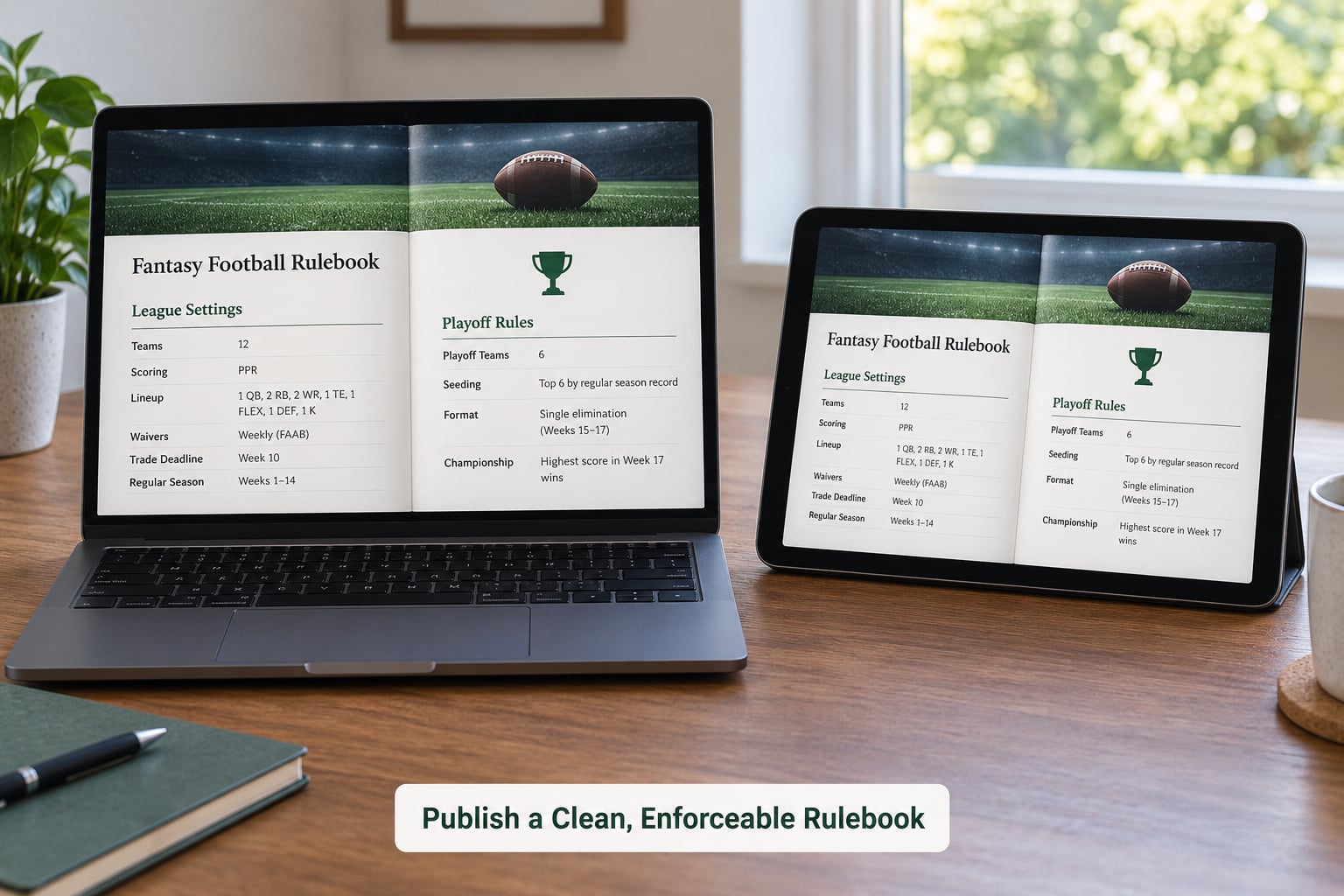
Publish the finished rules in one place that everyone can reach without logging into anything, and one place only. A shared document hosted on a league site, a public page, or a team chat pinned to the top all work. A Google Doc buried in a four-year-old message thread does not.
Get approval before the draft. Post the document, give owners a fixed review window, and record the vote. The review window matters more than the vote itself, because owners who never opened the document cannot claim they consented to it.
Record the effective date and the version number in the header, and freeze the document when the draft starts. Nothing in it changes until the season ends, with the narrow exception you wrote in the administration section.
Announce future changes to the whole league before you make them, even when the change is obviously an improvement. Telling owners what you are changing and when it takes effect costs one message and prevents most of the mid-season resentment that ends friendships.
Keep one authoritative copy. If you find an older version floating around, replace the link rather than replying with a correction, because half the league will read the old one.
Common Mistakes
Almost every failed rulebook fails the same way: something is ambiguous, two clauses disagree, or a rule exists that the platform cannot enforce. Here are the mistakes worth avoiding, each with the correction that fixes it.
Writing contradictory rules
Two clauses that point opposite ways will be used against each other for years. Re-read the document top to bottom once, specifically comparing the deadline rules with the trade rules and the fee rules with the payout rules.
Leaving definitions undefined
If you use the words flex, FAAB, league control, or divisor anywhere, define each of them once in a glossary at the top. The definitions are three lines each and they prevent the most tedious arguments in the league.
Choosing an unfair tiebreaker
A tiebreaker that rewards one manager’s preferred strategy, such as a points-for-only tiebreaker in a points-scored league, gets argued every time it fires. Use an ordered list that rewards the same thing the standings reward.
Setting transaction limits nobody can follow
A weekly add-and-drop cap of one is unusable in a league with heavy injuries, and a cap of ten does nothing. Set the limit, then run it against last season’s actual transaction volume before you commit to it.
Using unclear scoring units
Every custom scoring value needs its unit. One point per reception is clear, half a point for a reception under 10 yards is clear, and a bonus for a big play is not. Write the threshold and the exact point value.
Writing rules the platform ignores
Some platforms cannot enforce position limits on waivers, drop caps, or custom trade review windows. Either choose a platform that supports the rule or write an explicit manual procedure with a name attached to each step.
Changing rules mid-season
Owners drafted under one set of assumptions and should finish under it. Make changes in the offseason, or issue a temporary ruling only for genuine bugs, and say so in writing.
Writing more rules than the league needs
A 14-page constitution on a casual friends league generates resentment faster than an 8-team league missing three clauses does. Cover the things that cost money or change results, then stop.
A couple of habits make the difference between a document that works and one that collects dust. Test the scenarios, watch which section owners actually re-read in week one, and prune the sections nobody consults before the next season.
Frequently Asked Questions
How long should a fantasy football league rules document be?
Long enough to cover roster, scoring, draft, waivers, trades, playoffs, fees, and commissioner authority, which usually lands between four and eight pages for a money league. A casual redraft league can be shorter if those eight areas are still covered in plain language. Length is not the measure of fairness, clarity is. If a section is one paragraph and unambiguous, keep it short.
Should a commissioner be allowed to change rules during the season?
Only for genuine errors, and only in writing. A league that drafted under a set of assumptions should finish under those same assumptions, otherwise early-season results are decided by rules nobody played under. The workable exception covers platform bugs and one-owner loopholes. Post the ruling in the league, apply it to everyone, and fold it into next season’s document.
What rules should a dynasty league include that a redraft league does not need?
Dynasty needs clauses on keeper or retention costs, position limits on retained players, rebuild and teardown policies, and a clear trade deadline for aging assets. Redraft needs none of those because rosters reset every year. Dynasty also benefits from a stated policy on draft picks as trade assets and on what happens to a roster when an owner leaves the league.
How do I create custom fantasy football scoring without making the league unfair?
Change one category at a time and keep the total points per player inside a reasonable band of a standard scoring set. Publish every custom value in the constitution with its unit, so an owner can see that a catch is worth a set amount and a fumble costs a set amount. Avoid any rule that only rewards one roster-building style, because it eliminates strategy for everyone else.
When should league rules be finalized?
Before the draft, with a vote held at least a week ahead so owners have time to read them. Freeze the document on draft night and do not reopen it until the season ends. If you are starting late, publish a short version covering trades, waivers, playoffs, and payouts first, then add the rest during the offseason before the next draft.
How should a fantasy league handle a tied game or an inactive team?
Ties are resolved by the ordered tiebreaker list in the constitution, ending in a witnessed random draw if every listed method ties. For inactive teams, write a check-in requirement and a penalty schedule in advance: first missed check-in, second missed check-in, then league control. Applying a takeover rule after the fact feels personal, while applying one that everyone approved does not.
Conclusion
Start with the sentence about what winning means in your league, because every rule you write gets checked against it. Then document the handful of settings that decide results: scoring, waivers, trades, playoffs, and payouts.
Test those rules against six real scenarios before you publish anything, get a vote a week ahead of the draft, and freeze one version with a date on it. A constitution is not paperwork. It is the reason the league is still together in January.