Rookie tight ends are the hardest thing to price in fantasy football, because the position is scarce enough that you cannot simply pass on one, and volatile enough that a bad valuation costs you a full season. To value a rookie tight end in fantasy, start with what his draft round historically produces, then adjust for the quarterback, the vacated targets above him on the depth chart, the role he actually plays, and what your league will pay for that role. Reputation and highlight reels do not belong in the calculation at all.
The whole process takes about ten minutes per player once you have the inputs in front of you, and it holds up in any format because the math starts from opportunity rather than from a projection site. That matters most in a new class, when the projections are thin or missing and every ranking you can find is somebody’s spring opinion.
Table of Contents
- What You Need
- Step-by-Step: How to Value a Rookie Tight End in Fantasy
- 1. Identify the Player’s Real Role
- 2. Examine the Team’s Passing Game
- 3. Estimate Targets, Not Just Talent: How to Value a Rookie Tight End Without Projections
- 4. Adjust for Draft Capital and Competition
- 5. Set a Value Range by League Type
- Common Mistakes
- Frequently Asked Questions
- How do I know whether a rookie tight end is worth drafting?
- What is a good draft range for a rookie tight end with PPR upside?
- When should I avoid drafting a rookie tight end?
- How much does blocking role affect a rookie tight end’s fantasy value?
- When should I draft a rookie tight end in a dynasty league?
- How do I evaluate a rookie tight end in standard scoring versus PPR?
- Start With Role and Opportunity
What You Need
Eight inputs do almost all of the work. Anything beyond them is noise dressed up as analysis.
- Current NFL role. Starter, designated blocker, inline wingman or rotational two-tight-end piece.
- Team offense and scheme. Whether the offense lives in the pass, and whether it uses 11, 12, 13 or 21 personnel.
- Quarterback. Who throws the ball, how often they look middle, and how well they throw over the middle to linebackers.
- Target share context. Targets per game for the tight end he is replacing, and the number of viable receiving options around him.
- Route profile. Whether he is a seam, slot, out-of-slot or in-line weapon, because that maps directly to where targets come from.
- Blocking demands. Inline snaps, run game frequency and how much of the offense is spent protecting the quarterback.
- Draft capital. Round and pick, which sets the historical ceiling before you factor in anything else.
- Scoring format and ADP. Whether the league is standard, half PPR or full PPR, and what the market currently pays for him.
Comparable prospects come last and are optional. Bowers, LaPorta, Kincaid and Pitts are the yardstick fantasy managers actually use, but a comp tells you what a ceiling looks like, never what a given player will hit.
Step-by-Step: How to Value a Rookie Tight End in Fantasy
Run these five steps in order. Each one either establishes a ceiling or an adjustment, and skipping ahead to the price is how managers end up paying for a highlight reel.
1. Identify the Player’s Real Role
A rookie tight end is one of four things, and the four have wildly different fantasy ceilings. The primary receiving option is the guy already in the top ten of his position on a good passing offense, a role that usually has to be earned because veterans hold it. The complementary weapon splits snaps with a starter and lives in the slot on third down, which is how a handful of rookies have produced immediately. The blocking specialist takes real snaps and real inline work but almost no targets, and the rotational player is a body holding a jersey until someone gets hurt.
Role decides your floor more than your ceiling. A primary option has a path to 12 to 18 points a week in full PPR. A blocking specialist with a defined role can still be worth a late-round flier in dynasty, because the job usually arrives a year or two later, but he is nearly worthless in a redraft league.
Read the depth chart, the coaching press conference quotes and the offensive coordinator’s history, not the player’s listed position. Plenty of rookies listed as tight ends spend their first season in the slot, and that is a good thing for scoring.
2. Examine the Team’s Passing Game
The landing spot decides the volume, and the quarterback decides the conversion rate. You want a quarterback who throws over the middle, an offense that uses tight ends in the red zone, and a depth chart with something gone from it. Quarterback draft capital correlates negatively with future production at this position, which is a roundabout way of saying that bad quarterbacks produce bad tight ends no matter who the tight end is.
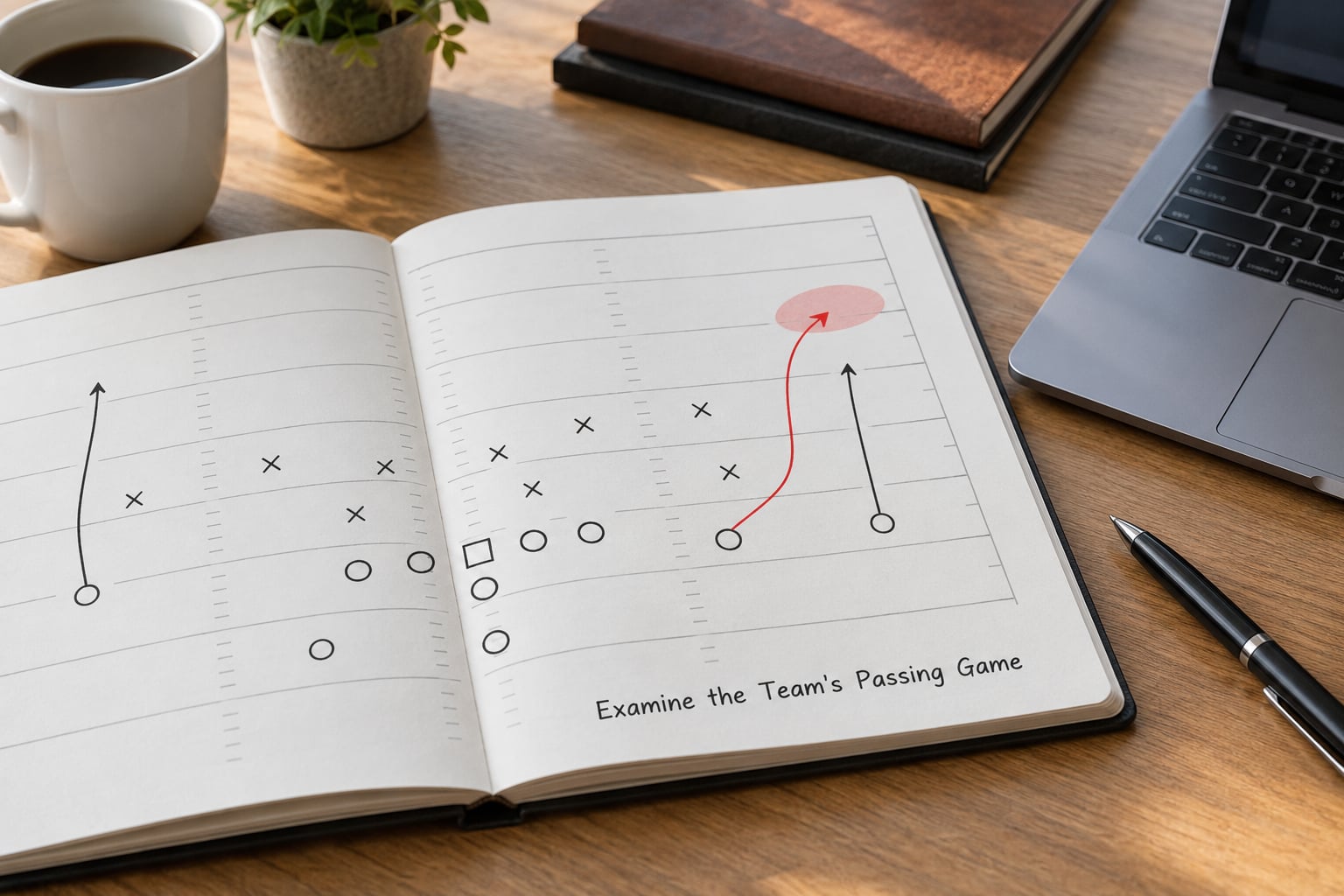
Work through four questions. How many targets per game did the tight end he is behind finish with last season, and how much of that was vacated? How many red zone targets does the offense throw to tight ends, and are those targets concentrated on one player? Does the scheme put an extra tight end on the field often enough that two routes stay live? And how many credible receiving options compete for the same throws, counting the wide receivers, not just the tight ends?
The two-tight-end set is the single mechanism most often credited with lifting a Day 3 rookie, and a manager in Los Angeles will tell you the same thing about the Sean McVay offense. It is also the reason a mid-round rookie can out-produce a first-rounder in a run-first, low-variance offense. Schemes that stay in 12 and 21 personnel keep the ball out of the air entirely, and no amount of talent compensates for that.
3. Estimate Targets, Not Just Talent: How to Value a Rookie Tight End Without Projections
Translate the role and scheme into a target range, then project points off the targets. Rookie tight ends drafted in different rounds have wildly different historical volumes, and those averages are the most honest starting point available because they describe what actually happened rather than what somebody expects to happen.
| Draft round | Historical average targets as a rookie | Conservative range | Likely range | Upside range |
|---|---|---|---|---|
| Round 1 | About 74 | 50 | 70 to 85 | 95 to 110 |
| Round 2 | About 37 | 28 | 35 to 50 | 55 to 70 |
| Round 3 and later | About 19 | 15 | 18 to 30 | 35 to 55 |
Those historical averages come from rookie tight end data covering 2013 onward, and the gap between Round 1 and Round 3 is the whole story of the position. A 19-target season is replacement-level production in every format. A 95-target season from a rookie is a top-ten finish, and it is rare enough that you should not build a draft plan around the expectation of getting one.
There is a second yardage signal worth knowing, and it needs a caveat. BrainyBallers’ analysis of rookie tight ends found that a rookie season of 250 or more receiving yards lines up with a 49.2 percent higher rate of appearing among the top ten fantasy finishers later on, with a Pearson correlation of 0.311 between rookie yardage and future fantasy production. The same study showed quarterback draft capital correlating at negative 0.219 to that outcome. The honest reading is that yardage confirms opportunity rather than creating it, and the same analysis found the metric’s influence weaker in the 2014 to 2023 split than in 2004 to 2013. Use it as a floor check, not a forecast.
Once you have a target range, points follow almost mechanically. In full PPR, a shared rough rule is about 10 points per 100 targets before accounting for the red zone share and the yards per reception difference between tight ends and receivers. Yardage per catch tends to run a bit higher for tight ends, so a high-volume, short-route player can out-score a projection that only counts targets.
Be explicit about the fact that this is noisy. Rookie tight end projections carry a wide error bar by design, and the position is the most volatile skill group in the sport. Confidence should rise with draft capital, with verified college production and with a stable quarterback, and stay low everywhere else.
4. Adjust for Draft Capital and Competition
Draft capital sets the ceiling you can work with, and competition eats into it from both sides. If a veteran tight end with comparable talent is still on the roster, a rookie’s realistic Year 1 target total is a share of the position’s work, not the full amount of it. If the incumbent has left, the rookie’s range moves up by the vacated volume, and that adjustment is usually larger than anything college production tells you.
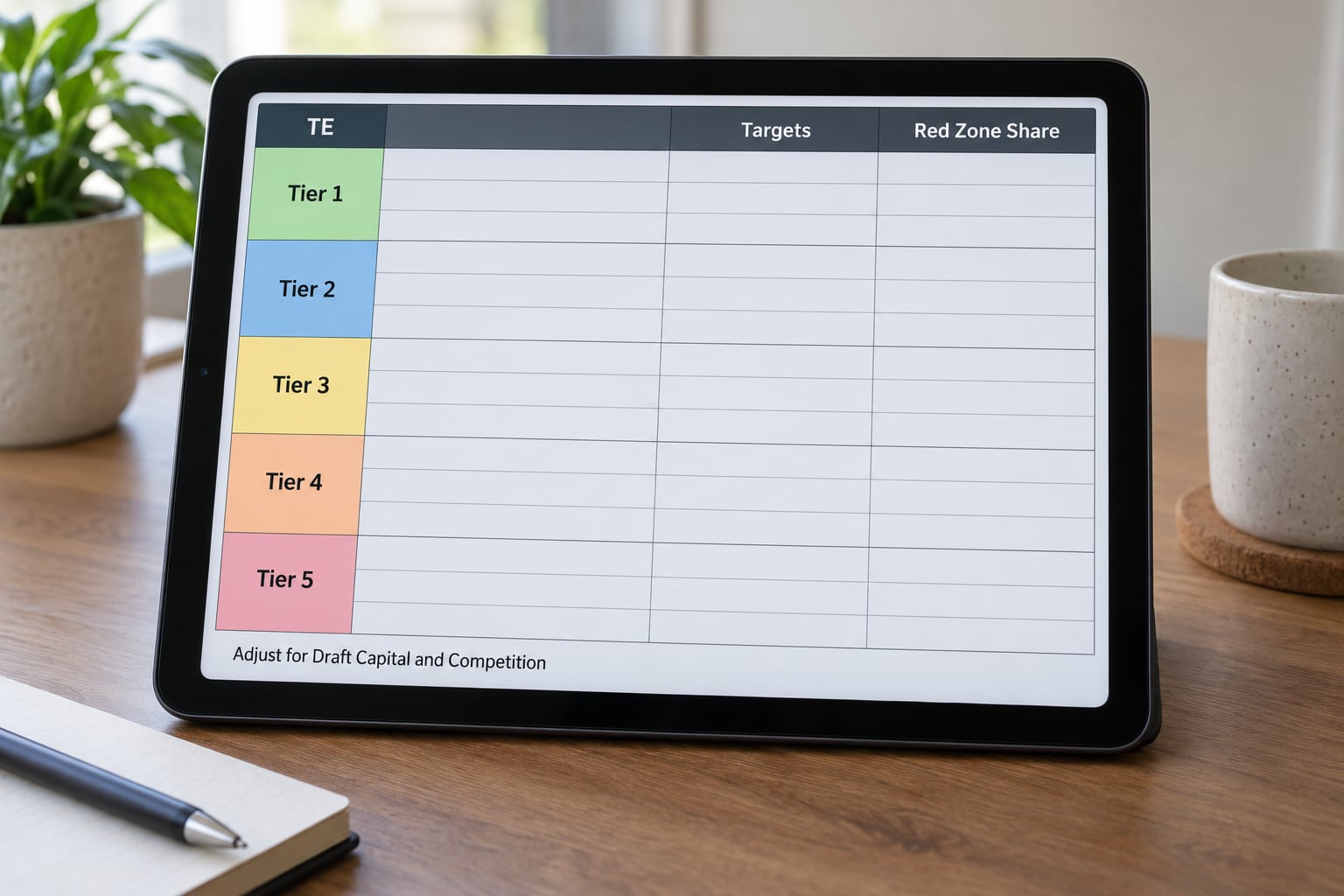
Rookie hype is its own distortion. Early first-round guarantees push ADP down before any film exists, and the market frequently prices a rookie tight end the way it prices a two-way player, as a hedge on upside rather than on an expectation. Managers have described that pattern on r/DynastyFF more than once, and it is worth naming because a hedge price is not the same as a fair price. If the ADP reflects enthusiasm rather than opportunity, the value sits on the buy side.
Count the competition carefully. A team with three legitimate receiving weapons who all need 80 targets cannot deliver 240 to one player, however talented he is. A team with one clear alpha receiver, one starting tight end and a rookie behind him is a very different board, and that is where the interesting values sit, usually a few weeks before the first ADP updates.
5. Set a Value Range by League Type
One opportunity profile produces several different values, and the differences are large enough that a single ranking cannot serve both a standard league and a superflex roster. Work out the expected target range first, then let the format decide what that volume is worth to you.
| Format | What the same rookie is worth | Practical adjustment |
|---|---|---|
| Standard | Replaced by the next cheap option at his draft slot | Only draft on Year 1 volume above 45 targets, or as a pure dynasty pick |
| Half PPR | A moderate gain over the streaming baseline | Target volume matters less; receiving efficiency and red zone share carry more weight |
| Full PPR | The full target range converts to value | Take more risk early; a 40-target floor is closer to usable here than anywhere else |
| TE premium superflex | Roughly 75 to 80 percent of a comparable wide receiver | Compare him to a receiver with similar targets per game, not to the tight end position |
| Redraft | One season of production, then the replacement question returns | Value the role on the depth chart, since the job usually survives a poor season |
| Dynasty | A three to five year asset with a defined takeover date | Draft a year early, accept a low Year 1 floor, and value the path to snaps |
That superflex line is forum practice rather than published consensus, and it is the most useful adjustment on the sheet. Take a sleeper tight end’s points per game, find the wide receiver with a similar weekly output, and use that receiver’s value instead. In a format where a receiver starts at one of your flex spots every week, a tight end is not a tight end in value terms.
Dynasty and redraft deserve separate answers, and managers routinely mix them up. Year 1 redraft value is low and volatile, often close to nothing. Dynasty value is the reason to draft the player at all, because the job is usually there in Year 3 even when the targets were not. The 2022 class is the clean example of the split: Chigoziem Okonkwo, a fifth-round pick, was the best-performing rookie tight end of that class, which tells you the ceiling in the later rounds is real but rare, and the floor in the early rounds is expensive and frequent.
Common Mistakes
Six errors account for most of the mispriced rookie tight ends I see. Each one has a straight fix.
Ranking by pedigree. Recruiting position, family name and combine numbers are not opportunity. Fix: skip them entirely until you have set a range from draft capital and scheme.
Ignoring a blocking role. Inline snaps are the whole job for some rookies, and no amount of receiving talent compensates for zero pass targets. Fix: check the run game frequency and the number of tight ends on the field together, and treat a blocking-only profile as a dynasty asset with a Year 3 arrival date.
Overvaluing one target season. A big Week 3 does not make a 40-target player. Fix: value the season, not the ceiling, unless the range you built in Step 3 already supports the ceiling.
Using one scoring format for every league. Standard rankings and TE-premium rankings diverge sharply, and managers lose picks by mixing them. Fix: convert through the receiver equivalent in Step 5 rather than comparing position rankings directly.
Comparing players without adjusting for opportunity. A 60-target rookie on a run-first team is worth more fantasy points than a 45-target rookie in a pass-heavy offense, and raw counting stats will not show you that. Fix: normalize every player to a per-game target rate before ranking.
Trusting spring class rankings in the summer. Rankings written in April are noise by July, and dynasty rookie drafts often happen even later. Fix: run the framework yourself each pre-draft and refresh the inputs, since the quarterback, the depth chart and the scheme are the only parts that actually change.
Two habits keep the rest of it honest. Write your target range down before you look at any ranking, and check how many of your picks clear the bar rather than how many of your favorite players come close to it. In this position, the correct number of rookie tight ends on your roster is usually smaller than you want it to be.
Frequently Asked Questions
How do I know whether a rookie tight end is worth drafting?
Draft him when the opportunity math clears the bar for your format: Round 1 capital or a clear role with vacated targets above him, a quarterback who throws over the middle, and a conservative target estimate that beats what you could get from the next player on your board. In redraft that bar is roughly 45 targets. In dynasty it is much lower, because the job tends to arrive a year or two later.
What is a good draft range for a rookie tight end with PPR upside?
In full PPR, a first-round rookie tight end with a settled role is worth a top-ten wide receiver pick when his conservative target range sits near 50 or better. A mid-round rookie becomes interesting in the double digits once two-tight-end sets are confirmed. Below about 18 targets, the player is a dynasty-only value at any price, because that volume is replacement-level in every format.
When should I avoid drafting a rookie tight end?
Skip him when the quarterback is a downgrade, when the offense is run-first and low-variance, when a comparable veteran is still on the roster, or when his ADP came from hype rather than film. The cleanest reason to pass is a run-first offense that already plays two tight ends and keeps the ball out of the air, since that removes the targets entirely.
How much does blocking role affect a rookie tight end’s fantasy value?
Almost completely. A blocking-only role means very few pass targets, so his value sits in dynasty leagues where you are buying the job for a future takeover, typically Year 3. In redraft or best ball, a rookie tight end who is primarily an inline blocker is usually a wasted pick unless the offense leans heavily on two-tight-end sets, which creates route volume later.
When should I draft a rookie tight end in a dynasty league?
Draft him one year before you expect the targets, and treat the low first season as the price of admission. The right round is usually one full tier above where you would take his redraft value, because you are buying three to five years rather than one. The strongest dynasty cases are players with early breakout age, verified college volume and a quarterback who will still be throwing passes in two years.
How do I evaluate a rookie tight end in standard scoring versus PPR?
In standard, only yardage and touchdowns count, so target volume matters more than receptions and the bar rises to roughly 45 targets as a rookie. In full PPR, receptions add about a point each, so a 40-target season becomes serviceable and an early-round pick is easier to justify. Convert through points per target in both cases instead of moving between published position rankings.
Start With Role and Opportunity
If you do one thing differently, change the order of operations. Find the role, the quarterback and the vacated targets first, write a conservative and an upside target range before you read a single ranking, and only then look at what the market is paying. The price is the last input, not the first, and a player whose ADP came from a spring hype cycle rather than from film is usually where the value is hiding.
To value a rookie tight end in fantasy, the whole framework collapses to four numbers: his draft round, his conservative target range, the format you play, and his current price. Get those right and the answer is fairly mechanical. Refresh them each pre-draft, because the quarterback and the scheme are the parts that move, and the rest of the class will not change enough to matter.