
How to evaluate rookie wide receivers for fantasy football: grade them in a fixed order — draft capital, team-adjusted college production, breakout age, landing spot, role and route tree, then projected ceiling in your scoring format. Talent tells you who is the better player. Opportunity tells you who actually gets the football, and opportunity is what turns into fantasy points.
That distinction matters more in the rookie class than anywhere else in a draft. Nobody is a consensus value at WR40, so your grade is doing all the work. A manager who grades on hype ends up owning two first-round rookies who never touched 70 targets; a manager who grades on volume and role often finds a fourth-round receiver who cleared 900 yards.
The data backs the framework. Pro Football Network ran the 2011-2023 rookie classes and found that a receiver who never reaches 525 receiving yards as a rookie almost never becomes a useful fantasy asset, with 700 and 900 yards marking progressively stronger outcomes. On the pre-draft side, draft capital alone explains roughly a quarter of the variance in a rookie’s three-year fantasy production, and layering in college production, breakout age, film and expected pass volume pushes that closer to 0.39. No single input is the answer. The order of the inputs is.
The process below takes about 45 minutes per receiver once you have your data tabs open, and it works the same whether you are building a dynasty roster or grabbing a late-round flyer in a redraft.
Table of Contents
- What You Need
- Step-by-Step: How to Evaluate Rookie Wide Receivers for Fantasy
- 1. Identify the Player’s Actual Role
- 2. Map the Target Competition
- 3. How to Evaluate Rookie Wide Receivers for Fantasy: Read the Production Data
- 4. Assess the Quarterback and Team Situation
- 5. Judge the Receiver’s Route Tree and Versatility
- 6. Check Separation and Contested-Catch Risk
- 7. Project Ceiling, Floor, and Fantasy Format
- 8. Make a Risk-Adjusted Draft Decision
- Common Mistakes
- Frequently Asked Questions
- What is the best way to evaluate a rookie wide receiver before his first NFL season?
- Which statistics matter most when judging a rookie wide receiver for fantasy football?
- Should I draft a rookie receiver in the first round of a dynasty league?
- How can I tell whether a rookie receiver is actually the team’s No. 1 target?
- Is strong college production enough to predict fantasy success?
- How should I evaluate a rookie receiver who plays in a run-heavy offense?
- What I’d Do First on Draft Day
What You Need
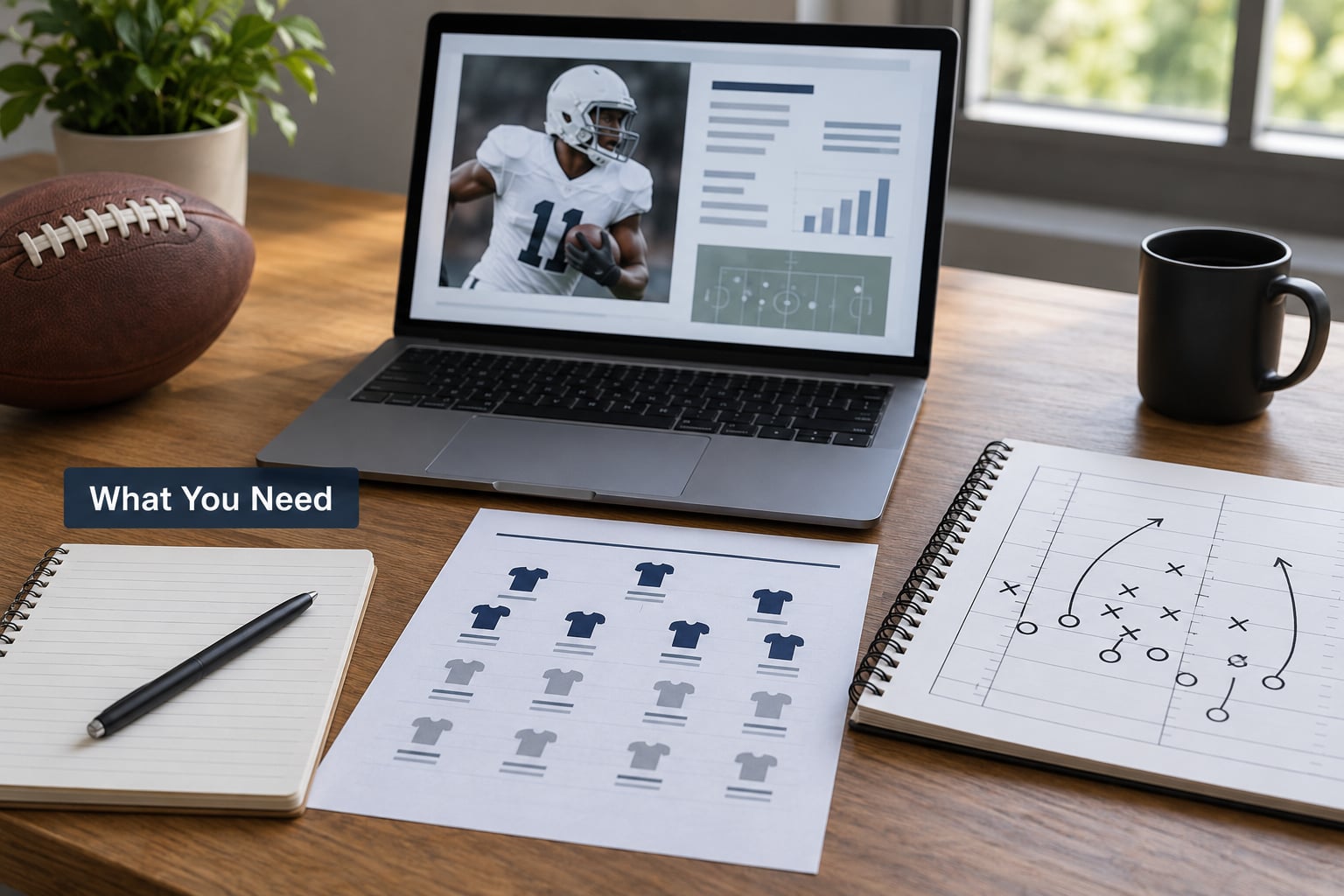
You need six inputs, and only the first one is about the player himself. Everything after that is context: what he will be asked to do, and how many throws that role produces.
- A depth chart read. Every receiver on the roster, ranked, with returning production noted. Vacated targets matter as much as who is new.
- Team and opponent strength context. SRS is a simple rating of how good a college team was overall; SOS is how hard that team’s schedule was. Both come from The Football Database and both change how you read raw production.
- College efficiency data. YPRR (yards per route run — yards gained for every route the player runs), dominator rating (share of his team’s receiving yards), market share of team passing yards, and breakout age.
- Target and route data from camp and preseason. Small samples, so use them as a tiebreaker rather than a verdict.
- Expected team pass volume. A projected dropbacks number, plus the share of those dropbacks that should go to receivers rather than the running game.
- Your league context. PPR or standard, redraft or dynasty, 12-team or super league, and how many years you need him to pay off.
That last one is the most underrated item on the list. A receiver whose ceiling is 60 points over three years is a dynasty stash and a redraft waste of a late pick. Same player, opposite decisions, because the format asked different questions.
Step-by-Step: How to Evaluate Rookie Wide Receivers for Fantasy
1. Identify the Player’s Actual Role
Start by deciding what the team is asking him to be, not what his college résumé suggests he could be. There are five honest answers: clear No. 1 target, complementary piece in a two-man rotation, slot and motion receiver, red-zone specialist, or rotational depth.
Role clarity drives weekly volume, and weekly volume drives everything else. A No. 1 outside receiver on a team that throws 40 times a game has a floor of 7 to 9 targets. A third receiver behind two established guys has a ceiling that can be crushed by one bad week of injuries ahead of him.
Write the role in one sentence before you look at any statistics. If you cannot, you do not have an answer yet.
2. Map the Target Competition
Now list every other body competing for throws: the other two or three receivers, the starting tight end, and the running back who stays in pass protection. Target share is a zero-sum game, so the departure of a 90-target tight end is worth more than a rookie’s talent.
Count the vacated targets on the depth chart and compare them to the number of the incoming class that needs them. A team that lost 140 targets and brought in one first-rounder puts a real ceiling on that player. A team that lost 140 targets and brought in three rookies splits the same pie three ways.
Managers on r/DynastyFF keep pointing out the same pattern: a lot of rookie value has come from finding the player whose year-one volume was buried under a crowded chart, not from finding the most talented one. Those are different guys, and the crowded-chart player is usually cheaper.
3. How to Evaluate Rookie Wide Receivers for Fantasy: Read the Production Data
YPRR is the cleanest efficiency number because routes are the unit of work. Three yards per route or better in college is a genuine signal; fewer than sixteen receivers drafted since 2018 have held a 3.0-plus career YPRR in the NFL, so treat it as a real filter rather than a formality.
Dominator rating and market share tell you how much of the offense ran through this player, and both need a team-strength adjustment. A receiver posting 35% market share while playing against a weak schedule on a top program is a different prospect from one doing it against ranked opponents every week, even with identical raw numbers.
Two more that travel well. Breakout age is the age at which the player first posted dominant production; 18 or 19 is a green flag, and 22 or 23 usually means the profile is already past its prime curve. Early declare means leaving college with eligibility left, which the Dynasty Nerds Z-Score work links to roughly four more points per game in later fantasy production.
Adjust every number once, then stop adjusting. Sample size runs out fast in college, and a 300-yard season against a bad defense is not a data point worth much.
4. Assess the Quarterback and Team Situation
A modest talent in a stable passing environment is more reliable in year one than a better talent on a team that changes coordinator and quarterback. Look for accuracy, a willingness to force throws into the middle, and whether the supporting cast around the quarterback is good enough to keep defenses honest.
Then check the offensive line and the run-game commitment. If a team is expected to run on roughly 45 early-down plays a week, that is volume permanently removed from the receiver’s ceiling, and no amount of draft position reverses it.
Quarterback continuity is the variable managers miss most. A rookie receiver catching passes from a first-year starter is on a learning curve the receiver cannot control, and that curve usually shows up in the first six weeks of the season.
5. Judge the Receiver’s Route Tree and Versatility
Versatility is the strongest leading indicator of year-two volume, and it is easy to see on film. Can he win from the slot and the boundary? Does he run routes off motion, does he block on third down, does he line up in an X shape, or is he stuck in one spot?
Every alignment added is another week of the season where he is on the field when the first choice is healthy. That is availability, and availability compounds.
The undersized slot receiver is the profile most consistently mispriced in this class. Analytics tends to underrate him because his production comes in short chunks, and draft capital tends to overrate him because he looked fast at the combine. The compensation is real: if his quarterback is accurate in the short-to-middle band, the volume shows up as points in PPR.
6. Check Separation and Contested-Catch Risk
Contested catching is a genuine skill and a genuine risk, and you need both numbers. Contested catch rate tells you how much of his production depended on winning a ball with a defender attached; a high rate on a small sample is a red flag that a corner who plays press will erase.
Balance it against separation and body control. A receiver who consistently creates a cushion on a breaking route will have a longer NFL career than one who lives entirely on 50/50 balls, no matter how good the highlights look.
You will not find separation as a stat. It is a film judgment, and it is the one place where putting on five games of a prospect’s tape still beats any spreadsheet. Watch his release off the line, how he decelerates on a slant, and whether he gets thrown the ball or has to go get it.
7. Project Ceiling, Floor, and Fantasy Format
Translate the role into points. Multiply expected weekly targets by points per target in your scoring, add a realistic yards-per-target figure from his college YPRR, and set a floor from the bottom of his target range rather than the middle.
In redraft, only the floor and the likely weekly volume matter, and only for one season. In dynasty, add the year-two and year-three upside, weight it by age at the end of that window, and discount it if the quarterback situation is unstable. A 21-year-old with three good years ahead of him is a different asset than a 24-year-old with two.
Then compare the projection to what the player will cost. The value gap between your grade and the market’s grade is the entire decision. If you project him as your tenth-best receiver and he is being taken eleventh, take him. If you project him as your fourth-best and he goes in the second round, pass.
8. Make a Risk-Adjusted Draft Decision
Summarize the profile into a tier with a written reason, and be specific about what would change it. A good note reads: third tier, because the role is clear but the target competition is heavy, and the grade moves up if the incumbent tight end misses a game in camp.
Draft early when the role is unambiguous, the quarterback is settled, and the college efficiency was adjusted for team strength and still held up. Draft late when the opportunity is speculative — a crowded chart, a new quarterback, or an offense expected to run more than it passes.
Skip the player when the only case for him is his ceiling and you have no path to the volume that ceiling requires. In a rookie class, most of your picks should not be picks at all. The best outcome of this process is a short list of three or four names, and a clear reason to pass on the rest.
Common Mistakes
Drafting on pedigree. Fix: grade on role and volume first, and treat draft capital as one input with a known correlation of about 0.25, not a verdict. A day-two pick with 90 targets is worth more than a day-one pick with 50.
Over-weighting one spectacular game. Fix: rookie seasons are noisy, and a single 30-target explosion usually means the depth chart was in shambles, not that the player is a No. 1. Look at the full season’s target distribution and the quality of the quarterbacks involved.
Ignoring offensive competition. Fix: count the throws available before you count the talent. Two established receivers ahead of him and a tight end who catches eight a game is three separate pieces of opportunity you have to subtract.
Treating raw dominator rating as truth on a dominant program. Fix: apply SRS and SOS. Market share on a top team playing a soft schedule can look like a WR1 profile and produce a third-round NFL role, and that gap is exactly where unadjusted numbers mislead.
Weighting the 40 too heavily. Fix: a fast prospect who cannot separate simply gets contested more, and contested is already a risk you priced in at step six. Treat speed as a tiebreaker and a slow release as a real flag.
Ignoring the format you play in. Fix: decide redraft versus dynasty payoff before you set a target, not after. The same grade supports two opposite draft actions, and the year in which you find out you got it wrong is the year you paid full price for a stashed pick.
One more worth naming: the 525-yard benchmark is a useful floor, not a verdict. Pro Football Network’s own write-up flags Chase Claypool and Zay Flowers among the names that did not convert, and it notes that a longer schedule and shrinking 11-personnel usage make the older thresholds harder to hit. Treat the yardage tiers as a year-one review tool, not a pre-draft ceiling.
Frequently Asked Questions
What is the best way to evaluate a rookie wide receiver before his first NFL season?
Work in a fixed order: draft capital, team-adjusted college production (YPRR, dominator rating, market share), breakout age and early declare, landing spot and expected pass volume, then role and route versatility. Grade each input separately, adjust for schedule and team strength, and only then translate the profile into projected weekly targets. Fixed order matters more than any single metric.
Which statistics matter most when judging a rookie wide receiver for fantasy football?
YPRR, dominator rating and market share adjusted for team and opponent strength, plus draft slot and breakout age. YPRR is the cleanest because it measures efficiency per route run, and 3.0 or better is a real signal. Treat physical testing as a tiebreaker. None of these predicts a role on its own, so they only matter once you know how many targets the depth chart will give him.
Should I draft a rookie receiver in the first round of a dynasty league?
Only when the role is settled and the age profile gives you three usable years. A first-round dynasty pick is a bet on year two, so a quarterback change, a crowded chart, or a 23-year-old landing spot can quietly turn it into a three-year holding cost. If your grade is uncertain below the first tier of the class, take the extra pick instead and target a clearer path to targets.
How can I tell whether a rookie receiver is actually the team’s No. 1 target?
Count, not reputation. Add up the targets the other receivers, the starting tight end, and the pass-heavy running back received last season, subtract the retired and traded ones, and split what is left by how many rookies need it. A lone first-rounder inheriting 120 vacated targets is a genuine No. 1. One of three rookies splitting 60 targets is a rotation, no matter what the beat writer says.
Is strong college production enough to predict fantasy success?
No, on its own. Dominant production on a powerful schedule against weak opponents is often a scheme and personnel advantage that does not travel, which is why team-strength and opponent-strength adjustments exist. Production becomes informative when it survives the adjustment, when the landing spot supplies comparable volume, and when the age profile leaves time for it to matter in your format.
How should I evaluate a rookie receiver who plays in a run-heavy offense?
Cap his ceiling first by projecting the team’s dropbacks, then estimate what share of those go to receivers. In a heavy-run offense the realistic outcome is slot work, short routes, and low weekly volume, so his value depends almost entirely on points per target in your format. He can still be a dynasty asset on talent, but he is a bad redraft pick unless the depth chart is unusually thin.
What I’d Do First on Draft Day
Before the draft, take the strongest name consensus expects you to take and grade him with the eight steps above. Then take the two receivers everyone is sleeping on and grade those. If your own grades do not contradict the consensus anywhere, you have graded reputation instead of opportunity, and that is the mistake this whole process is built to catch.
Then do the one check that changes the most grades: how many vacated targets his team actually has. Rookie seasons are decided by volume long before they are decided by talent.