A dynasty league in fantasy football is a format where managers keep their entire rosters from one season to the next instead of drafting fresh every September, adding new talent through an annual rookie draft and building franchises over a multi-year horizon. Updated for 2026 NFL cycle.
That single change — players do not go back into a pool at the end of the year — reshapes everything else. A decision you make in March can follow a player for six seasons. It is closer to running an actual NFL franchise than to picking a team fresh each autumn.
If you have never played one, this guide walks through the format end to end: what a roster looks like, how the startup and rookie drafts work, why future draft picks are the most valuable currency in the league, and what settings to use if you are starting one now.
Table of Contents
- What Is a Dynasty League in Fantasy Football?
- How Is Dynasty Football Different From Redraft Football?
- How Do Dynasty League Rosters and Scoring Work?
- How big should a dynasty roster be?
- What are taxi squad spots and bench spots?
- Which scoring format works best?
- What are superflex and IDP formats?
- How Do Dynasty Drafts and Rookie Drafts Work?
- The startup draft
- The annual rookie draft
- How Do Trades and Free Agents Shape a Dynasty Roster?
- What Is the Best Strategy for Start, Sit, and Lineup Decisions?
- How Do You Build a Successful Dynasty Team?
- Do not build an all-young roster
- Do not overvalue aging stars
- Do not burn your picks early
- Do not leave the league in February
- Frequently Asked Questions
- How long does a dynasty fantasy football league last?
- Is dynasty football easier for beginners than redraft?
- What platform is best for starting a dynasty league?
- What does a commissioner do in a dynasty league?
- When should I make trades in dynasty football?
- How do I evaluate rookie players in dynasty?
- Conclusion: Start With a Clear Dynasty Plan
What Is a Dynasty League in Fantasy Football?
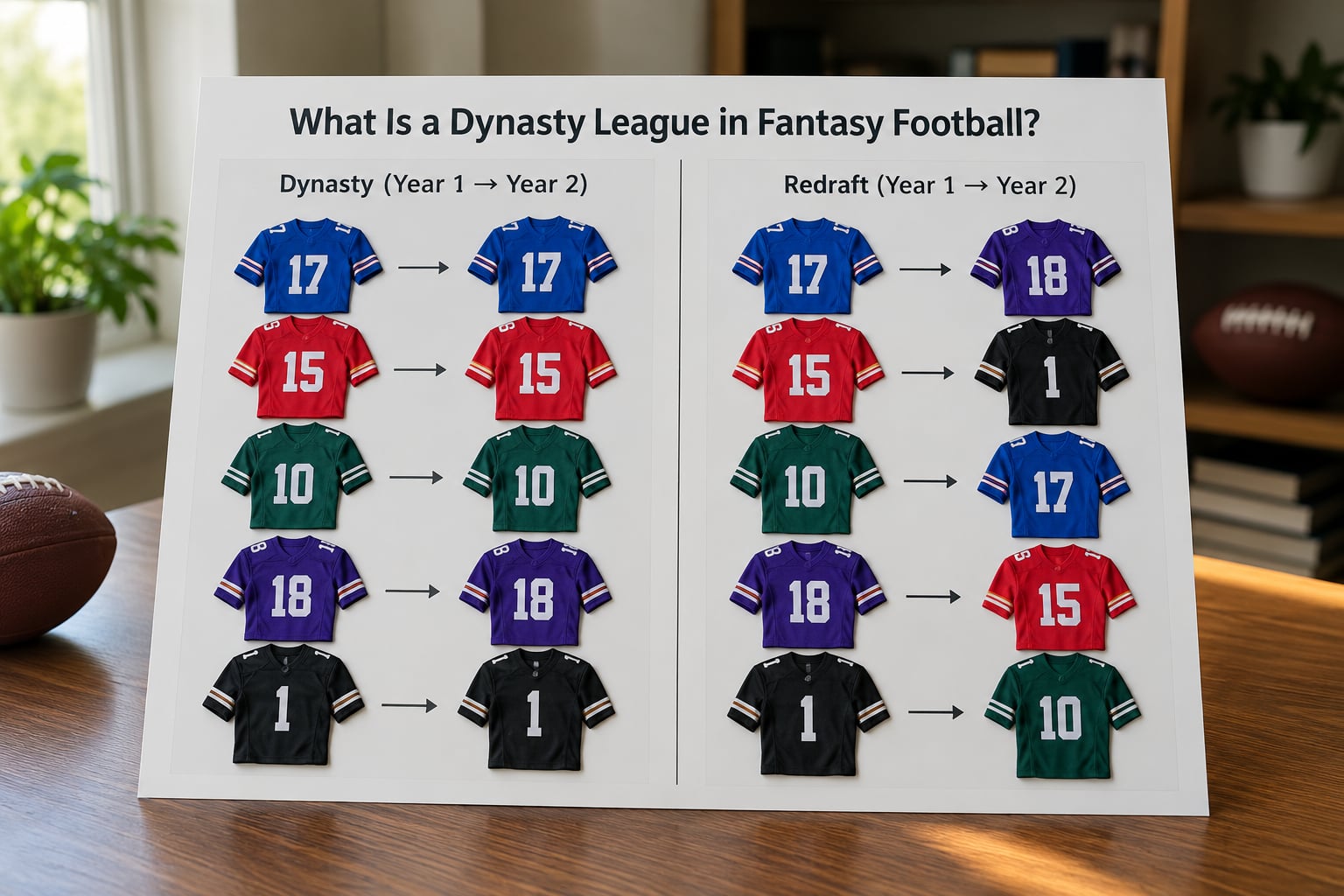
To put it plainly: a dynasty league is fantasy football where you keep your players year to year. Your starters, your bench, even your taxi squad and your injured guys all roll over into next season. Only new players — almost entirely NFL rookies — get added, and they get added through a draft held every offseason.
Three things follow from that setup:
- Age replaces stats as the main concern. A 24-year-old tight end with modest numbers is usually worth more than a 32-year-old running back putting up 1,200 yards.
- Your league runs 365 days. The regular season is 17 weeks, but the league competes from the NFL Draft in April through the end of the fantasy playoffs in February.
- Trades become the main way you improve. In a redraft league, the draft does the work. In dynasty, a well-timed trade in June can be worth two first-round picks.
Most dynasties are set up with 10 to 12 teams, 25 to 30 roster spots per franchise, and a lineup of nine or ten starters. Those are conventions, not rules — every platform handles the details differently, which is why understanding the mechanics matters more than memorizing anyone’s default settings.
How Is Dynasty Football Different From Redraft Football?
Redraft resets the board every year. Keeper gives you back a small handful of players. Dynasty keeps everything. The table below is the quickest way to see how the three formats diverge.
| Element | Redraft | Keeper | Dynasty |
|---|---|---|---|
| Roster duration | One season, then everyone returns to the pool | A fixed number of players carry over | The whole roster carries over |
| Annual draft | Full draft of all players, every year | Full draft, minus retained players | Rookie-only draft, usually rookies plus unrookies |
| Player aging | Mostly irrelevant after September | Mildly relevant | Central — the aging curve drives every decision |
| Trading | Rare, low stakes | Occasional | Constant, including future draft picks |
| Waivers and free agency | Short season-long wire | Short season-long wire | Year-round, with offseason periods and league rules |
| Time commitment | About 30 minutes a week in season | About 30 minutes a week in season | Roughly 30 minutes a week plus 5 to 8 offseason sessions |
| Typical lifespan | Season by season | Season by season | Five to fifteen years if owners stay |
| Best for | Newcomers wanting a clean slate | Redraft players who want a few keepers | Managers who like building and trading |
The practical difference shows up in week one of a new season. In redraft, an owner with the last pick can still land a star because every player is available. In dynasty, if you did not acquire that star in the rookie draft, in free agency, or in a trade, there is no mechanism left to get him — he is simply on someone else’s roster permanently.
Keepers are the middle ground. They are easier to run and they reset the boredom that pushes redraft players out, but they also cap how much you can change a roster from year to year, which is exactly the thing dynasty managers enjoy most.
How Do Dynasty League Rosters and Scoring Work?
Every dynasty roster splits into starters and reserves. Starters score weekly; reserves do nothing on the board but hold value for trades, free agent pickups and future seasons. The gap between your last starter and your best reserve is called the replacement level, and it is the number you use to decide whether a bench player is worth keeping at all.
How big should a dynasty roster be?
Twenty-five to thirty spots is the standard range. A smaller roster — say 20 spots on a 10-team league — makes every player more scarce and turns almost every season into a trade negotiation. A larger roster on a 12-team league, 28 or 30 spots, gives you room to stash prospects and survive injury weeks. The Fantasy Footballers notes that managers are allowed anywhere from 20 to 30 players depending on the league, which is a fair summary of the range you will see.
What are taxi squad spots and bench spots?
Some platforms let you designate a handful of reserve players as taxi squad members, meaning they occupy a roster space but do not fill a bench slot in your weekly lineup. That is how a 30-spot roster with only six bench spots still functions — you keep 24 in the “active” pool and park six prospects on taxi.
Which scoring format works best?
Points per reception is the default for most modern dynasty leagues, and it is a big reason the format grew. PPR rewards volume, which extends a receiver’s useful window and makes aging curves gentler. Half-PPR is the middle ground and the recommendation in the CBS Sports setup guide, paired with 0.05 points per passing yard, 0.1 per rushing yard, 6 per touchdown, 2 per two-point conversion and a tight end premium. Any of those work; just pick one and write it into your league settings before the first draft.
What are superflex and IDP formats?
Superflex lets you start a quarterback at a flex position, which doubles the value of a good signal-caller and pushes quarterbacks up most dynasty draft boards. IDP — individual defensive players — starts real defenders instead of a made-up defense, so sacks, tackles and interceptions all score. Both add depth, and both add work at draft time.
How Do Dynasty Drafts and Rookie Drafts Work?
There are two drafts in a dynasty league, and confusing them is the most common early mistake. The startup draft happens once, when the league is created. The rookie draft happens every single offseason.
The startup draft
At startup, every available NFL player — veterans and rookies together — is drafted. On a 12-team league with 25-man rosters you are picking 300 players, so the draft is 25 rounds. Drafts this long are normal in dynasty and are usually run fast, on a platform like Sleeper, ESPN, Yahoo or MyFantasyLeague.
The most common community consensus is to hold one combined startup draft after the NFL Draft, so the newest rookies are available when you pick. Draft the board tiered rather than strictly by position: take the best player on your board regardless of whether you already have three tight ends.
What you want out of a startup draft is assets, not a lineup. A 22-year-old with a second-round pick attached is worth more in year three than a 30-year-old who put up 1,400 rushing yards in year one. You can always trade up in a weekly league. You cannot un-age a running back.
The annual rookie draft
Every offseason, league members hold a short draft — usually two to four rounds — limited to rookies, sometimes including undrafted free agents. Rookie draft order is a setting: reverse standing order, random, or the same order every year. Reverse order rewards a bad season with a better prospect, which is the entire basis of the rebuild strategy.
The rookie draft is where a dynasty is actually won or lost, because it’s the only consistent influx of elite young talent. Leagues that set it to automatic, with draft picks assigned by the platform after a few days of roster moves, are far less work to run and remove arguments about players holding out.
Sleeper, Dynastyleaguefootball.com and League Tycoon are the names that come up most often when owners discuss platforms, and Sleeper in particular is repeatedly recommended for a first league. Whichever you pick, set the rookie draft for about a week after the NFL Draft so the rookie class is fully known and undrafted players have signed.
How Do Trades and Free Agents Shape a Dynasty Roster?
Trades are the engine of dynasty football, and the assets that hold value fall into a fairly short list:
- Young, high-upside players. The trade currency of the next three years.
- Future first-round picks. A pick two years out is worth more than most players, because you can flip it again.
- Depth at a scarce position. Tight ends and quarterbacks trade at a premium in superflex leagues.
- Elite aging veterans. Genuinely valuable — for one or two more seasons, not five.
- Late picks. Rarely worth much outside a deep rebuild.
Judge a trade by what the player is worth in two years, not this season. If you are giving up a 25-year-old wide receiver with a 3,000-yard projection for a 25-year-old tight end who caught seven passes last year, that is a reasonable deal even if it costs you points in September.
Most experienced leagues also vote on a trade-review process, where completed trades are reviewed at a set deadline and can be reversed with league approval. It exists to stop someone from making a lopsided trade at 11:59 pm on draft night. Several owners recommend adding a maximum player points setting, which caps the value of a single superstar and makes trades easier to evaluate on a scoreboard.
Free agency works the other direction. Your league’s waiver rules determine whether a player is claimed on a first-come basis or won in a blind bidding auction, and whether the wire runs year-round or only during a set window. Rules vary widely, which is exactly why a league constitution matters more here than in any other fantasy format.
What Is the Best Strategy for Start, Sit, and Lineup Decisions?
Weekly lineups in dynasty are the smallest part of the game, but they still decide your playoff run. The adjustment from redraft is that production and future value are two separate questions, and you answer both.
Start the guy who will give you the most points this week, unless he is actively hurting the players you care about later. That last exception is real: benching your third stringer so your top two backs stay healthy is a move most redraft managers would never make and every dynasty manager eventually does.
Handle injuries with rules, not reactions. Know which of your injured players are on IR or a designated-return list, who is a healthy scratch, and which of your taxi players are still earning a roster spot. Rookie players on IR typically stay on the roster in dynasty leagues, so a stash does not have a clock on it the way it does in redraft.
On free agents, be specific about why you are adding someone. Adding a practice squad receiver before the season because he caught 20 balls in preseason is a guess. Adding a 24-year-old tight end who flashed on a two-deep NFL depth chart is an investment. Both can work; only one of them survives a bad rookie season.
How Do You Build a Successful Dynasty Team?
A workable framework is less complicated than the forums make it sound. Acquire young talent, keep a few veterans who still produce, and never let a roster get so old that you have no trade chips.
Do not build an all-young roster
The mirror-image mistake is building only veterans, winning your first division title, and having nothing left in year three. A good roster has a spine of players under 26 plus two or three proven producers to bridge the rebuild. One common first-year story is a manager going 0-14, then winning a championship years later by trading aggressively — that arc only works if the roster stayed useful throughout.
Do not overvalue aging stars
Age 30 is fine at wide receiver and tight end. Age 28 is usually the end of a relevant career at running back. Draft boards that ignore this are redraft boards, and the mistake shows up as a core of players you cannot trade because nobody wants them.
Do not burn your picks early
FantasyPros’ startup draft roundup collects expert advice that pushes back on strict best-player-available and on spending your first three picks on the best available rookies. In a 25-round startup, early capital is cheap. In a two-round rookie draft, pick one is a franchise-changer and pick 12 is nearly worthless.
Do not leave the league in February
A dynasty league is a 365-day commitment, and the owners who go quiet are almost always the reason a league dies. Keep the constitution, collect dues before the rookie draft, and address an inactive owner before the season rather than after. It is the boring work that decides whether your league is still running in 2026.
A rough offseason calendar looks like this: NFL Draft in late April, rookie draft about a week later, training camp and preseason in July and August, regular season from September to December, playoffs in January and February. Four to six offseason decision points, plus a weekly waiver and trade check during the season.
Frequently Asked Questions
How long does a dynasty fantasy football league last?
Well-run dynasty leagues commonly run five to fifteen years, and some last decades. The format is built to be permanent because rosters carry over, so the only real expiration date is owner participation. Leagues tend to die when members stop checking in during the offseason, not when a single season goes badly. A written constitution and collected annual dues are the two strongest protections against collapse.
Is dynasty football easier for beginners than redraft?
No. Dynasty asks more of you up front and rewards you for years, while redraft is immediately understandable and resets every September. The learning curve in dynasty sits in draft strategy, trade evaluation and reading the aging curve, none of which matter in a standard league. If you want to learn the sport itself first, play a season of redraft, then move to dynasty once roster management stops being confusing.
What platform is best for starting a dynasty league?
Sleeper is the most commonly recommended starting point for a new dynasty league because rookie drafts can be set to automatic, trades are reviewed by league vote, and the free tier covers most small leagues. ESPN and Yahoo are solid if your group already uses them. MyFantasyLeague offers the deepest rule customization for a commissioner who wants to hand-build waivers, taxi squads and auction formats.
What does a commissioner do in a dynasty league?
A dynasty commissioner runs the league 365 days a year, not just on draft night. That means setting and defending the constitution, approving or reversing trades at a set deadline, handling roster moves and free agents, collecting dues, and replacing an owner who disappears. A written constitution covering those items prevents most of the arguments that otherwise burn a league down.
When should I make trades in dynasty football?
The biggest dynasty trades happen in the offseason, especially after the NFL Draft and before or during the rookie draft, when prospects are known and owners are deciding whether to win now or rebuild. During the season, trades spike before the trade deadline and around waiver additions. A league with a trade review deadline usually sets it just before the NFL Draft and again before the rookie draft.
How do I evaluate rookie players in dynasty?
Rookie evaluation in dynasty is mostly a projection problem. Look at draft capital, role, depth chart competition, athletic testing where available, and the offense the player is joining, then project a three-year ceiling instead of a rookie stat line. Landing spot and opportunity carry more weight than the box score from a single season, because a first-round pick who shares a backfield rarely gets the workload that makes dynasty value.
Conclusion: Start With a Clear Dynasty Plan
A dynasty league in fantasy football is simply fantasy football where you keep your players year to year, add rookies once a year, and manage a franchise instead of a lineup. The format rewards long-term thinking: age, draft capital and trading matter as much as weekly production.
Three things to do before you commit. Read your league settings line by line, especially roster size, taxi spots, trade review and rookie draft order. Pick a platform and tell the group which one. Then write down your strategy — win now for two years, or build around rookies for three — so your first draft has a plan behind it rather than a list of names.