Keeper league rules and settings explained in plain language: a keeper league is a redraft league where you carry a set number of your own players from one season to the next, either free or at the cost of the draft pick you originally spent on them. Every other setting stays the same, which is why keepers work so well as a first step up from a standard league.
What follows is the framework I use when a commissioner asks me to sanity-check their rules before season one, plus the defaults that hold up best in most leagues. Nothing here is one platform’s opinion, because the mechanics are near-identical on ESPN, Sleeper, Yahoo, Fantrax and MyFantasyLeague even though the menus are named differently.
Table of Contents
- What Is a Keeper League?
- Keeper League Rules and Settings Explained at a Glance
- How Many Keepers Should Your League Use?
- One or two keepers for smaller and beginner leagues
- Three or more keepers for large and experienced leagues
- League-size and semi-dynasty keepers
- How Do Keeper Eligibility and Cost Rules Work?
- Who is eligible at season end
- When you designate keepers
- The five keeper cost models
- How the draft slot gets calculated
- The drop-and-reacquire question every league needs to answer
- Waiver acquisitions, traded players and rookies
- A rulebook template you can paste in
- Which League Size and Roster Settings Work Best?
- How Do Scoring, Draft, and Trade Settings Change Keeper Strategy?
- Draft order, lotteries and stopping tanking
- Trade rules and the keeper trade problem
- Where each platform keeps its keeper settings
- How to Choose Settings for Redraft, Auction, and Dynasty Leagues
- Auction league keeper rules
- Dynasty-leaning and semi-dynasty settings
- Frequently Asked Questions
- Can you change keeper league settings after the league is created?
- Should keepers be selected during the draft or after it?
- How do keeper costs affect trades and player values?
- What happens when a league has more eligible players than keeper spots?
- Are one-player or two-player keeper leagues better for beginners?
- How do keeper rules differ in dynasty leagues?
- Start With the Cost Rule, Not the Keeper Count
What Is a Keeper League?
A keeper league is a fantasy league in which you keep a set number of your own players from one season into the next, either free of charge or at the cost of the draft pick you originally spent on them, instead of rebuilding your entire roster every year. At the end of the season, each manager designates a set number of players as keepers from the roster they already own. Those players are then slotted into the upcoming draft at a position set by the league’s cost rules, and their keeper cost is subtracted from the number of picks that manager receives.
That last sentence is where most arguments start. The keeper itself is simple; the accounting is what commissioners fumble.
| Format | Roster each year | What carries over | Typical draft |
|---|---|---|---|
| Redraft | Completely new | Nothing | Full snake draft |
| Keeper | Mostly new | A few players, at a cost | Snake draft minus keeper slots |
| Semi-keeper | New plus a few | Most of your roster | Short draft for the remainder |
| Dynasty | Continuous | Everything | College-style rookie and veteran drafts |
The practical difference is the value of a player you already know. In a redraft league, a second-year breakout is a coin flip. In a keeper league, you can hold him through the bad rookie year and pay a known draft price to keep him. That certainty is the whole appeal, and it is also the reason the cost rules exist: without a cost, the best manager simply hoards talent forever.
Keeper League Rules and Settings Explained at a Glance
The table below is the full decision list. Most commissioners only need to argue about the first six rows, but the rest decide how much chaos shows up in August.
| Setting | How it works | Common options | What most leagues use |
|---|---|---|---|
| League size | Number of teams drafting each year | 8, 10, 12, 16, 20 | 10 or 12 |
| Roster limits | Total players plus starters, bench, IR | 16 to 28 players | 16-18 in a 12-team league |
| Keeper spots | Players each manager may lock in | 1 to league size | 2 or 3 |
| Years in a row | Consecutive seasons one player may be kept | 1, 2, 3, unlimited | 2 |
| Cost model | What a keeper costs in the draft | No cost, fixed round, draft-round cost, escalating, salary cap years | Draft-round cost, one round earlier |
| Eligibility | Who can be designated a keeper | Roster at season end, no NA players, rookies only if drafted | On your roster when the season ends |
| Designation window | When keepers are locked in | Before the draft, in-season, at league creation | Pre-draft, locked once submitted |
| Draft order | How the new order is set | Reverse standings, lottery, snake rotation | Reverse standings or a lottery |
| Scoring | Points model | Standard, PPR, 0.5 PPR, superflex-friendly | PPR |
| Trade rules | How trades are approved | Unrestricted, commissioner review, league vote | Vote or commissioner review on any keeper trade |
| Trade window | When trades are allowed | All year, after draft only, no offseason | Open, with a vote on keeper trades |
Read that as a menu rather than a checklist. Each row has a defensible wrong answer, but not every combination holds together. Two costless keepers in an eight-team league, for example, locks up half the top twelve by year three.
How Many Keepers Should Your League Use?
Two or three keepers fits the large majority of leagues, and the reason is roster math rather than preference. A 12-team league with 16 spots leaves 13 players to rebuild. Keeping two leaves 11, keeping three leaves 10. Beyond four, your draft becomes a formality and the season’s outcome is mostly decided in the first two weeks after the draft.
One or two keepers for smaller and beginner leagues
One keeper per team is a good fit for an eight-team league or any group where one manager goes inactive in August. Two keepers per team is the sweet spot most people land on, because it gives you flexibility to hold one player and re-evaluate the rest of your roster each year.
Three or more keepers for large and experienced leagues
Three works in a 12-team league with a comfortable bench, and four is defensible in a 16-team superflex league where the weekly player pool matters more than the draft. If your managers already understand positional scarcity and you have at least four years of participation, four keepers is fine.
League-size and semi-dynasty keepers
Keeping your entire roster is really a dynasty league with a different name, and it works well in a small, tight group. Between those extremes sits the semi-keeper setup, where you keep most of your roster and hold a short draft for the rest. It reduces draft day to about 30 seconds, which appeals to busy leagues and annoys others completely.
A useful test: ask your managers how many players they expect to still own in two years. If more than half, move toward semi-keeper or dynasty. If a quarter, stay at two or three.
How Do Keeper Eligibility and Cost Rules Work?
Eligibility decides who is allowed in the keeper pool, and cost decides what it takes to keep them. These are separate settings and leagues that combine them carelessly are the ones that get a commish messaged in September.
Who is eligible at season end
The default rule is simple: a player must be on your roster when your regular season ends to be designated. That timing matters. A player dropped on the final week of the season is not keeper-eligible, which stops the trade-deadline shuffle of dropping stars to strip opponents of keeper value.
Most leagues also restrict what you can keep. Common limits: no players on the injured reserve or the disabled list, a cap on how many rookies or pre-draft prospects you can lock in, and sometimes a ban on keeping more than one player originally drafted in the first round. Each of these exists to protect league balance, and each is a vote, not a law.
When you designate keepers
There are three common windows. Designating at the end of the prior season means your choices are locked months early and everyone knows the board. Designating at the end of the current season keeps it simple and current. Setting the window inside the draft means you can see free agents before you commit, which is the more advanced option and the one most platforms support well.
Whichever you pick, publish the deadline in league timezone. Half the disputes I have seen came from one manager submitting at 11:58 p.m. and another at 12:02 a.m.
The five keeper cost models
The cost model is the single most important setting in the league, because it decides whether a keeper is a modest decision or a season-defining one.
| Cost model | What a keeper costs | Effect on parity | Suits |
|---|---|---|---|
| No cost | Nothing; the manager just loses a draft slot | Breaks down in two or three years | Small leagues, dynasty-leaning groups |
| Fixed round cost | Everyone pays the same, commonly the 1st or 2nd round | Simple and stable | New leagues and mixed-experience groups |
| Draft-round cost | One round earlier than you originally drafted him | Rewards drafting deep, punishes early mistakes | Most competitive redraft leagues |
| Escalating cost | Kept players cost one more round each year in a row | Self-limiting, discourages long hoarding | Leagues with three or more keepers |
| Salary cap years | Keeping a player costs cap space or a contract year | Best parity, slowest to set up | Dynasty-style and auction keeper hybrids |
The draft-round cost model is the most common one I see, and the one to copy if you are starting fresh. It has a clean logic: a player you took in the fifth round of last season costs you a fourth-round pick to keep him, so the earlier you misjudged a player, the more you pay to admit it.
How the draft slot gets calculated
Keeper picks are slotted into the round where the cost puts them, at the position of the manager who drafted them, which is why the board looks odd in a snake draft. Work through an example with a 12-team league and a one-round-earlier cost model.
| Original round drafted | Round you drafted | Keeper cost in draft | Where he is slotted |
|---|---|---|---|
| 2nd round pick, 7th overall | 2 | 1 round | 1st round, 7th overall |
| 5th round pick, 3rd in round | 5 | 1 round | 4th round, that manager’s slot |
| 9th round pick, 11th in round | 9 | 1 round | 8th round, that manager’s slot |
| Undrafted rookie | FA | 1st round | 1st round, end of round |
Then remove those slots from the normal draft order. A manager who keeps two players no longer has two picks in those rounds, and every manager’s turn after them shifts accordingly. This is why some platforms ask you to set the number of keepers before the draft, so the slotting can be calculated in advance.
The drop-and-reacquire question every league needs to answer
Does a player’s keeper cost reset if you drop him and draft or reacquire him later? This is the single most argued rule in keeper leagues, and the highest-ranking thread on the topic is a commissioner asking for an objective read rather than starting another argument.
Three answers are common, and each is internally consistent. The player keeps his original draft round, so dropping and re-acquiring a fifth-round player never improves his cost. The player is treated as undrafted, so his keeper cost becomes the league default. Or the rule is season-based: if you dropped him before the prior season ended, he re-enters the pool as undrafted the following year.
Whichever you choose, write the sentence into the rulebook and vote on it before the season, not the week the argument starts. A league that has said it out loud is a league that keeps playing.
Waiver acquisitions, traded players and rookies
Players picked up off the waiver wire are usually undrafted, so their keeper cost defaults to whatever your league charges for an undrafted player. The common default is a first-round pick, which some leagues soften to a second or third. Be explicit, because a waiver-wire star suddenly becoming a first-round keeper cost is exactly the season-changing surprise that ends friendships.
Traded players follow eligibility, not transaction. If the player was on your roster at season end, you may keep him; if not, you may not. The cost stays tied to the round he was originally drafted in, and traded draft picks follow the trade.
Rookies and prospects need their own line. The community convention is that you may only keep a rookie you drafted yourself, and only if he was on your roster at season end. Without that clause, one manager can stockpile every draft class and shape the league for a decade.
A rulebook template you can paste in
Commissioners ask for language more than they ask for advice, so here is a starting block. Adjust the numbers, then have the league vote on the whole thing at once.
Each team may designate up to three (3) players as keepers at the conclusion of the regular season. A keeper must be on that team’s active roster at that time. Each keeper costs the team one round earlier than the round in which that player was originally drafted. A player acquired as a free agent or off the waiver wire may be kept at a cost equal to the second round. A player may be kept for a maximum of two (2) consecutive seasons, after which he returns to the player pool and his consecutive-season counter resets. A first-round draft pick may not be kept in any season. A rookie may be kept only if that team drafted him, and only for his first two seasons. A dropped player’s keeper cost does not reset; it remains tied to his original draft round. Any trade involving a keeper or a draft pick must be approved by a majority vote of the league before the trade deadline. These rules may be amended only by a two-thirds vote, and only before the keeper designation window opens.
Which League Size and Roster Settings Work Best?
League size changes what keepers are worth more than any other setting. A player is less scarce in a 16-team league with 20 roster spots than in an eight-team league with 13, so the cost model that feels right at one size will feel punitive at another.
| League size | Typical roster | Keeper spots | Notes |
|---|---|---|---|
| 8 teams | 13-16 players | 1-2, often at no cost | Waivers do a lot of the work; tight rosters punish bad luck |
| 10 teams | 15-18 players | 2-3 with a cost | Most forgiving of uneven participation |
| 12 teams | 16-18 players | 2-3 with a cost | The default and the safest first choice |
| 16 teams | 18-22 players | 3-4 with a cost | Suplex and flex spots make positional scarcity extreme |
Roster construction matters just as much. A superflex or two-tight-end slot multiplies the value of keeping a quarterback, tight end or offensive lineman, because those positions stop being replacements and start being assets. If you keep those spots, three keepers is plenty. If you run a flex-only league, two is often enough because your bench is wider and the draft does more work.
Two settings get overlooked by new commissioners. Taxi squads let injured rookies sit on a limited roster without using an IR slot, which protects young players you may want to keep. IR slots themselves should be few and costly, or the waiver wire becomes a parking lot. A sensible default is two IR slots with a minimum three games missed, and no more than one IR player ever designated a keeper.
How Do Scoring, Draft, and Trade Settings Change Keeper Strategy?
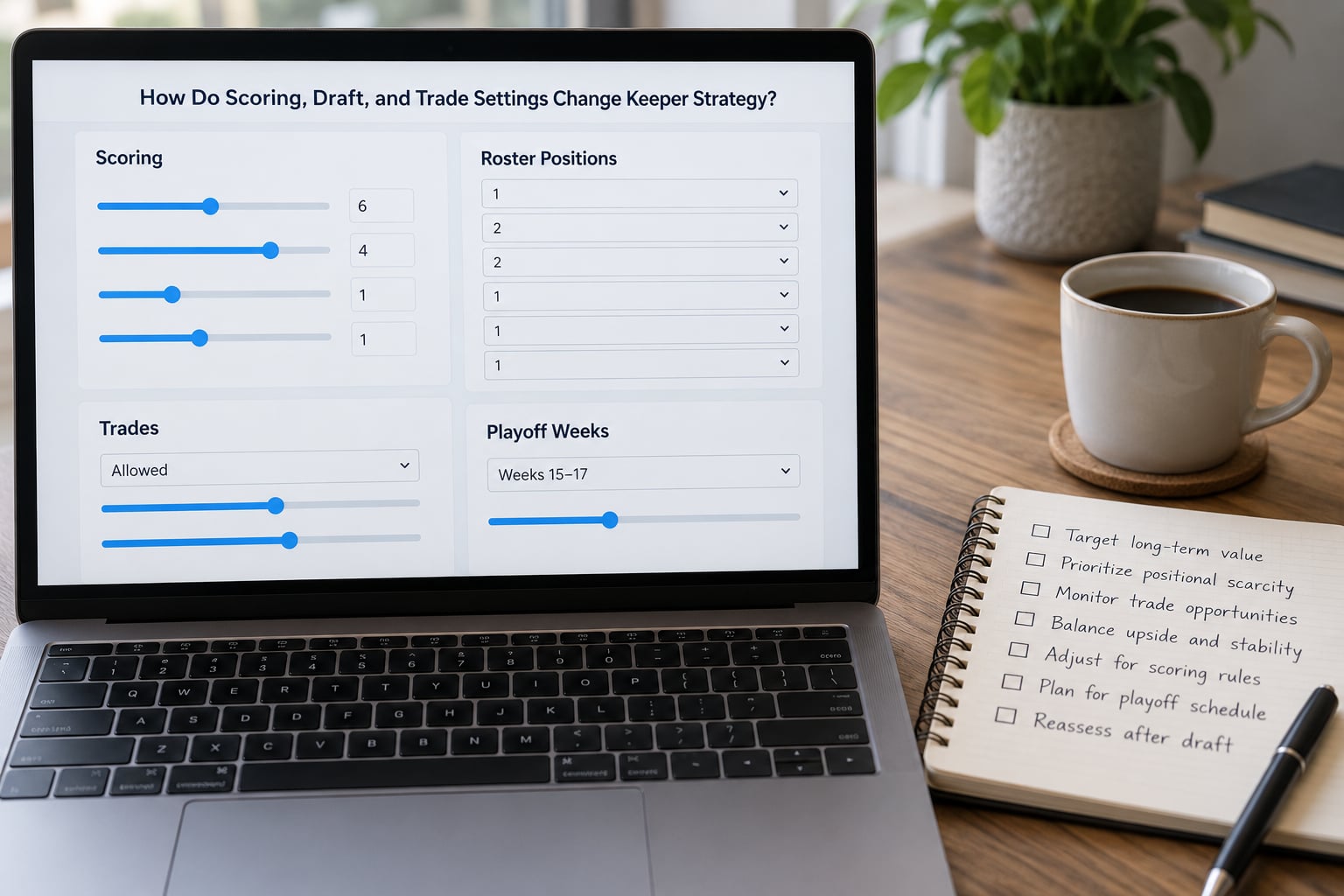
Keepers are a bet on a player’s future value, and scoring decides how much of that value exists. In PPR, a pass-catcher’s floor rises every week, which makes a mid-tier wideout a safer keeper than a touchdown-dependent player with a similar projection. In standard scoring, the same player is a coin flip. The cost model does not change, but the players you should spend picks on do.
Draft order, lotteries and stopping tanking
Reverse standings is the traditional default and it has a well-known problem: a manager at the bottom has no reason to compete in the final week if the first pick is on the line. A weighted draft lottery fixes that. Standard odds for a 12-team league with six teams drawing are 1 in 12 for the last-place team and 6 in 12 for the first-place team, with the middle weighted between them, and you can adjust those percentages as long as every team has a real shot.
Whichever you use, publish the odds before the season. A lottery the league understands is a lottery nobody can accuse the commissioner of rigging.
Trade rules and the keeper trade problem
Trades are where keeper leagues are most vulnerable to collusion, because trading away a keeper for a future pick with no immediate fantasy value is easy to explain and hard to police. Two rules handle most of it: trades involving a keeper or a future draft pick require a league vote before the trade deadline, and trades are only reviewed in good faith rather than for competitive balance. The second rule is the important one, since leagues that review trades for balance end up in court every October.
Keep a transaction limit too, typically one or two per week, so nobody assembles a dream roster on Sunday night.
Where each platform keeps its keeper settings
The field names differ but the concepts do not, and all five of these run on the web with the same menu logic.
- ESPN Fantasy: open the league, go to Settings, then League Settings, and look for the Keeper Settings section. You set the number of keepers and the cost per keeper, and ESPN handles slotting the picks for you.
- Sleeper: in the league, select League Settings, then the General tab, where the number of keepers is set at creation. Keeper costs are adjusted per league through the draft settings, and Sleeper shows the resulting draft slot before you confirm.
- Yahoo Fantasy: open League Settings and use the Keepers tab to set the number of keepers and the years a player can be kept. Yahoo applies the cost automatically when keepers are submitted.
- Fantrax: the league rules editor has a dedicated Keeper Rules section covering the count, the cost method, the consecutive-year limit and eligibility. It is the most explicit of the five, which is why many dynasty-leaning managers migrate there.
- MyFantasyLeague: go to the league, then Settings, then the Edit League Rules tab, where the number of keepers, the cost method and the years limit are all set as dropdowns rather than free text.
Check one thing before you commit: whether the platform lets you set a maximum number of consecutive years. Some do not, and if your league needs a two-year cap you may have to enforce it by hand at the designation window.
How to Choose Settings for Redraft, Auction, and Dynasty Leagues
The most reliable approach is to pick settings that match how your managers actually behave. Leagues rarely fail because of a bad rule; they fail because the rule and the participants disagreed.
| League type | Keepers | Cost | Years in a row | Reasoning |
|---|---|---|---|---|
| Beginner redraft | 2 | One round earlier than drafted | 2 | Simple to explain, no cheap tricks available |
| Competitive redraft | 3 | One round earlier, escalating after year one | 2 | Rewards drafting depth rather than hoarding |
| 8-team league | 1-2 | Fixed second-round cost | 2 | Tight rosters make keepers more valuable than picks |
| 12-team league | 2-3 | One round earlier than drafted | 2 | The balanced default |
| 16-team superflex | 4 | One round earlier, no first-round keepers | 3 | Position scarcity makes early keeps too strong |
| Auction league | 2-3 | Fixed round equivalent or a cap penalty | 2-3 | Auction prices are unknown, so a fixed cost keeps it fair |
| Dynasty-leaning | 5+ | None, or a contract year | Unlimited | The draft matters less than accumulation |
Auction league keeper rules
Auction leagues confuse keepers the most, because there is no original draft round to charge against. Two workable models exist. The first converts the auction price into a draft round, so a player bought for the equivalent of a second-round pick costs a second-round pick to keep. The second uses a flat cost, typically a first- or second-round pick regardless of price, which is simpler and stops cheap auction fliers from being free keepers. Avoid any model based on last season’s auction value, since it rewards managers who overpay and punishes the rest.
Dynasty-leaning and semi-dynasty settings
If you want to move toward dynasty without a full conversion, the cleanest path is to cap consecutive keeper years at one, drop the cost to nothing, and add a rookie draft. That combination keeps a core of your best players, still gives everyone a meaningful annual draft, and makes trading easier because a pick from a keeper draft is roughly a dynasty first-round equivalent.
Frequently Asked Questions
Can you change keeper league settings after the league is created?
Usually not without league consent, and that is by design. On most platforms the number of keepers and the years limit are locked once the league is created, because changing them mid-flight invalidates everyone’s existing strategy. Some settings can be adjusted by a vote. A good rule is that keeper settings stay frozen for three seasons before any change is considered.
Should keepers be selected during the draft or after it?
After the draft is usually better, and it is the only option most platforms support cleanly. Designating inside the draft means you can see which free agents survive to your pick, which is valuable but slow and often allows uneven information. Designating after the draft keeps one deadline, one timezone and one locked board, and it removes the argument about who submitted first.
How do keeper costs affect trades and player values?
A cost turns a keeper into a tradeable asset worth roughly the slot it consumes. A first-round-equivalent keeper should fetch a first-round-equivalent prospect, and a fourth-round-equivalent keeper should never be priced like a star. When costs escalate each year, trade prices should escalate too, since the player is worth more picks in the future. Write the valuation rule into your trade review so votes are consistent.
What happens when a league has more eligible players than keeper spots?
The manager keeps the players they want and the rest return to the pool, but the system still has to charge the keeper cost for the ones they pass on, because eligibility is not the same as designation. This is where leagues get confused: a player can be keeper-eligible and go undrafted as a keeper, then be drafted normally at his original slot. Decide in the rulebook whether passing on a keeper rolls his cost back into the draft order.
Are one-player or two-player keeper leagues better for beginners?
One or two keepers is the better starting point, and the reason is recovery from mistakes. With two keepers you can hold one safe player and still make a real decision on the second, so a bad draft does not follow you for years. Save four or five keepers until your managers know how the cost model works. Rules that only work when everyone plays perfectly rarely survive a real league.
How do keeper rules differ in dynasty leagues?
In a dynasty league there is no annual draft for veterans, so keepers disappear as a separate concept and are replaced by roster construction rules: contract length, salary cap space and the amateur draft each year. Dynasty leagues still have a keeper-style decision in the rookie draft, where you may keep a drafted rookie for a set number of years. The overlap is eligibility, which both formats define carefully.
Start With the Cost Rule, Not the Keeper Count
If you only decide one thing before season one, decide the cost model. It is the setting that makes the format either interesting or broken, and every other choice on the list above can be adjusted later without much damage. Pick a one-round-earlier cost, cap consecutive years at two, set eligibility to the roster at season end, and put those four sentences in writing before anyone drafts.
Then run one full season without changing anything. Leagues that survive their first three years with stable rules almost never have the arguments that show up in the forums every August.