To set your fantasy football lineup each week, you compare everyone on your roster against that week’s projections and matchups, fill your required slots plus any flex spot, and submit before your league’s lock time. Most managers spend twenty minutes on a process that deserves an hour, then wonder why they benched a 15-point starter for an upside play.
The fix is boring and it works. A fixed routine you run Tuesday through Sunday turns start/sit decisions into a short list of checks instead of a weekly argument with yourself. This guide walks through that routine the same way every week, whether you play on ESPN, Yahoo, Sleeper, NFL.com or CBS.
Table of Contents
- What You Need
- Step-by-Step
- 1. Confirm Your League Rules and Rosters
- 2. Review the Week’s Schedule and Matchups
- 3. Check News, Injuries, and Practice Reports
- 4. Use Projections Without Ignoring Context
- 5. Set Start, Sit, and Flex Decisions
- 6. Lock the Lineup and Verify the Final Slate
- Common Mistakes
- Frequently Asked Questions
- When should I set my fantasy football lineup?
- Should I start a player based only on a favorable matchup?
- How early should I check injury news before games?
- What is the best strategy for choosing flex players?
- Should I make changes to my lineup after the games begin?
- Conclusion
What You Need
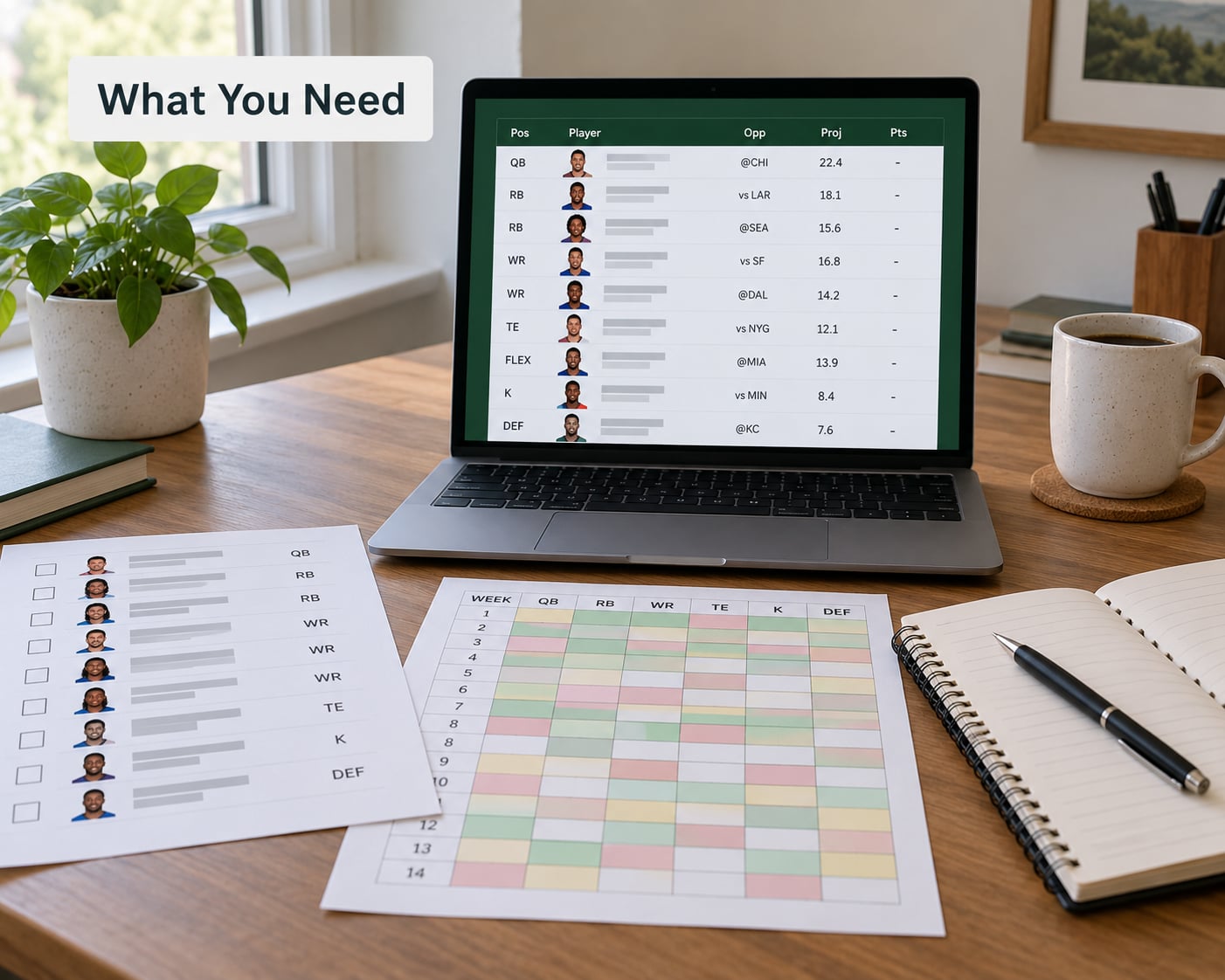
You need five things ready before you decide anything, and none of them cost money.
- Your league settings. Scoring format, flex eligibility, number of starters, IR slots, whether your league allows in-week swaps after the games start, and the exact lock time. Every subsequent decision depends on this.
- Your full roster with eligibility status. Include IR, out, questionable, and suspended players. You cannot make a waiver claim or a drop until you know who is actually on your team.
- The week’s schedule. Every game matters, including the ones you were not expecting. Two backups playing in the same game is a real possibility, and it changes your flex math.
- Consensus projections and weekly rankings. Pre-season rankings are a draft tool. Weekly rankings are the lineup tool. Mixing them up is one of the most common mistakes managers make.
- Opponent context. How the defense you face ranks against your player’s position, where that defense is weak, and who draws the coverage on the other side of the ball.
Add news access and an injury report from whatever team beat reporter you trust, and you have everything. Write your decisions down. A notebook line per player (“start”, “sit”, “flex-eligible”) is the cheapest insurance against the Sunday scramble.
Step-by-Step
Knowing how to set your fantasy football lineup each week comes down to four phases in a fixed order: know your league constraints, research the week, make the decisions, then verify before you submit. Skipping straight to the research phase is where most weeks go wrong, because you end up building a lineup your rules do not allow.
1. Confirm Your League Rules and Rosters
Open the league settings page before you open any projections. Note the lock time and whether it is your local time or the league’s, because those are often not the same thing. Then check whether the platform auto-locks at the deadline or accepts swaps after kickoff, since that single setting changes how aggressive you can be on Sunday afternoon.
Next, confirm eligibility. Players marked IR, out, or suspended do not count toward your lineup. Questionable players do count, and that is the point at which you decide whether a questionable designation is something you can live with.
Finally, look at the roster as a whole rather than position by position. If you have four running backs and two tight ends, your flex options are narrower than your slot count suggests, and you should think about that imbalance before Sunday rather than after.
2. Review the Week’s Schedule and Matchups
A favorable matchup is about more than an opponent’s fantasy points allowed. Look at where that defense is actually vulnerable. A secondary that concedes a lot of volume to slot receivers is a different situation from a defense that allows completions but keeps chains short, and the difference matters for your ceiling.
Read the game environment too. A team projected to be a heavy favorite will run more plays, which tends to help their skill players even when the opponent is good. A team likely to be trailing will throw more, which helps receivers and tight ends but can strangle a running back who depends on goal-line work.
Then check the role, not just the name. A backup who split carries with the starter last week, or a receiver who moved into the slot, is a different player than he was three weeks ago. Projections built on stale usage will not tell you that on their own.
3. Check News, Injuries, and Practice Reports
Practice reports carry the most signal of anything you will read all week. A player who was limited Wednesday and did not practice Thursday is a real downgrade from his projection, and one who was limited Wednesday and returned to full work Thursday is usually fine.
Pay attention to usage changes, not just injury labels. A snap share that dropped from 80 percent to 45 percent because a rookie was drafted over him matters more than the word “questionable” on any report. Coaches tell you about a role change through the snap counts a week before they say it publicly.
Separate meaningful updates from noise. A routine soreness report that a player practiced in full is not a reason to change anything. A position change, a coaching change, or a quarterback who has stopped throwing to a particular receiver are all reasons to edit your projections.
4. Use Projections Without Ignoring Context
Consensus projections are the best single input you have, and they are a starting point rather than a verdict. A projected 11 points for a wide receiver means something very different if his quarterback threw for 190 yards last week, and something else again if he is the only healthy target on an offense missing two others.
Here is the ranking I use, roughly in order: expected opportunity, matchup quality, game script, role stability, and last week’s results. Last week’s results sit last on purpose. A player who just scored 30 points against a bad defense is priced into your projection already, and chasing that number is the most common way managers talk themselves into a bad flex call.
Adjust projections rather than discard them. If the consensus has a player at 8 points and his matchup is genuinely terrible and his volume is falling, sitting him at 6.5 might be the right adjustment. If you find yourself moving a projection by more than about 25 percent, you are probably telling yourself a story rather than reading the data.
5. Set Start, Sit, and Flex Decisions
Work position by position and make every call explicit. If you only ever look at a matchup list, you will skip over the player on your own bench who fits your flex better than someone in your starting nine.
When two players are close, use these tiebreakers in order: start the player with a defined role, then the one with a more stable snap share, then the one whose floor is higher. A player who is guaranteed 12 targets is a safer flex than one who needs a specific touchdown to reach his projection, especially in a playoff week.
For the flex spot itself, treat it as a position swap rather than a bonus. Ask a simple question: which of my bench players would I start at another position? That framing usually ends the debate, and it stops you from saving a flex player who only works if his own position somehow stays open.
On kickers and defenses, streaming beats a set pick most weeks. Streaming a defense playing a team that throws a lot against a good defense is a well-understood edge, and dropping your kicker first to free a roster spot is standard practice. The community consensus on r/fantasyfootball is consistent on both points: start your studs elsewhere, and stream where the week-to-week variance is high.
6. Lock the Lineup and Verify the Final Slate
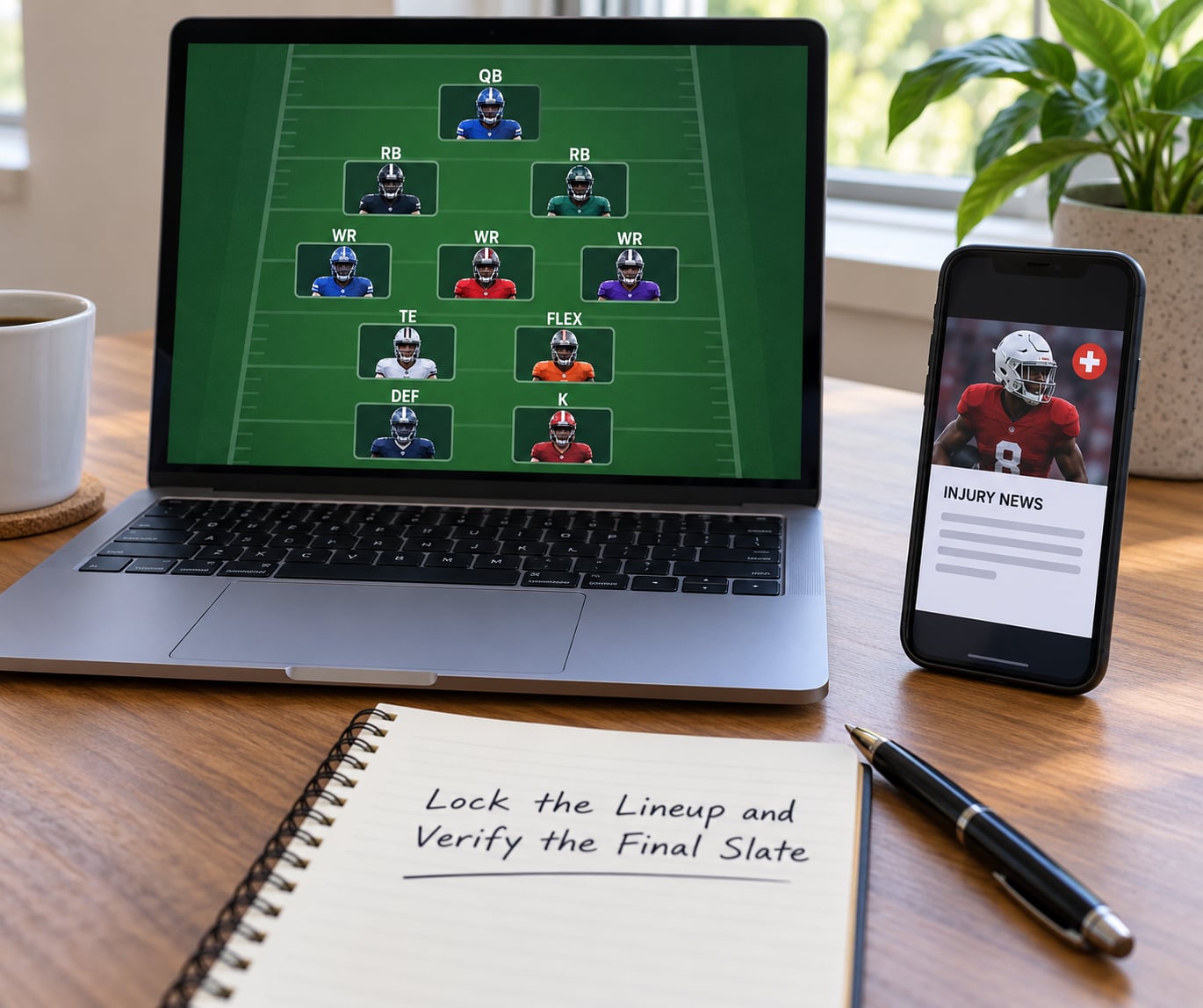
Build the lineup the night before, then revisit it before kickoff. The purpose of the second pass is not to re-litigate your decisions. It is to catch mistakes and late news.
Run a short verification list every time. Confirm every player is eligible and none are marked out. Confirm the flex and superflex rules are satisfied, including minimum position requirements if your league uses them. Check for late scratches and for quarterbacks who have been limited in warmups. Confirm the lineup is saved and submitted rather than sitting in a draft state. Leave at least a couple of hours of margin before the lock rather than the last five minutes.
If your league accepts in-week changes after kickoff, treat that as a repair tool for verified injury information, not as a second chance to upgrade your flex spot. Changing a locked-in starter because another player’s projection moved on a news aggregator is exactly the over-management that the r/fantasyfootball wiki warns managers about, and it costs more than it gains.
Common Mistakes
Chasing last week’s points. The scoring of the previous week is already reflected in every projection you looked at. Starting a player because he exploded is paying twice for the same information.
Ignoring a role change. A running back who went from 20 carries to 8 without an injury is a different player. Snap counts catch this a week before the box score does.
Responding to headlines only. News gets published at odd hours and often contradicts practice reports. Confirm it before you act on it.
Forgetting the bench. The player sitting in your WR3 slot who happens to be facing the league’s worst defense against outside receivers is a legitimate flex option, and reviewing him takes thirty seconds.
Ignoring flex rules. Superflex leagues carry minimum-position requirements. Check them before you submit, not after your league sets it to zero.
Last-minute changes without a reason. If you cannot name the specific piece of new information behind a swap, do not make the swap. Forum consensus is firm on this one, and it protects you from your own impatience.
One more habit worth naming: over-management is more expensive than being wrong. Sitting a stud for a waiver wire pickup usually loses less than it feels like it will.
Frequently Asked Questions
When should I set my fantasy football lineup?
Most managers should build a first draft on Tuesday or Wednesday and then finalize it on Sunday, ideally a few hours before the league lock. That first pass lets you add waiver claims and account for early injury news without pressure. The final pass exists to catch late scratches and last-minute changes. Whatever you do, know your exact lock time and whether it is set to your local time or the league’s, because that mismatch accounts for a lot of missed lineups.
Should I start a player based only on a favorable matchup?
No. A favorable matchup is one input among several, and a weak one by itself is rarely enough to bench a genuinely strong player. Matchup matters most when it lines up with role and opportunity: a receiver already getting 30 percent of his team’s targets, facing a secondary that concedes heavily to that slot, is where the edge is. A favorable opponent with no volume is a trap, and an unfavorable opponent rarely sinks a player who gets 8 targets a game.
How early should I check injury news before games?
Read the first practice reports on Wednesday to catch anything significant, then check again on Thursday because that is where most meaningful designations land. The final check should happen about 90 minutes before kickoff, when late scratches and warmup reports surface. Going in sequence and then stopping is the goal. Managers who check every 15 minutes tend to find noise, act on it, and finish the week second-guessing a lineup that was already fine.
What is the best strategy for choosing flex players?
Stop thinking of flex as a bonus slot and treat it as a position swap instead. Ask which player on your bench you would start at another position, then put that player in the flex spot. It simplifies the decision and removes the temptation to hold a player for a fantasy matchup that may never happen. In a playoff week, bias toward the higher floor over the higher ceiling, since a 6-point outcome often beats a 15-point one in head-to-head formats.
Should I make changes to my lineup after the games begin?
Only for one reason: a verified injury that invalidates a player already in your lineup. If your league permits in-week changes, that is a repair mechanism, not an upgrade window. Reconsidering a flex pick mid-game because a projection moved on a news aggregator is how managers lose games they were winning. If your league locks at kickoff, the decision is simply final, and the better habit is to submit early enough to stop thinking about it.
Conclusion
Start with your league rules and eligibility, because every decision after that depends on them. Read the schedule and the matchup context, check practice reports midweek, adjust the consensus projections rather than replacing them, and make each start, sit and flex call explicit. Then verify the final slate and submit with time to spare.
Run that same order every week and the process stops being a source of anxiety and starts being a habit. The lineup you submit on Sunday will not be perfect, and no method guarantees a win, but a repeatable routine is the closest thing to an edge that a fantasy manager can actually control.