To read a fantasy football matchup, work through the same five questions every week: what role does the player own, who is likely to cover him, what does the expected game script look like, and does volume survive any injury news. Matchup data on its own just tells you how many fantasy points a defense has surrendered; role and usage tell you whether your player will be there to benefit from it.
The whole process takes about fifteen minutes per week if you have your tools open, and most of that time goes into reading personnel notes rather than staring at rankings. Anyone can finish it. The hard part is resisting the urge to let one star rating decide your lineup.
Table of Contents
- What You Need
- Matchup ratings across the major platforms at a glance
- Step-by-Step
- 1. Identify each player’s role in the offense
- 2. Check the coverage matchup, not just the opponent
- 3. Compare recent usage and expected game script
- 4. Factor in injuries, weather, and travel context
- 5. Turn the matchup into a start, sit, or fade decision
- Common Mistakes
- Frequently Asked Questions
- What is a fantasy football matchup?
- Should I start the player with the better matchup or the better projection?
- How many games of data before you can trust a matchup?
- How do I read a WR versus CB matchup?
- Is strength of schedule a tiebreaker or a primary factor?
- Conclusion
What You Need

You need four things before a matchup is worth reading at all: the player’s role, coverage information for the defense he faces, usage trends, and the injury report. If a player is missing any of those, the matchup number on your screen is decoration.
The role piece is the most important and the one most often skipped. A wide receiver who runs roughly 60 percent of routes from the slot has a different matchup than a flanker who lines up wide against a press-man corner every week. You can read both of those against the same cornerback and get opposite answers.
Second, you need the actual opponent, not just the defense’s ranking. Team-level numbers roll together every player who faced that unit, including backups and players working through injuries.
Third, you need usage data: snaps, targets, touches, red-zone touches, and how those have moved over the last three or four weeks rather than the last one.
Fourth, the injury report, read on Thursday night rather than Sunday morning. Plenty of starters change their role status between those two reads, usually because a practice report says a shoulder looks better than it did two days earlier.
Matchup ratings across the major platforms at a glance
Every app scales matchups differently, and the scales are rarely explained on the same screen that shows the number. That confusion is the single most common complaint in fantasy football forums, so here is a plain crosswalk of what each platform’s scale generally means.
| Tool or app | What the scale usually shows | Reading a favorable week | Common trap |
|---|---|---|---|
| FantasyPros | A one-to-five star rating by position against the weekly opponent | Four stars or better | Treating stars as a projection rather than a comparison |
| NFL Fantasy | An opponent strength rank, where a lower number means a tougher defense | A rank in the bottom third of the league at that position | Reading a lower number as worse |
| ESPN | A plus or minus matchup number, where positive means favorable | Any positive number, larger is better | Chasing a big positive on a low-volume player |
| Yahoo | A scheduled-opponent difficulty grade, roughly A through F | A or B grade | Ignoring grade entirely when the player is on a bye or hurt |
| Sleeper | Bonus and projection adjustments built into consensus rankings | A bonus bump of a few points or more | Overriding a full projection split for a small bonus |
Check the site’s own key before you commit to an interpretation, because these scales get rebalanced from season to season. The takeaway is the same regardless of platform: a matchup rating is a second opinion, not a projection.
Step-by-Step
1. Identify each player’s role in the offense
Start by writing down what the player actually does, in numbers. A high-volume target who sees nine to ten targets a game is a different player from a shared target in a two-man rotation, and the matchup should be read differently for each.
For running backs, the role question is goal-line and early-down work. Count how many carries came inside the 10-yard line over the last four games, and how many of those were in the first quarter when the game script is unknown. For wide receivers, look at route participation and whether the catches are contested or clean. For tight ends, look at whether he is the primary target or a blocking-heavy presence who catches three passes on a good day.
You will know the role is wrong for a favorable matchup when the player’s volume is too small to move. A defense that concedes the most points to wide receivers in the league does nothing for a receiver averaging three targets a game, because there simply are not enough balls to go around.
2. Check the coverage matchup, not just the opponent
Next, find out who is actually covering the player. Team totals average away the one defender who matters most for your particular player. A boundary receiver against a corner who plays almost entirely press-man is a different weekly ceiling than the same receiver against a club that plays zone on 80 percent of snaps.
Coverage charts tell you the baseline assignment. Then adjust for alignment: if the receiver lines up in the slot most weeks, the relevant defender is often the nickel safety or the slot corner, not the outside corner. If your receiver is a deep threat and the safety is a patroller who rarely gives up big plays, the matchup is weaker than the team number suggests.
For quarterbacks, check the pass rush and the coverage behind it. Pressure rate and pressure rate allowed tell you more about a QB’s week than the secondary’s points-allowed number does, because sacks and pressures drive turnovers, and turnovers swing weekly scoring more than completions do.
Adjust for personnel grouping when a defense goes to a sub-package. Three or four linebackers, a single-high safety, and two defensive backs mean a lot of man coverage. A dime package with three safeties means zone shells and underneath throwing lanes.
3. Compare recent usage and expected game script
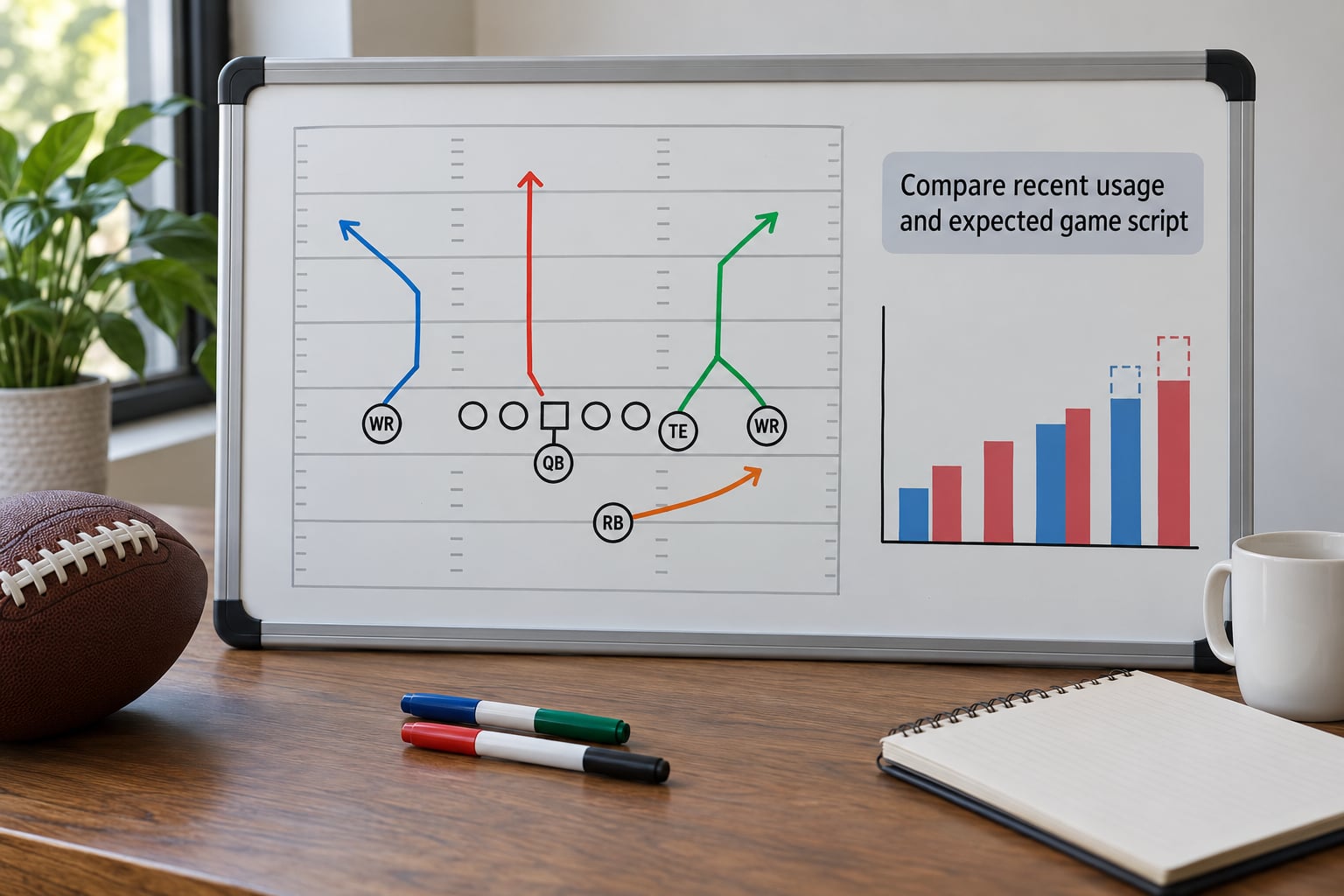
Now combine usage with the expected game script. Look at four consecutive weeks, not one. A single 28-point game means less than a trend of six, nine, eleven, and eight targets.
Game script changes what is possible. A team projected to trail will run more, hand off more, and attack the areas the defense protects. A favorite who leads by two scores in the fourth quarter stops throwing to the third string. Estimate the implied team total, then ask whether your player’s role is the kind of role that thrives in that environment.
Running backs are the clearest case. A back who carries the ball on early downs in a game the script expects to be close gets far more touches than a backup whose team is throwing 40 times. That single projection justifies more movement than any matchup rating.
One more useful cross-check: compare the opponent’s recent schedule. A defense that just faced two run-heavy offenses is likely to load up against the run this week. That adjustment cuts both ways, which is exactly why a one-week number should never drive a start on its own.
4. Factor in injuries, weather, and travel context
Give each external factor a weight before you apply it, or you will move a player on every rumor. A defensive back who is out and has no credible replacement on that side changes the matchup meaningfully. Rain matters for a player whose entire production is contested catches along the boundary and barely at all for a running back who only needs a short yardage.
A common mistake is treating every injury as equally important. Compare the replacement to the player he replaces. Losing a starting corner to a rookie who has not played a full season is a downgrade. Losing a nickel corner to a veteran backup is close to nothing.
Travel and short-rest weeks rarely move a projection enough to justify lineup changes, with one exception: a short-rest Thursday night game against a team that also played on a short week. At that point the offensive line is the thing to worry about, not the receiver.
If you only want one rule here, use this: adjust for injuries, adjust slightly for weather, and ignore travel unless the schedule itself is unusual.
5. Turn the matchup into a start, sit, or fade decision
Put the pieces together in a consistent order so the decision does not depend on which site you opened last. Start with the consensus projection, which already includes most of the above. Then apply the matchup as a modifier: a favorable one adds a point or two, an unfavorable one subtracts a similar amount. Then apply a volume filter before you commit.
The volume filter is the step most managers skip. If a player averages fewer than about five targets or fewer than about 10 touches per game, matchup movement should barely touch his projection, because there is not enough opportunity for a soft defense to matter. At that volume, start on talent and floor.
Then account for replacement options. The right question is rarely “is this matchup good” but “is this matchup better than the guy on my bench.” If both players sit at 7 projected points, the tiebreaker is the player with the workload that survives an ugly game.
Finally, check your roster rules. In a two-player flex league the calculus is different because you are picking from four positions rather than one, and in a super league with six flex slots, bench depth matters more than any single matchup edge.
Common Mistakes
The first mistake is anchoring on a single defender’s name. Knowing that a corner is elite tells you very little until you know that your receiver lines up on that side. The fix is to check the alignment chart every week rather than assuming a familiar matchup from a previous season.
The second is overreacting to one game. A 30-point explosion usually means the player got a heavy workload in a lopsided script, not that the matchup was uncoverable. The fix is a three-to-four week window with a note on how each game was played.
The third is ignoring team context entirely. A player on an offense that scores 12 points a week caps your ceiling no matter how soft his opponent is. Before you look at the defense, confirm the offense can actually get the ball.
The fourth is pretending blocking assignments produce fantasy points. A guard can win his matchup for four straight quarters and post zero fantasy statistics. Run-blocking grades are useful context for a back’s ceiling, but they are never a reason to start anyone.
The fifth is making decisions without checking your replacement options. Sitting a 15-point projection for a 6-point projection with a great matchup is a bad trade whenever something better sits on your bench.
The sixth is reading defensive and kicker matchups as if they were meaningful. Defenses score through turnovers and defensive touchdowns, both of which swing wildly week to week. Those matchup charts are noise dressed up as data, and treating them as a core of a lineup is a reliable way to lose weeks.
A seventh, quieter mistake: trusting season-long schedule projections published in the summer before games are played. Schedules get reshuffled, personnel changes, and offenses change their identity. Rest-of-season strength of schedule is worth a tiebreaker glance in August and almost nothing in November.
Frequently Asked Questions
What is a fantasy football matchup?
A fantasy football matchup is the pairing of your player against the defense he faces this week. The matchup rating estimates how favorable that opponent is for his position and role. Team ratings average every player who faced that defense, while coverage ratings look at one defender covering one receiver. Ratings are most useful when compared against your own player projection, never as a replacement for it.
Should I start the player with the better matchup or the better projection?
Start the better projection, then use the matchup as a tiebreaker. A projection already blends role, schedule, and expected games played. If two players are within a point or two of each other, the favorable matchup is a reasonable reason to take the one with the softer opponent. A large projection gap means something is structurally different, and the matchup usually will not close it.
How many games of data before you can trust a matchup?
Give a defense about four to six games before its matchup numbers stabilize. Early in the season, opponent strength swings several spots after a single unusual performance. Use the first month to establish roles and usage, then let defensive rankings settle. Until then, lean on player talent and workload, and treat schedule data as provisional rather than as a reason to change a lineup.
How do I read a WR versus CB matchup?
Find the baseline coverage assignment first, then check where your receiver lines up. A slot receiver is usually covered by the nickel defender, and an outside receiver by the boundary corner. Compare the corner’s coverage style, his allowed catch rate, and whether he plays press or zone. If the defensive scheme rotates that corner out of the game, the individual matchup matters far less than the team number.
Is strength of schedule a tiebreaker or a primary factor?
It works best as a tiebreaker between similar players, which is the view most fantasy football communities share. Schedule difficulty should adjust a decision between two players at the same tier, not justify starting a low-volume backup over a proven producer. In dynasty formats, season-long schedule planning is more valuable because it shapes trade values and roster building months ahead.
Conclusion
Start every week the same way. Identify the role, because opportunity decides the ceiling. Then check the coverage assignment, because that is the part of the opponent’s number that applies to your specific player. Only after that do you weigh game script, injury context, and your bench.
Matchup data works as a second opinion that sharpens a decision you were already leaning toward. When it contradicts a large projection gap, believe the projection. That single habit removes most of the bad decisions people make with these tools every Sunday.