The Hero RB strategy is a draft build where you take one elite, workhorse running back in the first round, then stop drafting running backs until the middle rounds. You fill rounds two through five with wide receivers, a quarterback and a tight end, then return to the position around round six for your RB2. That is the whole idea, and this guide covers how to pick the hero, when the plan breaks and what to do instead.
It is not a lazy version of Zero RB, which is what a lot of people say when they first hear it. The distinction matters, because the two plans produce very different rosters when the running back board does what it usually does in September.
Quick note on timing: this is a framework, not a target list. Player names go stale in a few weeks, so the criteria below matter more than any name I could print in 2026.
Table of Contents
- Hero RB Draft Strategy Explained: The Core Idea
- What Makes a Running Back a Hero Target?
- Workload share
- Passing-down usage
- Durability
- Scheme fit
- ADP value
- How to Build Hero RB Draft Tiers
- Hero tier: the one player who can carry the position
- Support tier: your RB2 candidates
- Depth and avoid tiers
- Hero RB Draft Strategy by Draft Slot
- Picks 1 through 4
- The turn, picks 5 through 8
- Picks 9 through 12
- How to Use Zero-RB and Hero RB Strategies Together
- How to Set a Target and Cutoff Before Draft Day
- How to Manage Risk in PPR, Half-PPR, and Standard Leagues
- PPR
- Half-PPR and 0.5 PPR
- Standard
- When Should You Draft the Hero RB?
- Common Hero RB Draft Mistakes to Avoid
- Frequently Asked Questions
- Is Hero RB better than Zero RB?
- What draft slot should I use Hero RB from?
- How do I pick my RB2 after taking a hero?
- What are the biggest risks of the Hero RB strategy?
- Does Hero RB work in Best Ball drafts?
- Is Anchor RB the same as Hero RB?
- Conclusion: Make the First Move
Hero RB Draft Strategy Explained: The Core Idea
Hero RB, also called Anchor RB, is a draft strategy where you take one elite running back in the first round and then hold off on running backs until the middle-to-late rounds. The single early back is expected to win the position outright, and every other round before your RB2 goes to a skill position that stays deep.
That is the definition to lift, and the rest of this page is the execution. Forum consensus lines up with it. On a Footballguys team-draft thread, the argument settled on one top-10 back followed by loading up on everything else, which is exactly what most managers end up doing whether they planned to or not.
Three terms show up in the same conversations and are worth separating now:
- Hero RB is the version above: one elite back early, then nothing until the middle rounds.
- Anchor RB is the same plan under a different name. Some writers use it for a milder version where the anchor can come in round two.
- Hero Player is the same logic stretched beyond running backs. Anchor a quarterback or tight end, then fill around him.
What separates a hero from just taking any first-round running back is concentration. A normal build takes a first-round back because the position is scarce. A Hero build takes one and then deliberately accepts a thin, volatile middle at the position in exchange for owning the top of it.
What Makes a Running Back a Hero Target?
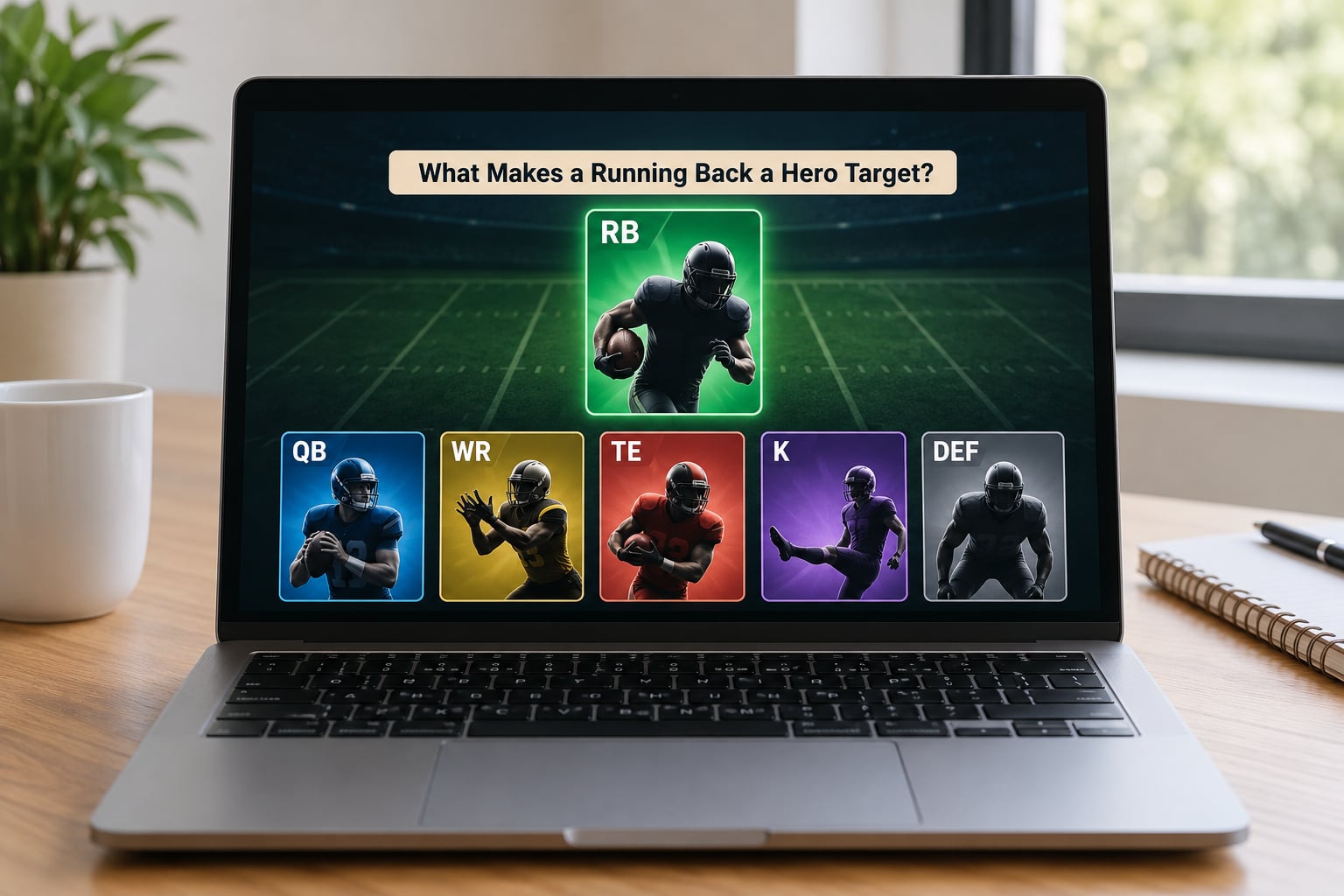
A good hero candidate is a player whose floor is high enough that the rest of your roster can be built on autopilot. I look at five things, in this order.
Workload share
Touches, carries and goal-line attempts inside the 20-yard line. A back who loses the end zone to a fullback is a committee back wearing a first-round price tag.
Passing-down usage
Targets per game and route share tell you what happens when the game script goes sideways. In PPR this is often the difference between a 15-point week and a 6-point week, and it is the single most underrated part of hero candidate profiles.
Durability
Games played over the last two seasons, not career totals. Look for a player who has missed time in consecutive years and decide in advance whether you are willing to write off that risk in one pick.
Scheme fit
Offensive line quality, coaching tendency and quarterback style. A back behind a mid-tier line in a pass-heavy offense gets volume, but volume without efficiency caps his ceiling.
ADP value
Where the consensus draft him versus where you have him. You are giving up roughly one receiver pick for this player, so the hero you want is usually the best back available rather than the best back on the board.
How to Build Hero RB Draft Tiers
Sort your eligible backs into four tiers before draft day so you are not deciding at the podium. Projected touches, red-zone opportunities, yards per touch and committee competition are enough to do it, and you do not need a paywall tool to build the list.
Hero tier: the one player who can carry the position
One or two names. Top-10 workload, real involvement in the passing game, no meaningful committee threat. If your list has five names in it, you have not graded the durability column yet.
Support tier: your RB2 candidates
These are the picks you will still be able to make in rounds six and seven. Committee backs with a defined slice of carries, strong receiving profiles and stable offensive lines belong here. So do the handcuffs of elite backs, and I will get into why that matters below.
Depth and avoid tiers
Depth tier players are your seventh-round dart throws and bench filler. Avoid tier means a name your league-mates want but you have no interest in, typically because the backfield is crowded and the role depends on injuries. Mark those names on your board so you never reach for one by accident.
One number makes the tiers feel real. In a recent scoring season, the top four PPR running backs all cleared 336 points while the group from roughly fifth through twenty-first clustered between 200 and 300. That is the whole economic case for a hero: one pick at the top of the distribution is worth more than three picks inside the middle of it.
Hero RB Draft Strategy by Draft Slot
The strategy is not equally good from every seat in the first round. Draft slot is the variable managers ignore most, and it is the one that decides whether the plan is executable at all.
Picks 1 through 4
This is where the plan is at its cleanest. You can take the best available hero on the board, still have the second-best receiver one pick later, and land your RB2 in a round where the board is genuinely uncertain.
The turn, picks 5 through 8
You will rarely get a true hero here, and pretending otherwise is how drafts get wrecked. A Heavy RB or Robust RB-style build, three backs by round four, fits the turn better because you are already behind on the top of the position.
You can still run a milder version: take the best running back on the board at your slot, treat him as your RB1, and plan to add a committee back as your RB2. It just is not the same bet, and calling it a hero pick inflates your confidence in it.
Picks 9 through 12
Do not force it. The hero tier will be gone, and the best remaining back is a player you are drafting on role speculation rather than workload. Take the best wide receiver available, because extra receiver picks are the cheapest value in a 12-team league, and build your running back depth late with committee players who have independent roles.
How to Use Zero-RB and Hero RB Strategies Together
Hero RB and Zero RB are not rivals. Hero RB is a modified zero build that starts at pick two, and once you are past your first-round back, the two plans tell you to do the same thing: keep taking receivers while the position is deep.
| Plan | Backs by round four | First WR taken | Where the second RB comes from | Core bet |
|---|---|---|---|---|
| Zero RB | None | Round one or two | Round six or later | The best receivers on the board |
| Hero RB | One, in round one | Round one or two | Round five or six | One true difference maker at RB |
| Robust RB | Three | Round one or two | Already taken | Committee volume that compounds |
The real cost of Hero RB versus Zero RB is about one receiver pick. That is the trade, and it is a good trade when the running back board produces one clear alpha. It stops being a good trade the year it does not, which is the argument you will hear on every forum when two of the top five backs go down in September.
Running back supply also thins in holes rather than gradually. On a 12-team board in a recent season there were two backs available in round seven and one in round nine, which is why round four matters so much for a Robust build and why waiting too long for an RB2 is the most common way a hero roster breaks.
How to Set a Target and Cutoff Before Draft Day
The plan fails when it lives only in your head during the draft. Write four numbers down beforehand and you are done thinking about it live.
- The hero name. One player, one number next to it.
- The reach threshold. The pick number past which you stop waiting. If your hero is available at 2.07, you take him at 2.07 and not at 2.10.
- The RB2 cutoff. The round after which you take the best available committee back even if your perfect target is still sitting there. Round seven is a common setting.
- The fallback. The best running back still on the board at your slot, named in advance.
When earlier players come off the board, the threshold is what keeps you calm. You are not deciding whether you like a player at 1.09, you are checking whether he beat the number you wrote on your cheat sheet. A round-six RB2 taken under a hero build typically carries a pick deviation somewhere in the 5-to-11 range, so plan for the player you get being slightly worse than the one you wanted.
Three six-round constructions are legal under a hero build if you want the template: 1QB/1RB/3WR/1TE, 1QB/1RB/4WR, or 1RB/4WR/1TE. In all three, at least half of your picks through round six are receivers.
How to Manage Risk in PPR, Half-PPR, and Standard Leagues
Scoring format changes which player makes a good hero, because it changes what the rest of your roster has to do. Run the same candidate list through three different settings and the top name does not always survive.
PPR
The friendliest format to this strategy. Target volume adds to a hero’s floor, and it also makes your RB2 selection easier because receiving work matters on every roster, not just the one with a difference maker. Most Hero RB drafts happen in PPR for a reason.
Half-PPR and 0.5 PPR
The hero needs both a rushing role and some passing involvement. A goal-line back with no targets is fine in a heavy RB league and a liability here, so weight receiving usage more heavily and be more skeptical of committee backs as your RB2.
Standard
This is the hard fit. Receivers carry less weekly value, so the argument that “extra WR picks are cheap” weakens considerably, and your RB2 needs a real share of carries. Standard scoring pushes most managers toward a Robust build with three backs by round four.
On injury risk, the honest framing is that a hero build is a variance play. It is not a safe play dressed up as a smart one, and managers who go in knowing that are far less likely to panic-sell in week three when something goes wrong.
When Should You Draft the Hero RB?
Run this checklist before you commit. If three or more answers come back no, pick a different plan.
- Do you pick inside the top four, with a genuine hero tier still available at your slot?
- Is your scoring format PPR or half-PPR rather than standard?
- Is your hero candidate’s projected workload based on evidence, not on last year’s highlights?
- Does your support tier have at least two committee backs with independent roles?
- Can you identify at least one handcuff or timeshare partner for your hero?
- Are you prepared to accept week-to-week volatility on your running back spot?
How many running backs should a hero roster own in total? Two starting plus one or two cheap flyers with upside. In a 12-team league that is enough depth to survive a bye schedule and one injury, without spending the mid-round receiver picks that made the strategy work in the first place.
Skip the plan entirely if you pick outside the top six, if your only hero candidate has a significant recent injury history, or if the round-six-plus running back supply on your league settings looks thin. Also skip it in auction drafts unless you are deliberately building a high-variance roster, since auction value is priced off the same consensus board you are trying to beat.
Common Hero RB Draft Mistakes to Avoid
These five mistakes account for most of the failed hero drafts I have seen.
- Chasing the name instead of the profile. Take the best back available in your hero tier, not the most famous one. Popularity is already reflected in the ADP you are trying to beat.
- Ignoring depth. If your support tier is empty, you are not running a hero build, you are running a one-player strategy with a hole behind it.
- Projecting workload without evidence. Preseason depth chart charts are not workload. Look for carries, targets and goal-line attempts from the prior season.
- Drafting multiple heroes. Double and triple hero builds have their own active threads and they are a different, riskier strategy. Do not drift into one by accident while chasing upside at the position.
- Reaching too early with no fallback. If the three players ahead of you all reach and you have no named fallback, you will take a name you have not graded.
And when the hero goes down mid-season, the salvage is straightforward: add the handcuff or the timeshare partner immediately, then work the waiver wire for a back with independent goal-line work rather than another committee member. A replacement needs a role of his own, not a share of a job that no longer exists.
Frequently Asked Questions
Is Hero RB better than Zero RB?
It depends on your slot. From the top four picks, Hero RB costs you roughly one receiver selection and gives you a real chance at the best back on the board, which is usually the better trade. From the turn or later, Zero RB wins more often because you would be settling for a back who is not clearly a hero. The forum consensus treats these as the same plan after round one, with the first pick as the only real difference.
What draft slot should I use Hero RB from?
Picks 1 through 4 is the cleanest range, because you can take the best available hero and still have the second-best receiver one pick later. From picks 5 through 8, a Robust RB or Heavy RB build fits better since you are already behind at the top of the position. From pick 9 onward, take receivers early and build running back depth late instead of forcing a hero target.
How do I pick my RB2 after taking a hero?
You have three options. A handcuff is safest in shallow PPR and gains value when the hero gets hurt. A committee back with a defined slice of carries offers more weekly floor. A late-round flyer on a backfield opening up gives you the highest ceiling and the least likely path to it. One practitioner described the round-three RB2 as the real decision point in a hero build, and that framing is accurate.
What are the biggest risks of the Hero RB strategy?
The concentration risk is the main one. A single injury to your hero leaves you with a thin, volatile middle at the position, and a 150-plus comment Reddit thread on this exact query is titled around that glaring issue. Second, your RB2 is usually a mid-round committee back with no stable role. Third, receivers taken in rounds two through five can be boom-or-bust, which compounds the week-to-week variance.
Does Hero RB work in Best Ball drafts?
Yes, and Best Ball is arguably the best setting for it, because you never manage the bad weeks and the variance is spread across a tournament roster. The top-end upside of a true workhorse is what wins championships, and the committee back you reach for at RB2 costs you nothing on a roster you will never manage. In a redraft league the same build requires you to actually survive the weeks your hero sits out.
Is Anchor RB the same as Hero RB?
For most practical purposes, yes. Anchor RB is the more common name for the same idea: one elite back early, then nothing until the middle rounds. Some writers use Anchor RB for a milder version where the back can come in round two, and the Hero Player variant applies the same logic to quarterbacks or tight ends. When a guide says Anchor RB, read it as Hero RB unless it says otherwise.
Conclusion: Make the First Move
The whole strategy comes down to preparation done before your league drafts. Grade every eligible back into hero, support, depth and avoid tiers, write down your hero name and the pick number where you stop waiting, and set an RB2 cutoff so round seven never becomes a coin flip.
Then check the disqualifiers honestly. Wrong draft slot, standard scoring, or a hero candidate with a bad recent injury history, and the answer is a Robust build with three backs by round four. Make the first move before the draft starts, and the rest of the board takes care of itself.