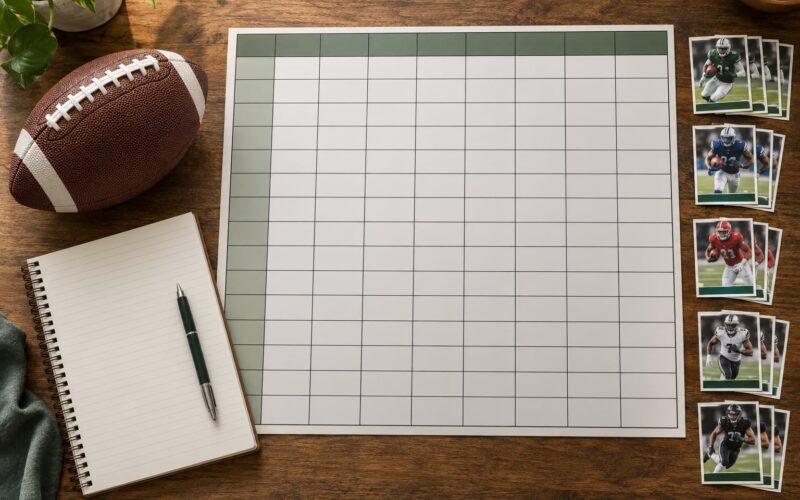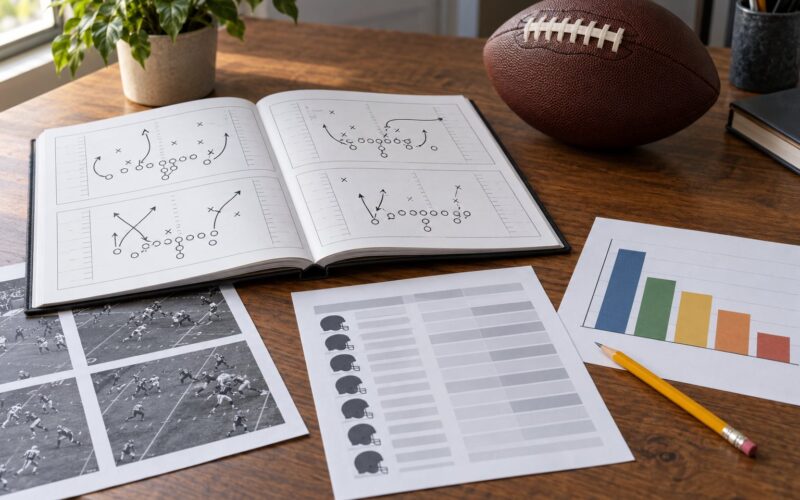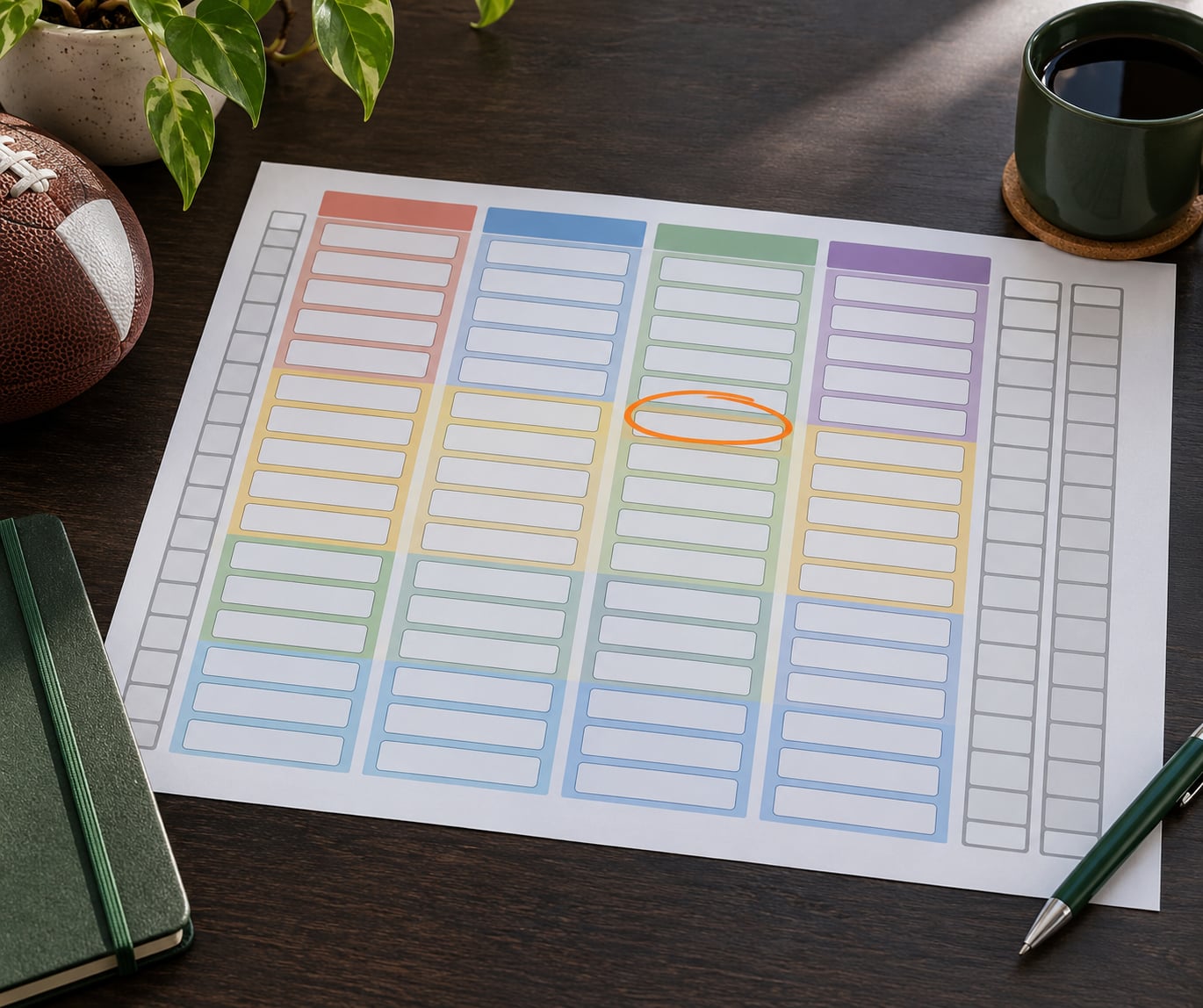
A fantasy football cheat sheet is one page that holds your rankings, your league’s roster rules, player tiers, bye weeks and your own notes, so you draft from a plan instead of four browser tabs. Building one takes about 90 minutes the first time and 20 minutes for every draft after that.
Worth saying up front, because the search bar confuses people: a cheat sheet has nothing to do with breaking the rules. It is the same thing as a draft board or a rankings printout. All it does is put your research in front of you in a form you can read in two seconds while the clock runs.
The mistake almost everybody makes is starting with the player list. Start with the league settings instead. The same 200 names get tiered differently in a points-per-reception league than in a two-tight-end superflex league, and the sheet has to match the league you are actually in.
Table of Contents
- What You Need
- How to Build a Fantasy Football Cheat Sheet: Step-by-Step
- 1. Confirm Your League Rules and Scoring
- 2. Create a Draft Board That Fits Your League
- 3. Group Players by Role and Draft Tier
- 4. Add the Matchup and Schedule Notes That Matter
- 5. Write a Quick Draft-Day Checklist
- 6. Proof and Print the Final Cheat Sheet
- 7. Common Mistakes When Building a Cheat Sheet
- Frequently Asked Questions
- Should a fantasy football cheat sheet be handwritten or typed?
- What information should be on a fantasy football cheat sheet?
- How long should a fantasy football cheat sheet take to make?
- Can I use the same cheat sheet for redraft, keeper, and dynasty leagues?
- How often should I update a fantasy football cheat sheet before my draft?
- Should I include player rankings on my fantasy football cheat sheet?
- Conclusion
What You Need
You need seven things on the table before you start assembling. Anything missing turns into a hole you discover at pick 47.
- The draft board your league actually uses, so your pick numbers and roster slots match what you will see on draft day.
- Your scoring rules, read from the league settings page rather than assumed from the site defaults.
- Roster requirements: how many starters at each position, how many flex slots, and which positions are eligible in each flex.
- Current player news — injuries, camp battles, suspensions and depth chart changes, dated.
- Bye weeks, which change what a good pick is in a playoff-relevant league.
- Team schedules and strength for playoff weeks, not just week one.
- A one-page output — a spreadsheet tab, a printable page, or a phone screen you can actually read at a glance.
The last one matters more than people expect. The best sheet in the world is useless if it scrolls across four screens while your league is on the clock.
How to Build a Fantasy Football Cheat Sheet: Step-by-Step
Seven short steps, in this order. Skipping ahead to the player list is how sheets end up wrong.
1. Confirm Your League Rules and Scoring
Open your league settings and write down the roster spots, the flex eligibility, the tiebreakers and anything custom. Every later decision depends on this page being accurate.
Scoring format is the single biggest driver of tiering. In PPR, a receiver catches passes, and volume matters enormously, so the drop between the top twelve wideouts and the next twelve is usually a cliff. In standard scoring, reception totals barely register, so wideout tiers flatten out and running backs gain value. Half-PPR sits in the middle, and most managers find it rewards the same player pool with less noise.
Also note whether your league is superflex. If you start a quarterback every week, quarterbacks move from a once-a-year position to a weekly one, and your sheet needs an extra quarterback column with its own tier break.
How you know this step worked: you could hand the sheet to a leaguemate and they would draft their own roster correctly from it.
2. Create a Draft Board That Fits Your League
Build the columns before you fill them. A cheat sheet that fits on one page needs about ten columns and no more.
| Column | What it shows | Why it matters on draft day |
|---|---|---|
| Rank | Your overall ordering | Gives the list a spine, but stop reading it literally past the first two rounds |
| Player | Full name, spelled as the league spells it | Misspellings cause search failures in the draft room |
| Position | QB, RB, WR, TE, K, DEF, plus flex eligibility | Flex slots decide what you can afford to reach for |
| Team | NFL team | Quick sanity check against your own league’s player pool |
| Bye | The player’s bye week | Turns a mid-tier pick into a liability in a playoff-relevant league |
| Tier | Tier 1, 1a, 1b, 2 and so on | The real decision unit. Players inside a tier are roughly equal |
| Tag | Target, sleeper, bust, avoid, breakout, handcuff | Your opinion, which no imported ranking set can supply |
| ADP | Average draft position across drafts | A value baseline, not a forecast. A big gap against ECR means value |
| ECR | Expert consensus ranking | Where the room expects a player to go, so you can fade or fade up |
| Notes | One short line per player | Your research, compressed into something readable mid-draft |
Two optional columns earn their place if you have room: an auction value column for salary-cap leagues, and a strength-of-schedule or offensive-line rank for the players whose production depends on the people in front of them.
The one-page limit is the real constraint. One r/fantasyfootball manager described cramming four separate ranking sources onto a single printable page covering 248 players with their byes, laid out as QB32 over TE32 on the left, running backs beside receivers in the middle, and defense over kicker on the right. That is the ceiling most people should aim for.
3. Group Players by Role and Draft Tier
A tier is a group of players at one position who are worth roughly the same. The decision that matters is which tier to pick from, not whether player 41 beats player 42.
Read a raw ranked list during a live draft and you will chase the player one row above your target. Read a tiered list and you see that the whole tier is available, which is exactly what you need when a positional run hits three picks early.
Three other terms come up constantly, so they are worth pinning down now. ECR is the expert consensus ranking, the averaged ranking of a hundred-plus fantasy analysts, which tells you where the room expects a player to go. ADP is the average draft position, the pick at which a player has historically gone, which is a value baseline rather than a forecast. VORP, value over a replacement-level player, measures the surplus a player adds over the last starter you could realistically get at his position — the level flex slots and injuries guarantee you access to.
Segment each position into four buckets, and keep the depth-chart competition bucket smaller than you think. Several positions have one clear number one and a very long flat tail behind him, which is exactly the shape that produces a bust.
- Realistic starters — players you would be happy to start every week.
- Rotation and depth-chart competition — guys sharing a backfield or a slot.
- Uncertain roles — players whose workload depends on camp or a coaching change.
- Low priority — deep fliers and players you will never draft.
Keep tiers on the same board as a column rather than a separate tab. A r/fantasyfootball spreadsheet maintainer ships both, and either works, but a column means you see the tier while you see the ADP, which is the whole point.
4. Add the Matchup and Schedule Notes That Matter
Schedule context turns a flat list into a draft plan. Three notes carry most of the value: the bye week, the strength of the player’s team in playoff weeks, and the competition for touches on his own offense.
Bye weeks are the one most guides skip and most real sheets include. A receiver with a bye in week 6 is a different pick than an identical receiver with a bye in week 14, and in a league that seeds on record the difference is real money.
Be careful with precision here. Writing projected fantasy points next to a name implies a confidence you do not have, and stale numbers are worse than no numbers. Round to a range, date every note, and delete anything you cannot source.
One r/fantasyfootball thread is a good example of the instinct to chase: someone added offensive line rank, strength of schedule, player props and a boom-or-bust outlier flag to a free sheet. Those columns are useful if you know how to read them. They are noise if you cannot.
5. Write a Quick Draft-Day Checklist
The sheet carries the data. A short checklist carries the decisions. Keep it to the top or the margin, about six lines:
- Biggest roster need at my next pick
- Players I will not draft above a specific round
- The ADP gap I am hunting for — where I think the room is wrong
- My drop-off point at each position
- Players to avoid at any cost
- The fallback if a positional run kills my plan
Run two or three mock drafts on the same league before the real one. The point is not to see who falls to you, it is to catch your own blind spots: a sheet that looks sensible until you notice you have no late-round tight end plan at all. Draft on your phone while you do it, because that is where the legibility problems show up.
Write the fallback line first. Every draft has a moment where your board says one thing and the room is doing something else, and the managers who recover are the ones who already decided in advance what they will do instead.
Last thing for the checklist: name the two players you would be happy to take 30 spots later than consensus. Those are the reach-ins that decide a draft, and they are the easiest names to forget at pick 90 when you are staring at a wall of tight ends.
6. Proof and Print the Final Cheat Sheet
Print it before draft day, hold it, and read it at arm’s length. If you cannot find the tight end column without hunting, the layout is wrong.
The standard trick for forcing one page is to set the print area explicitly, scale to fit one page wide by one page tall, then use print and save as PDF. That is how the 248-player sheet stays legible instead of spilling onto a second page.
On the question everyone is actually asking — do I still need to print anything when my league has a built-in draft board — the honest answer is yes, but for less than you think. Keep the sheet on a phone or tablet as a second screen and skip the printer entirely if you are comfortable reading a small screen. What you cannot skip is having your tiers and tags in front of you somewhere, because the league app will show you the board and will not show you your notes.
7. Common Mistakes When Building a Cheat Sheet
Information overload. Twenty columns, six tabs and a formula per cell is a research project, not a draft aid. Fix: ten columns, one page, everything else lives in a second tab you never open live.
Rankings without context. A raw overall rank treats player 41 and player 44 as meaningfully different. They usually are not. Fix: tier them together and let the tier break carry the decision.
Ignoring league settings. Default platform rankings assume standard scoring and a normal flex. In superflex, IDP, two-tight-end or first-down scoring leagues, that default is simply wrong. Fix: import a ranking set built for your format, or generate your own from projections.
Stale injury news. An undated note is worse than a blank cell. Fix: put a date next to every news note and wipe anything older than a week during draft season.
No plan for positional runs. When running backs go in the first three picks, a sheet with no fallback produces panic. Fix: pre-decide your drop-off point per position.
Overriding projections by hand. Editing the wrong cell in a projection spreadsheet breaks formulas silently and the whole sheet goes wrong later. Fix: if a sheet uses color to mark editable cells, respect the color, and never retype a formula you did not write.
One caution about community spreadsheets: they are excellent, and they are often built for exactly one program. A widely shared Google Sheets draft board carries a literal warning not to open it in Excel, because the formatting does not survive. Know which tool you are in before you start editing.
Frequently Asked Questions
Should a fantasy football cheat sheet be handwritten or typed?
Typed, almost always. A typed sheet can be re-sorted when news changes, printed on one page, and searched mid-draft for a player name in seconds. Handwriting works if you draft offline or on paper and it keeps you from tab-switching, but it cannot be updated once injury news lands the morning of your draft.
What information should be on a fantasy football cheat sheet?
Ten fields cover it: rank, player, position, team, bye week, tier, your tag, ADP, ECR and a short note. The tier, tag and note columns are the ones no imported ranking set can give you, so they are the reason to build your own. Add an auction value column only if your league is salary cap.
How long should a fantasy football cheat sheet take to make?
Budget 60 to 90 minutes the first time, mostly spent reading your league settings and tiering each position. After that, a refresh takes about 20 minutes: update ADP, swap in current injury news, re-check the top two tiers. If it takes more than two hours the first time, you are building a research system rather than a draft sheet.
Can I use the same cheat sheet for redraft, keeper, and dynasty leagues?
Yes, if you keep league-specific data on a separate tab or column. Player names, tiers, ADP and notes carry across all three. What changes is the pool: for a keeper league cross off players already kept, and for dynasty weight long-term upside, age and opportunity over single-season projection.
How often should I update a fantasy football cheat sheet before my draft?
Twice is usually enough: a full build two to three weeks out, and a refresh two or three days before your draft. Draft season moves fast, so check for injury news in the day before. Any note older than a week should be deleted rather than left in place, because an undated note reads as current when it is not.
Should I include player rankings on my fantasy football cheat sheet?
Yes, but as tiers rather than a strict 1 through 200 list. Rankings set the order; tiers tell you where the real drop-off sits and which players are interchangeable. Keep the numeric rank as a column so you can reference it, but draft from the tiers, and treat ADP as a value baseline rather than a forecast.
Conclusion
Start with one action before you look at a single player name: write down your league settings, then decide which ten fields go on the page. Build a blank template with those columns, print it at one-page scale, and check that you can find any position in a second.
Fill it in during the last two weeks before your draft, re-tier after the final injury news, and draft from the tiers with ADP beside them. That is how to build a fantasy football cheat sheet that earns its place at the draft table.