Value based drafting ranks every player by the projected fantasy points they produce above a realistic replacement-level option at their own position. Projected points minus replacement points equals VBD value, and that gap is what makes a tight end comparable to a running back.
I have run the same method in a 12-team PPR league for years, and the version I use every draft is not the complicated spreadsheet people describe online. It is one subtraction, applied to every player on a board, with the baseline set to my own league size and scoring. Once you see the math work, the acronyms stop mattering.
Core concept
- The formula: projected season points minus replacement-level points at that position equals VBD value.
- The baseline: the projection of the last realistic starter at that position across your league — usually someone you would end up grabbing off the waiver wire.
- The goal: take the player with the biggest remaining gap, which means you are buying a positional advantage rather than a name.
Why it matters
- It removes positional scarcity from the decision and replaces it with a number you can check.
- It shows you which positions the board is undervaluing right now, not which position went cold three rounds ago.
- It adapts to your league settings. The same player is worth more in a superflex league and less in standard.
Table of Contents
- What Is Value Based Drafting in Fantasy Football?
- What the replacement level actually means
- What VBD is not
- Why Value Based Drafting Changes the Way You Draft
- How to Calculate Fantasy Football Player Value
- Step 1: get a projection for every player
- Step 2: set a replacement baseline for each position
- Step 3: subtract, then rank everyone by the remainder
- A replacement level cheat sheet by league format
- How to Build a Value Based Draft Board
- How to Find Players Who Will Outperform Their ADP
- Use variance deliberately, not accidentally
- How to Find Players Worth Avoiding in Every Round
- Value Based Drafting Example: A Full Round-by-Round Strategy
- How to Use Value Based Drafting in Redraft, Keepers, and Dynasty Leagues
- Common Value Based Drafting Mistakes
- The honest criticism: is value based drafting outdated?
- Where value stops working
- Frequently Asked Questions
- What is the difference between VBD and ADP?
- Is value based drafting better than ADP?
- Is value based drafting too complicated for beginners?
- How does league size change player values in value based drafting?
- What is VBD and how is it different from Zero RB?
- What is VORP in fantasy football?
- Conclusion: Start With One Value Target Each Round
What Is Value Based Drafting in Fantasy Football?
Value based drafting is a ranking method, not a roster-building strategy like Zero RB. It takes each player’s season projection, subtracts the projection of the replacement-level player at that position, and ranks everyone by what remains. A quarterback projected for 380 points in a league where the replacement quarterback goes for 240 has 140 points of value. A wide receiver projected for 250 in a league where the replacement receiver goes for 195 has 55. That is the whole idea.
Why bother? Because raw point totals across positions are close to meaningless. A 240-point tight end in a standard scoring league and a 240-point running back are not the same asset. They come from different distributions of outcomes, they are hit by injuries in different ways, and the pool of people who will outperform the low projection looks completely different for each. Subtract a position-appropriate baseline and you are comparing what the player gives you above the guy who replaces him in your lineup three weeks from now.
What the replacement level actually means
The replacement level is the projection of the weakest player who still starts in your league. Not the worst player on the roster, and not the last guy drafted. In a 12-team league, twelve quarterbacks start. If your league adds a superflex spot, a few more start or become starter-equivalent. The replacement-level quarterback is therefore the guy ranked around 14th to 17th at the position in your scoring system — and he is a real player you could realistically add in October, not a theoretical zero.
That last detail is why VBD matters in practice. Drafting someone who projects at replacement level gains you nothing, because the waiver wire will supply that production for free. Drafting someone far above replacement gives you a cushion that shows up in points, not just in rankings.
What VBD is not
It is not an auto-draft setting, it is not a projection system, and it does not replace your rankings. Projections come from consensus sources; VBD is a way of layering your league’s settings over the top of them. It also does not tell you who is the best player. It tells you who gives you the most value relative to their expected draft price, which is a different question and often produces a different answer.
Why Value Based Drafting Changes the Way You Draft
The mental shift is small and it changes everything downstream: stop asking “who is the best player available” and start asking “who is the best value available.” The first question sends you to the top of the board every time. The second sends you to the top of the board minus the players whose price is already locked in.
Here is the timing effect. In the first three or four rounds, almost every player has a reasonable ADP and the value gaps between positions are enormous, so value and ADP usually agree. By the middle rounds, the board has been picked clean in some positions and untouched in others, and the two signals start pointing at different players. Value says take the running back nobody wants at pick 41. ADP says wait. Taking him at 41 is exactly how a draft is won or lost, and it only works if you decided in advance that you would trade early-round certainty for mid-round value.
Players on r/fantasyfootball tend to describe the method the same way, and I think the phrasing is right: value based drafting is about buying a positional advantage. You are not trying to identify the league’s best team. You are trying to end up with better players than the guy drafting across from you at every position, which usually means going away from the consensus order exactly once per round.
How to Calculate Fantasy Football Player Value
The calculation is three steps and it takes about ten minutes with a spreadsheet, or zero minutes if a tool does it for you.
Step 1: get a projection for every player
Use one consensus projection set for the whole league. Mixing sources creates noise, because a five-point difference between two projection systems is a modeling difference, not an insight. Sort by position so each baseline lines up with the right group.
Step 2: set a replacement baseline for each position
Estimate the projection of the last starter at each position in your league. Multiply teams by starting slots, add the flex and superflex contribution, and accept that the answer is an estimate rather than a fact. Consistency matters more than precision here.
Step 3: subtract, then rank everyone by the remainder
Here is a worked example from a 12-team PPR league with a superflex spot. Projections are per-season and the baselines reflect that league’s settings, so anyone can reproduce the arithmetic.
| Player group | Projected points | Replacement baseline | VBD value |
|---|---|---|---|
| QB1 | 385 | 245 | +140 |
| TE1 | 235 | 140 | +95 |
| WR1 | 285 | 200 | +85 |
| WR3 | 262 | 200 | +62 |
| RB2 | 250 | 180 | +70 |
| WR12 | 205 | 200 | +5 |
| RB18 | 190 | 180 | +10 |
TE1 projects 50 fewer points than WR1 and is worth 10 more. That looks wrong until you look at the middle of the list, where the tight end drop-off is far steeper than the receiver drop-off. Six more tight ends project below 140 points, which means the guys drafted after him are considerably worse. Raw totals cannot show you that. The subtraction can.
The bottom two rows matter too. WR12 and RB18 are not bad players, but they project barely above the replacement line, so they are worth about as much as the waiver wire will give you in October. Drafting a RB18 over a QB1 is the exact mistake VBD exists to prevent, and it is a mistake that happens in drafts every single year.
A replacement level cheat sheet by league format
These are approximate baselines for a typical scoring setup, not gospel. Scoring changes them, and flex eligibility moves them more than most people expect. Use them as a starting point, then adjust.
| League format | QB | RB | WR | TE |
|---|---|---|---|---|
| 12-team superflex PPR | ~QB16 | ~RB36 | ~WR48 | ~TE13 |
| 12-team PPR | ~QB13 | ~RB33 | ~WR45 | ~TE12 |
| 12-team half-PPR | ~QB13 | ~RB30 | ~WR38 | ~TE11 |
| 10-team standard | ~QB11 | ~RB25 | ~WR30 | ~TE11 |
| 8-team standard | ~QB9 | ~RB20 | ~WR25 | ~TE9 |
Two things jump out. Superflex pushes the QB baseline down dramatically, which inflates every quarterback’s value. PPR pushes both RB and WR baselines deeper, which compresses running back value and lifts receiver value. If your baseline came from a standard league chart and you play PPR, your board is quietly mispricing half your roster.
How to Build a Value Based Draft Board
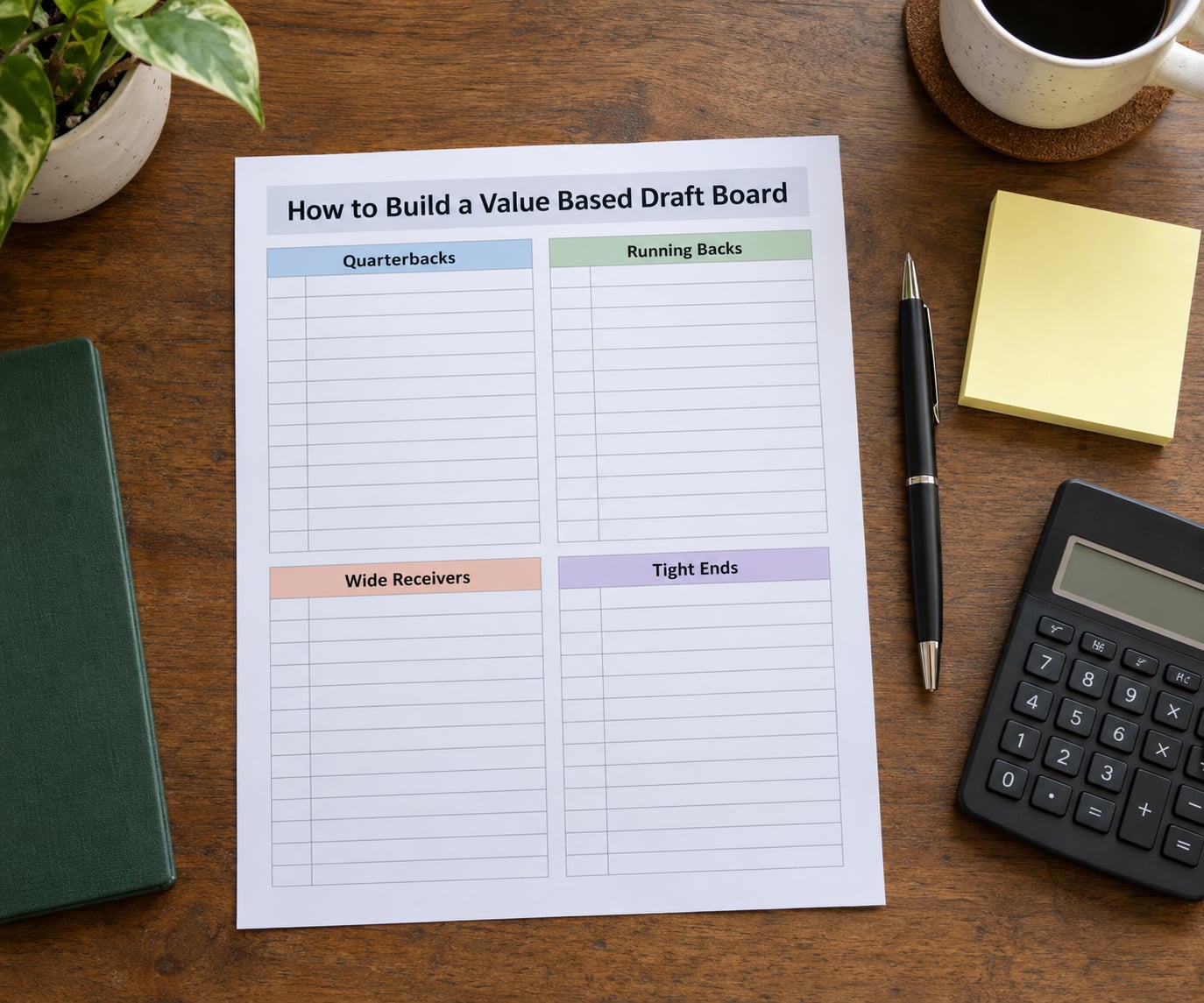
A board is just a sorted list, and you already have all the pieces. What you do not have is the layering order. Here is the order I use.
- Start with consensus ADP. Not because ADP is the answer, but because it tells you where the market expects each player to go, and every value decision you make is a disagreement with that expectation.
- Overlay your own tier grouping. Inside a tier, players are close enough in value that you should prefer the one with the safer role, the better schedule, or simply the one you are more confident about. Sorting inside a tier by decimal places is fake precision.
- Adjust for league settings. Add a flex spot and receivers gain; add two starting quarterbacks and quarterbacks gain sharply.
- Reorder by VBD value, keeping tiers intact. A tiered VBD board where tiers have not been destroyed by a two-point difference is the version that survives contact with a live draft.
- On the clock, take the highest value in the top surviving tier that is still available. One player, one round. Then let the board fall back toward ADP for the picks in between.
That last rule is what makes this manageable. Trying to run pure VBD down to the final pick means recalculating every baseline after every selection, because each pick changes who is available and, in the aggregate, where replacement sits. That is not practical in a 60-minute draft. Taking one value target per round is a deliberate simplification that captures most of the benefit for a fraction of the effort, and most of the people doing this well are doing exactly that.
If you want to skip the spreadsheet, FantasyPros publishes VBD rankings you can match to consensus ADP and sort by the difference. The important part is that you set the scoring format to match your own league, because a VBD list built for standard scoring is not a VBD list for your PPR league.
How to Find Players Who Will Outperform Their ADP
A player is underpriced when his expected production is higher than the board assumes, and that almost always traces back to opportunity rather than talent. Look for three things.
First, role stability with volume. A receiver who is a clear first or second option on the depth chart is going to get targets no matter what the box score says in October. Second, age and trend curves, mostly to avoid rather than to target: a player the market is fading because of a down year is often faded correctly, but one fading because of a single injury season is frequently faded too far. Third, a floor that the projection understates, which happens when a player has quietly improved his route share or efficiency in a way the model has not fully caught up to.
Where a breakout projection is realistic, you get a specific combination: a young player, an expanded role with no competition for it, and a baseline the market set too high. Where it is not realistic, you get a veteran losing snaps to a rookie. The same raw projection means completely different things in those two situations, which is why role information matters more than stat corrections when you are hunting for ADP steals.
Use variance deliberately, not accidentally
Pure expected-value math undervalues high-variance players, because a boom-or-bust profile looks identical in projection and much better or much worse in reality. That is a real limitation, and the correction is to take a controlled amount of it. Pick one or two high-variance players per draft at positions where the board is already deep, and accept that you will miss more often than you hit. Chasing upside is fine as a side dish. Making it the whole strategy is how you end up with three tight ends.
How to Find Players Worth Avoiding in Every Round
The mirror image of value hunting is knowing which players to leave on the board even when they look good.
- Elite production already priced in. A player the board has marked as a top-10 pick needs to be genuinely elite. If the only path to that value is a full 17-game season plus a leading role, the downside is severe and the draft cost is set. Some of the best picks in this category come after the price has already been paid by somebody else.
- Unstable roles. Committee backfields, shared target splits, and quarterbacks whose job depends on a holdout not happening. Projections assume the role holds; rosters change without notice.
- Zero floor above replacement. Players whose bad-case season is the replacement baseline. You paid a draft slot and got nothing back.
- Buy now or wait traps. A player whose ADP is only a pick or two above where you are sitting. If he falls to you, the cost is already sunk, so wait. Do not spend a pick on a two-spot reach.
You also learn to ignore players whose value comes entirely from an injury helping them. That upside is real, but it is not projectable, and treating it as a reason to move up a spot is a coin flip with your pick number attached.
Value Based Drafting Example: A Full Round-by-Round Strategy
Here is how the method plays out in a 12-team PPR league with a superflex spot, drafting from pick 3.04. ADP figures are round picks from a consensus board, and the value column comes from the arithmetic above.
| Round | Board signal | Value target | Pick made | Why |
|---|---|---|---|---|
| 3.04 | TE1 ADP 3.06 | +95 | TE1 | Highest value available and the ADP is close enough to reach. This is the buy-now pick. |
| 4.01 | WR1, WR2, RB1 gone | +62 | WR3 | ADP said 2.09, so there is no reach cost. Still the best gap on the board. |
| 4.11 | RB2 ADP 2.06 | +70 | WR5 | RB2 is a bigger value but sits inside the WR cliff this late. Take the reachable value instead. |
| 6.01 | RB2 still available | +70 | RB2 | Eighteen picks of drift made him cheap. Biggest gap on the board at a price worth paying. |
| 6.09 | RB3 ADP 4.07 | +66 | RB3 | Second consecutive value pick is fine when both are at reach prices. |
Notice that rounds 1 and 2 held no value picks at all, and round 5 held none either. That is normal. The value gaps early are enormous but the prices are equally enormous, so you take the best player the board offers. Value picking earns its keep in the middle, when the board has fragmented and the consensus has not yet adjusted.
The RB2 decision at 6.01 is the whole strategy in miniature. At pick 3.04 he was a stretch of six rounds and not worth it. At pick 6.01 he was the largest gap on the board at a price most managers had stopped wanting him at. Same player, opposite decision, because the price changed and the value did not.
How to Use Value Based Drafting in Redraft, Keepers, and Dynasty Leagues
Redraft leagues are the pure case, and everything above applies directly. Baselines come from your league size and scoring, and you recalculate them in the offseason because last year’s replacement level is only a starting point.
Keepers and dynasty startups change one thing: the replacement level is no longer about the draft alone. Any player who might hit the waiver wire is part of the baseline, including the good ones your league mates keep. If two owners keep the last two starting tight ends, your replacement tight end is the 15th player at the position rather than the 12th, and every tight end on your board gains value. That is a real, cheap edge in a league where nobody does the arithmetic.
Dynasty leagues need a longer clock, and a one-year VBD score is only the first term. A 22-year-old running back projected at 250 points may be worth far more than a 27-year-old projected at 290, because the young one has four productive years and the older one has two. Most dynasty drafters run the same subtraction and then add a longevity multiplier by age band, which is crude but far better than ignoring age. If you want the deeper treatment, run the same subtraction across a four-year window and add the totals.
Auction drafts use the same math with the currency changed. The replacement level becomes your floor price for each position, since anything above the floor is where you win the auction. Best ball uses the same math too, with one important twist: because you never know which team scores, you want players with the highest realistic ceiling, and pure expected-value ranking underweights that. Take the highest VBD value early, then loosen the rule after round eight and prefer upside.
League size matters more than most beginners expect. In an 8-team league the baselines are shallow, so every starter is genuinely valuable and there is less value in the late rounds. In a 16-team league the baselines are deep, so there is almost no value at all after round 12. Setting your baseline wrong by a few spots in a small league will send you to the wire for a starter, and that mistake shows up in your record in October.
Common Value Based Drafting Mistakes
Drafting a fixed position order. If your board says RB, WR, WR, WR, RB every single round, you are not using value; you are using a template. Value picks land wherever the biggest gap is, including two tight ends in four rounds if the board says so.
Chasing the highest raw projection. This is the most common failure and it produces exactly the outcome VBD was built to prevent. A 265-point receiver who is a replacement-level receiver is worth less than a 220-point tight end who is not.
False precision. Two players with VBD values of 71 and 73 are the same player as far as you are concerned. Break near-ties with role, age, and schedule, and stop trying to find the exact right answer between two options you cannot separate.
Ignoring updated news. A VBD board built in July is wrong by September. Depth chart changes, injuries, and coaching hires all shift projections, and stale numbers are the fastest way to build an argument on sand.
Treating every analyst ranking as equally reliable. Consensus ranking differences of a spot or two are noise. Differences of fifteen spots mean somebody is making a genuine, checkable claim about role or opportunity. Weight the former lightly.
Trusting a black box completely. If you cannot explain why a tool ranks a player where it does, you cannot tell when it is wrong. Know the baseline it used.
The honest criticism: is value based drafting outdated?
There is a real contrarian case, and it deserves a straight answer rather than a dodge. The argument goes that VBD is a projection-dependent method dressed up as mathematics, that its replacement baseline is a subjective choice someone made in a spreadsheet, that the precision it implies is fictional, and that a pure expected-value approach structurally ignores boom-or-bust upside.
All four of those are fair. Here is my read after years of comparing drafts run both ways. VBD is a comparison layer, and a comparison layer is only as good as the projections underneath it. If your projections are bad, subtracting a baseline will not save the board. The baseline is a judgement, and different analysts set different ones, which is why values from two sites are not directly comparable. The precision is an illusion at the margins. And the upside blind spot is genuine.
What the criticism misses is that a draft has to be made under uncertainty anyway, and VBD is a better way to be uncertain than consensus order is. Consensus ADP also has a subjective baseline baked in; it is just hidden inside an average of thousands of drafters, which makes it no more objective, only less inspectable. So the fair verdict is that VBD is a strong default method that needs sane judgment layered on top. Use it. Do not follow it literally. And never let a six-point value gap on a spreadsheet decide a pick you have a real reason to hate.
Where value stops working
Late rounds. In rounds 12 through 16, the replacement player is not an undrafted free agent, it is a waiver wire pickup, and waivers behave differently from drafts. Teams add players at the drop, and the player you are drafting is competing with a dozen managers for one roster spot. VBD’s clean logic degrades there, and the sensible move is to switch to role, age, and opportunity rather than keep subtracting from a baseline that no longer describes the real market.
There is also the calculation-on-the-fly problem, which comes up more than any other objection from people drafting in real leagues. Recomputing every baseline after every pick is not realistic, and the forum consensus is that nobody really does it. That is why one value target per round works so well. You do the math once, take the one pick per round where value and price disagree, and draft the rest on your rankings and your read of the board.
Frequently Asked Questions
What is the difference between VBD and ADP?
ADP tells you where thousands of drafters expect a player to be taken. VBD tells you how many projected points a player adds above the replacement-level option at his position. ADP is a market average and moves with public opinion; VBD is a calculation built from your league size and scoring. VBD wins when the two disagree, because that gap is your edge.
Is value based drafting better than ADP?
Neither is better on its own; they answer different questions. Use ADP to know where the price is and VBD to judge whether that price is fair. If you take the highest VBD score every round you will reach too often, and if you follow ADP exactly you are drafting a popularity contest. The workable approach is one value target per round and ADP-based drafting everywhere else.
Is value based drafting too complicated for beginners?
Not if you skip the jargon. You need one consensus projection list, one replacement baseline per position, and a subtraction. The VORP and VONA vocabulary exists because analysts needed names for different baselines, not because beginners have to learn them. A spreadsheet with two columns and a sorted list is a complete VBD setup, and most of the method comes from setting the baseline honestly.
How does league size change player values in value based drafting?
Smaller leagues have shallower baselines. In an 8-team standard league, roughly 8 to 10 quarterbacks, 20 to 25 running backs and 25 to 30 receivers start, so replacement level sits much higher and almost every starter has real value. In a 16-team league the baselines sit much deeper, which means late-round picks are close to worthless. Always set the baseline from your own league size before ranking anyone.
What is VBD and how is it different from Zero RB?
VBD ranks every player by projected points above the replacement level at their position, no matter which position that is. Zero RB is a roster construction strategy: go so light at running back that opponents must pay up for theirs. The two can be used together, but they pull in opposite directions, because a strategy that deliberately avoids one position depends on that position being scarce. Decide the construction first, then let VBD rank within it.
What is VORP in fantasy football?
VORP stands for Value Over Replacement Player and means the gap between a player’s projected points and the projection of the replacement-level player at that position. It is the core unit of value based drafting. Related terms measure against different baselines: VONA measures against the next available player at the same position, and value over last starter measures against the weakest player who still starts. All three are answers to slightly different versions of the same question.
Conclusion: Start With One Value Target Each Round
Value based drafting means ranking every player by projected fantasy points above a realistic replacement-level option at their own position, so players at different positions can finally be compared honestly. Pick a baseline for each position using your league size and scoring, subtract, and let the gap do the work.
You do not need to run it perfectly. Before your next draft, mark one player per round where the value gap and the ADP disagree most, and take that player if he is still there when you are on the clock. Everything else can follow your normal board. That single habit is worth more than any spreadsheet.