
A workhorse running back in fantasy football is a running back who absorbs nearly all of his team’s backfield work, usually averaging 20 or more touches per game and 60 percent or more of his team’s carries. That concentration of early-down snaps, goal-line carries and checkdown targets is what creates a predictable weekly floor.
It is a role, not a talent grade. Plenty of workhorses are average runners with clean blocking assignments and no special teams work, and the label describes workload rather than ability. If you have been reading fantasy talk and nodding along without being sure what the phrase means, this guide sorts the vocabulary out and gives you numbers you can check before the season starts.
Table of Contents
- What Is a Workhorse Running Back in Fantasy Football?
- How to Identify a Workhorse Running Back
- Why Teams Use a Workhorse Running Back
- What Fantasy Statistics Make a Back a Workhorse?
- What Is a Workhorse Running Back in Fantasy?
- Does the Role Score Differently in PPR Than in Standard?
- How Is a Workhorse Different From a Committee Back?
- Is More Rushing Production Always Better for Fantasy?
- How to Draft a Workhorse Running Back
- How to Start a Workhorse Running Back Each Week
- What Are the Main Risks of Targeting a Workhorse?
- Fantasy Football Terms You Need to Tell These Roles Apart
- Frequently Asked Questions
- What is the difference between a fantasy football workhorse and a bell cow?
- How many carries per game make a running back a workhorse?
- Does a workhorse running back need receiving targets to be fantasy reliable?
- Are injury-prone running backs still worth drafting as workhorses?
- Should I always start a workhorse running back in fantasy football?
- What is the best way to project a workhorse running back for fantasy?
- Conclusion
What Is a Workhorse Running Back in Fantasy Football?
What is a workhorse running back in fantasy terms? It is a back whose team has built the offense around him, so almost every meaningful snap that a running back plays belongs to him. When one player owns that workload, you stop guessing at weekly projections and start reading a role chart instead.
The word gets used loosely, so it helps to anchor it to three measurable things: touches, carry share, and durability. Volume gives you production. Carry share tells you how much of that production survives a rotation. Durability tells you whether the whole thing lasts sixteen weeks.
| Profile | Typical weekly volume | What it does to your fantasy season |
|---|---|---|
| True workhorse | 20+ touches, 60%+ of team carries | Steady baseline you can build a roster around |
| Committee back | 10-15 touches, split by situation or down | Boom-b weeks, floors that vanish in a bad matchup |
| Injury-prone rusher | 20+ touches when healthy, 6-8 games played | High ceiling, replacement value you cannot schedule around |
Notice that the third row is not a different role. It is the same workload with a durability problem attached, and the problem is what fantasy managers most often regret ignoring.
How to Identify a Workhorse Running Back
You identify a workhorse by combining signals, not by reading a single stat. Total rushing yards is the number that fools people most, because a committee split can produce a handsome total while a genuine workhorse gets erased by an early injury.
The signals that hold up, in rough order of usefulness:
- Carry share. His share of the team’s carries, not the league’s carries. Anything near 60 percent means the plan does not have a built-in reason to take the ball away.
- Goal-line and short-yardage work. Red zone carries turn into touchdowns, which is where weekly floors come from.
- Early-down carries. First and second down rushing attempts are the volume that fantasy scoring actually pays for.
- Pass protection reps. A back who stays in on third down is a back the offense is not ready to replace.
- Offensive snap share above 80 percent. This is the cleanest public confirmation, because it counts snaps rather than coaches’ intentions.
- Absence of a designated backup. Teams do not trade a first-round pick for a player they plan to rotate.
A concrete example: a back who finishes a season with 240 carries, 41 receptions and 1,100 yards is a workhorse when those 240 carries were concentrated in the first half of every game, inside the 20, and on snaps where the offense needed a run. The same yardage spread evenly across four backs describes a committee, and your weekly expectations should be completely different.
Why Teams Use a Workhorse Running Back
Coaches lean on one back because a run game built around a single runner is easier to install, easier to disguise and easier to adjust. Blocking assignments get consistent, the play-action game stays honest, and the quarterback has one protection scheme to remember on pass downs.
There is a matchup argument too. Handing the ball to one back against a front that loaded the box, or running play-action with a runner who threatens the linebacker level, is cheaper than moving five pieces on every snap. Add reduced defensive preparation and you get the modern bell cow revival, where offense wins before the first snap is thrown.
For fantasy managers the part that matters is simple: production follows opportunity. Coaching intent is a decent leading indicator, but touches are the thing that actually scores you points, and intent gets overruled by a fumble, a blown assignment or a scripted two-minute drill.
It is worth knowing that the role is not new, and that it has been out of fashion before. Running backs dominated the fantasy landscape through the 2000s, when a 300-carry season was treated as the default expectation at the position. The 2010s brought the committee era, and plenty of experienced managers still dismiss the phrase as a relic from before pass-heavy offenses became normal.
That dismissal no longer fits. The current NFL has rebuilt the case for a featured runner, with offenses that want a checkdown threat, a play-action threat and a pass-protection option all coming from the same player. The term now means roughly what it used to, which is why a search for the definition still turns up pages written a decade apart.
What Fantasy Statistics Make a Back a Workhorse?
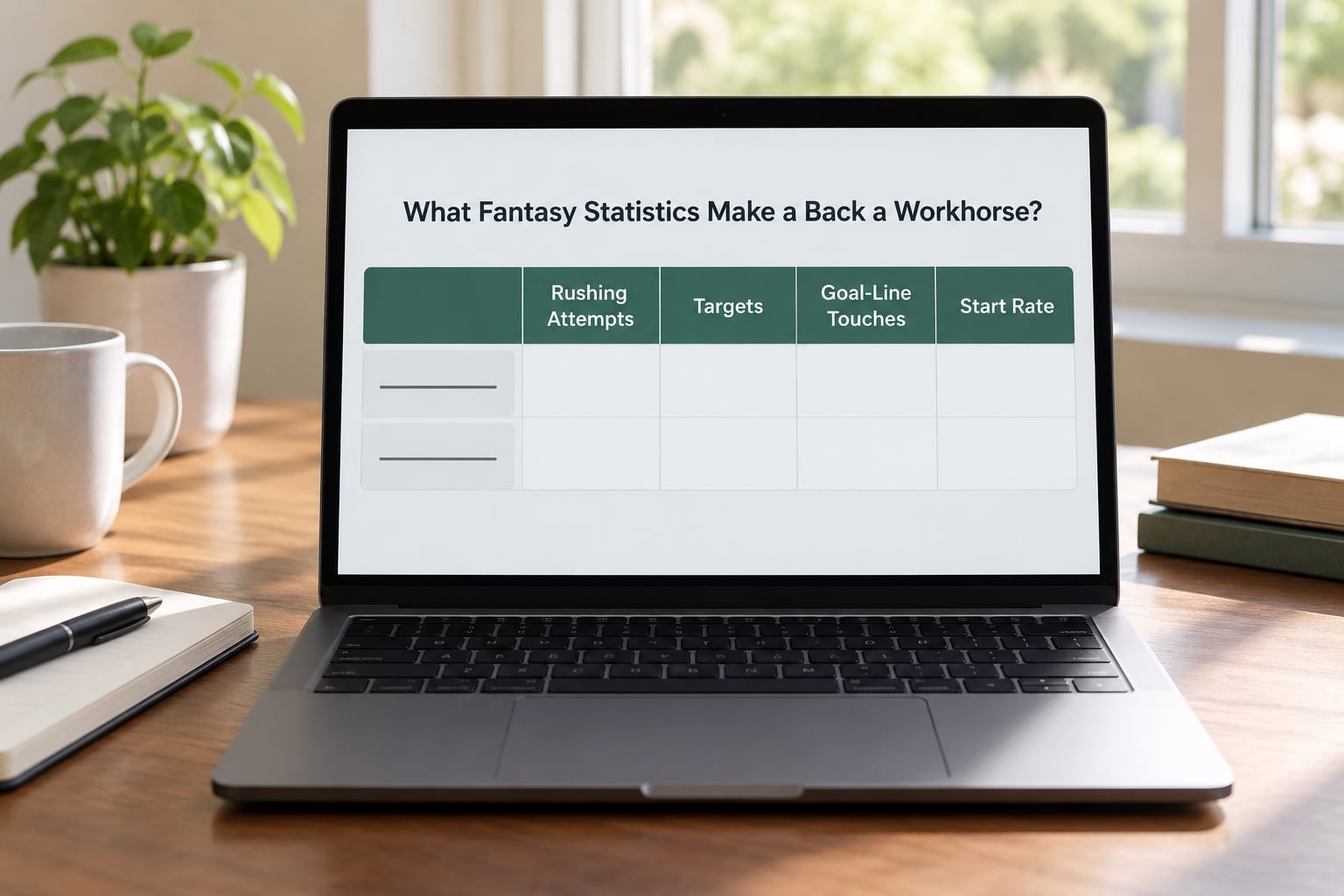
No single statistic makes a back a workhorse, which is why the profiles are easy to mislabel. Evaluate these measures together, and the role usually shows itself within three weeks of real game film.
| Measure | Workhorse range | Why it matters |
|---|---|---|
| Touches per game | 20 or more | The single best volume proxy |
| Carry share | 60% or more | Survives a rotation week |
| Goal-line carries | 4-6 per game | Converts opportunity into touchdowns |
| Target share | 15% of team targets | Adds PPR and half-PPR floors |
| Yards per touch | 3.5-4.2 in the league | Efficiency trims the need for more touches |
| Offensive snap share | 80% or more | Public, verifiable workload data |
| Games played | 14 or more | Converts role into season production |
| Fumbles | Fewer than 4 per season | Turnovers erase volume quickly |
What Is a Workhorse Running Back in Fantasy?
In practical terms, a workhorse is an offensive player who receives enough weekly volume to be a consistent fantasy option, usually because his team relies on him to carry the ball and contribute in several phases. Reliability here means opportunity, not durability, and there is no official statistical threshold that earns the label.
That last point is worth sitting with. Two fantasy analysts can look at the same backfield and disagree about whether a player is a workhorse, because the term is a description of a plan rather than a rule. Use the numbers above as a working checklist, not a certification.
Does the Role Score Differently in PPR Than in Standard?
Yes, and it changes which players deserve the label in your league. In PPR, a workhorse with three to five targets a week is a different asset than the same back with none, because every reception is a point that does not depend on the run game.
Standard scoring compresses the difference between the best and worst workhorse profile, since touchdowns and yardage are the whole menu. That makes early-down carry volume and goal-line work the entire conversation, and it makes an injury-prone high-volume back easier to replace than he would be in PPR.
Half-PPR sits in between, and the practical split looks like this:
| Format | What carries a workhorse | What to downgrade for |
|---|---|---|
| PPR | Volume plus reliable target share | Zero receiving work in the passing game |
| Half-PPR | Carry volume with checkdowns as a bonus | A back who never catches a pass |
| Standard | Goal-line attempts and total yardage | Low target share is irrelevant here |
How Is a Workhorse Different From a Committee Back?
A committee back shares a job, and a workhorse owns it. The difference shows up less in the season total than in the weekly range, which is exactly where redraft leagues are won and lost.
| Factor | Workhorse | Committee back |
|---|---|---|
| Carries per game | 18-24 | 7-13 |
| Receiving work | Occasional checkdowns | Often a genuine outlet |
| Game script | Neutral on most snaps | Behind or playing from ahead |
| Injury volatility | Hits accumulate, workload is hard to replace | Easy to redistribute, less fantasy impact |
| Weekly floor | Reliable double-digit rushing output | Can be single digits |
| Ceiling | Modest, tied to volume and goal-line work | Higher in a perfect matchup |
Committee backs do out-score workhorses in favorable matchups, and that is the trap. A back who splits carries with two other players can post three 25-point weeks in a season if the splits fall his way. The workhorse is not always the better weekly pick, but he is the one whose floor you can plan around.
The classic complaint in fantasy groups is the inverse of the workhorse profile: drafting a back who never gets a carry, then watching the committee partner eat the volume. Recognition is the whole game here.
Is More Rushing Production Always Better for Fantasy?
No. Raw yardage misleads more often than it helps, because rushing totals hide the context that decided them. A 1,100-yard season means very different things in a division with two good offenses and a red zone he never entered.
Five things change how you read a large total:
- Goal-line work. 900 yards with no short-yardage carries is a very different ceiling than 900 yards with eight touchdowns.
- Receiving involvement. In PPR formats, target share often matters more than total yardage.
- Missed games. A big total built over 12 games is not repeatable in a sixteen-game season.
- Fumbles. Lost possessions do not show up in yardage and do show up in your score.
- Offensive context. Play volume, line quality and red zone attempts all shape what the number could have been.
Two backs can finish within 40 yards of each other and produce nothing alike. One averaged 6.4 yards per touch with a rotating cast of quarterbacks and never crossed the goal line. The other ground out 3.8 yards per touch behind a strong line, took 60 percent of the carries and scored nine times. The second profile is the one you can project.
How to Draft a Workhorse Running Back
Draft a workhorse when the role is confirmed and the price is not. The judgment is never about whether a back is good, it is about whether the opportunity is underpriced relative to what other managers will pay for it.
Before your draft, work through a short checklist:
- Offensive context. New head coach, new play caller, new general manager, or a rebuilt line. Some of these help, some hurt.
- Contract incentives. Carries, attempts and playing-time bonuses in a contract year are the most honest signal coaches publish.
- Draft capital spent on the line. A front that added a first-round blocker usually means a bigger commitment to the run game.
- Depth chart language. Camp reports and coordinator quotes are more useful when a coach says a back is a three-down option rather than a committee piece.
- Number of backs on the roster. Four backs on a roster is a warning sign even when the depth chart says otherwise.
In redraft, buying the workhorse role early is usually wrong because the position runs out of names before the second round. Wait until other backs fall, and pay for the role rather than the previous year’s total. A back coming off a big year is priced for a repeat of that year.
In dynasty, the calculation stretches across years, so age and contract length matter more than a single season’s touch count. A 24-year-old with 300 touches and a contract running three more years is a different asset than a 29-year-old with the same workload, even though the weekly production looks identical.
Age is also the underrated risk. Backs decline in explosiveness before they decline in workload, so a workhorse role in his seventh season often means the same carries and a smaller share of the carries that produce points.
How to Start a Workhorse Running Back Each Week
Start by projecting touches, not by trusting the label. The workhorse tag tells you what usually happens; your lineup needs what happens this weekend.
My weekly order looks like this:
- Check the injury report first. A limited-practice designation on the questionable list changes the projection before anything else does.
- Look at the opponent’s run defense. Fronts that rank near the bottom in run stoppage usually give up carries in volume.
- Count the goal-line snaps. Touches inside the five are the closest thing to points you can project.
- Read the game script. A heavy favorite that runs 45 times in a blowout produces more work for the back, not less.
- Check weather and box scores. Wind and ugly surfaces reduce passing volume, which usually helps a high-carry back and hurts the receiving backs competing with him.
- Set a minimum playing-time bar. In most leagues I want three guaranteed touches, which means a clear lead and real goal-line involvement.
A workhorse is not an automatic starter. If he shares a backfield, is listed behind a genuinely better runner on the depth chart, or your league punishes bench points, the role alone does not clear him.
What Are the Main Risks of Targeting a Workhorse?
The durability tax is the price of the role. Every extra carry adds wear, and a workhorse is the player coaches lean on when a game is on the line, which means more contact in the situations that hurt most.
Other risks worth pricing in:
- Injury. One bad week can end a playoff run in a redraft league.
- A shared workload returning. A team that adds a drafted back or signs a veteran can cut carry share without warning.
- Declining efficiency. The same 20 carries produce fewer fantasy points as a back ages.
- Game script swings. Workhorses on bad teams can disappear in the second half of a lopsided loss.
- Fumbles. Volume without ball security is a liability, not an asset.
- Peaking too early. A role in his final contract year is not a long-term asset, whatever his draft pedigree says.
In weekly redraft, injury and workload redistribution are your real enemies, so pairing a workhorse with a second back on a different team is a hedge. In dynasty, the risk that matters is the aging curve, and a second back on the same division is a more useful insurance policy than a second back on the same team.
Fantasy Football Terms You Need to Tell These Roles Apart
Most of the confusion around this term is vocabulary, not strategy. Six words get used loosely in the same draft room, and they do not mean the same thing.
| Term | What it actually means |
|---|---|
| Workhorse | A back who takes the large majority of his team’s carries, typically 20-plus touches a game |
| Bell cow | The modern workhorse, whose role extends to pass downs, space and play-action |
| Committee back | A back who shares carries by down, situation or rotation rather than owning the job |
| Three-down back | Any back who stays on the field on first, second and third down, which is the clearest durability signal |
| Handcuff | The backup you own so that if the starter goes down, someone on your roster takes the carries |
| Vulture target | A committee back who gets a handful of goal-line carries when the starter is hurt, a cheap source of touchdowns |
| RB1 / RB2 / RB3 | Finish rank among running backs in your league, which is a result rather than a role description |
The most common mistake is treating RB1 and workhorse as synonyms. A back can finish as your RB1 with 240 touches in a week where nobody else ran well, while a genuine workhorse lands mid-range because he lost a game to a hamstring. Rank is what happened, role is what was planned.
Handcuffs are the piece beginners miss. If you own the workhorse and the game plan says he is out, the carries usually go to one specific backup, and that is the player who replaces him on your roster. Most managers know who their RB1 is and almost none can name his replacement from memory.
Frequently Asked Questions
What is the difference between a fantasy football workhorse and a bell cow?
The terms overlap heavily, and most people use them interchangeably. Workhorse describes workload: the back takes the large majority of his team’s carries and touches. Bell cow describes the modern version of that role, a runner who also carries the offense on pass downs and in space. If you hear both words for the same player, the difference is mostly emphasis, not a separate category.
How many carries per game make a running back a workhorse?
Roughly 18 to 20 carries per game is the usual working line, and you would also expect 60 percent or more of the team’s carries plus a handful of receptions to reach 20-plus touches. That is a practical threshold rather than an official rule, and it works better as a season-long average than as a single-game requirement.
Does a workhorse running back need receiving targets to be fantasy reliable?
Not strictly, but target share lowers the risk. A back with three to five targets per game in point-per-reception formats has a higher weekly floor and more ways to score when the run game stalls. In standard scoring, a workhorse with no receiving work can still be very reliable as long as he keeps his carries and his goal-line attempts.
Are injury-prone running backs still worth drafting as workhorses?
In redraft leagues, the risk is real and the payoff is small, so a workhorse with a recent soft-tissue history usually has to be bought a round later than his role suggests. In dynasty, it can still work, provided the back is young and the injury history was a single event rather than a yearly pattern. The right question is how many games the workload survives.
Should I always start a workhorse running back in fantasy football?
Usually, but not automatically. Start him when he is healthy, listed as the clear lead, and projected for a normal share of his team’s carries and goal-line work. Sit him when he is on the injury report, sharing snaps with an equal, or facing a defense that has taken away the run game. A role describes a baseline, not a weekly decision.
What is the best way to project a workhorse running back for fantasy?
Project touches first and let efficiency handle the rest. Estimate his carry share, multiply by projected team attempts, add a conservative share of red zone carries and checkdown targets, then apply your league’s scoring. Historical yards per touch tells you how many points those touches become, but the workload is the part you can actually project with confidence.
Conclusion
What is a workhorse running back in fantasy football? A player his team built the offense around, taking roughly 20 touches a game, 60 percent or more of the carries and most of the goal-line work. That role buys you a floor, not a ceiling, and the price is durability risk.
Before you act on the label, check two things: what share of his team’s carries he actually commanded last season, and how many games he finished. Those two numbers tell you more than any ranking or highlight reel, and they are the difference between a role you can build a season on and a name you wish you had not drafted.