To win your fantasy football draft, accumulate value over ADP at every pick: take the best player available inside his tier, let positional scarcity push running backs and wide receivers to the top of your board, and wait on quarterbacks, tight ends, defenses and kickers. Seven steps get you there, and the whole process takes a few evenings of prep plus one focused draft night.
Most drafts are lost before the first pick. Managers show up with generic rankings that were built for a different scoring format, freeze when their target disappears three rounds early, and end up with three running backs and no usable tight end. The fix is boring and repeatable, which is exactly why it works.
Here is the process I would run again from scratch if I were starting a new league in 2026: know the settings, tier the board, set position priorities, and give every pick a rule before the draft starts.
Table of Contents
- What You Need Before Draft Day
- Step-by-Step: How to Win Your Fantasy Football Draft
- Step 1: Know Your League and Build a Big Board
- Step 2: Create a Tiered Player Ranking
- Step 3: Set Position Priorities Before Drafting
- Step 4: Draft for Need or Value in Your Fantasy Football Draft
- Step 5: Build a Draft Board with Tiers and Sleepers
- Step 6: Use Draft Position and Round Context
- Step 7: Make Each Pick with a Simple Rule
- Bonus: Auction Leagues Change Three Rules
- Bonus: What Happens After the Draft
- Common Mistakes That Cost Leagues
- Frequently Asked Questions
- How do I win my fantasy football snake draft?
- Should I draft by position or best player available?
- What is the best draft strategy for 10-team leagues?
- How do I know which fantasy football sleepers to target?
- Should I trade up during my fantasy football draft?
- How do I recover if I had a bad fantasy football start?
- Conclusion
What You Need Before Draft Day
Preparation is the whole game. Everything below can be done in three or four evenings, and none of it requires a paid subscription.
- Your league settings — team count, roster size, roster construction, flex spots, superflex, keeper rules, and the number of draft rounds.
- Your scoring format — standard, half-PPR, or full PPR. This single setting changes player values more than any ranking source.
- A scoring-aware ranking set — the same player is a different pick in PPR than in standard.
- Current ADP — average draft position across thousands of drafts, which tells you the price the rest of your league is paying.
- A big board — every player you could plausibly roster, sorted into tiers, not just your top 50.
- A draft sheet — a printable or on-screen cheat sheet that syncs to your league settings.
- Written notes — role, snap share expectations, injury status, and why you like or dislike each player.
- Two or three mock drafts — run from your real draft slot, not just the first slot.
The single most common preparation failure is ranking players before checking how the league scores them. A back who is a mediocre standard-scoring flex option can be a first-round value in a PPR league. Know the format first, then rank.
Step-by-Step: How to Win Your Fantasy Football Draft
Step 1: Know Your League and Build a Big Board
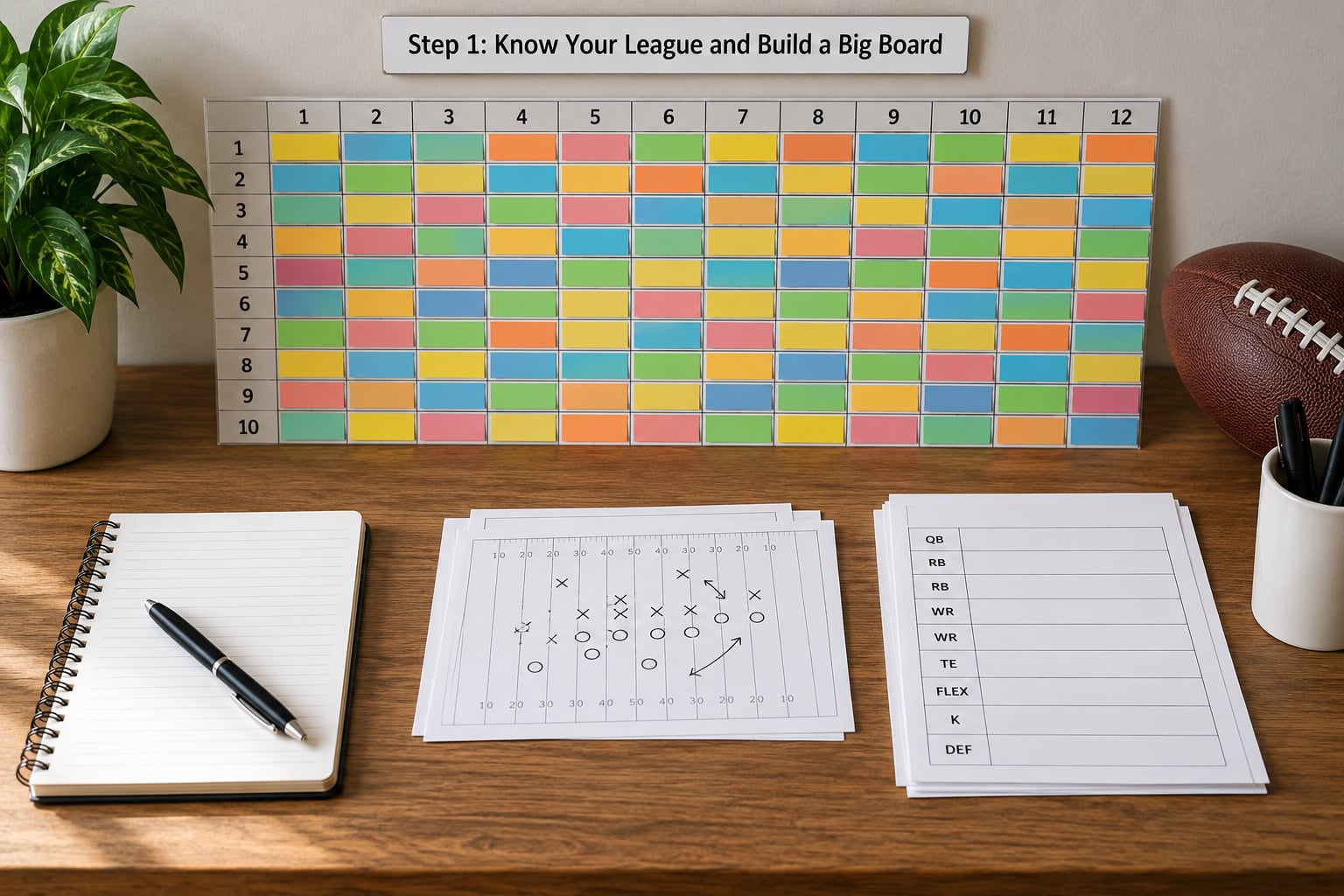
League size and roster construction decide how many starters you need at each position, and that count decides how fast each position disappears. A 12-team PPR league with two flex spots needs about 30 wide receivers drafted. A 10-team standard league needs closer to 22, and those numbers are why your board has to be long.
Build one board with all your target players on it, then duplicate that board per draft slot so you can see who is realistically available when you pick. If your pick is 3.07 in a 12-team league, open the board for slot 3 and work from what is still available there.
How do you know it worked? By round four, you can name your likely starting lineup without hesitation.
Step 2: Create a Tiered Player Ranking
A tiered ranking groups players whose talent is close enough that the pick between them barely matters. The line between the top tier and the second tier matters enormously; the line between players 22 and 23 usually does not.
Use tier breaks as your guardrails. If you are on the clock and the best player available is your fourth-best running back while the top three tiers of receivers are gone, a reach is justified. A reach of one tier is fine. Reaching two full tiers early because of a personal favorite is how good drafts turn into mediocre ones.
Check that your tiers exist in the same league settings. A tight end who is a clear top-10 pick in a superflex league is a round-eight guy in a standard redraft.
Step 3: Set Position Priorities Before Drafting
Positional scarcity is supply and demand applied to your league. Running backs and wide receivers are scarce because most teams start one or two at each spot. Quarterbacks, tight ends, defenses and kickers are deep, so they keep falling well past the point where they are worth owning.
Before the draft, write down what a reasonable starter looks like at each position and note how many of them your league needs. Then set the pick range where you will act on each position: the running back window, the wide receiver window, the tight end window.
Community consensus across r/fantasyfootball for years has been the same on quarterbacks: wait, then wait a little longer, because preseason quarterback rankings always miss somebody. That consensus is why the position keeps falling.
If you write down your windows and still find yourself drafting outside them, that is when you know you are reacting to a run instead of following a plan.
Step 4: Draft for Need or Value in Your Fantasy Football Draft
Best player available inside your tiers is the default rule, and it is correct more often than any alternative. Need-based drafting earns its place in three situations: your positional window is closing, a player sits in the tier you are willing to pay for, and taking him still leaves you a plan at his position.
The test is simple. Would you take this player if he played a different position? If yes, take him. If no, check whether your need is real or whether you are just nervous about being thin at a spot that fills itself in rounds six through ten.
The opposite mistake is drafting a player a full tier above your cutoff because your league mates took three tight ends. Runs are information, not instructions. The point of value over ADP is that you never have to reason about who is panicking.
Step 5: Build a Draft Board with Tiers and Sleepers
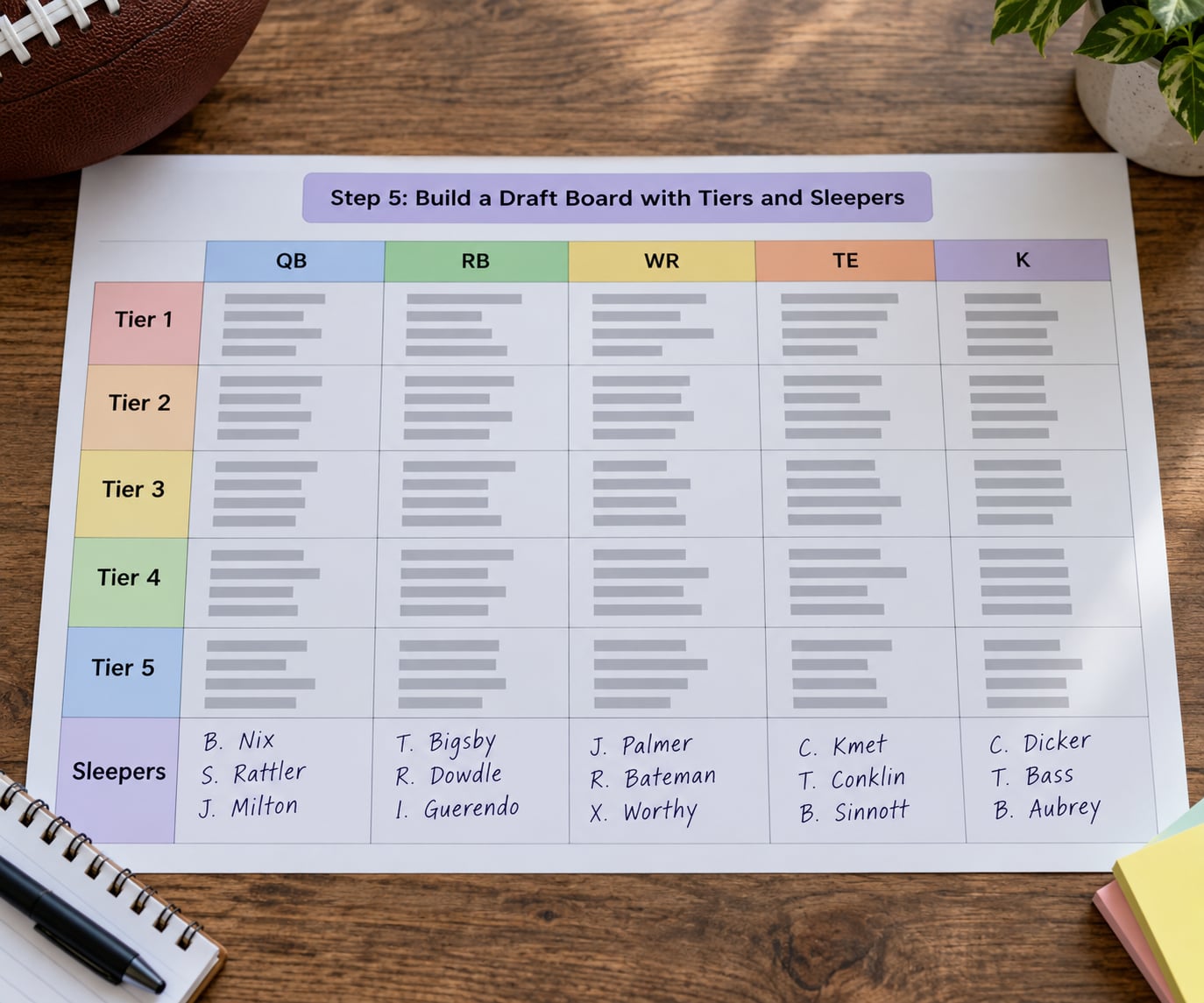
Three lists go on the board: your primary targets in tier order, your secondary targets at each position, and a short sleeper list you will revisit in the final third of the draft.
A sleeper needs a real path to production, not just a hopeful label. Look for rookies with a clear route to the starting job behind an aging or injured incumbent, players whose workload jumped last year after a role change, and veteran returners coming back from an injury that suppressed their usage.
Mark each sleeper with the pick range where you would take him. If you reach round eleven and the player is gone, nothing broke — you were never drafting him as a starter.
Keep the board flexible. A board that assumes exactly twelve players will be gone in round two is not a plan, it is a guess.
Step 6: Use Draft Position and Round Context
Your slot changes your strategy more than most managers expect. Slot 1 needs a plan for being the last team on the board in every round, which usually means an early running back and a wide receiver in round two. Slot 12 means drafting best available while reacting to what the eleven teams before you took.
Round context matters just as much. Rounds one through three set your ceiling. Rounds four through seven are where rosters get balanced and where reaching starts to hurt. Rounds eight onward are about finding two or three names who beat the replacement level at their position.
The same round-by-round blueprint shifts with league size:
- Rounds 1-2. In a 10-team league, two to three running backs and one elite wide receiver. In a 12-team league, one to two running backs and one wide receiver, plus a quarterback only if the board forces it. In a 16-team league, one running back or wide receiver, best player available.
- Rounds 3-4. In a 10-team league, wide receivers and the best quarterback left. In a 12-team league, a second-tier wide receiver and a quarterback if value exists. In a 16-team league, two wide receivers and hold on quarterback.
- Rounds 5-7. In a 10-team league, tight end, a third back and flex pieces. In a 12-team league, tight end if the board allows, a second back and flex. In a 16-team league, the first quarterback taken at a fair price.
- Rounds 8 and later. In a 10-team league, depth, defenses, kickers and sleepers. In a 12-team league, defense, kicker and two sleepers. In a 16-team league, tight end, defense, kicker and three sleepers.
Drafting from the last slot of a 16-team league is an entirely different job from drafting from the first slot of a 10-team league, mostly because you will not see the same players go. Mock from your real slot and the plan gets specific.
Step 7: Make Each Pick with a Simple Rule
Run the same four-beat sequence on every pick. First, look at your board and confirm the top player available at each position. Second, compare your need against that player’s price relative to ADP. Third, name the next player on your list who would be a genuine upgrade at a position you still need. Fourth, if your target just went one pick ago, take the least damaging remaining option instead of burning three minutes deciding.
Speed matters more than cleverness in the later rounds. A manager who makes a pick in fifteen seconds gets to the next round with a clearer head than one still arguing with the chat about a kicker.
Bonus: Auction Leagues Change Three Rules
In an auction, the mechanics change but the principles hold. Budget planning replaces round position, so divide your total budget across your starters and reserve a fixed slice for your bench. Nomination becomes a weapon: put out players you do not want so rivals spend money you would never have spent.
Set a bid cap for every player before the draft begins and refuse to break it. Most auction drafts are lost to bidding wars, not to bad player evaluation. Auction leagues usually run deeper, which means the tail of the draft is worth more than the first pick.
Bonus: What Happens After the Draft
A won draft does not win a season. Manager after manager in the r/fantasyfootball threads makes the same point: the waiver wire and matchup planning decide more of the outcome than draft night does, and almost nobody plans them on purpose.
Before your league’s first waiver period, decide your two or three players you will always add at any cost. On matchup weeks, know which of your players you will bench and what you expect from the worst matchup on your roster. The managers who win October are the ones who treat those two plans like part of the draft.
Common Mistakes That Cost Leagues
- Overvaluing one position. Fix: check your positional windows the night before, not during the draft.
- Reaching for a personal favorite. Fix: one tier of reach is fine, two is a bust waiting to happen.
- Ignoring league settings. Fix: confirm scoring and roster construction before you look at a single ranking.
- Changing strategy after every pick. Fix: write your plan down, then only deviate for a reason you can name out loud.
- Drafting without backup targets. Fix: keep a second name at every position before round seven.
- Waiting too late on quarterbacks. Fix: set a pick range and take the best passer inside it, even if it is not a name you love.
- Picking first overall for the sake of it. Fix: best available inside your tiers beats the most exciting player on the board.
- Mock drafting only from slot one. Fix: run two mocks from your real slot so you see the board you will actually get.
- Panicking during a positional run. Fix: let the run go and rebuild from your tier list.
- Stopping at the draft board. Fix: plan your waivers and matchup strategy in the same week you draft.
One more, and it is the most expensive: taking a tight end in round two because everyone says tight ends are undervalued this year. Consensus is already in the price. By round two, the value is gone.
Frequently Asked Questions
How do I win my fantasy football snake draft?
You win a snake draft by taking the best player available inside your tiers at every pick and letting positional scarcity set your early board. Elite running backs and wide receivers go early because most teams need them. Wait on quarterbacks, tight ends, defenses and kickers, keep one tier of reach in your pocket, and stop reassessing your strategy after every selection.
Should I draft by position or best player available?
Draft by best player available inside tiers as your default rule, and switch to positional need only when a player sits in a tier you are willing to pay for and your window at that position is closing. If you would never take the player at another position, you are drafting on need alone, and that is usually a reach you can avoid.
What is the best draft strategy for 10-team leagues?
In a 10-team league, scarcity bites sooner because fewer players are needed. Expect the top one or two rounds to be running backs and wide receivers, use rounds three and four to add receiving depth and a quarterback at fair value, and treat rounds six onward as where you find tight end and flex production. Mock from your real slot, since the board comes to you faster.
How do I know which fantasy football sleepers to target?
A sleeper needs a visible path to touches, not a good name. Look for rookies who are the clear heir to a starting job, players whose usage rose sharply after a role change, and veterans returning from an injury that suppressed their workload. Give each one a pick range, and if he is gone at that price, move on without regret.
Should I trade up during my fantasy football draft?
Rarely. Trading up moves you to a worse draft slot and costs a future pick, and the only real gain is choosing a player from a round above your own. Take the best available player at your pick instead. The exception is a league trade for a proven starter at a price that would be hard to get on draft day.
How do I recover if I had a bad fantasy football start?
Assess the damage honestly rather than trading in a panic. Count the players you would actually start, identify the two positions where you are thinnest, and look for those needs on the waiver wire before you trade anything away. Then rebuild your weekly bench plan, because a manageable roster can still finish first with clean lineup decisions.
Conclusion
If you take one thing from how to win your fantasy football draft, take the process rather than the player names. Confirm your scoring format, tier your board so the differences that matter stand out, write down your position windows before the first pick, and give every selection the same four-beat decision rule.
Start this week by opening your league settings and checking roster construction, then rebuild your rankings for that scoring format. Tier them tonight, run two mocks from your real slot this weekend, and walk into draft night with a plan you can repeat.