Dynasty startup draft strategy explained, in one sentence: draft on tiers instead of on positional need, pick a clear team direction before you sit down, and treat the startup as an asset accumulation event rather than a lineup filler. Everything else in this guide is the detail behind that idea, and it is the detail that decides whether you are contending in year three or rebuilding in year three.
The startup draft is the one draft that fills empty rosters. Every other draft in dynasty football hands you players. That difference changes the math completely, and it is why so much advice written for redraft leagues falls apart the moment a dynasty league starts.
Updated for the 2026 season.
Key takeaways
- Draft for value, not for need. Your roster is empty, so every position is a need on the board and none of them are needs on your team.
- Decide whether you are a contender or a productive struggle team before pick 1.01, and let that choice filter every tier.
- Trade back far more often than you trade up. Falling two or three slots usually costs you less than reaching for one specific player.
- Treat future rookie draft picks as a separate decision from your startup picks. They often carry more long-term value than the veterans you will draft.
- A startup draft is reversible through trades and waivers. A bad roster is not a permanent sentence, but the young assets you give away are.
Table of Contents
- What Is a Dynasty Startup Draft?
- How League Setup Changes Your Plan
- Building a Dynasty Startup Draft Board
- How Dynasty Startup Draft Strategy Explained Applies by Draft Slot
- How to Allocate Roster Spots by Position
- Which Players Should You Target in Each Tier?
- How to Find Value After the First Pick
- How to Build for Both the Present and Future
- Dynasty Startup Draft Strategy Checklist
- Frequently Asked Questions
- How do you approach a dynasty startup draft?
- Should I punt in a dynasty startup draft?
- How many quarterbacks should I draft in a startup?
- What is the best draft strategy from the last pick?
- Should I trade during a dynasty startup draft?
- How do you know which young players to prioritize?
- Conclusion
What Is a Dynasty Startup Draft?
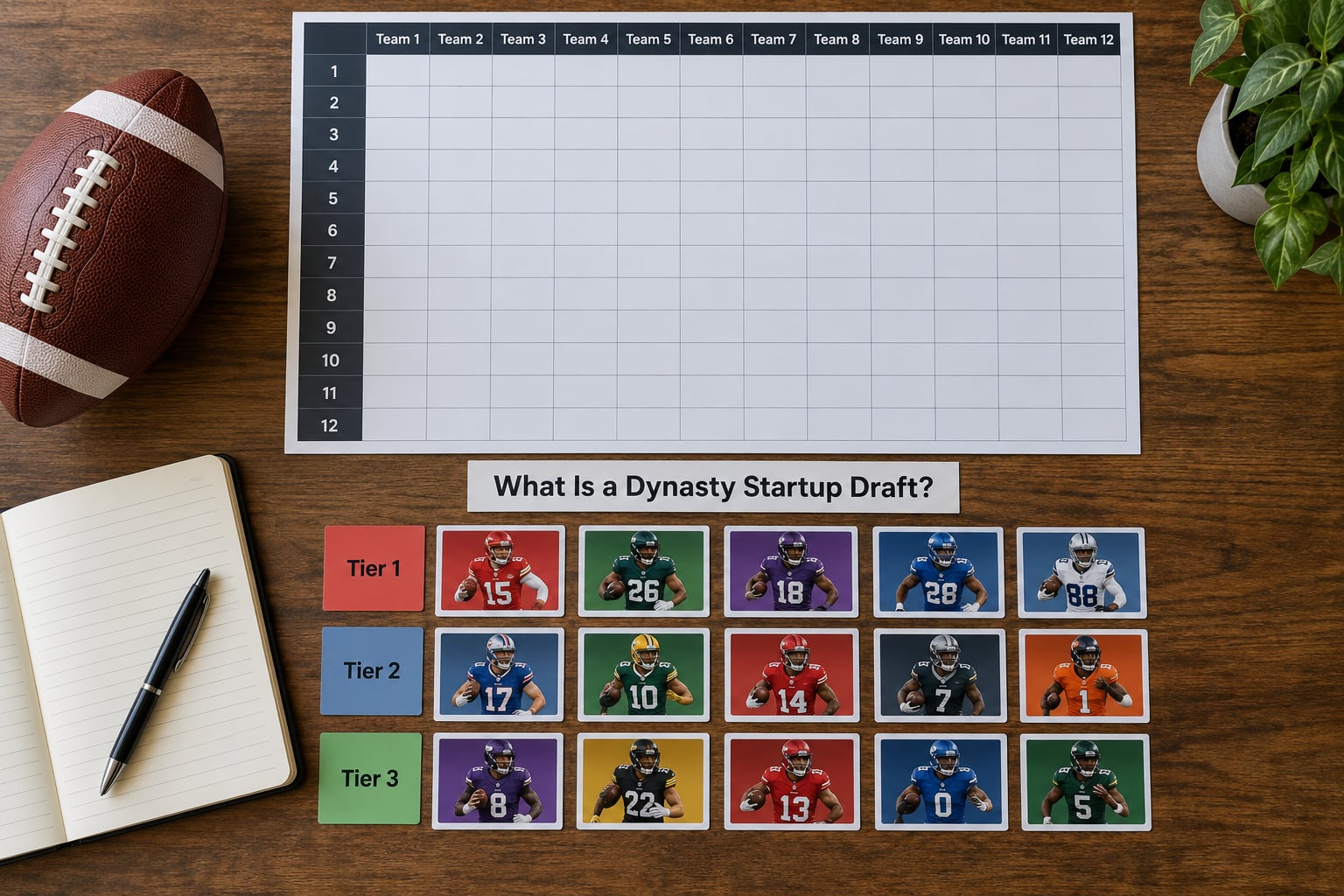
A dynasty startup draft is the single draft used to fill every empty roster at the beginning of a dynasty fantasy football league. Unlike a redraft, rosters carry over from year to year, and unlike the annual rookie draft, the startup includes every veteran player in the league.
Its goal is not to build the best lineup for the season that is about to start. Its goal is to accumulate the most valuable assets you can get, because you will hold those players for years while your leaguemates try to do the same thing with the players you did not take.
That is the whole reason this draft works differently. In redraft, a 28-year-old tight end on a good offense is a genuine asset. In a startup, he is a depreciating asset, and the 22-year-old receiver two rounds later is usually the better buy.
How League Setup Changes Your Plan
League settings change player value before you draft a single player, so read them twice. The most important ones are roster size, how many starters you field, how many teams are in the league, your scoring format, and where you draw in the draft order.
Most managers spend their preparation time on rankings. Rankings do not matter much if your league has ten bench spots and only four starting receivers, because the marginal starting receiver barely moves your weekly score and a log of fifteen bench players is a real asset.
A few settings do more damage to a strategy than others. Members of the r/DynastyFF community raise the same three repeatedly: superflex or single QB, full point-per-reception or half, and the size of the IR and taxi squads.
In a superflex league, every starting lineup has two quarterback slots, so a young backup with a path to a start is worth drafting early rather than punting. In a single-QB league, the same player is a late-round flyer at best.
Roster size is the quiet one. Bigger rosters mean the draft runs longer, which means more chances to draft players nobody wanted, and more chances to make the mistake everyone makes: loading up on young running backs because nobody else took them.
Scoring shifts tight end and wide receiver value more than most people expect. Points per reception settings reward volume receivers and streaming tight ends, while standard scoring flattens the difference between a 70-catch receiver and a 90-catch one.
Draft position matters too, and we will get to it. For now, know that a late pick gives you information and no leverage, while pick 1.01 gives you leverage and almost no information.
Building a Dynasty Startup Draft Board
A dynasty startup draft board is a set of positional scarcity tiers, not a single ranked list. You build it by asking one question for every player: how many teams still need this player at this position, and how long will he produce?
Start by separating long-term assets from temporary producers. A long-term asset is under 25 with a starting job and a multi-year runway. A temporary producer is 30-something with one good season left, and in a startup he is a fine third-round pick that you will be replacing within two years.
Next, run the age curve. Running backs peak earliest and fall off fastest, wide receivers peak in their mid-20s, tight ends peak later, and quarterbacks can produce into their late 30s if they stay healthy. If you are not comfortable using a table like this, build your tiers around it.
Then convert the tiers into a pick-by-pick plan. Write down, for each round, the position you will take if your primary target is gone and the one you will take if the board cooperates. Drafting from a written plan stops you from making panic decisions in the fifteenth minute of a live session.
Most of the best board advice comes down to a single habit: when your target comes off the board, move to the next player on your list rather than the best player on the screen. The player on your list was there because you already checked his age, his role, and his positional run.
How Dynasty Startup Draft Strategy Explained Applies by Draft Slot
Draft slot strategy in a startup comes down to how much information you have when you pick. Early picks act on talent alone, middle picks can react to runs, and late picks draft whatever survived the run and still fits your plan.
If you have an early pick, build from the top. Take the best young player available at a position with a predictable scarcity, then look to trade down a few slots for extra picks. Early picks have the most trade value in the league, which makes them the ones you can convert into volume.
If you have a middle pick, the running-back-first approach sometimes works: take one premium back, then spend the next several picks on young receivers and quarterbacks while the board is still cheap. It only works in scoring formats where that back actually produces every week.
If you have the last pick, you win by being the least attached player in the room. Take the best player still available at 1.12 without flinching, then punt positions deliberately through the middle rounds and come back for depth at the tail. The player still on the board at the end of a startup is rarely a bad player, only an unwanted one.
Late-round strategy is where the value-and-punt plan lives. When the runs have happened, one position is still sitting there with unclaimed players at every level. That is where you spend five straight picks, because a league that ignored tight ends all draft will hand you a starter for free.
How to Allocate Roster Spots by Position
Allocate roster spots by position after you draft on tiers, never before. A roster budget is a tool for the late rounds, when the board is no longer giving you anything for free, not a script for pick 1.01.
Here is a rough budget for a typical 12-team superflex league with 16 roster spots and four bench slots, which is where most new dynasty leagues land. Treat it as a starting template and adjust it to your settings.
| Roster group | Spots | How to fill them |
|---|---|---|
| Quarterbacks | 3 | One young starter, one young backup with a path to a job, one late flyer |
| Running backs | 5 | One premium young back, one handcuff, three dart throws |
| Wide receivers | 5 | Two young high-volume players, three rotational or low-cost guys |
| Tight ends | 2 | One young asset, one cheap starter |
| Offensive line | 2 | Only if your league uses projected starts or IDP scoring that rewards line play |
| Defense and IDP | 4 | Prioritize players on heavy early-fade teams; they end up on waivers in October |
| Bench | 4 | Fill with the highest-ceiling young players nobody claimed |
Roster construction rules exist for a reason. They stop you from ending the draft with nine quarterbacks and no offense, and they force you to think about what a trade will look like in November when your league mates want a player you cannot supply.
The one rule I would write on the board in pen: no position group fills more than about a third of your roster, and no two positions fill more than half of it. A lopsided roster is fixable through the waiver wire, but only if you can still field all your starting slots.
Which Players Should You Target in Each Tier?
Target players by archetype rather than by name, because player names go stale fast and archetypes hold up for years. Five archetypes cover almost every player you will draft.
Dependable young cores are the players you build the roster around: under 25, a clear starter, on an offense that tends to keep them there. You want three or four of these before you want anything else.
Upside prospects are second-round and third-round caliber talents stuck behind someone else. They cost you a mid pick, they hit at a decent rate, and one of them becomes the best player on your team. This is where startup drafts create the most value.
One-year punts are players you take specifically to fill a lineup for a single season while a young asset develops. They are a real tool in startup drafts, and taking one is not a mistake if you did it consciously.
Aging stars still produce, and that matters if you are trying to win immediately. But the price in a startup is wrong. A 32-year-old running back going in the second round is a trade you will regret by next offseason.
Rebound candidates are players coming off a bad year who fit a new scheme or a new offensive line. They are cheap and reasonably reliable, which makes them good bench filler and good trade bait once the season turns.
Players whose value falls with age are the group to avoid early. Running backs are the clearest example, and the consensus about how to treat them is the single most argued topic in dynasty, so I will settle it rather than dodge it.
You do not need to build a zero-running-back roster. You do need to stop treating every second-round back like a future star. Take backs early when the price reflects a genuine workhorse role, and otherwise let someone else overpay for them.
How to Find Value After the First Pick
Find value after the first pick by watching positional runs instead of chasing consensus average draft position. ADP tells you what the crowd will pick. What you need to know is which position the crowd is walking away from, because that is where the next good player is still available.
Three things create value in a startup draft: tiers that break down earlier than expected, roster rules that make a position harder to fill than usual, and runs that remove a group of players you already like.
When a run happens, resist the urge to panic-trade. If three tight ends go in a row and you still want the fourth, the price just dropped. Drafting into a run at the fourth slot is how you end up with a value player instead of a need.
Here is the age reference most managers end up building tiers from anyway, so it is easier to use as a table.
| Position | Typical peak years | What that means in a startup |
|---|---|---|
| Running back | Years 2 to 3 | Buy the role, not the name, and only early |
| Tight end | Years 3 to 4 | Patient, and cheap in the mid rounds |
| Wide receiver | Years 4 to 5 | The best value-to-age ratio in a startup |
| Quarterback | Years 5 and beyond | Longest runway of any skill position |
Before my first startup I built one flat ranking of every player, and I spent three rounds waiting for a name to come back to me that I had already passed on. Tiers fixed that instantly, because a tier tells you what to do next without any memory at all.
Consensus ADP is still useful, with one condition: know why a player is going where he is going. If a wide receiver’s ADP reflects a 300-touch projection from an analytics model, you are not obliged to believe the model.
One more source of value is other managers’ settings. A superflex league will run out of quarterbacks before it runs out of tight ends, and a points-per-reception league will gobble receivers in the middle rounds. Read the league, not just the board.
How to Build for Both the Present and Future
Building for the present and the future at the same time means accepting that most of your roster will be useless for one of those two things, and choosing the ratio deliberately. A roster of only veterans is a trap. A roster with no veterans is slow, painful, and often produces its first real payoff in year four.
Win-now players are bought for production and sold in their first good season, when the market is loudest. Long-term assets are bought quietly, kept through a bad rookie year, and traded for a veteran when they are sitting on the bench of someone else’s expectations.
Four variables decide which one a pick should be: age, injury history, positional opportunity, and replacement cost. Replacement cost is the one people skip, and it is the reason a mediocre starting tight end can be worth more than a talented rookie at a position where the league has depth.
Set the ratio before the draft rather than negotiating with yourself in round six. A workable default for most managers is roughly one-third immediate producers, two-thirds young assets, spread across at least three positions.
Then accept that your roster will be wrong in places, because it will be. The value of a startup roster is that you can fix it. Young players who do not pan out get replaced through waivers and trades within a season or two, and a manager who drafted a good board can recover from a bad rookie class.
Dynasty Startup Draft Strategy Checklist
Work through this checklist in order before you open your draft room, in this order because each step depends on the one before it.
- Read the settings twice. Roster size, starter counts, scoring, IR and taxi size, number of teams, and your draft position. Write the numbers down.
- Pick your direction. Contender or productive struggle. Contender means older, proven production. Productive struggle means young assets and slower years.
- Build tiered rankings by position. Not one big list. Tiers break down in a predictable order and tell you when a position run is happening.
- Set positional budgets. Decide the number of running backs, receivers, and quarterbacks you will allow yourself before the draft constrains you.
- Write contingency targets. For each of your first five picks, name the two players you take if your main target is gone.
- Price your future rookie picks separately. Know roughly which of your future picks you would trade and which you would never move.
- Scout your leaguemates. Redraft converts who stream quarterbacks tell you exactly how your young assets will be valued in trades.
- Run one mock draft. The purpose is not to predict the board. It is to rehearse the moments where you will be tempted to break your own plan.
- Know your trade value. Have a short list of players you would accept for each of your premium assets before the league starts, not during a bidding war.
- Know your roster minimums. Confirm you can field a legal lineup at every stage of the draft. An incomplete roster costs more than a mediocre pick.
The order of selection matters less than most managers think. Take the best player available at a position that is genuinely scarce, and only trade when the trade fixes a structural problem like too few quarterbacks or too few young assets.
Frequently Asked Questions
How do you approach a dynasty startup draft?
Draft on tiers rather than positional need, because every position on an empty roster is already a need. Decide whether you are building to contend now or to accumulate young assets, then let that choice filter your rankings. Take the best young player available at a scarce position, trade back more often than you trade up, and treat future rookie picks as a separate decision from your startup picks.
Should I punt in a dynasty startup draft?
Yes, but later than most redraft managers do. Spend your first half of the draft on young assets at scarce positions, then punt hard once a position is clearly abandoned by the board. Teams routinely find a starting tight end or a usable running back in the last three rounds of a startup because nobody wanted one.
How many quarterbacks should I draft in a startup?
Two to three in a superflex league, one to two in a single-quarterback league. Young quarterbacks have the longest career runway of any skill position, so one premium young passer is usually worth an early pick. A second young backup with a path to a starting job is the single most valuable player most managers give away.
What is the best draft strategy from the last pick?
Take the best player still available at the first pick without hesitation, then stop trying to plan. Use the middle rounds to identify which position the board has abandoned and take five straight players there. Last pick is an information advantage: you draft what is left, and leftovers in a startup draft are usually solid players nobody wanted.
Should I trade during a dynasty startup draft?
Trade during the draft, mostly to move back. Trading down two or three slots rarely costs you a tier and often buys you two extra picks, which compound in a long league. Avoid trading up for one favorite player, since a single pick rarely justifies giving up several assets in a format where players are held for years.
How do you know which young players to prioritize?
Look for a starting job, a young age, and a scheme that is unlikely to change. Youth plus opportunity beats youth plus hype, and rookie draft capital is the best public signal available. A 21-year-old who is the clear starter on a stable offense is a safer long-term bet than a 23-year-old waiting behind a contract year.
Conclusion
Here is the first move: before draft day, write down your league settings, choose your direction, build one tiered ranking per position, and set a roster spot budget for running backs, receivers, and quarterbacks. Then draft your flexible plan, one contingency target per early pick.
Everything after that is execution. Draft for value, keep the young assets you paid early picks for, and do not be afraid of moving back when the board offers a better deal. A startup draft done with a plan is recoverable, and one done on impulse is not.