
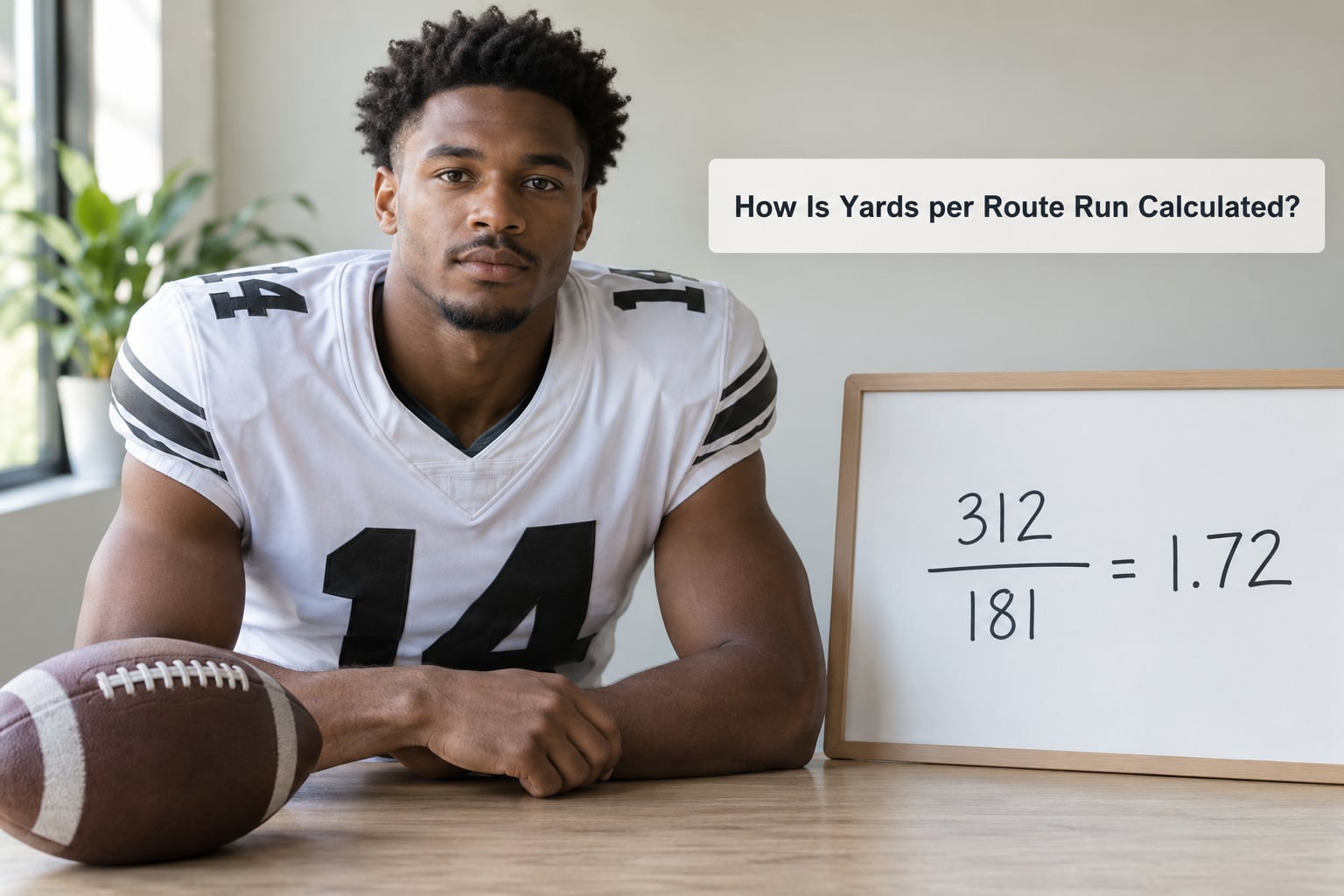
Yards per route run is the average number of receiving yards a player produces for every pass route he runs: take his total receiving yards and divide by his total routes. If a wide receiver catches 312 yards on 181 routes, his yards per route run is 1.72. It is one of the most useful efficiency numbers in fantasy football, and one of the most misused.
Most of the trouble comes from people treating a single rate stat as a verdict. A 2.4 number built on 60 routes in two games means something different from a 2.1 number built on 700 routes across a full season. This guide is about reading the metric properly, not worshipping it.
Table of Contents
- What Is Yards per Route Run (YPRR)?
- How Is Yards per Route Run Calculated?
- How to calculate yards per route run step by step
- How sensitive is one big play?
- Why Does YPRR Matter for Fantasy Football?
- Isolates talent from opportunity
- Accounts for the quarterback and the offense
- Holds up year over year
- Predictive, not a guarantee
- What Is a Good YPRR for an NFL Receiver?
- How Do You Read YPRR Without Misleading Yourself?
- Set a minimum sample
- Pair it with first downs per route run
- Check target share before you celebrate
- Read the coverage and matchup split
- Separate air yards from yards after catch
- Adjust for quarterback and scheme
- YPRR vs. Yards After Catch: What Is the Difference?
- How Can Fantasy Managers Use YPRR in Draft and Waiver Decisions?
- On redraft and best ball boards
- Grading dynasty rookies
- Projecting, not repeating
- Finding waiver wire values
- Deciding what to sell
- Frequently Asked Questions
- What is a good yards per route run number?
- Is yards per route run better than receiving yards?
- How many routes should a receiver run before YPRR is reliable?
- Should fantasy football managers use YPRR for tight ends?
- Where can I find yards per route run data?
- Does a high YPRR always mean a receiver will be fantasy productive?
- Conclusion: Start with Opportunity, Then Check Efficiency
What Is Yards per Route Run (YPRR)?
Yards per route run, usually shortened to YPRR or written as Y/RR, measures how many receiving yards a player generates per route run. The formula is simple: receiving yards divided by routes run. Nothing else goes into it.
A route run is one pass attempt at a receiver who is running a route, regardless of whether the ball is thrown or completed. Two hitches, a curl and a go route all count as one route run each. Pro Football Focus popularized the per-route framing, and it is now the standard way analysts normalize receiving output.
Here is why that normalization matters. A receiver on a team that throws 45 times a game will have more routes to work with than a teammate on a team that throws 30 times. Raw yards blend what the player did with how many chances he got. YPRR strips out the chance volume and keeps only the conversion rate.
It is different from raw receiving yards, which scale with opportunity, and different from yards after catch, which only counts the yards a receiver collects once the ball is in his hands. YPRR counts everything a pass produces for that player, air yards and YAC together.
How Is Yards per Route Run Calculated?
How to calculate yards per route run step by step
- Get the player’s routes run for the exact period you are measuring. Routes are logged for games, seasons, or rolling windows, and the two do not mix.
- Get his receiving yards for that same period, counted the same way.
- Divide yards by routes and round to two decimal places.
- Check the route count before you trust the result.
| Player (season total) | Receiving yards | Routes run | YPRR |
|---|---|---|---|
| Receiver A | 312 | 181 | 1.72 |
| Receiver B | 640 | 240 | 2.67 |
| Receiver C | 980 | 560 | 1.75 |
| Receiver D | 1,120 | 700 | 1.60 |
Receiver C has the second-most yards on this list and a perfectly ordinary efficiency number. Receiver B has less than half the yards of C and the best rate on the board. That gap is the whole reason the metric exists.
How sensitive is one big play?
More sensitive than most people expect. Take Receiver A’s 312 yards on 181 routes, a 1.72 YPRR. If he caught one additional 45-yard reception, the same route total now produces 357 yards, which works out to 1.97. One play moved the number by a quarter point.
That sensitivity is not an argument against the stat. It is an argument for weighting it by sample size, and for pairing it with first downs per route run, which is far harder to skew with a single deep shot.
Why Does YPRR Matter for Fantasy Football?
Isolates talent from opportunity
Two receivers can finish a season with identical receiving yards and be completely different players. One did it on 350 routes, the other on 600. Dividing by routes is the closest public stat comes to asking how well a player converts his individual opportunities.
Accounts for the quarterback and the offense
A quarterback who throws 45 times a game inflates every passcatcher on his team. YPRR at least holds the denominator constant, so a receiver’s rate survives a schedule change, an injury to a quarterback, or a coaching switch better than his yard total does.
Holds up year over year
4for4’s work on stat predictability has found that efficiency metrics, including YPRR and first downs per route run, carry stronger year-over-year correlation than volume metrics such as receiving yards per game. Efficiency tends to stick. Opportunity rarely does. That is exactly the shape you want when projecting a player into an unknown season, and it is why r/DynastyFF users treat a strong YPRR season as a signal worth projecting rather than a number worth repeating.
Predictive, not a guarantee
Fantasy players on r/NFL_Draft have been blunt about the ceiling here: a high YPRR describes how a player has performed, it does not grade a prospect’s future. Track records and projections are different things, and a rookie’s YPRR is a forecast, not a fact.
What Is a Good YPRR for an NFL Receiver?
League average lands near 1.5 yards per route run for wide receivers. Above that is efficient, around 2.0 is solidly productive, and 2.5 or higher puts a player in rare territory. Those tiers are a starting point for interpretation, not a universal grading scale.
| YPRR range | How to read it | What to check next |
|---|---|---|
| Below 1.3 | Efficiency is hurting the player’s floor | Drop rate, contested catch rate, depth of target |
| 1.3 to 1.6 | Around league average for a regular contributor | Whether volume alone keeps him fantasy relevant |
| 1.6 to 2.0 | Clearly above average, the useful band for most WR2 and WR3 profiles | Route rate and target share |
| 2.0 to 2.5 | Elite efficiency; the community’s practical good-receiver threshold | Sample size, first downs per route run, age |
| Above 2.5 | Exceptional, often one or two players a season | Big-play skew and target volume |
Role changes the reading. A tight end running a comparable route tree can post a lower number simply because his routes are shorter and his catches come in traffic. Running backs rarely reach these ranges because their route totals are small and their receiving yards come with blocking assignments attached.
Rookies need a different bar too. A first-year player averaging 1.8 with heavy slot work is a materially different prospect from a 1.8 produced almost entirely on third-down crosses against press coverage.
How Do You Read YPRR Without Misleading Yourself?
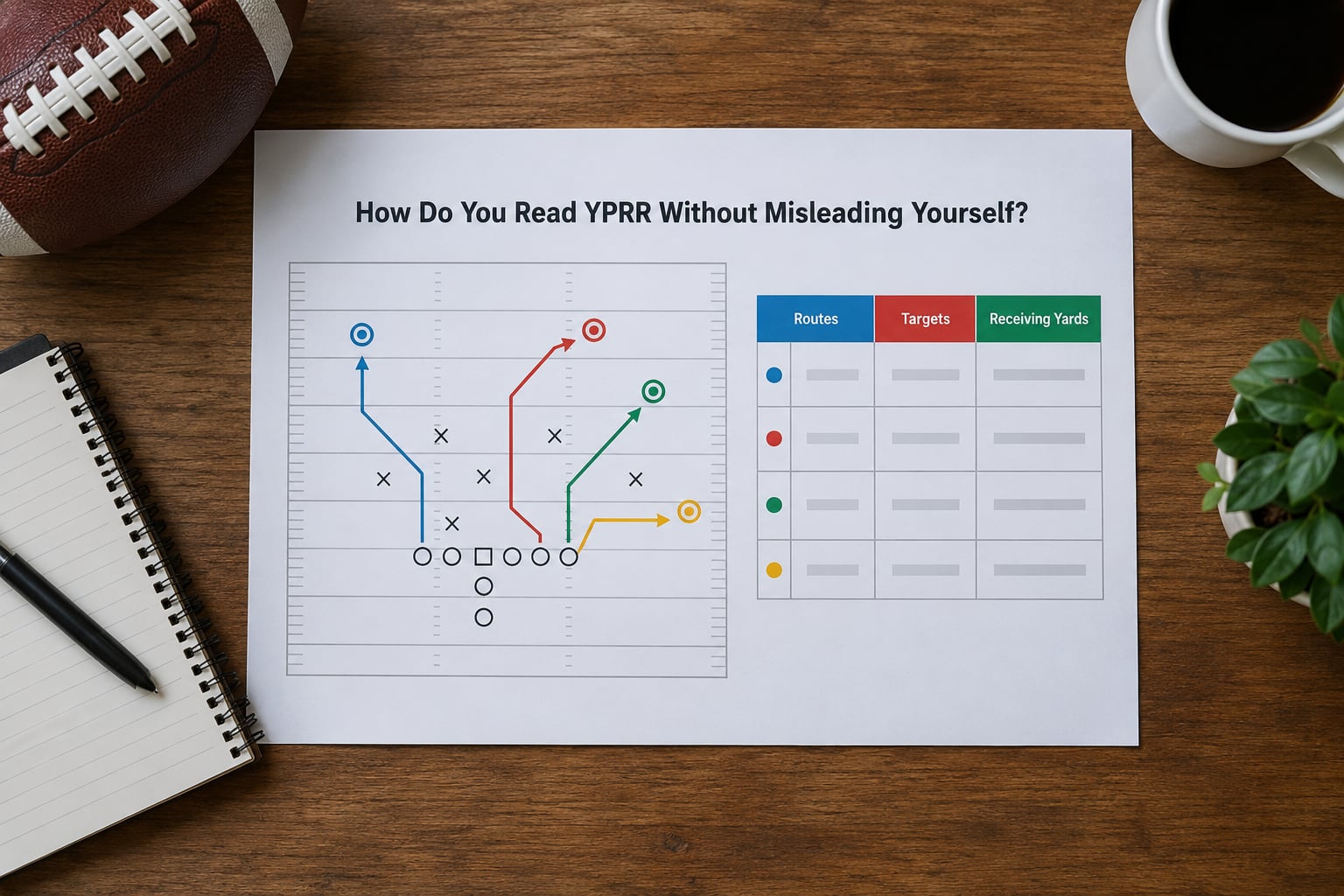
Most bad reads come from skipping context. A handful of habits fix most of them.
Set a minimum sample
Forum consensus lands somewhere around 50 routes as the floor, with 30 or more targets as a common alternative filter. Below that, treat the number as a scouting note rather than evidence. Garbage-time reps and two deep plays can manufacture any rate you want.
Pair it with first downs per route run
YPRR rewards big plays. First downs per route run does not. Plotting a receiver on both axes separates the guys who convert drives from the guys who collect occasional yardage bombs, which is a pattern r/nfl users have been filtering with for years.
Check target share before you celebrate
A receiver with a great rate and a shrinking route tree is fading. Target share is what determines ceiling; YPRR tells you how well he has used the chances he got.
Read the coverage and matchup split
Man coverage and zone coverage produce different rate profiles. A receiver whose number is built on one matchup against one team is not a season-long talent signal.
Separate air yards from yards after catch
High YAC profiles and high air-yard profiles describe different players. If you know which one drives a given receiver’s rate, you know what to expect when the quarterback throws downfield less.
Adjust for quarterback and scheme
A quarterback who throws short and to the slot inflates a specific receiver’s number and depresses the outside guys. Scheme-driven numbers fade the moment the play-caller changes.
YPRR vs. Yards After Catch: What Is the Difference?
They answer different questions. YPRR asks how much production a receiver gets per route. Yards after catch asks how much of that production happens once the ball arrives, on plays the receiver catches and runs with. One measures opportunity conversion, the other measures running ability after the catch.
| Metric | What it measures | What it misses |
|---|---|---|
| YPRR | Total receiving output per route run | Does not separate the catch from the run |
| Yards after catch | Yardage collected after the ball arrives | Blind to how often the player is thrown the ball |
| Yards per target | Output per throw, catch or not | Sensitive to drops and target quality |
| Targets per route run | How often a route turns into a target | Quality of those targets is invisible |
| Average depth of target | How far downfield the throws go | Says nothing about whether they are completed |
| First downs per route run | Drive production per route | Ignores yardage on non-first-down plays |
A receiver can post top-tier yards after catch on a modest route total, and it means far less than the same number on a heavy workload. Neither metric is a complete measure of fantasy value on its own.
How Can Fantasy Managers Use YPRR in Draft and Waiver Decisions?
On redraft and best ball boards
Sort by YPRR, then require a minimum route count, then layer on target share. What survives that filter is a receiver who converts his chances and still gets enough of them. That combination is rarer than either half, and it is a good reason to reach one round earlier.
Grading dynasty rookies
For rookies, judge the efficiency relative to role rather than in absolute terms. A slot receiver on a high-volume passing offense hitting 1.8 has a stronger foundation than an outside receiver with the same number on four targets a game. Roles move, opportunity is not yet fixed, and dynasty trades often turn on the role change more than the rate.
Projecting, not repeating
This is where the metric earns its keep and where most mistakes happen. Regression to the mean is real: a player well above 2.0 is more likely to come back down than to hold, and a player dragging a low rate is more likely to bounce up. Project the expected value and draft accordingly, which is precisely the reasoning r/DynastyFF users apply to a 2.0-plus season.
Finding waiver wire values
When a player changes teams, his route tree and target share reset while his underlying efficiency often does not. A receiver who held a strong YPRR in a low-volume offense and lands in a high-volume one is a classic add. Check that the new quarterback actually throws to the alignment he plays in.
Deciding what to sell
A buyer will pay for volume, and that is the part that evaporates. If the only argument for a player is yards and target totals, a buyer who checks route-adjusted efficiency is going to offer less than you expected.
Frequently Asked Questions
What is a good yards per route run number?
League average for wide receivers sits near 1.5. Anything from 1.6 to 2.0 indicates clearly above-average efficiency, 2.0 to 2.5 is elite territory, and anything above 2.5 happens for only a few players a season. Treat those as reading guides rather than universal grades, since role, alignment, depth of target and route volume all shift what a fair number looks like.
Is yards per route run better than receiving yards?
They measure different things. Receiving yards tell you how much a player produced, which includes how much his team threw. YPRR divides that production by route volume, which makes players easier to compare across offenses and quarterbacks. For projecting future fantasy output, the route-adjusted rate is usually more useful, because opportunity changes from year to year and efficiency tends to stick.
How many routes should a receiver run before YPRR is reliable?
Most of the fantasy community settles on roughly 50 routes as the floor, and 30 or more targets is a common alternative filter. Below either threshold, a single deep catch can move the number by a quarter yard or more, which is enough to invent an entire scouting narrative. Small samples are fine for spotting a name to watch, not fine for making a draft decision.
Should fantasy football managers use YPRR for tight ends?
Yes, with adjustments. Tight ends run shorter routes, work out of the slot and line up against traffic, so their comparable numbers usually sit below a wide receiver’s. A high-end tight end producing near 1.5 on heavy route volume is a genuinely strong result. Pair the rate with target share, because a tight end’s ceiling is set almost entirely by how often the ball comes his way.
Where can I find yards per route run data?
FantasyPros publishes free advanced receiving stats including routes run, yards after catch, average depth of target and YPRR, with season and minimum-route filters. Pro Football Focus grades routes at the source and is the origin of most public YPRR data, though its deepest splits sit behind a subscription. Some draft tools also surface the rate inside their player pages.
Does a high YPRR always mean a receiver will be fantasy productive?
No. Efficiency describes how a player used his chances, not how many chances he will get. A receiver with a 2.2 rate on 150 routes is a different investment than the same rate on 700 routes, because the volume ceiling is set by target share, alignment and quarterback. Project the rate toward the mean and check that the opportunity is real before you commit to the player.
Conclusion: Start with Opportunity, Then Check Efficiency
Yards per route run tells you how much a receiver produced for each route he ran, and it is one of the better efficiency measures available to fantasy managers in 2026. Find the route volume first, confirm the rate holds over a real sample, then project it toward the mean rather than repeating it. Efficiency tells you how well a player has worked; only opportunity tells you how much he is likely to get.