
Strength of schedule rankings in fantasy football are a 1-through-32 ordering of every NFL team by how easy or difficult its opponents are, measured separately at each offensive position using the fantasy points those opposing defenses are expected to allow. Most tools also adjust those raw points for the difficulty of the schedule the defense itself faced. It is context for a ranking, not a ranking on its own.
The nickname for the metric is SoS, and you will see it on nearly every major fantasy tool. Once you know what the number measures, where it comes from and which direction the scale runs, it becomes one of the more useful tiebreakers you have. Misread it and you will happily draft a low-volume backup because his team drew a soft slate.
Table of Contents
- What Are Strength of Schedule Rankings in Fantasy Football?
- How Are Strength of Schedule Rankings Calculated?
- Which Schedule Factors Matter Most?
- How Do Time Horizon and Statistical Models Change a Ranking?
- What Do Favorable and Difficult Schedule Rankings Mean?
- How Do You Use Strength of Schedule Rankings in Fantasy Football?
- Should You Favor Easy Schedules or Strong Competition?
- How Do Common Schedule Ranking Methods Differ?
- What Mistakes Do Fantasy Football Managers Make With Schedule Rankings?
- Frequently Asked Questions
- Are strength of schedule rankings the same for every fantasy football scoring system?
- Why does my league’s schedule rank differ from a team’s strength-of-schedule rank?
- Is a weak fantasy football schedule always better than a difficult one?
- Should a dynasty manager care about the opponent’s long-term quality?
- How important is division strength in schedule rankings?
- Do schedule rankings account for playoff matchups and injuries?
- Can two schedule rankings disagree if they use the same opponents?
- Conclusion
What Are Strength of Schedule Rankings in Fantasy Football?
A strength of schedule ranking answers one narrow question: how good are the defenses this team is scheduled to face? Every provider builds that answer from some blend of opponent win percentage, point differential, and fantasy points allowed to each position, then sorts the 32 teams from easiest to hardest.
Two different things get called strength of schedule, and mixing them up causes most of the confusion. Team-level SoS looks at a whole slate of opponents and summarizes them into a single rank. Weekly matchup difficulty looks at the one defense in front of your wide receiver on Sunday and asks how that defense has been against that specific position.
Team-level SoS is what most draft boards and cheat sheets publish, and it is a season-long context number. A weekly matchup grade is what a start/sit tool shows you on a Wednesday night, and it moves every week. They can point in opposite directions: a team can own the easiest schedule in the league and still face a genuinely difficult defense this weekend.
It also helps to separate fantasy SoS from the NFL’s own strength of schedule. The NFL version is built on wins and losses, which makes it a measure of team quality. The fantasy version is built on points, which makes it a measure of what a defense gives up to a specific position.
| Feature | NFL strength of schedule | Fantasy strength of schedule |
|---|---|---|
| Unit of measure | Wins and losses | Fantasy points allowed |
| What it rates | The quality of an NFL team | The quality of a matchup for one position |
| Typical use | Futures, playoff seeding, team evaluation | Draft strategy, trade talks, weekly lineups |
| Position specific | No | Yes, one rank per position |
| Affected by injuries | Heavily | Heavily, and it is not fully updated in advance |
That last row matters more than it looks. A ranking published in August cannot know which quarterback will be hurt in October. Treat the number as a snapshot of what was true when it was built, not as a live read on your team.
How Are Strength of Schedule Rankings Calculated?
Every version of the calculation ends the same way. You collect how many fantasy points each defense allowed at a position, you correct those totals for how hard that defense’s own schedule was, you apply the corrected grades to the opponents each team faces, and you sort the results.
The mechanics in a bit more detail:
Step one. Gather raw fantasy points allowed. For each defense, record the points it gave up to quarterbacks, running backs, receivers and tight ends, usually averaged per game and often split into year-to-date and rest-of-season figures.
Step two. Adjust for the schedule that defense faced. A defense that allowed 22 points a game to receivers while playing nobody but rebuilding offenses has not done anything impressive. Providers scale each figure by the opponents’ own quality, and some publish the underlying methodology while others keep it closed.
Step three. Apply the grades to opponents. Each team’s schedule is scored position by position, often with home and road weighting and penalties for short weeks or long road trips.
Step four. Rank and publish. The 32 teams are sorted from 1 to 32, and the direction of that sort is where most readers get burned. Some tools rank No. 1 as the easiest schedule. Others publish a defensive difficulty list where No. 1 is the toughest unit in the league. Check the legend before you read a single row.
Which Schedule Factors Matter Most?
Opponent win percentage is the crude version most beginners meet first: add up the records of every team on the schedule and divide. It is transparent and easy to calculate by hand, which is exactly why so many people build their own spreadsheet version of it.
Point differential is a better filter because a team can win ugly and still be outscored. If the defenses you face outscore opponents by an average of nine points a game, that says more than a 60 percent win rate built on four wins decided by a field goal.
Divisional strength is the sleeper factor. Six games against one division means a bad quarterback play against a good defense three or four times a year, and those repeat matchups get more physical and more predictable each time. Schedules are unbalanced by design, so this is not a rounding error.
Offensive and defensive quality matter most when the tool separates positions. How much a pass rush threatens a quarterback’s pocket tells you more about a quarterback’s ceiling than that defense’s points allowed tells you about its receivers, because sacks do not count as receiver points. A quality-weighted method grades coverage units and pass rush separately, then blends them.
The playoff path is a smaller, more speculative input. Ranking the stretch of Weeks 15 through 17 tells you who faces the better defenses when your league decides its champion, but those games are six months away at draft time and worth very little weight early.
Finally, time horizon decides how much recent form counts. A pure season-long method smooths noise out. A rolling four-week window reacts fast but swings wildly, which is why the same defense can look elite in October and terrible in November.
How Do Time Horizon and Statistical Models Change a Ranking?
The same opponents produce three different numbers depending on when you measure them. A full-season rank averages the entire slate, a rest-of-season rank counts only the games still ahead, and a playoff-only rank counts three games out of sixteen.
For a redraft league, the rest-of-season view is the useful one after the draft is done, because it reflects the opponents actually left to play. Early in the season it is built on very little data, so it moves several spots a week for reasons that have nothing to do with football.
Playoff-only rankings look decisive and are mostly noise. They give a team facing two soft opponents a great grade while ignoring the eleven games that decide its finishing position, and they were computed using projection models built before the season began.
For dynasty, the horizon stretches further again. Year-over-year comparisons are close to meaningless because roster turnover, coaching changes and free agency move almost every unit in the league between seasons. What carries over is scheme continuity and the coaching staff’s tendency, not last September’s numbers.
That is the reconciliation most managers miss. Opponents change every year, so an average across multiple seasons is a description of who a team usually was, not who it will be in 2026.
What Do Favorable and Difficult Schedule Rankings Mean?
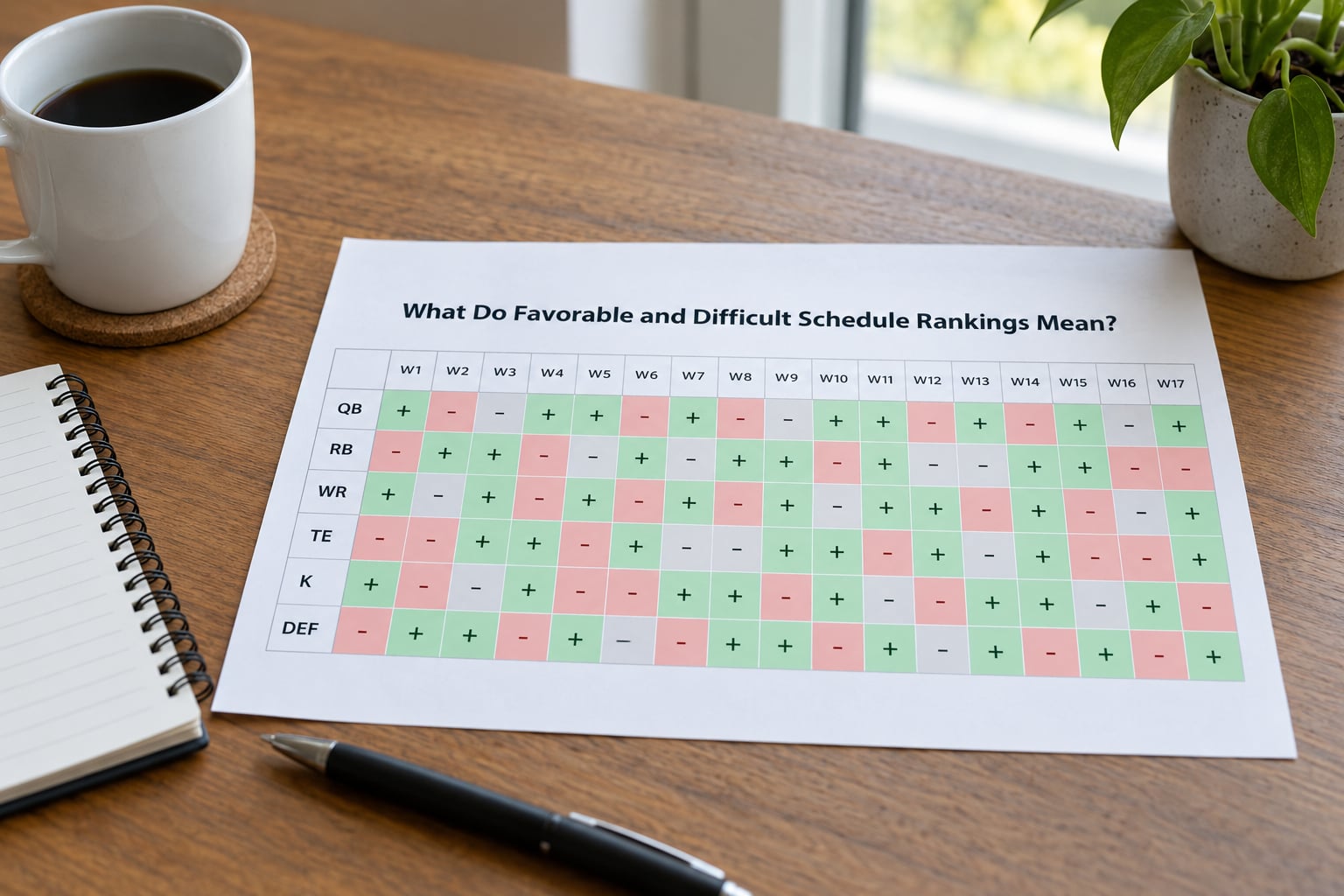
A number near the top of an easiest-first list usually means a defense group that gave up roughly 16 fantasy points a game to that position after adjustment. Near the bottom of a toughest-first list, expect something closer to 24. That gap of about eight points per game is the whole range most fantasy assets actually move across.
Now put a real player next to it. Suppose two receivers are within a few fantasy points of each other in your projections and both have similar target volume. One faces a bottom-eight schedule at wide receiver, the other faces a top-eight group with two teams ranked in the top five against the position. The softer schedule is a legitimate reason to prefer the first receiver in a close call.
Now change one thing. The second receiver is being drafted two full rounds earlier because his quarterback throws 45 passes a game, while the first receiver shares a backfield with a workhorse running back who takes away targets. The harder schedule no longer matters much, because neither receiver is going to see enough balls to be moved by it.
That is the real limit of the metric. A schedule adjusts the ceiling on a player who already has the volume to reach it. It cannot create volume that does not exist.
How Do You Use Strength of Schedule Rankings in Fantasy Football?
Used well, SoS is a filter and a tiebreaker. Used badly, it becomes a reason to ignore talent, which is how managers end up with six running backs and no upside.
In redraft leagues, apply the schedule only after opportunity is established. A player needs a defined role, a reasonable share of his team’s snaps or targets and a health status. Once those are settled, SoS is a legitimate tiebreaker between players at the same tier.
On the waiver wire, use it to explain an outlier rather than to predict one. If a wide receiver has been held on a low projection for six weeks and his team has been facing the toughest slate at his position, that mismatch is worth a look. It is not a reason to add a player nobody else wants.
In trades, it is one line in the conversation. A player coming off a tough run of opponents has a real chance to bounce, and that is a fair thing to raise when you are asking for a player coming off a soft one.
For playoff planning, look at the weeks your league decides the title, not the whole season. Two teams can be even over sixteen games and wildly different across Weeks 14 through 16, and only the second difference will decide your championship.
In keeper and dynasty formats, weight the schedule lightly and weight the offense more heavily. Stable coaching and stable target share travel better across seasons than any opponent ranking.
One caution worth stating plainly: most weekly projections already have opponent quality built into them. If you take a projection that accounts for matchups and then adjust it again by SoS, you are counting the same variable twice.
Should You Favor Easy Schedules or Strong Competition?
Easy schedules are safer, and strong competition is more informative, but only for players who will actually be on the field either way. A veteran with a locked-in role loses very little to a tough slate. A young player fighting for snaps gets nothing from a soft schedule if the coach is already planning to give him 40 percent of the snaps.
Scoring format shifts the balance noticeably. Points-per-reception leagues reward a wide receiver’s volume, so a schedule that produces a high target share matters more than a schedule that merely allows points. Six-point and super leagues compress scoring at the top, where one big week decides a season, so a player facing top-five defenses is more exposed to a ceiling game than a floor game.
Roster construction is the tiebreaker of last resort. In a league loaded with running backs, wide receiver scarcity already inflates value, and taking a soft-schedule running back on purpose does little. In a 16-team league where you need starting quality every week, taking the easy path at one position may be worth more than chasing a ceiling.
The short version: pick the soft schedule when the players are otherwise equivalent. The moment one is clearly better, the schedule should not be what decides it.
How Do Common Schedule Ranking Methods Differ?
Five methods cover nearly everything published today, and they disagree with each other more often than readers expect.
| Method | What it measures | Where it is strong | Where it fails |
|---|---|---|---|
| Opponent win percentage | Combined record of every opponent | Simple, fast, easy to reproduce in a spreadsheet | Ignores scoring margin and which positions are affected |
| Point differential | Average margin of victory allowed and scored | Separates quality wins from lucky ones | Team-wide, so it hides a bad pass rush behind a good run front |
| Raw fantasy points allowed | Points a defense concedes per game at a position | Directly readable and tied to scoring | Soft-slate teams look far tougher than they are |
| Opponent-adjusted points | Raw points scaled by opponent quality | The most defensible of the lot when the method is published | Needs a lot of data and does not move quickly with injuries |
| Playoff path ranking | Only the late-season opponents | Maps directly onto how leagues are won | Built six months out and built on projections |
Two providers can use the same opponents and land on different ranks, and that is not a bug. One may weight recent games, the other the full season. One may grade coverage film, the other trust only adjusted points. One may rank No. 1 as easiest and the other as hardest. Always read the legend and the update date before comparing anything.
What Mistakes Do Fantasy Football Managers Make With Schedule Rankings?
The first mistake is reading the direction wrong. It is the loudest complaint from fantasy communities and it has no excuse, because every site publishes a legend. If you are asking whether a high number is good, you have already lost a draft slot.
The second is comparing scales. A rank of 8 out of 32 on one tool and 8 out of 32 on another does not mean the same thing. Read the underlying figures, not just the order.
The third is ignoring small samples. In the first four weeks of 2026, a rest-of-season ranking rests on a handful of games against opponents who were themselves expected to struggle. The movement is noise, and it is exactly when most casual managers first go looking at these tools.
The fourth is letting schedule override role. Passing on a higher-volume, higher-tier player because his team drew a tough slate is the most expensive version of this mistake, and it shows up in drafts every single year.
The fifth is treating preseason projections as fixed. Rosters change, quarterbacks get hurt, coaches install new systems. A schedule ranking built in July is describing a league that no longer exists.
Finally, double counting. If your weekly projection already accounts for opponent quality, adjusting it again by SoS tilts your lineup toward players whose ceiling the projection was deliberately not assuming.
One useful tiebreaker for weekly lineups: if SoS is your only reason to start one player over another, and the two are within a few projected points, start the one with the better matchup and move on. That is a reasonable place for the number to sit in your decision process.
Frequently Asked Questions
Are strength of schedule rankings the same for every fantasy football scoring system?
Not always. Most tools publish one set of rankings per position and let you pick how you score them, so the same underlying schedule produces different fantasy points in a points-per-reception league than in a standard league. A few providers publish format-specific tables built on that format’s scoring rules, which makes their numbers non-comparable with everyone else’s. Check whether the tool you use lets you switch scoring before you compare its ranks to another site.
Why does my league’s schedule rank differ from a team’s strength-of-schedule rank?
Because most league platforms run a much simpler calculation than the published rankings do. They usually average the raw record of your opponents, which weights quarterback games and running back games equally and ignores scoring margin. A published ranking weights by position, adjusts for the quality of each opponent’s own schedule and sometimes splits year-to-date from the rest of the season. Neither number is wrong; they answer different questions.
Is a weak fantasy football schedule always better than a difficult one?
No. A soft schedule raises the ceiling for a player who already has the volume to take advantage of it, and does very little for a player fighting for snaps. It also says nothing about a quarterback’s supporting cast or a defense’s ability to force turnovers week to week. Use a favorable schedule to break a tie between similar players, not to pass on a clearly better talent.
Should a dynasty manager care about the opponent’s long-term quality?
Weight it lightly. Year-over-year schedule comparisons break down because free agency, coaching changes and roster turnover move almost every unit between seasons. What travels reasonably well is scheme continuity, a stable offensive coordinator and a defense built on the same front. For dynasty valuation, look at role, snap share and the trajectory of the offense rather than last season’s opponents.
How important is division strength in schedule rankings?
More than most published rankings admit, because the NFL schedule is unbalanced by design. Six games against one division means facing the same strong defense three or four times, and repeat matchups get more predictable and more physical each time. Good methods weight division games or grade each opponent separately. Crude methods that just average win percentages treat a repeat opponent as one opponent and understate it.
Do schedule rankings account for playoff matchups and injuries?
Injuries are only partly accounted for, because a ranking published before the season cannot know who will be hurt. Playoff matchups are usually built from projections rather than known results, so treat them as a rough map rather than a forecast. Check the update stamp on any ranking you rely on, and read the weeks your league decides its title separately from the full-season number.
Can two schedule rankings disagree if they use the same opponents?
Yes, and it is normal. One tool may weight the last four weeks heavily while another weights the full season, or one may grade defensive film while another trusts opponent-adjusted points allowed. Home field, short weeks and long road trips get treated differently too. Always compare the underlying numbers rather than the ranks, and confirm which direction the scale runs before you act on either one.
Conclusion
Strength of schedule rankings tell you how good the defenses a team faces are, position by position, adjusted for how hard those defenses’ own schedules were. That makes them a context signal, and a useful one, when you read them correctly.
Before you lean on any number, check four things: the time window it covers, whether No. 1 means easiest or hardest, what scoring format it was built for, and whether the player actually has the role and volume to benefit. Get those right and the ranking quietly improves every lineup you set. Get the direction backwards and it will cost you a draft pick.