Most of the fantasy football draft mistakes to avoid are decision errors, not talent errors. You rarely lose a league because one player busted; you lose it because you spent a first-round pick on insurance, ignored your scoring format, and let a positional run dictate four straight picks.
The fix is a repeatable process. Below are the ten errors that show up in draft rooms and forum threads most often, why each one hurts, and what to do instead. It applies to redraft, PPR, auction, keeper, dynasty and best-ball formats.
One framing note before the list: the average manager who finishes mid-pack every year usually does not have a talent problem. They have a preparation problem, and preparation is the cheapest competitive edge available in this game.
Table of Contents
- Fantasy Football Draft Mistakes to Avoid at a Glance
- 1. Drafting on Autopilot
- What a flexible board looks like in practice
- 2. Ignoring Your League Settings
- How PPR changes every value on your board
- 3. Reaching for a Ceiling Player Too Early
- 4. Treating All Running Backs the Same
- Six things that separate one back from another
- 5. Overvaluing One Perfect Season
- 6. Drafting All Your Players From One Position
- A positional minimum that works in most formats
- 7. Ignoring Injury and Availability Signals
- 8. Taking the Best Player Available Without a Plan
- 9. Overvaluing Draft Capital Without a Trade Plan
- Common fantasy football draft mistakes to avoid in keeper and dynasty leagues
- 10. Failing to Prepare for the Post-Draft Waiver Wire
- Frequently Asked Questions
- What are the most common fantasy football draft mistakes to avoid?
- Should I follow average draft position or my own rankings?
- Is it a mistake to draft a quarterback in the first round?
- How do I recover when my draft goes wrong early?
- What is the biggest draft mistake in keeper and dynasty leagues?
- How to Use This Draft Checklist
Fantasy Football Draft Mistakes to Avoid at a Glance
The table below is the whole article in compressed form. Use it as a pre-draft checklist, then read the section for any row you know you have done before.
| Mistake | Why it hurts your roster | Quickest correction |
|---|---|---|
| Drafting on autopilot | You follow a stale pre-made sheet and never react to what the league actually does | Build a flexible, tiered board with three fallbacks per pick |
| Ignoring league settings | A player who is great in one format is a waste of a pick in another | Read scoring, roster size and flex eligibility before you rank anyone |
| Reaching for a ceiling player too early | You burn 15 picks of draft capital on a difference one round would have covered | Set a tier threshold, then pay up only for a genuine tier drop |
| Treating all running backs the same | Backs on bad blocking and in rotations have far less stable volume | Rank backs by opportunity, not by last year’s total |
| Overvaluing one perfect season | Career-best years get bought at peak price and regress | Weight role, age curve and touches over raw yardage |
| Drafting from one position | Thin depth at quarterback or wide receiver wrecks your weekly ceiling | Write positional minimums before the draft starts |
| Ignoring injury signals | A soft-tissue concern reported in July is not a blip on a depth chart | Price availability risk and draft a second body at the position |
| Pure best-player-available | BPA ignores scarcity, so a thin position drains you by round three | Combine BPA with a tier threshold and a live need list |
| Overvaluing draft capital with no trade plan | You trade down for volume and never convert the volume into a better roster | Decide the trade target before you trade, especially in keeper and dynasty |
| Ignoring the waiver wire | The draft decides your ceiling; free agents decide your floor | Build a short replacement list before the season starts |
1. Drafting on Autopilot
Autopilot drafting means letting a draft sheet or a pre-built queue make your picks without a deliberate check before every selection. It is the most common mistake in the game because the sheet still produces a legal roster, which hides the failure until Week 6.
A pre-made board is a starting point, not a plan. The useful version is a tiered list with three fallbacks per pick, ordered by what you would actually take, and reviewed the night before the draft.
What a flexible board looks like in practice
At every pick you should be able to name three players in order. If you can only name one, you have no fallback, and the moment that player goes early the draft stalls and you reach out of fear.
Take the example everyone faces: a breakout-style running back sits at the top of your second-round list, and he is still there at your pick. Take him. The old instinct is to wait for a “value” version of the same profile at the top of round three, and in most drafts there is no second version. He is the tier.
Rebuild your board the day before. Preseason depth charts, injury reports and coaching news all move in the final week, and a board you built three weeks ago is already a memory.
2. Ignoring Your League Settings
Ignoring league settings means ranking players on consensus instead of on how your league actually scores them. Two managers can share identical rankings and end up with opposite picks in a four-team draft, because one of you is in PPR and the other is not.
Scoring rules, roster size, flex eligibility, rostered players, number of bench slots and transaction settings all change who is valuable. Check them first, every season, even if you have never changed a setting in your life.
How PPR changes every value on your board
Points per reception is not a small adjustment. It turns receiving work into the entire job for a wide receiver, which means a slot who runs routes in a heavy passing attack can out-produce a bigger teammate who never sees the ball. In standard scoring, the same two players are nearly identical and you can take them in either order.
| Setting | What it changes | What to do before drafting |
|---|---|---|
| Points per reception | Volume of targets becomes more valuable than touchdowns | Re-rank receivers and tight ends by target share |
| Standard scoring | Touches matter less; goal-line work matters more | Favor backs and receivers on high-end red zone teams |
| Flex eligibility | A position with two flex slots behaves like a starter | Count how many real starters each position supplies |
| Superflex roster | Quarterback scarcity begins in round two | Plan a second-passing-backup plan early |
| Two-wide versus three-wide | Late-round volume is scarcer | Push the wide receiver positions deeper on your board |
| Two tight end slots | Tight end is a real starter group, not a streamer | Stop letting the position fall to a waiver pickup |
Roster construction is the second half of this. A league that starts two tight ends changes how you value every tight end on the board, including the ones you will never draft. My own rule is simple: no pick goes on my board without a line next to it explaining which format that pick depends on.
3. Reaching for a Ceiling Player Too Early
Reaching too early is spending a pick far above average draft position purely on name recognition, when the upside is already priced in by everyone in the league. Upside is worth buying; hype is not.
The test is whether you are crossing a tier or crossing a rank. Crossing a rank means the player is 20 spots below his ADP but plays the same role as the guy who just went. Crossing a tier means the player belongs to the next group up and the drop to the current group is steep.
Reach across a tier and you are usually right. Reach across a rank and you are usually just early, and you paid for it with a pick you needed.
Late-round drafts punish this hardest. Take two players at the same position with similar profiles in rounds 11 and 12 instead of forcing one of them in round 6, and you keep the same upside with far less risk of having no running back at all.
4. Treating All Running Backs the Same
Running backs are not interchangeable, and drafting them as though they are is how managers end up with three committee backs and no featured runner. Opportunities differ more between backs in the same tier than they do between players listed ten spots apart.
Six things that separate one back from another
- Offensive line quality, measured by run blocking wins and pressure rate allowed.
- Pass blocking, which keeps a back on the field in obvious passing downs.
- Receiving work, especially third-down and two-minute situations.
- Goal-line and short-yardage touches, which decide standard-scoring floors.
- Coaching changes, since a new play-caller reshuffles early-down volume fast.
- Depth chart news, including camp surprises and veteran signings.
The practical method is to project opportunity first and production second. If two backs are projected for similar carries but one of them also has a defined receiving role and a better run-blocking situation, the second back is the safer pick at a higher price, not a worse one.
Committee backs still have value in deep leagues, because weekly upside is a real currency. They just do not deserve the price of a workhorse. Draft one early if your board offers it, then treat the rest of the position as a weekly puzzle you solve on the waiver wire.
5. Overvaluing One Perfect Season
A single dominant season is the most expensive stat in fantasy football, because it sells itself. The mistake is drafting on last year’s numbers when the underlying opportunity has already changed.
Before you take a player because of a huge year, ask four questions. Has his role changed, and is he older with a declining age curve at his position? What does his injury history look like over three seasons, not one?
Then ask whether his expected volume next year is actually supportable given the competition behind him.
Regression works in both directions. A back who gained a huge chunk of his yardage on a handful of long runs is priced as though those long runs repeat. A veteran who posted a career-best year on a rebuilt offensive line is priced as though the line stays.
The players to avoid here are not bad players. They are good players bought at the top of their own curve. Target share and role stability tell you more about a repeat season than total yards do.
This is where draft mistakes become self-fulfilling. If everyone owns a declining veteran at a top-10 price, the price already assumes the good year continues, and your margin for error is zero.
6. Drafting All Your Players From One Position
Drafting from one position is filling your roster with the best player available at a single spot, then scrambling to make up your other starters in the final two rounds. You end up with two starting running backs and a tight end who plays for a team with no passing offense.
Unbalanced drafting is not always avoidable, because positional runs will happen. It is always correctable, if you set your minimums before the run starts rather than after.
A positional minimum that works in most formats
In a typical 12-team redraft league, a workable skeleton is one starting quarterback plus a cheap depth option, two to three wide receivers, at least one tight end, and one running back drafted in the top 60 picks with two more added across the middle rounds. The exact numbers move with roster size and flex slots, so treat this as a starting template and adjust it to your league file.
The rule that matters: once you pass your minimum at a position, the best available player wins. Before you hit it, the need wins. That single distinction removes most of the second-guessing that makes people reach.
Zero-running-back builds are the extreme version of the same error, and they work only when the rest of the roster construction compensates for them. Running back is the thinnest position on most boards in most years, so a roster that skips it entirely needs an unusually deep wide receiver corps to absorb the missed volume.
7. Ignoring Injury and Availability Signals
Availability risk is not a crystal ball, and nobody should be making medical predictions about a player. It is, however, a documented and trackable factor, and pretending a soft-tissue concern is meaningless is one of the fantasy football draft mistakes to avoid.
Separate the two categories. A minor uncertainty is a player managing a routine issue with a history of playing through it. Meaningful availability risk is a documented soft-tissue problem, a recent significant procedure, or a player whose reported status has already limited camp and practice participation.
You do not need to project a recovery timeline. You need to know that the player missed meaningful practice time, and then price that as a risk rather than a certainty in either direction.
The hedge is roster construction. Drafting two backs from the same team, two receivers from the same offense, or a running back and his teammate in the same round gives you a replacement path when the first body misses time. Reddit draft threads repeatedly surface the same pattern: four first-round picks concentrated on players with availability questions, then nothing to fall back on when two of them sit in Week 4.
Consensus treats this far more harshly than a reach. Taking a slight risk at a discount is accepted; stacking every risk in the first five picks is not.
8. Taking the Best Player Available Without a Plan
Pure best-player-available drafting ignores positional scarcity, and that is why it produces rosters with no tight end and a bench full of running backs. BPA is a decision rule, and every decision rule has conditions.
The fix is to run BPA inside a framework instead of on its own. Set your positional minimums first, identify the tiers, and then let the best available player win only inside the range where your roster is not compromised.
Positional scarcity is the engine here. When a position has a small number of drafted-worthy players, a run drains it, and the price of the last acceptable option rises sharply. Good drafters recognize the run forming and either pay early for a tier-one option or accept that they will be picking late at that position all night.
Panic-buying is the failure mode. A manager who watches a tight end run in round three and immediately takes the fourth-best tight end on the board has converted a manageable problem into a wasted round, and the run itself was already information they could have planned around.
The clean version: queue three names at every pick, react to the pick in front of you, and revisit the plan when the board deviates from your expectation. Plan A dies after the first pick in most drafts. Bring Plan B.
9. Overvaluing Draft Capital Without a Trade Plan
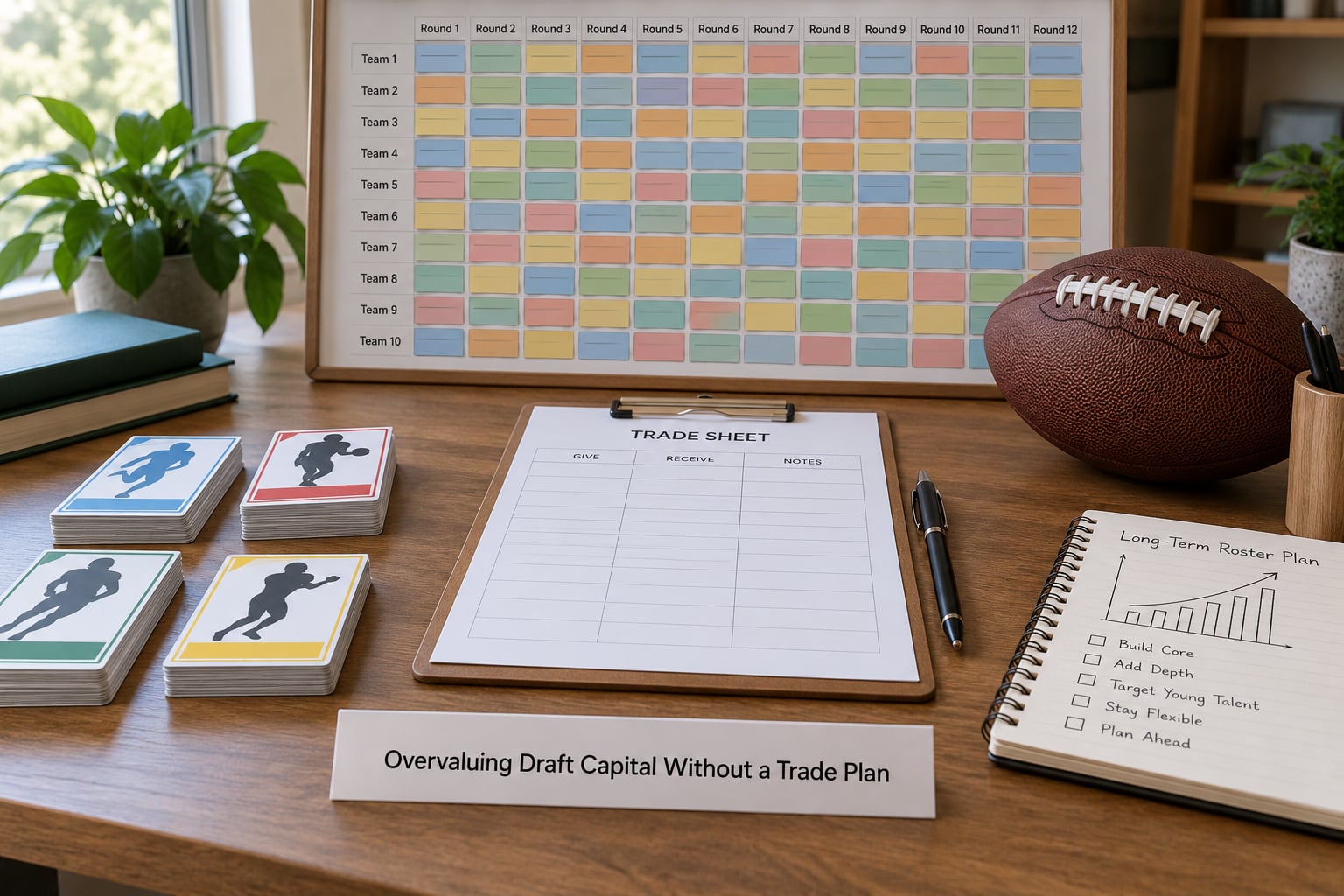
Treating draft capital as a score to maximize is a mistake in redraft leagues and a serious one in keeper and dynasty formats. Extra picks feel valuable, but they only turn into a better roster if you have a reason to use them or someone to use them for you.
Before you move down a board, name the target. A younger player at a premium position? A proven weekly starter to flip? Depth at a position with three injuries? “More picks” is not a reason; it is a feeling.
Quantify the cost. Three picks in round 10 rarely produce three starters. One pick in round 3 produces a player you will still own in year four of a dynasty league. In long-horizon formats the math tilts hard toward the earlier pick, especially at running back and quarterback where age curves are steep.
Common fantasy football draft mistakes to avoid in keeper and dynasty leagues
In keeper and dynasty formats, the most expensive error is buying a one-year name with a pick you could have spent on a young player. A thirty-one-year-old running back gives you a season; a twenty-two-year-old gives you four to six, and the market underprices the second one every year because the payoff is delayed.
Two more format-specific traps. First, valuing a pick on its count instead of its range, when a first-round pick obtained in a trade is worth far more to you than three fifth-round picks. Second, letting auction or snake logic from a redraft league run your keeper draft, when the real currency is age and positional scarcity.
The community consensus I keep coming back to is that process errors hurt more than player errors. Managers forgive a reach; they do not forgive trading down twice with no plan and finishing the draft with a roster that cannot score a consistent week.
10. Failing to Prepare for the Post-Draft Waiver Wire
Treating draft night as the finish line is a mistake, because a draft sets your ceiling and the waiver wire sets your floor. The player who saves your season in November was almost never on your board in September.
Start before the season. List the two or three players at each of your thinnest positions who would immediately upgrade you if they became available, and note what you would drop to add them. That single page is worth more than any dynasty cheat sheet.
Know the categories that generate movement. Offseason roster moves create new roles, a coaching hire can revive a dead offense, and a single preseason game is often the first real information anyone has about a depth chart. Managers who are already watching these players add them within a day of the news; everyone else adds them on Thursday night.
Separate the four waiver categories so you are not just grabbing the loudest name. Injury replacements, role upgrades, breakouts and depth-chart churn all have different time horizons, and the fourth one is where the season-saving value hides.
Keep the league rules in view here too. Some settings let you stash players on IR or bench, and a league that allows it rewards patience that a shallower roster punishes.
Frequently Asked Questions
What are the most common fantasy football draft mistakes to avoid?
The most common errors are drafting on autopilot, ignoring league scoring settings, reaching for players based on hype rather than tier, chasing last season’s numbers, and failing to keep a live draft queue. Every one of them is a process problem with a cheap fix: build a tiered board with fallbacks, read your league file, and update the queue after every single pick.
Should I follow average draft position or my own rankings?
Use average draft position as a market signal, not an instruction. It tells you what other managers are paying, which is useful for identifying tier drops and stretches. It is far less reliable for deciding which player is best for your roster. If your rankings differ from the market, know the reason before the draft, and be ready to state it out loud in the draft room.
Is it a mistake to draft a quarterback in the first round?
It is not automatically a mistake, but it is rarely necessary. Quarterbacks score the most variable weekly in most formats, and a safer option usually sits ten or fifteen picks later. Draft one early in superflex leagues, where scarcity is real, or in auction formats when the price stays low. In a standard redraft league, waiting is almost always the better expected value.
How do I recover when my draft goes wrong early?
Accept it and draft the best available player from that point forward. A bad first pick is recoverable because the rest of your roster is still empty, and the player who looks worse on a ranking than the one you took is not usually worse in practice. Do not compensate with a reach on the next pick, and do not refuse to trade later if an offer improves a position you drafted thin.
What is the biggest draft mistake in keeper and dynasty leagues?
Spending a premium pick on a player at the peak of his age curve. In long-horizon formats, a younger player at a scarce position is worth more than a proven older one, because you own the younger player for several more years. The second mistake is trading down for volume without a plan for using it. Extra picks are only valuable when you have already decided who they are for.
How to Use This Draft Checklist
Start with settings. Confirm scoring, roster size, flex eligibility and transaction rules, then let that shape your rankings rather than patching your rankings afterward.
Next, set your tiers and mark the two tier drops you would pay a real price for. Write your positional minimums beside them so you know the exact pick where need overrides value.
Then handle availability. Read the documented injury notes, decide which players you are pricing for risk, and make sure your roster has a second option at the two positions most likely to lose a starter.
Finally, spend twenty minutes on the post-draft list of waiver replacements. Do it before free agency, before training camp, and before your league mates are all watching the same news.
None of this is clever, and that is the point. A manager who avoids the ten mistakes in this guide usually finishes with a steadier weekly score than a manager with a sharper player list, because the mistakes are what break seasons. Prep wins more often than talent, and the prep costs a Sunday afternoon.