If you want the short answer to how many mock drafts should you do before your draft, most managers are done after three to five purposeful simulations. That number is deliberately low. Fifteen identical mocks do not make you better at picking; four mocks that each answer a different question usually do.
A mock draft is a rehearsal of decisions under a clock, not a preview of your real draft. The board your opponents use is not yours, and the run on wide receivers in rep three was not scripted. Simulating fixes your clock speed, your roster construction and your familiarity with the interface. It does not fix variance.
Table of Contents
- How Many Mock Drafts Should You Do Before Your Draft?
- Are mock drafts worth it?
- What Determines the Right Number of Mock Drafts?
- League format
- Your draft position
- Roster construction and league settings
- Time available
- Simulator or manual draft
- A Practical Mock Draft Schedule
- Mock drafts by time available before kickoff
- How to Get a Useful Result From Each Mock
- Mocks versus ADP research
- What to record
- When More Mock Drafts Are Worth It
- Stopping rules
- Mock Drafting vs. Real-Draft Preparation
- How long does a mock draft take?
- What mocks cannot teach you
- The live-draft checklist mocking does not cover
- Frequently Asked Questions
- Is three mock drafts enough before a fantasy football draft?
- Should I mock draft manually or use an automated simulator?
- How many mock drafts should dynasty league managers do?
- Do I need to mock draft before deciding on a keeper?
- When should I stop mock drafting and prepare for my live draft?
- How do I know whether my mock draft strategy is working?
- Conclusion: Make Your Final Mock Count
How Many Mock Drafts Should You Do Before Your Draft?
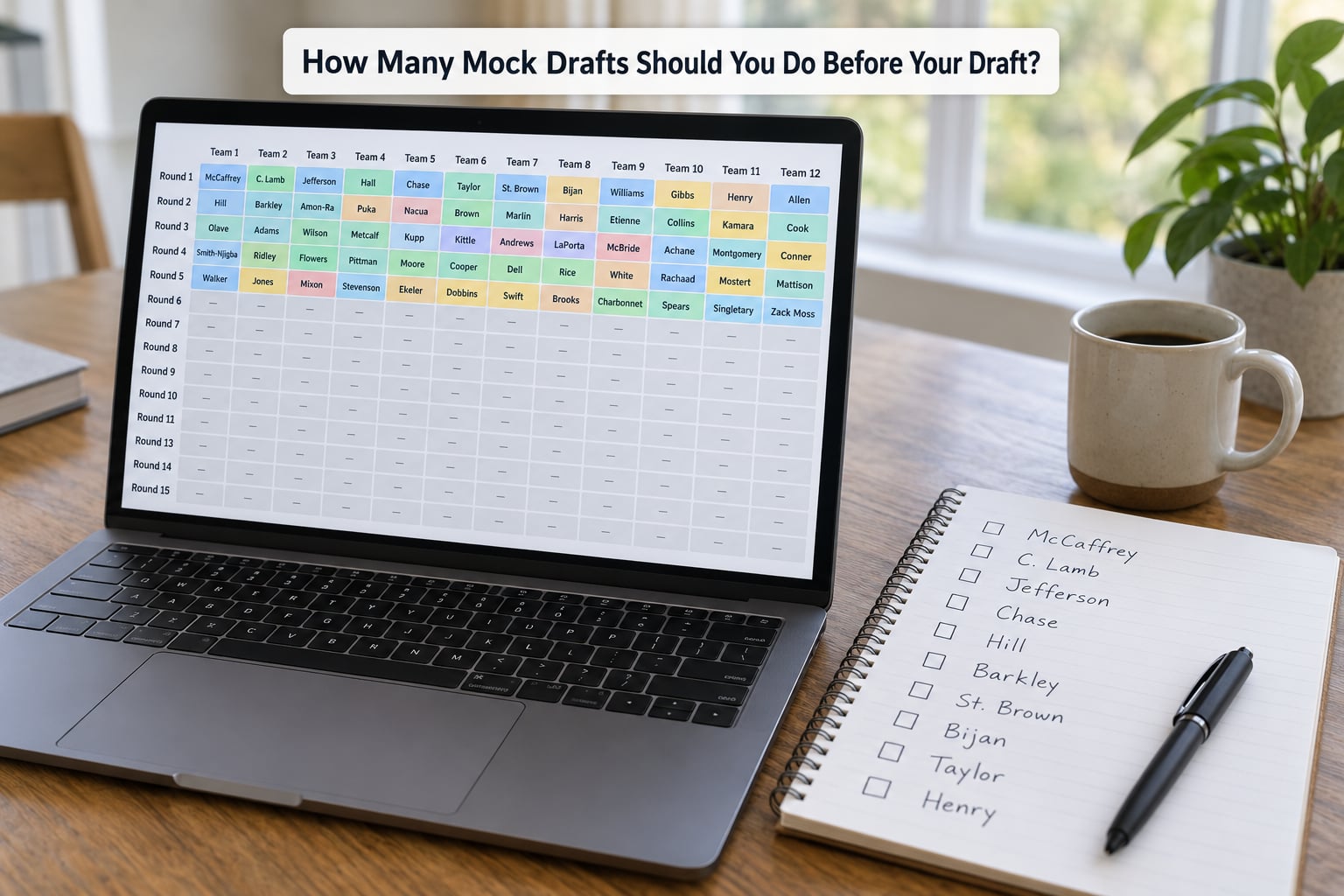
Three to five purposeful mock drafts is the working range for most redraft managers, and five is the floor below which you are probably under-rehearsed. Past that, extra simulations only pay off when you change something on purpose between reps. The signal that you have hit diminishing returns is a draft you can run without thinking, because you have already seen it three times.
Here is what mocks genuinely build that reading alone does not:
- Clock speed. Most managers can identify the right player and cannot commit to them inside ninety seconds. Reps fix that gap faster than any draft board.
- Roster construction. You stop ending up with six receivers and two tight ends because a run felt good at the time.
- Positional run awareness. Seeing running backs fall in reps one and two tells you how thin the position is in your league size.
- Draft client familiarity. Queueing players, undoing picks and finding the settings menu should not eat your first two minutes on draft night.
- Decision tolerance. Losing a player you wanted teaches you to move on. That is the hardest thing to practice and the easiest to skip.
Are mock drafts worth it?
Yes, with one condition: they are worth it when each rep has a job. A manager who mocks twenty times and studies none of the results has paid a subscription fee for entertainment. A manager who mocks four times and can explain why the board fell apart at pick 33 has done real preparation. The reps are cheap, the analysis is the part that changes your draft.
What Determines the Right Number of Mock Drafts?
There is no universal count, and the honest answer depends on variables most managers never think to check. Here are the ones that actually move the number.
League format
Auction drafts need fewer reps and better ones. There is no positional scarcity in an auction, so five mocks that teach you budget discipline are worth more than twenty snake mocks. Dynasty startup drafts sit in the middle, because a mistake in round two compounds across years.
Your draft position
The later you pick, the more drafts you need. Picking twelfth in a twelve-team league means the board has already thinned out before you act, and you have to react rather than execute. That manager needs at least one extra rep from an early slot.
Roster construction and league settings
Superflex leagues, two tight end formats, 16-team versus 10-team leagues and custom scoring all change how the board behaves. If your league is unusual, add a mock configured exactly like it. Most platforms let you mirror your own league.
Time available
This is the biggest factor and the one nobody plans around. A manual mock from your real slot takes roughly 45 to 90 minutes of genuine attention. An instant simulator mock takes about five minutes and teaches you considerably less.
Simulator or manual draft
Instant mocks built from consensus rankings are useful for gauging availability and terrible for practicing decisions. Live mocks against humans feel real but can collapse when opponents bail out early, which is a recurring complaint in fantasy football forums. Mix both rather than picking one.
A Practical Mock Draft Schedule
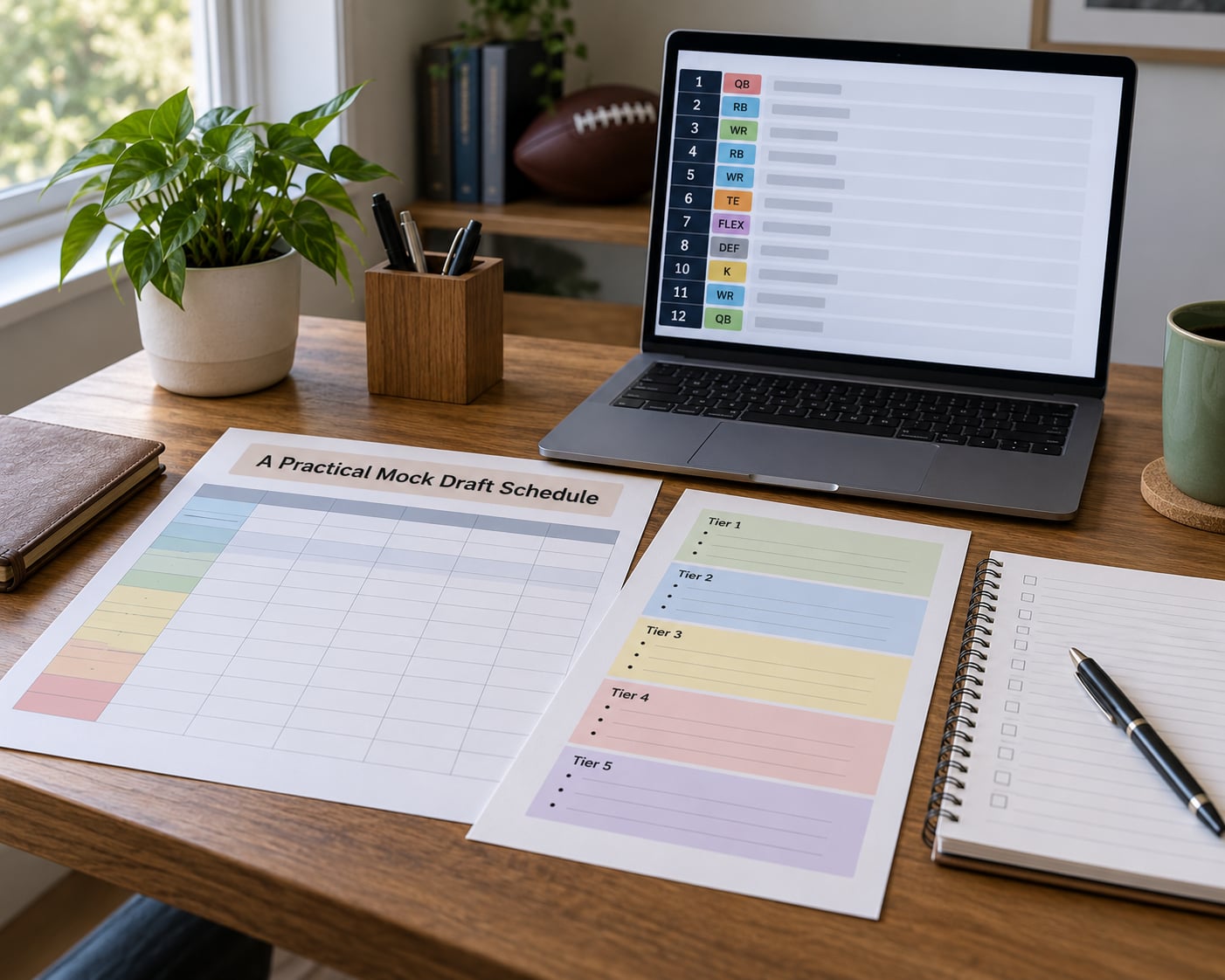
Here is the rotation I would run, roughly in order, with one question assigned to each pass.
- Mock 1, the big board. Draft your real slot on a standard board with no experiments. This one builds pace and exposes roster construction habits. Note the round you panicked and started reaching.
- Mock 2, the alternate build. Force a roster you would normally avoid, such as a Zero RB approach or a loaded receiver room. The goal is to learn where that strategy breaks, not to adopt it.
- Mock 3, the sleeper test. Ignore your own sleepers entirely and draft purely on what the board does. If your sleeper keeps falling, you have a real signal rather than a feeling.
- Mock 4, the league-specific rep. Mirror your actual league: scoring format, roster slots, keepers, superflex settings. This is the rep most managers skip and the one that prevents draft-night surprises.
- Mock 5, the confidence check. One clean run from your real slot on your real settings, on the platform you will actually use. No notes, no experiments.
After each one, write down three lines: which pick felt worst, what the board told you about availability, and one thing to change next rep. That log is worth more than the roster itself.
Mock drafts by time available before kickoff
| Time until your draft | Target mocks | Where to spend the reps |
|---|---|---|
| A few days | 3 | Real slot, real settings, one instant mock for availability |
| About a week | 4 to 5 | Add one alternate build and one sleeper test |
| Two weeks | 5 to 8 | One auction or dynasty-format rep, plus a re-mock after news |
| A month or more | 5, then wait | Early data is soft; spend the gap on rankings and cheat sheets |
How to Get a Useful Result From Each Mock
The difference between a useful mock and a wasted one is written down before you start. Give each rep one question, then let the answer go even if it is unflattering.
Compare two things after every draft. First, your roster construction against the league average: how many running backs, how much total projection at wide receiver, how many picks you spent before your first tight end. Second, your results against average draft position. If your board consistently lands you six picks above a player’s ADP, either your league is smaller than the consensus board or you are fading players who are actually early picks.
Mocks versus ADP research
| Tool | Good at | Weak at |
|---|---|---|
| Mock drafts | Clock speed, roster building, reacting to runs | Predicting a specific board or a specific outcome |
| ADP and cheat sheets | Identifying value when your pick arrives | Building a whole roster under time pressure |
These are complements. Fantasy football managers who quote ADP as a draft strategy often skip mocks entirely and arrive on draft night with good player targets and no practiced plan for the round where everyone else went running back.
What to record
Keep a simple tally sheet: rep number, slot, the question it tested, the pick you would change on a re-run, and the position run you noticed. Four columns is enough. After mock five you should be able to name your build, your fade list and your two contingency plans for picks one through three.
When More Mock Drafts Are Worth It
There are situations where a fourth, fifth or sixth mock is clearly justified rather than a way to avoid preparation.
- Keeper decisions. Mock the startup after your keeper list is applied so you can see which prospects you would actually reach.
- Auction budgets. Auction practice is about discipline under pressure. Managers who will not hold their price in a mock will not hold it live.
- A new league rule. Superflex slots, two tight ends or a shorter roster need at least one rep configured correctly.
- An uncertain slot. If you do not know where you are picking, run one mock from early and one from late so you are not surprised by scarcity.
- Testing a different ADP source. If you have been fading consensus and want to know what happens when it is right, change the board and run it.
- After real news. A significant injury, a trade or a depth-chart reshuffle from preseason games is a valid reason to re-mock, not a reason to add reps for their own sake.
Stopping rules
Stop when you can predict your own draft. Run one more only when it answers a question you have not answered yet, and cap the extras at a handful. Ten mocks done as ten different experiments is preparation. Ten identical mocks is a habit.
Mock Drafting vs. Real-Draft Preparation
Mocking is rehearsal. Draft night still requires tasks that no simulator can do for you, and skipping them is the most common way a well-mocked team still loses.
How long does a mock draft take?
Budget 45 to 90 minutes for a manual mock you actually think through, plus another 15 minutes of review. Instant simulator mocks run in about five minutes and mostly tell you where consensus expects a player to go. If your prep window is one evening, two manual mocks and a stack of instant ones is the honest ceiling.
What mocks cannot teach you
Mock drafts say nothing about in-season waivers, mid-season injury replacements, trade value or playoff path variance. They also cannot tell you how you will react to a manager who takes your sleeper at pick 19, because the board has no memory of your agreement with yourself. Plan for that separately with a short list of players you will take next.
The live-draft checklist mocking does not cover
- Confirm scoring format, roster slots, keeper rules and any house rules.
- Test your login and confirm notifications or the draft-room link work on your phone.
- Know your draft slot and what players typically go there.
- Pre-load your queue with two or three players per round so you are never browsing during your pick.
- Review injury and camp news in the final 48 hours and adjust tiers, not strategy.
- Decide in advance what you will do at your first pick that is not your favorite.
Frequently Asked Questions
Is three mock drafts enough before a fantasy football draft?
Yes, if each one tests something different. Three purposeful mocks can cover your real draft slot, an alternate roster construction and your actual league settings, which covers nearly everything a manager needs. The risk is running three identical drafts and calling it preparation. Write down one question before each rep and check afterwards whether you would change a single pick.
Should I mock draft manually or use an automated simulator?
Use both, for different jobs. An automated mock based on consensus rankings takes about five minutes and tells you roughly where players are expected to go. A manual mock against human opponents takes 45 to 90 minutes and is the only way to practice clock speed, roster building and reacting to positional runs. Automated mocks alone leave you under-rehearsed.
How many mock drafts should dynasty league managers do?
Dynasty managers need fewer mocks on count and more attention on depth. Four to six is usually right, because the real work is projecting how a young player develops rather than guessing this season’s board. Mirror your actual startup format including keepers and roster slots, then spend your remaining reps on player-age and upside questions rather than on who goes at pick 12.
Do I need to mock draft before deciding on a keeper?
Yes, at least once. The keeper decision changes the entire shape of your startup, and a mock configured with your keeper list applied shows which prospects you actually reach rather than which ones sound good in isolation. It also reveals the market for the players you would trade to acquire a keeper. One clean mock is usually enough to make the call.
When should I stop mock drafting and prepare for my live draft?
Stop when your next rep would repeat a rep you have already run, and no earlier. At that point switch to live-draft preparation: confirming league rules, testing your login, checking your draft slot, pre-loading a player queue and reviewing injury news in the final 48 hours. Mocking and draft-night preparation are separate tasks, and skipping the second one is the usual reason a well-rehearsed team underperforms.
How do I know whether my mock draft strategy is working?
Compare outcomes, not finishes. After each rep check your roster construction against the league average and your results against consensus average draft position. Look for repeats: the same round where you reach, the same position run you keep ignoring, the same type of player you pass on twice. A repeatable mistake is a problem; one bad mock draft is variance.
Conclusion: Make Your Final Mock Count
Three to five purposeful mock drafts prepare most managers better than fifteen repetitive ones. Add reps when a specific question is still unanswered, such as a keeper decision, an auction budget or a league with unusual settings, and stop the moment you can predict your own draft. The number matters far less than whether each simulation tested something.
Do one thing now. Write your five mock questions on paper, block the time, and keep the log after every rep. Then spend the hours before kickoff on the prep that mocking cannot touch.