Knowing how to draft in a superflex league comes down to a handful of repeatable decisions: get one starting quarterback in your first two rounds and a second by round 4 to 6, build running back and wide receiver depth through rounds 5 to 9, add a third quarterback for injury and bye-week cover around round 9 or 10, and wait on tight end until the late rounds. If you have never done it before, the whole method takes about 45 to 60 minutes of prep, and the first draft in the format has a real learning curve. This guide assumes a 12-team, superflex, redraft, full-PPR league, and I note where 8- and 10-team leagues, auction, best ball and IDP settings change the plan.
Table of Contents
- What a superflex league is
- The 7 core rules of a superflex draft
- What You Need
- Your league settings, opened and read line by line
- Your scoring settings, especially passing touchdowns
- A draft board that reflects your league
- A ranking source you actually trust
- Twenty to thirty minutes of preparation
- Step-by-Step: How to Draft in a Superflex League
- How to Draft in a Superflex League by Confirming Your Scoring
- Create League-Specific Big Boards
- Understand Your League’s Tiers
- Map Quarterback Runs Before Pick 10
- Set Realistic Scarcity Thresholds
- Build a Starter-Based Plan by Round
- Drafting from Your Pick
- Use Tiers to Survive Position Runs
- Draft for Weekly Flex and Superflex Utility
- Manage the Late Rounds and Final 20 Picks
- Run a Post-Draft Check
- Common Mistakes
- Frequently Asked Questions
- When should I take a quarterback in a superflex league?
- How many quarterbacks should I draft?
- What is a good superflex scoring threshold?
- Should I draft a rookie quarterback in superflex?
- Does superflex strategy change in a keeper or dynasty league?
- Conclusion
What a superflex league is
A superflex league uses a flex spot that accepts a quarterback as well as a running back, wide receiver or tight end. That single rule turns it into a two-quarterback start every week, which is why quarterbacks are drafted earlier and valued far higher here than in any other format. The only requirement is that your QB2 is a real starter, not a backup QB you drafted as a flyer.
That constraint is the whole format. In standard or flex-only leagues a quarterback is a flex option you use when a running back is on your bye. In superflex, your quarterback is a starting slot and your flex is a second quarterback plus a running back, receiver or tight end. You are not adding one interesting pick to a normal roster; you are running two separate starting lineups at the position everyone fights over.
The proof point that convinced me years ago is a positional-equivalence number: a mid-tier starter who finished 21st among quarterbacks produced a season total that would have ranked about ninth among running backs and third among wide receivers. That is the median starter outscoring most flex options. If the guy finishing 21st at QB would be a top-10 RB, the guy finishing 12th is your flex, and everybody in a superflex league needs a flex spot filled every single week.
The 7 core rules of a superflex draft
- Move every quarterback up the board. Value them at the flex spot, not the starter spot, so your ranking list has zero quarterbacks in the bottom third.
- Do not force round 1. If the elite quarterbacks are gone at your pick, take the best available running back or receiver and circle back to quarterback in round 2.
- Secure two reliable starters by round 4. Waiting until round 5 or 6 means bidding in a market that has already tripled.
- Build running back and wide receiver depth in rounds 5 to 9. The replacement window for those two positions is where most of the value hides.
- Add a third quarterback by round 9 or 10. That is your bye-week and injury cover, and it replaces a fourth running back on most rosters.
- Fade early tight ends. In a one-starter format, waiting until round 10 or later costs almost nothing in expected points.
- Read the live board, not just your sheet. When quarterbacks leave faster than your board says, accelerate your whole quarterback plan by a round.
Managers on r/fantasyfootballadvice repeat the third-quarterback rule constantly, usually framed as insurance rather than upside. One common thread is worth repeating: a quarterback held as a bye-week fill-in is an advantage, whereas hoarding a fourth running back just adds another injury risk to the same position you already own three times.
What You Need
Before you sit down to draft, you need six things. None of them cost money, and all of them are findable in an evening.
Your league settings, opened and read line by line
Not the platform’s default template. Open the actual settings and confirm the number of starters, how many flex spots you have, whether the flex spot can take a quarterback, and the bench size. A 1QB/2RB/3WR/1TE/1SF/1K/1DST/6Bench league and a 1QB/1RB/3WR/1TE/1SF/1DEF league produce very different round budgets, and managers regularly misremember which one they are in.
Your scoring settings, especially passing touchdowns
This single number changes the quarterback plan more than any other variable, and it is the most-asked question in the forum threads I read. A league scoring three points per passing touchdown is a meaningfully different draft from one scoring six, and I break it out below.
A draft board that reflects your league
Any board, honestly. What matters is that it is not blank, that you have typed in your own players, and that you can see the whole pool rather than scrolling. A spreadsheet works. So does the board inside your league platform.
A ranking source you actually trust
Consensus rankings are a fine starting point. What you actually need is superflex average draft position data, because the ordinary ADP lists quarterbacks far lower than they will finish in your league. If your board and your league’s board disagree about quarterbacks, the league wins.
Twenty to thirty minutes of preparation
That is enough to type in your league’s scoring, mark tiers, and write your two quarterback deadlines in the margin. It is also the difference between a draft you steered and a draft you reacted to.
Step-by-Step: How to Draft in a Superflex League
The method below is how to draft in a superflex league properly: eleven steps, designed to be done once before draft day so that draft night is nothing but execution. Eleven steps take roughly 45 to 60 minutes end to end. For a first-time superflex manager, expect the first live draft to feel slower than usual, because the board moves in a pattern you have not seen before and you will second-guess your own plan at pick 1.04 or so.
How to Draft in a Superflex League by Confirming Your Scoring
Start by writing down how many points a passing touchdown is worth, because that number sets your quarterback deadline. A passing-yard scoring setting changes it again. Once you have the number, count how many quarterbacks you need as starters and how many you want as insurance, then work backward to a round.
| Passing TD points | What it means for the draft | Target round for QB1 | Target round for QB2 |
|---|---|---|---|
| 3 points | Passing volume is under-rewarded, so the top skill players hold more value | Round 2 | Rounds 5 to 6 |
| 4 points | The league default in most formats; the balanced case | Round 1 or 2 | Rounds 3 to 4 |
| 6 points | Passing is heavily rewarded and the position inflates hard | Round 1 | Rounds 2 to 3 |
That table is why one manager in a r/fantasyfootballadvice thread asked whether a top quarterback was even a top-three pick in a league scoring three points per passing touchdown. The answer in that league was genuinely no, and taking the running back or receiver first was correct. In a six-point league, going running back first would have been a mistake. Same format, same player, opposite decision.
Next, look at your flex eligibility. If you have two flex spots and only one can take a quarterback, you need a different roster shape than if both can. And count your actual weekly starters: a 12-team league with nine starters plus flex has far more weekly replacement jobs than an eight-team league with five.
Create League-Specific Big Boards
Build your player pool without ranking it. This sounds strange, but ranking first is a trap: it freezes a global order that has nothing to do with your league’s settings, and you end up drafting a generic list instead of a roster.
Instead, list every player you would consider drafting into your slots and nothing else. Then take your trusted ranking and sort that pool by tier. Sorting a narrowed pool takes five minutes and produces a board that already matches your league.
On this board, add the two most important annotations: which quarterbacks you are willing to draft and which ones you would take at a discount. Everything else can stay generic.
Understand Your League’s Tiers
A tier is a group of players who are effectively interchangeable. A narrow tier has a clear top and a clear bottom. A deep tier is a cluster of eight or nine guys who will all produce roughly the same weekly range, and the order inside it is noise.
Most running back and wide receiver tiers are deep. Most tight end tiers are narrow, which is why one elite tight end is worth an early pick and the next ten are not worth round 5.
The practical rule is this: once a tier break happens, ignore the tier labels. If your first-choice player in a tier is gone and the ninth-best player in that tier is sitting right there, the two are the same player for your season. Taking the ninth guy to preserve the label wastes a round, and managers who refuse to do it are the reason a supposedly great superflex draft ends up with one flex filler.
Map Quarterback Runs Before Pick 10
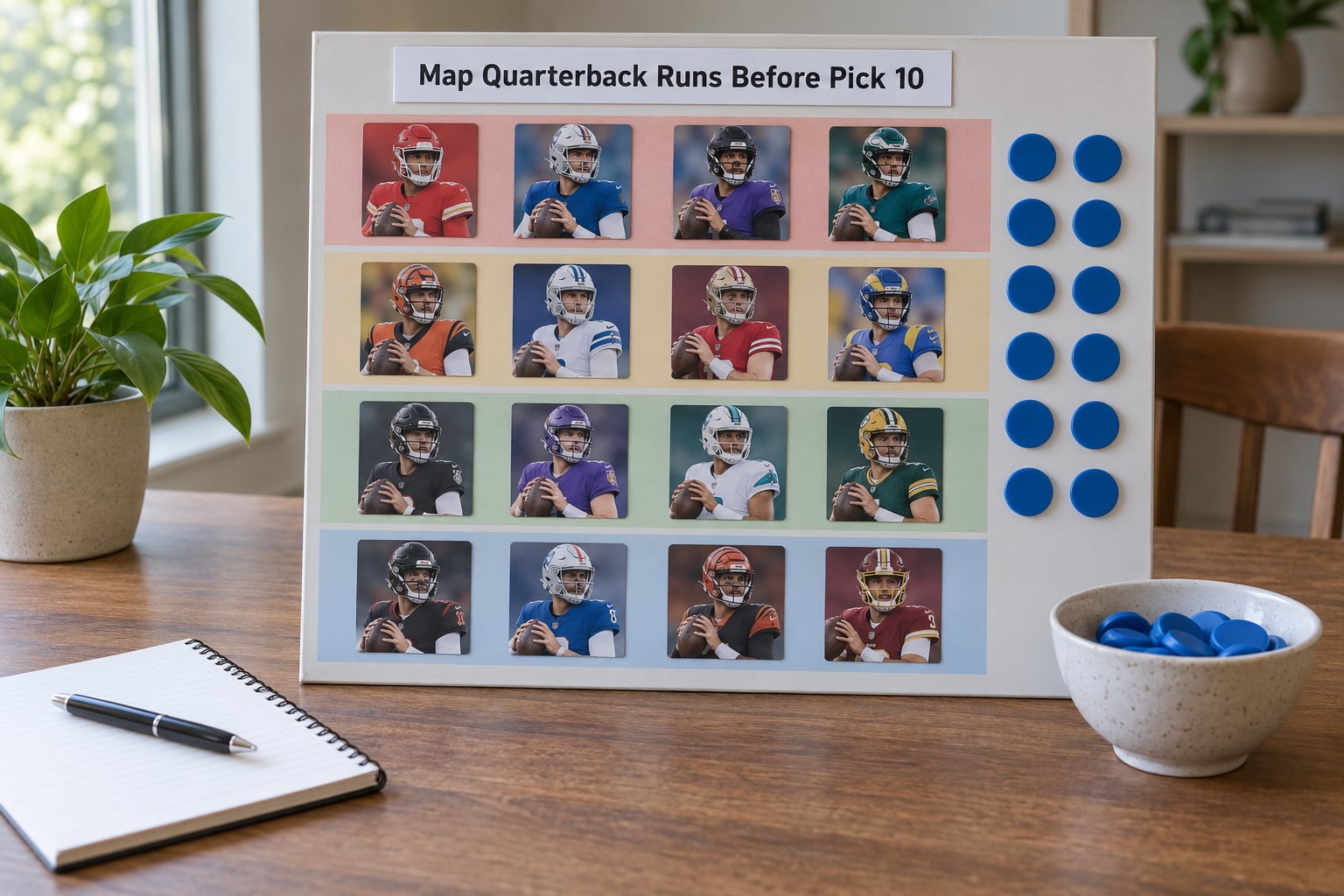
A quarterback run happens when three or four teams take quarterbacks back to back, usually in rounds 2 and 3. You will see it from about pick 8 onward, because by then every manager in the league has checked the quarterback board.
Before the draft, decide your response to a run in advance, because you will not be calm when it happens. The response is not always to join it. If the run is happening at pick 2.03 and you are at 2.04, your options are a bridge quarterback, a running back, or a receiver.
A bridge quarterback is the best player available who you would be happy to start. If that guy is your 15th-ranked quarterback and you know three better ones will still be there at 3.06, take the bridge, take a starter at another position on the next pick, and come back to the second starter in round 3. That sequence gives you two starters by round 3 without the run pricing you out of the second round.
The other option is to skip the run entirely, take the best skill player at your pick, and let the bridge quarterback fall to your next pick. That works when the run is small, three picks or fewer. When it stretches to six or more, you are gambling that a usable fallback exists, and in a 12-team league there usually is not one.
What you should never do is reach for a bad quarterback to stop a run. The purpose of a run is to make you pay a price you were not planning to pay. If the price is more than one round of value, decline it and adjust later.
Set Realistic Scarcity Thresholds
A scarcity threshold is the round at which a player stops being a luxury and becomes a need. Write yours down as a number before draft night, and use position counts from your league settings rather than general rules.
For a 12-team superflex league with one starting quarterback, one superflex, one kicker and one defense, the league needs roughly 36 quarterbacks across all rosters. A usable starting-quality population for that league is about 20 names. So the twelfth quarterback in your ranking is the point where you should stop calling a QB a stretch.
For running backs, 12 teams needing two starters plus a flex plus bench means a realistic useful pool of about 45 names. The receivers run deeper, roughly 70 before the pool becomes unusable, but because the flex spots absorb receivers all year, your own receiver line needs to keep producing beyond the tier everyone else is drafting from. Tight ends are the outlier: with one starter slot in most of these leagues, a pool of about 20 is plenty, which is exactly why you can wait.
Scale those numbers to your league. Eight teams needs far fewer quarterbacks, so the scarcity threshold arrives much earlier and you must take your QB1 in round 1. Twenty teams stretches the pool, so you can wait. Write the numbers down for your league, not mine.
Build a Starter-Based Plan by Round
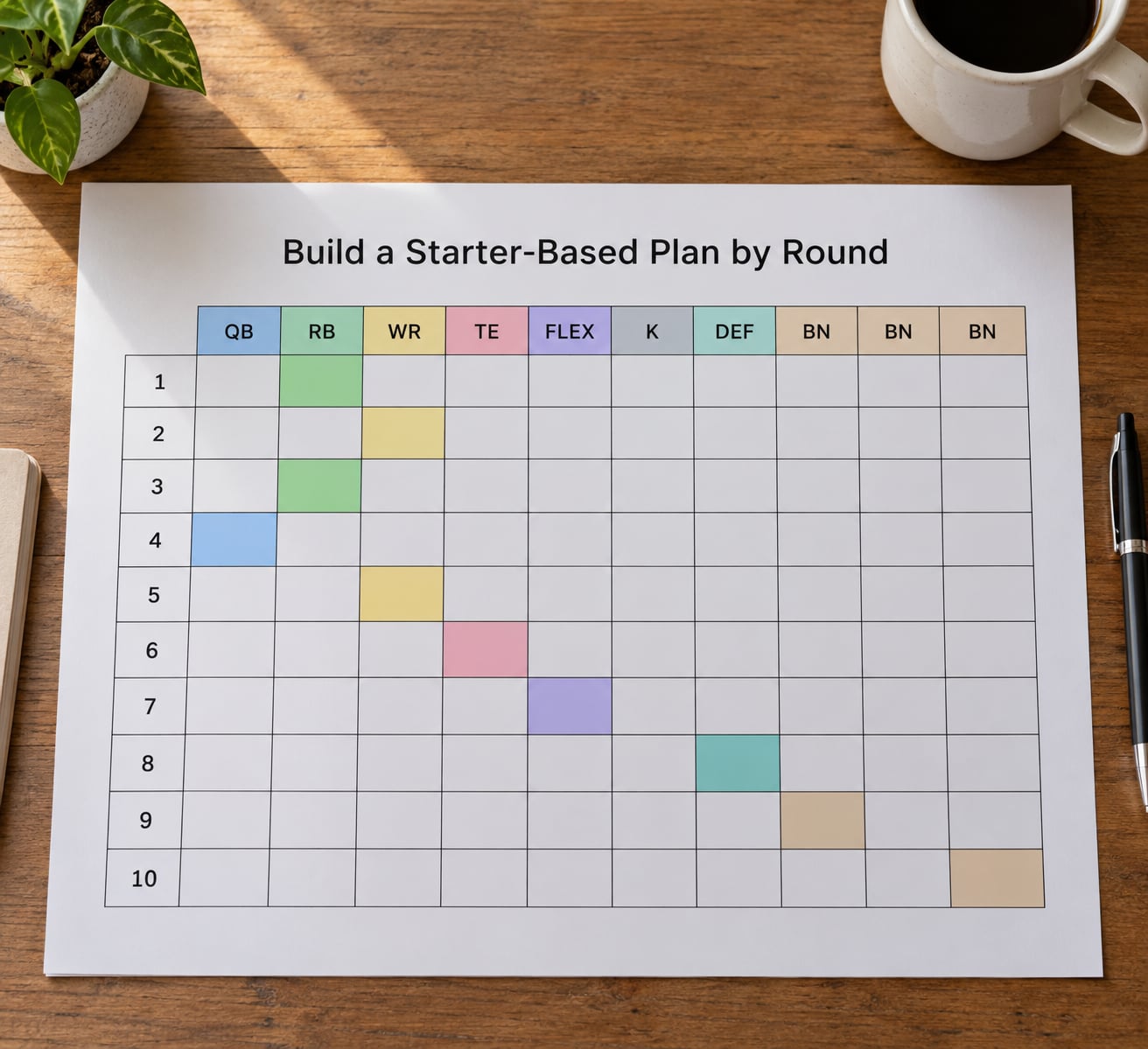
Your plan should be built from your own weekly lineup, not from a generic round list. Take your nine or ten starters plus flex, subtract what you expect to get in your final rounds, and work backward.
| Round | Target position | What the round is for | Quarterback deadline |
|---|---|---|---|
| 1 | Best player available, usually QB or an elite RB | Anchor your highest weekly ceiling | QB1 by round 2 at the latest |
| 2 | Second QB or the best remaining anchor | Get the second starter | QB2 by round 4 in a four-point league |
| 3 | Running back and wide receiver depth | Fill the starting skill spots | Decide here if you are taking a bridge QB |
| 4 | More skill depth | Cover your starter requirement | Hard deadline for QB2 in every league |
| 5 | Running back and receiver depth | Build the replacement pool | No deadline yet |
| 6 | Skill depth, plus a second tight end if the board forces it | Volume matters more than talent now | Bridge QB target if you waited |
| 7 | Skill depth | Separate yourself from the middle of the draft | No deadline yet |
| 8 | Skill depth, tighten the bench | Build the lineup that plays in weeks 1 through 8 | No deadline yet |
| 9 | Third quarterback | Bye-week and injury cover | Third QB by round 10 |
| 10 | Tight end | Fill the only one-starter position you can wait on | Complete |
| 11 | Deeper skill depth | Separate replacement value from replacement-plus value | Complete |
| 12 and later | Kicker, defense, sleepers | Late upside and same-team stacking | Complete |
The plan is a fallback, not a script. If the board gives you three receivers in round 3 because your league is fading tight ends and quarterbacks, take the receivers. Knowing how to draft in a superflex league is mostly deciding, in advance, what you will do when the board is ambiguous rather than deciding in the moment out of panic.
Drafting from Your Pick
Almost every question in the forum threads reads the same way: I have pick 1.06, now what. So here is what each range looks like.
Pick 1.01. Take the best player available, which in most superflex leagues is an elite quarterback or an elite running back. If you take the running back, your quarterback deadline becomes round 2 and you have to hit it.
Picks 1.02 to 1.04. Still inside the quarterback window. Take the best available and do not overthink it. A mid-tier running back at 1.03 is fine; a mid-tier quarterback at 1.03 is usually better.
Picks 1.05 and 1.06. This is the most common draft slot in these leagues, and the most common source of paralysis. If a top-tier quarterback is available, take him; you get your QB1 and your QB2 becomes a round 3 or 4 target. If the quarterbacks are gone, take the best running back or receiver and set your quarterback targets for rounds 2 and 3.
Picks 1.07 to 1.09. You are probably outside the top quarterback tier. Draft two top-ten running backs or wide receivers if they exist, then plan on a bridge quarterback plus a starter by round 4.
Picks 1.10 to 1.12. No pressure on quarterbacks at all. Take the best skill players you can find and let the quarterbacks come to you in rounds 2 through 4. Your league mates are drafting them, and that is exactly what you want.
Use Tiers to Survive Position Runs
Runs happen at every position, but tight end is the one that hurts most, because the pool is narrow and everyone wants the same two names in round 1.
When a run starts, your first question is whether the run is about value or about need. A tight end run in round 1 is usually need-driven, because managers do not want to face an empty tight end slot later. A running back run in rounds 2 and 3 is usually value-driven, because someone just saw a name climb on their board.
Either way, the fix is the same: find the players inside the depleted tier who can replace what you wanted. If the top two tight ends go in round 1 and you drafted one, the third-best tight end is a fine starter. If you drafted neither and take one in round 4, you were also fine, provided nobody else in your league takes three before round 6.
The exception is the first two rounds of tight end. Those are the only two players in the format with a genuine weekly ceiling above the replacement tight end, and if you are picking in the top four, taking one of them is defensible. Everywhere else, follow the run one round and then pivot back.
Draft for Weekly Flex and Superflex Utility
Weekly flex value and superflex value are not the same thing, and confusing the two is the most expensive mistake in the format. Weekly flex value is what a player does in one matchup. Superflex value is whether you could start him in the flex slot every week without thinking about it.
| Position | Weekly flex value | Superflex value | How to use it |
|---|---|---|---|
| Quarterback | Highest weekly ceiling in the format | Highest, because the superflex slot can take him | Draft two starters early, always |
| Running back | High but volatile | High and reliable, since a starter almost never hurts you | Draft early starters, then volume late |
| Wide receiver | Ceiling is the highest of the three skill positions in PPR | High, and the safest filler when a quarterback is on a bye | Build depth across many rounds |
| Tight end | Acceptable filler in PPR | Weakest superflex filler of the four | Wait until round 10 or later |
That table is the reason tight ends are the position you fade. A tight end fills your flex fine on a good week and wastes it on a bad one, whereas a running back or receiver who goes into the flex is usually there because something happened to your quarterback. You want that something to happen, and you want the replacement to be reliable.
So the draft priority follows the table: two quarterbacks first, then enough starters at the skill positions that a quarterback bye is painless, then volume on the bench in rounds 5 through 9. Your superflex lineup should be full of players you never have to think about.
Manage the Late Rounds and Final 20 Picks
Once your starters and two quarterbacks are done, roughly half your picks are left and the draft gets sloppy. A few rules keep it productive.
From round 5 to round 9, draft volume. Look for running backs and receivers on teams that give them three-plus offensive touches per game, because a running back with a defined role can start on a flex spot during your quarterback’s bye. A back who is a goal-line specialist only is a bench player, not a flex option.
Between rounds 9 and 10, take the third quarterback. Some people prefer a fourth receiver instead, arguing the flex spot needs depth more than a third quarterback. Both builds work in a 12-team league. Just do not take two third quarterbacks and call it a strategy.
In the last ten picks, hunt for two-starter combinations and same-team stacks. A rookie quarterback is not a stash in redraft, because he will not play until year two in most organizations. A rookie wide receiver on a high-volume offense, however, is a legitimate late-round flier because he can start in week one.
And keep your draft capital honest. A player who cannot start in your flex, cannot start at his own position, and carries no special teams role is a wasted pick, however much you liked his ceiling in August.
Run a Post-Draft Check
Spend ten minutes after the draft on four checks. This is the step most managers skip and it catches real problems.
Worst-case injury test. Assume your first-choice quarterback is out for three weeks. Do you have two players who can start in the superflex slot? If not, you need a replacement, and finding one in August is easier than finding one in week 6.
Replacement-level test. Assume every player above your first-round quarterback is disappointing by 30 percent. Is your second quarterback still a starter? If your QB2 was a borderline name, a down season collapses your whole lineup.
Bye-week test. Count how many of your quarterbacks are on bye in the same week. Two quarterbacks are enough; three on the same bye is bad luck, but you should know before week 1.
The flex threshold test. List the ten best players on your roster who are not your two starting quarterbacks. Your weekly flex is drawn from that group. If it is mostly backups and fourth-string receivers, you have a flex problem, not a quarterback problem.
People on r/DynastyFF run mock superflex drafts as a weekly routine, and the reason is that this check is much easier on a practice roster than on the real one.
Common Mistakes
Five mistakes come up over and over, and each one has a straightforward fix.
Drafting superflex like standard flex. The fix is the whole premise of this article: value quarterbacks at the flex spot, so two of them leave your board in the first four rounds.
Reaching for a bridge quarterback too early. The fix is to draft the best player at your pick and set your next pick as the quarterback pick. You will almost always get one more good quarterback than you think at pick 2.05.
Ranking every player equally. A flat list treats a difference of two points the same as a difference of forty. The fix is tiers, and within-tier indifference. Take the ninth-best player in a deep tier without blinking.
Ignoring roster rules. Bench size, kicker and defense requirements, and the number of flex spots change the round budget more than most rankings do. The fix is to read the settings page the night before and note the number of quarterbacks the league needs in total.
Loading up on one weak tier. Four tight ends in round 6 sounds like depth and plays like a wasted bench. The fix is one starter plus depth at the positions the flex spot can absorb, which is every skill position except tight end.
One more that deserves naming: pairing a quarterback with his own team’s lead running back. They fail together in a bad offensive week, and in a format where you need one of them in your flex every week, a correlated bad week is exactly what you cannot afford.
Frequently Asked Questions
When should I take a quarterback in a superflex league?
Take your first starting quarterback by round 2 and your second by round 4 in most 12-team leagues. If your league scores six points per passing touchdown, take one in round 1 and the other by round 3. In an eight-team league the whole thing happens sooner because the league needs fewer quarterbacks in total. The deadline matters more than the exact round: once the fifth quarterback in your ranking is gone at your pick, you are late.
How many quarterbacks should I draft?
Three in a 12-team superflex league, two in an eight-team league. Your two starters handle every regular week, and the third covers injuries and your starters’ bye weeks. A fourth is usually one pick too many unless your league is large or heavily pass-weighted. Replacing the fourth quarterback with a fourth receiver gives your flex spot a genuine week-one option, which most rosters do not otherwise have.
What is a good superflex scoring threshold?
Three points per passing touchdown is the number most likely to make you skip quarterbacks at 1.01, because passing volume is under-rewarded and elite skill players hold more value. Four points is the balanced default and the case most advice is written for. Six points inflates the position so hard that a top quarterback at 1.01 is usually correct. Check your own settings before you set a plan.
Should I draft a rookie quarterback in superflex?
In redraft, almost never as your second starter, because most rookies do not start in week one. In dynasty it is different: age curves mean a rookie quarterback is often your best long-term value if he lands in a good offense. The middle ground is a rookie on a team with an unsettled starter job. Draft him late with a spot you can afford to waste, not early with a pick you needed.
Does superflex strategy change in a keeper or dynasty league?
Yes, mainly because the cost of a bad pick lasts longer. In keeper and dynasty leagues, prefer quarterbacks with a multi-year ceiling and a favourable age curve over a quarterback who is merely a 15-point-per-game replacement. Two-man keeper superflex leagues add a second constraint: the player you keep next year may be one you would rather trade, so draft for value rather than for this season only.
Conclusion
To draft in a superflex league, do three things in order. Confirm your league settings and scoring first, because the passing touchdown points decide everything downstream. Write your two quarterback deadlines on your board before the draft starts. Then draft the best player available at every pick and only adjust when the board gives you a reason.
Everything else, the tier work, the scarcity thresholds, the round-by-round targets, is there to answer one question when it arrives at 2.07 with two teams taking quarterbacks: should I take one? Having decided that in advance is the entire difference between a superflex draft you steered and one you survived.