
A committee backfield is one where a team deliberately spreads carries and pass-catching work across two or more running backs instead of handing the job to one bell cow. You spot one by triangulating roster moves, scheme, and camp reps, then confirming with real carry and target splits in the first few weeks of the season, because published depth charts are released far too early to trust on their own. Ten minutes of offseason research and a weekly five-minute check is usually enough.
Most of the bad committee calls I have seen come from one of two places: a manager who heard the word “committee” once in a press conference and faded the whole backfield, or a manager who saw a single 24-carry game and called it a bell cow. Both are avoidable with a fixed process.
Table of Contents
- What You Need
- Step-by-Step
- How to Spot a Committee Backfield by Checking Whether It Really Shares Carries
- Review Targets and Passing Game Involvement
- Look for Role Changes in the Depth Chart
- Separate Committee Opportunity From Committee Risk
- Confirm the Pattern Over Time
- Common Mistakes
- Frequently Asked Questions
- What is a committee backfield?
- How many carries indicate a committee backfield?
- Is a committee backfield good or bad for fantasy football?
- How do I choose between two players in a committee backfield?
- Does goal-line work matter in a committee backfield?
- How long should I monitor a possible committee before acting?
What You Need

You do not need a paid subscription to anything. Free snap and target data, team beat reports, and a notebook cover the whole job, because the method is about counting touches rather than guessing at talent.
Here is the toolkit, in the order you will use it:
- Carry and snap splits by week. Share of carries is the base layer. A genuine committee shows up as two players in the 30 to 50 percent range over several weeks, not one spike.
- Red zone carries and goal-line snaps. Goal-line work is the scarcest resource in a committee and the best tiebreaker between two backs with similar totals.
- Target share and checkdown counts. Passing game involvement is what separates a real committee member from a backup who only gets carries in blowouts.
- Depth chart news and revision dates. Note when a chart was published. Most team charts are posted in August and barely touched afterward.
- Teammate role descriptions. Practice reports that say “first-team reps” or “shared carries” in week one are worth more than a chart from six weeks earlier.
- Team context. Roster construction, contract years, and the offensive coordinator’s history of committee usage.
Keep everything in one place per team. By draft time you will have a page per backfield, and the page is what stops you from re-deciding the same question every Sunday.
Step-by-Step
Learning how to spot a committee backfield takes five checks, in this order. Each one rules out a different explanation, and the order matters because carry split is the only one that settles the question on its own.
How to Spot a Committee Backfield by Checking Whether It Really Shares Carries
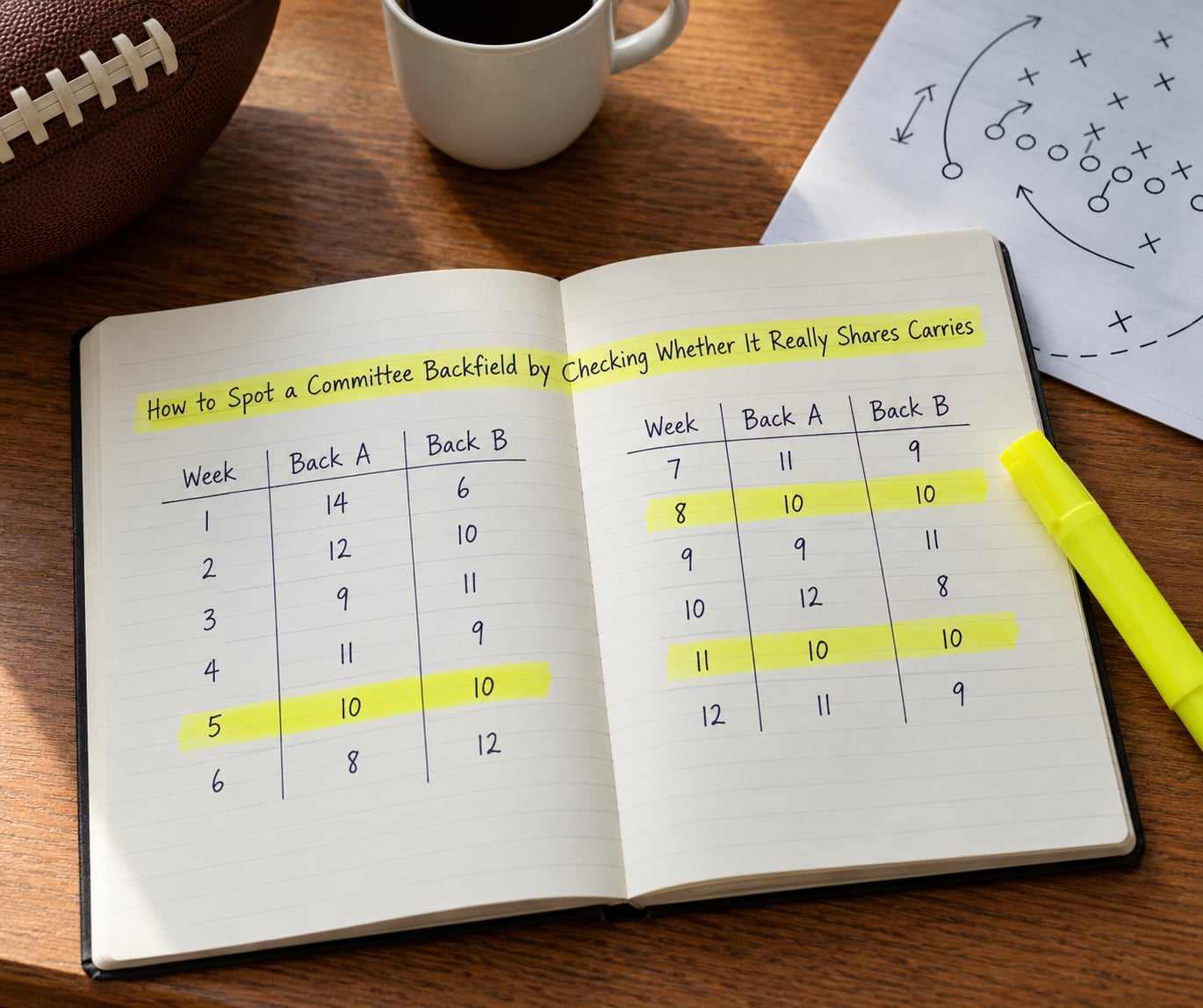
A real committee divides early-down run plays roughly evenly, every week, regardless of score. That consistency is the test.
Start with the last four to six games of the prior season and count each back’s share of carries. If one player has won 60 percent or more, you are looking at a lead back with a backup, not a committee. If two players have traded the lead role week to week and neither has held above 55 percent across the stretch, the split is real.
Temporary rotation and game-script usage look different. Game script inflates the starter late in blowouts, which shows up as a wide but uneven split. A committee shows up as a narrow split that never resolves, even in a 24-point win.
The check that worked for me: ignore the first quarter of each game. Count carries from the second quarter on, when coaches are running planned plays rather than reacting. Committees stay balanced there. Game script shows up as a backfield that only splits when the game is already decided.
Watch red zone carries separately. A committee where one back takes every goal-line snap is not a committee, it is a lead back with a change-of-pace complement.
Review Targets and Passing Game Involvement
A committee back who never catches a pass is a committee back with a fantasy ceiling you can write down in advance.
Count targets and checkdowns per game. Passing game involvement is what separates three different situations that all get called committees: two backs who genuinely share a three-down role, a lead back plus a designated checkdown option, and a lead back whose backup only gets touches when the game is out of hand.
The middle case is the one that punishes drafters. If a backup lines up in two-wide on third down and the lead back goes nowhere, that is a real two-man role. If the backup only appears in garbage time, he is insurance, not a committee member, and projecting him as a committee piece will cost you a roster spot.
Then check the personnel groupings. If both backs are on the field together on early downs, the split is likely to be a feature of the offense rather than a response to injuries. If they only share the field on obvious passing downs, treat the committee label with more caution.
Even in the last two seasons of a shared role, a player can post a 3-carry, 6-target game on the back of committee usage and 4 carries the following week. That kind of swing is expected, and it is the reason you want the season-long share rather than the weekly box score.
Look for Role Changes in the Depth Chart
Treat every published depth chart as a snapshot, never a conclusion.
Charts go up in August, when rosters are least settled and least informative. They are rarely updated when a coach changes his mind, which is exactly the change you are trying to catch. Instead of trusting the chart, treat it as a starting claim and look for corroboration.
Four things contradict a stale chart: the first-team rep report from a beat writer, a coach using a specific player’s name first when describing the backfield, the veteran and rookie reversing the order in practice participation, and third-down personnel groupings on film.
Coaching language is the strongest signal here. When a coach describes one back as the primary option and the other as a complementary piece, you have a lead back with a committee member. When a coach says the touches will be decided each week, or uses both names in the same sentence as equals, you have a committee.
Signals that multiple players are listed as starters, or that the chart shows a shared goal-line role, are worth checking too. Just verify them against rep data, because those charts are frequently boilerplate.
Separate Committee Opportunity From Committee Risk
A committee lowers a back’s ceiling and often creates a cheap alternative. Whether that is a problem depends on the matchup, your league format, and the week on your calendar.
Work the math in two columns. On the opportunity side, count expected touches per game: projected carries plus projected targets, then multiply by your scoring format. A back averaging 11 touches in a committee at a low draft slot often beats a bell-cow projection of 14 touches drafted three rounds earlier.
On the risk side, list role security. Is this back guaranteed touches next week? Does the coach rotate by opponent? Is he on a bad offense that will trail and take the ball out of the run game entirely? Is he one injury, one fumble, or one bad block away from the bench?
Matchup is the tiebreaker you get for free. A committee back against a team that concedes a high share of carries is a better weekly play than the same back against a top-five run defense, even at the same projected total. Committees also tend to resolve one way against bad teams: the lead back keeps the goal-line work regardless of score.
Then decide the format. In redraft, uncertainty is expensive and a cheap committee member is often a bench stash rather than a starter. In dynasty, the same player is a cheap asset on an age curve, and the buy-low window is now rather than in three weeks.
Confirm the Pattern Over Time
Do not act on a single week, in either direction.
Keep a running sheet with carries, targets, and red zone touches per back per game, and read it once a week on the same day. Judge the committee on a rolling three-to-four week window, because one-game samples swing wildly in a split role.
Three weeks is the practical minimum before you commit to a start or sit decision, and a full month is more honest. A committee that has stayed within a few percentage points of even across four games is a committee. One that has drifted toward a single back is resolving, and by week six the resolution is usually complete.
Decide in advance what changes your mind. If the leading back takes 70 percent of the carries for two consecutive weeks, you have your answer and should stop re-checking. If a starter misses time, expect the split to widen before the replacement is absorbed, and adjust rather than panic.
Write down the conclusion and the date. Fantasy managers re-litigate a decision from three weeks ago more than any other kind of error, and a dated note ends that conversation in about ten seconds.
| Structure | Carry pattern | What it means for you |
|---|---|---|
| Bell cow | One back takes 65 percent or more every week | Draft normally; project the lead back’s volume directly |
| Committee | Two backs stay within a narrow split for four-plus weeks | Target one member by role, expect a lower ceiling, check ADP value |
| Rotation | Even split that only happens after one player is injured | Buy the replacement, not the original, and check the return date |
| Timeshare | Offensive coordinator splits plays by design, usually by down | Track down and distance, not raw totals, to find the better weekly play |
| Handcuff | Backup with no independent role, insurance only | Waiver-wire asset; do not draft as a committee member |
The distinction matters more than it looks. A rotation is usually an injury event, a timeshare is a scheme choice, and a committee is a roster construction decision. They produce similar-looking splits on paper and completely different draft instructions.
Common Mistakes
Overreacting to one game. A single 26-carry performance from a committee back says almost nothing. The fix is a rolling three-week window, written down before you decide.
Treating every rotation as a permanent committee. Rotations usually collapse the moment the starter returns, and the backup’s role disappears with him. Check whether a player is playing because of a design or because of a missing body.
Ignoring passing game involvement. A back with no targets in a committee is a worse committee member than the split alone suggests. Count checkdowns before you project touches.
Assuming the most popular player is the best weekly performer. Consensus drafts concentrate value on one name, which often means the other member is available at a discount. That gap is where the value is.
Trusting the published depth chart. It is written in August and rarely updated. Corroborate it with rep counts and coaching language instead.
Two habits handle most of the rest. Draft one member of the committee and treat the other as a bench stash, which gets you exposure without spending a full round on a split role. And re-check your team pages weekly on a fixed day, so you are reading a trend instead of reacting to noise.
Frequently Asked Questions
What is a committee backfield?
A committee backfield is a running back group where a team intentionally splits carries and pass-catching work across two or more backs instead of committing to one lead back. The sign of a real committee is an even carry share that holds steady week after week, even in blowouts, with no player firmly owning the goal-line role. The label gets used loosely, so a rotation after an injury and a handcuff are often miscalled committees.
How many carries indicate a committee backfield?
Count share of carries over four to six games, not raw totals. Two backs trading the lead role and neither holding above roughly 55 percent of carries points to a genuine committee. A stable 65 to 70 percent share for one back means lead back and backup, not a committee. Judge it on a rolling multi-week window, because a single game tells you almost nothing in a split role.
Is a committee backfield good or bad for fantasy football?
Neither on its own. A committee lowers a back’s weekly ceiling, which makes committee members weaker picks at a normal price, but it also creates cheap exposure and bench-stash value at a low draft slot. It tends to be good value in PPR and dynasty, and harder to swallow in standard scoring where one big rushing game carries the week. Judge it by role security and matchup, not by the label.
How do I choose between two players in a committee backfield?
Separate the roles first. If one back owns the goal line and the other is the primary pass catcher, the pass catcher is usually the better weekly fantasy play in PPR because points are easier to project. If both are three-down runners, draft the one with the cleaner path to targets and take the other as a bench stash. When the roles are identical, take whichever one your league drafted later.
Does goal-line work matter in a committee backfield?
It matters a great deal, because goal-line carries are the one part of the run game coaches protect. A committee where one back takes nearly every short-yardage snap is not a true split, and the other back’s fantasy value depends on whether he has a real passing game role. Track red zone carries per game to find the tiebreaker when two committee members post similar totals.
How long should I monitor a possible committee before acting?
Give it three weeks before making a start or sit call, and a full month before treating it as settled. A committee that stays within a few percentage points of an even split across four games is real. If the leading back takes around 70 percent of carries for two straight weeks, the split has resolved and your file is wrong. Write the conclusion down with a date so you stop re-litigating it.
Committees are not a red flag, they are a description. Once you know how to spot a committee backfield you can size it up in an afternoon and stop guessing week to week.
Start with one team this week and build the page: carries, targets, red zone touches, and the date on their depth chart. Once you have done it for three or four teams, you will see which backfields are genuinely shared and which are just a backup waiting for a game script, and the draft decisions make themselves from there.