To evaluate a fantasy football trade, convert every player and pick on both sides of the offer into a comparable value, adjust those values for your league’s scoring and roster rules, then overlay your own roster needs, playoff path, and risk tolerance before you accept. Most managers get stuck because they judge an offer on the names alone instead of on what each side gives up. The process below takes about ten minutes once you have your inputs open.
This guide was updated for October 2026, and the same method works in redraft, keeper, dynasty, and contract leagues. Only the valuation inputs change.
Table of Contents
- What You Need
- Which trade value charts and analyzers are worth opening
- How to Evaluate a Fantasy Football Trade, Step by Step
- 1. Confirm the trade terms and your league format
- 2. Set replacement baselines for both players
- 3. Compare players on a consistent value scale
- 4. Translate player value into team value
- 5. Factor in schedule, injuries, and opportunity
- 6. Test the trade under multiple seasons of outcomes
- 7. Make the final decision using a trade rule
- Common Mistakes
- Frequently Asked Questions
- How do I evaluate a fantasy football trade without a trade value chart?
- Should I use the same trade process for redraft, keeper, and dynasty leagues?
- Is a fantasy football trade worth accepting if I only get a small advantage?
- How should I account for positional scarcity when evaluating a trade?
- When should I reconsider a trade after new injury or role news?
- How many players should I receive for a top fantasy football player?
- Conclusion: Start With Value, Then Add League Context
What You Need
You cannot evaluate a trade with an opinion. You need a fixed set of inputs, and you need them open before the offer arrives, not after.
- Your league settings sheet. Scoring format, roster size, starter and bench slots, flex and superflex positions, playoff weeks, tiebreakers, and the trade deadline. Value is league-specific, so this comes first.
- Rest-of-season projections from at least two sources. One expert consensus set (FantasyPros and the individual analyst grades it blends are the usual reference) and one stats-based set. Where they agree, your confidence goes up. Where they split by a wide margin, that player is the one to slow down on.
- A trade value chart or trade analyzer. One number per player so you are comparing like with like. Charts exist because eyeballing production is worse than useless.
- A current news and injury feed. Practice reports, depth-chart changes, and scheme news move rest-of-season projections more than most people expect.
- A comparable-player list. Six to ten players in your league who are close substitutes for each other. This is the thing that actually lets you say one player is worth more than another.
- Somewhere to write the numbers down. A note on your phone is fine. Written records are what stop you from re-litigating the same offer at midnight.
Worth saying plainly: no analyzer is right. Managers cross-check two or three and treat the spread as a confidence range rather than a verdict. A chart that is three weeks stale is close to useless in a sport where roles change weekly, so check the update date before you trust a single number on it.
Which trade value charts and analyzers are worth opening
| Tool | What it gives you | Best used for |
|---|---|---|
| FantasyCalc | Algorithmic player values built from aggregated real trades, refreshed continually | A quick sanity check on a one-for-one before you reply |
| RotoTrade | League import from ESPN, Sleeper, MyFantasyLeague, CBS, and Yahoo, plus an analyzer, weekly projections, and a team analyzer | Reading your own roster weaknesses and dynasty pick curves |
| FantasyPros | Consensus expert rankings, weekly charts, and matchup and start-sit data | Rest-of-season baselines and cross-checking another site’s values |
| FantasySP | Projection sets and trade value charts run alongside its fantasy shows | Projections when you want a second opinion away from expert rankings |
| Draft Sharks | Projections, rankings, and dynasty trade values | Keeper and dynasty valuation across multiple seasons |
| Fantasy Life | Projections, rankings, and trade tools | A third data point when two tools disagree sharply |
If your league platform offers a built-in analyzer, run the offer there as well. The numbers will not match the outside tools, and that gap is useful information about your specific league.
How to Evaluate a Fantasy Football Trade, Step by Step
Run these seven steps in order. Each one produces a number or a yes-or-no answer, so the final call is a decision rather than a feeling. Skip straight to step five and you are negotiating against yourself.
1. Confirm the trade terms and your league format
Write out both sides in full before you look at a single value. Player for player, plus any picks, plus whether the other manager wants a player dropped or kept on your bench. Uneven trades often hide in the details: a 2-for-1 where one asset is a mid-round pick you are keeping is a different offer from one where that pick is your only backup at the position.
Then note what your league actually rewards. PPR scoring pushes receivers and running backs who catch passes, standard scoring pushes goal-line backs, and superflex raises the price of every starting quarterback and a meaningful chunk of backups. Playoff week structure decides whether a player with a late bye is a problem or a rounding error.
The step works when you can read the offer back to the other manager in one sentence and neither of you has to ask a follow-up question about what is included.
2. Set replacement baselines for both players
Replacement level is the production of the last player on a roster someone would actually start, and everything above it carries value while everything below it is worth very little. This is how you evaluate a fantasy football trade without getting lost in name recognition: ask what the player would produce if he were the replacement at his position on your roster.
Several inputs push a player up or down from his baseline. Expected games played matters more than talent in a season with injuries. Positional scarcity matters when the replacement pool at tight end is thin. Role security matters when a back shares carries or a receiver is listed as a blocker. Age and contract years matter enormously in dynasty and barely at all in a redraft league.
The step works when you can name a reasonable replacement for each player, out loud, without checking a chart. If you cannot, you are not ready to value them yet.
3. Compare players on a consistent value scale
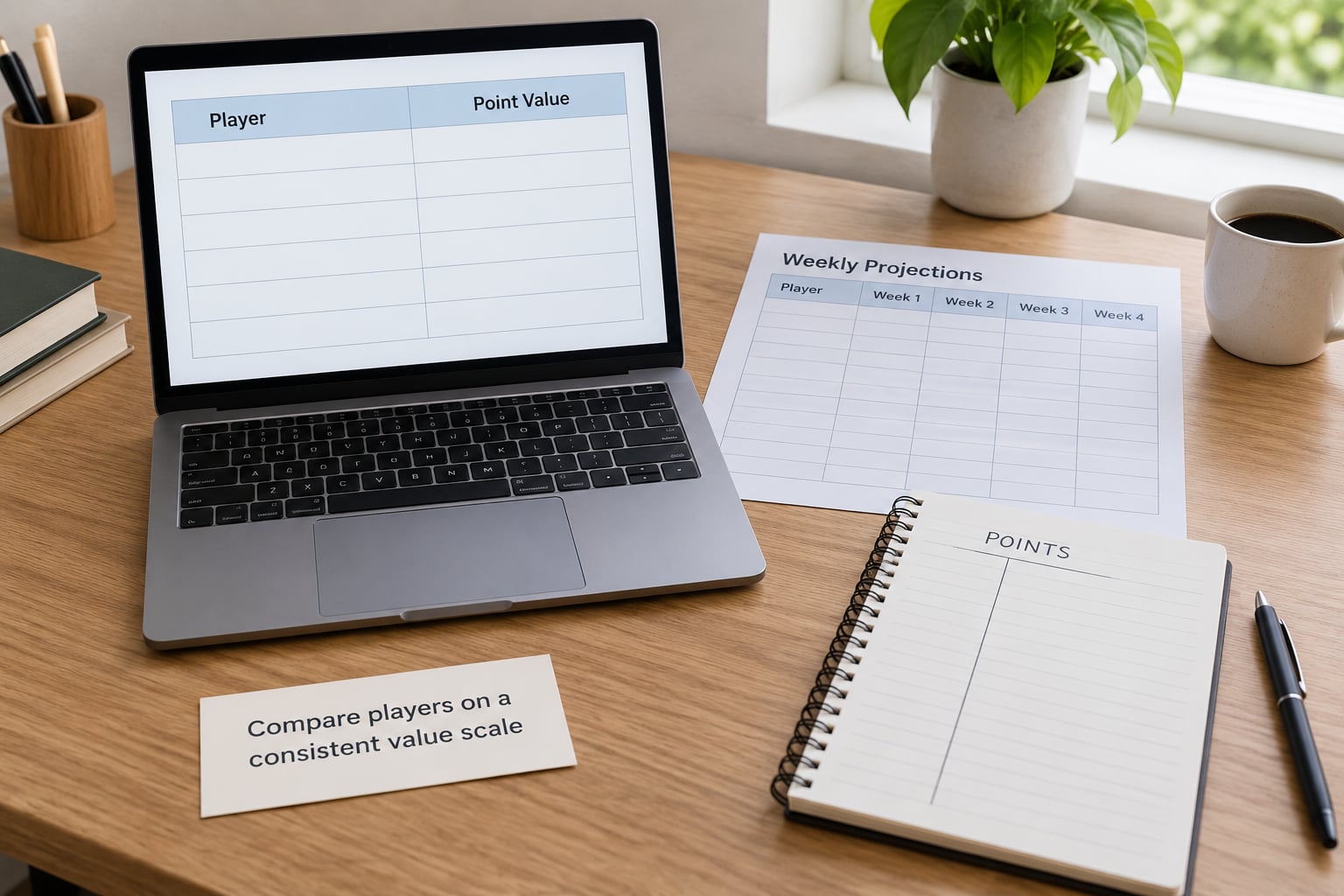
Put every asset in the offer on one scale at one time horizon. The common mistake is comparing a player’s season value against a pick’s season value, or comparing a dynasty asset to a redraft one. Everything in a given offer has to be measured against the same horizon, or the comparison is meaningless.
For uneven trades, value the pieces the other manager is giving up as well as the ones you are receiving. If they are sending three players and one goes to your bench or gets dropped, that third player still has value, and refusing to price it is how 2-for-1 offers start to feel insulting. As a working rule, the side giving up more players should be paid a modest premium, somewhere in the 5 to 10 percent range, because extra assets carry roster-management risk.
Where two tools disagree by more than about 15 percent, do not average them and move on. Look at what each tool is projecting for the rest of the season, and decide whose assumption you buy.
The step works when you can say plainly that the return is better than, equal to, or worse than what you are giving up, and by roughly how much.
4. Translate player value into team value
Raw value assumes every roster is the same roster, which it never is. A player you are replacing at a position you already have three of is worth less to you than the same player would be on a roster that needs one. Roster need is the overlay that most managers never apply, and it is where surplus value gets created.
Work through it in order. What does your lineup look like right now, and who starts on your bench that you would rather not start? What happens to your floor if the incoming player’s opponent is rough for four weeks? Does the trade create a starter, a bench piece, or nothing at all? And who is this player on your schedule? In most leagues, one bad divisional rival can sink a season that the value chart said would work.
Trade depth for scarcity, not depth for depth. Two running backs on your bench plus a third from the trade offer is a roster problem, not a surplus.
The step works when the player’s role on your roster is clearly more useful than the same player’s rank in a generic chart suggests.
5. Factor in schedule, injuries, and opportunity
Now adjust for uncertainty, in both directions. Expected games played, target share in the passing game, offensive scheme, coaching continuity, and injury history all shift fair value. A fragile player on a bad schedule is worth less than his chart value. A player in a scheme that manufactures touches every week is worth more, even if his ceiling is lower.
Two habits keep this honest. First, discount a risk rather than erasing the player for it. If an injury concern is real and known, shave the value; do not drop the asset to zero because of something a beat reporter guessed at on a Tuesday. Second, apply the same scrutiny to the player you are keeping. Every offer is flattering to the incoming side until you price the outgoing side’s own risks.
The step works when a fair-value adjustment in your notes accounts for each real risk, rather than a gut feeling that the offer is bad because you are nervous about one name.
6. Test the trade under multiple seasons of outcomes
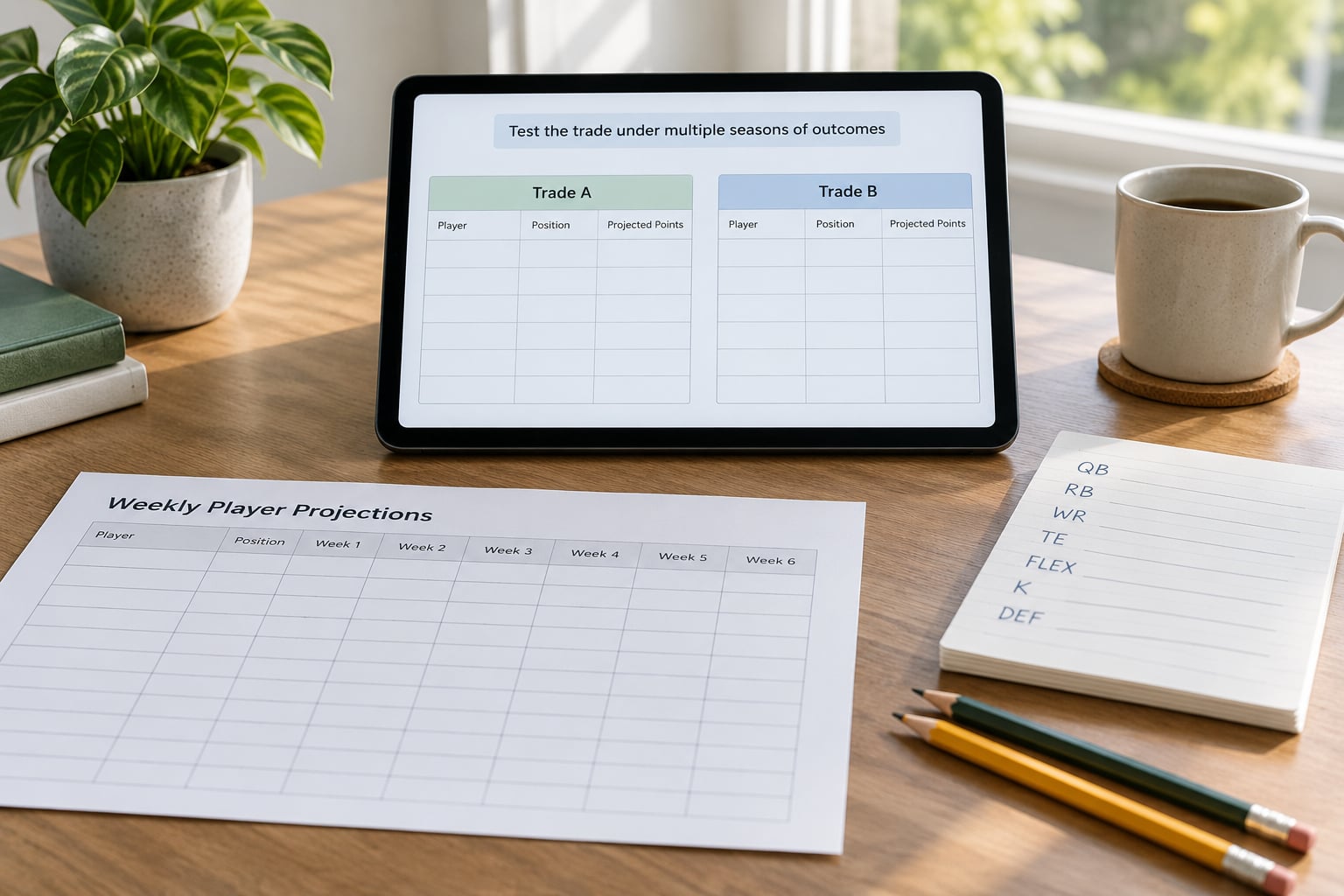
Run the trade three or four times: a downside case where the incoming player has a bad stretch and plays a handful of games, a median case matching his rest-of-season projection, and an upside case where he outperforms. Ask a narrower question in each: does the receiving roster still produce something useful in the bad case?
Separate bad luck from a broken profile. A player who underperforms one week is variance. A player whose role, target share, and scheme have all shifted against him is a profile problem, and no amount of schedule luck rescues that. Dynasty managers add a fourth scenario here, a two-year and three-year horizon, because a single season tells you very little about a young player’s arc.
The step works when you would still take the trade in the downside scenario, because the receiving roster has depth behind it and the trade did not hollow out a position.
7. Make the final decision using a trade rule
Decide your threshold before you look at what the other manager said. A simple rule works: accept when the incoming side is worth at least 10 percent more than the outgoing side in your own numbers, and require a bigger margin, 20 percent or more, in dynasty or in a trade that removes your starter at a position with one thin backup.
Then record the values you used, the adjustments you made, and the reason. This is how to evaluate a fantasy football trade without re-running the whole analysis every time the offer resurfaces. When you write it down, the decision stops depending on whether you liked the other manager or felt guilty about your best player.
Send the response the same day if you can. Offers decay, and a manager with four rejected offers has already picked their next option.
The step works when your final answer traces back to a documented threshold rather than to emotion, panic over a bad week, or how confident the other manager sounded.
Common Mistakes
These are the errors that show up again and again in trade threads, and each one has a straightforward correction.
- Overvaluing a familiar name. You know his name, you watched his games, and the chart treats him like a stranger. Correction: price him like the stranger first, then adjust for anything the chart cannot see, like a schedule that got worse or a teammate who left.
- Comparing players on different time horizons. A dynasty rookie pick valued over three years is not comparable to a tight end valued for the next eight weeks. Correction: split the offer by horizon and evaluate each group separately.
- Trusting one rigid chart. Published values feel arbitrary to most managers, and they often are, since they are averages built from trades made by other people in other leagues. Correction: run two or three tools, treat the spread as a range, and trust your own read inside that range.
- Ignoring positional replacement. Replacement-level value is not the same at every position. In a league with a shallow tight end pool, a mediocre tight end is worth far more than a mediocre wide receiver. Correction: check how many startable players exist at that position in your league before treating the two positions as interchangeable.
- Reacting to unverified injury reports. A single practice report, and especially one without a coach quote, moves trade values more than it should. Correction: wait for a confirmation from the team or a beat writer you trust before you reprice anything.
- Counting guaranteed production. You receive a running back who has played sixteen straight games, but nothing in football is guaranteed past Sunday. Correction: price the player’s games played as an average rather than a certainty.
- Damaging roster balance. A trade can be fair on value and still lose the season because it left you with three tight ends and one usable linebacker. Correction: check your flex coverage and positional floors before you send the accept.
Three habits fix most of that. Set a walk-away price before the negotiation starts and hold it, even when the offer feels insulting, because the correct response to a lowball is no trade rather than a counter built from hope. Document every analysis, including the ones you rejected, since your own past evaluations are the best calibration tool you own. And revisit an offer when an input changes, not when you get bored: a meaningful role change, a confirmed injury, or a playoff date shift are all reasons to reopen the numbers.
One last thing on etiquette. Declining an uneven offer is normal, not an insult. The recurring complaint in league forums is about offers built as bait, where two good players come back for one mid-tier player plus a pile of drops. A short, friendly decline followed by a different offer usually ends those threads faster than silence.
Frequently Asked Questions
How do I evaluate a fantasy football trade without a trade value chart?
Build your own house chart. List the players you would genuinely target on your waiver wire, rank them by rest-of-season projection, and assign each a fixed point value you are willing to trade up to. Two months of that habit produces a list that matches your league’s scoring and your own reads better than any published number does. Compare both sides of the offer on that single scale.
Should I use the same trade process for redraft, keeper, and dynasty leagues?
The steps are identical, but the inputs shift. Redraft values only the remaining games and cares most about expected games played and role. Keeper leagues add one more year of value and make age a bigger factor. Dynasty needs multi-year projections, rookie pick curves, and contract years. A player worth acquiring for eight weeks can be a bad three-year asset.
Is a fantasy football trade worth accepting if I only get a small advantage?
Usually, yes, if the edge is real and the alternative is doing nothing. A thin edge on a player you would happily roster is usually worth taking, especially with a trade deadline approaching. Hold out for a bigger margin when the trade would remove your starter at a position with one thin backup, or when it locks up a scarce position you could otherwise fill on the waiver wire.
How should I account for positional scarcity when evaluating a trade?
Count how many players at that position are actually startable in your league, then ask what happens when two owners want the same one. A replacement-level tight end in a shallow pool is worth materially more than a similar wide receiver in a deep one. That difference is the reason a surplus player at a crowded position can be worth more than a slightly better name at a scarce one.
When should I reconsider a trade after new injury or role news?
Reopen the numbers when a confirmed injury, a depth-chart change, a coaching change, or a scheme shift alters a rest-of-season projection. An unverified practice report is not enough. When you do revisit, rerun only the affected player and check whether the change moves the value enough to cross your accept threshold, rather than re-running the entire analysis because one name feels different.
How many players should I receive for a top fantasy football player?
One elite player usually beats any package of mid-tier players, because production at the top is hard to replace and mid-tier production is available on the waiver wire. For uneven trades, the side giving up more players should generally pay a premium in the 5 to 10 percent range to cover roster-management risk. Exception: when the extra piece is a starter in a scarce position, it can be worth more than its raw value.
Conclusion: Start With Value, Then Add League Context
Here is the short version. List the full offer, including picks and any bench pieces. Set a replacement-level baseline for each player and put everything on one scale at one time horizon. Adjust for roster fit, positional scarcity, schedule, and risk, then stress-test the trade under a bad season as well as a good one. Accept only when the return clears your documented threshold, and walk away when it does not.
The method matters more than any single tool, because values change weekly and your league will never look exactly like the one a chart was built for. Run the process the same way every time, write the numbers down, and the answer takes care of itself.