
Running a fantasy football consolation bracket takes about twenty minutes of setup: seed the non-playoff teams, pair them for the playoff weeks, set a tiebreaker order, and hand out a consolation prize. Most of the work happens before the first game, not during it. In a 12-team league with six playoff spots, the bottom six teams enter a single-elimination bracket that runs alongside the playoffs, and the last manager standing is named the consolation winner.
The part that trips up commissioners is the math. An odd number of non-playoff teams, a bye that changes week to week, or a platform that only offers a toilet bowl instead of a true consolation bracket can all turn a fun idea into an argument. Fix those three things in writing, post them in the league chat, and the postseason stays fun for everyone instead of just the teams in the playoffs. Most advice on how to run a fantasy football consolation bracket gets the field right and the scoring wrong, which is where the arguments start.
I’ve run this format in a 10-team and a 14-team league, and the version that works best treats the consolation bracket as a real competition with real stakes, not a punishment for losing. That framing is the whole trick, and the rest of this guide walks through it step by step.
Table of Contents
- What You Need
- Step-by-Step
- Decide What Counts as Your Consolation Field
- Set the Bracket Format and Pairings
- Choose a Simple Fantasy Scoring Method
- Reschedule and Rescore Games Fairly
- Break Ties Before You Need Them
- Award the Consolation Prize and Finish the Bracket
- Common Mistakes
- Frequently Asked Questions
- What is a consolation round?
- Who qualifies for a fantasy football consolation bracket?
- What does consolation winner mean?
- How does a fantasy playoff tiebreaker work inside a consolation matchup?
- How many non-playoff teams can fit in a consolation bracket?
- Should my league have a consolation playoff bracket?
- Conclusion
What You Need
Everything below comes out of your league settings or your own spreadsheet. Gather it before you touch a single pairing.
- Your final regular-season standings. Record, points for, and points against for every manager, sorted worst to best. That list is your seeding sheet.
- The playoff field size. How many teams qualified for the playoffs, and whether that field uses byes. This determines how many teams are left over.
- The number of playoff weeks. Most head-to-head leagues run two or three. The consolation bracket needs enough weeks to finish, or you shorten it to match.
- Scoring settings. Whether matchups score on total points, head-to-head points, or a points-per-game average.
- A tiebreaker order. Written down and ranked, not decided in the moment when two teams finish level.
- A consolation reward. A small cash prize, a supplemental draft pick, a trophy, or a punishment game. Pick it before seeding so nobody argues about it later.
- A place to post results. League chat, email, or a shared sheet. Commissioners say repeatedly that written rules beat the assumption that the app handles it.
Step-by-Step
Decide What Counts as Your Consolation Field
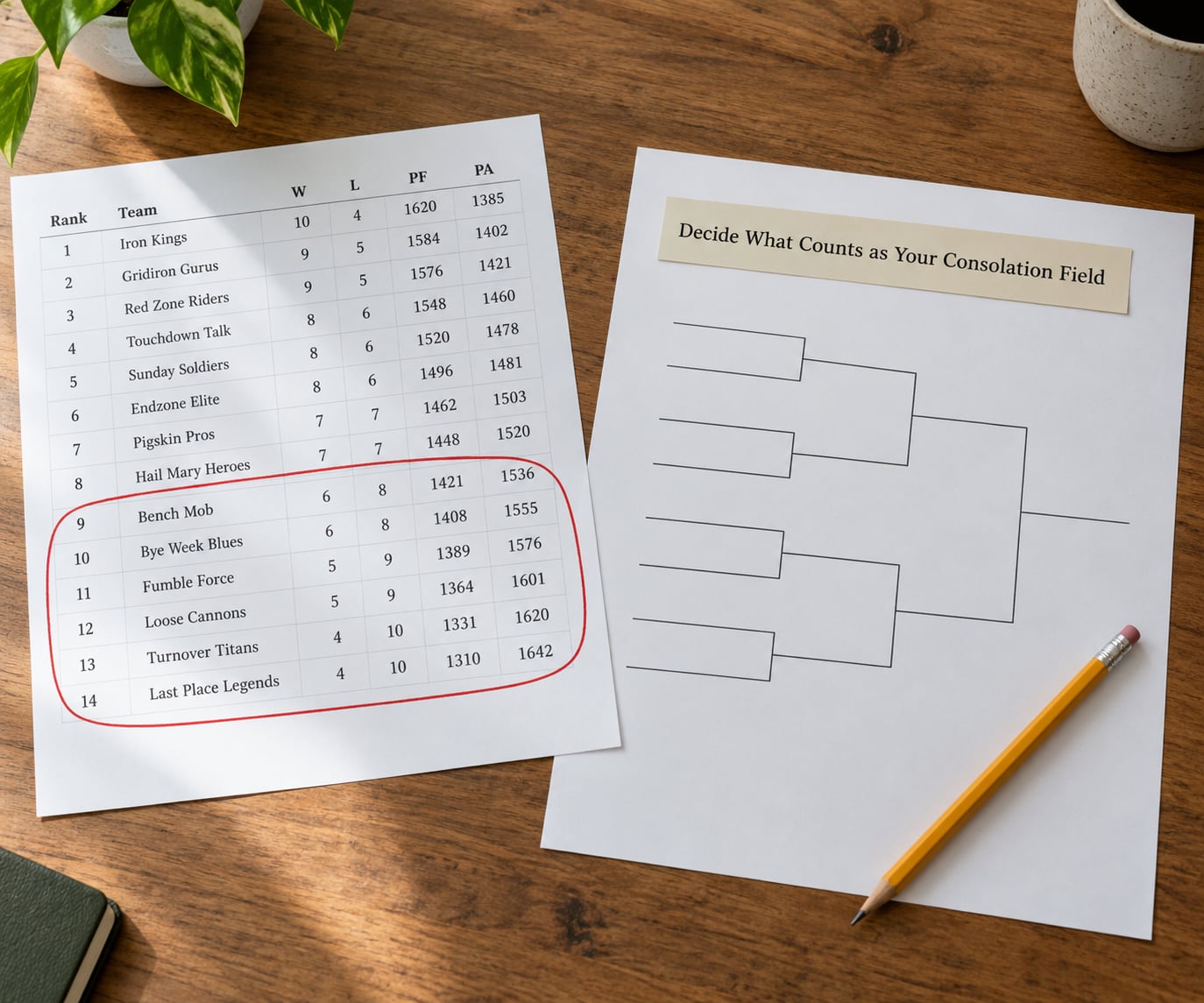
The consolation field is every team that did not make the playoffs, and you can either take all of them or only a defined range of the worst records. The straightforward answer is to include every non-playoff team, because the managers you most want to keep active are exactly the ones sitting right below the cut line.
Some leagues cap the field instead. Sleeper’s own documentation describes its consolation bracket as taking teams with the worst records, up to eight. Capping at eight keeps the bracket to three short rounds, which matters if your playoff window is only two weeks. Just be explicit that teams outside the field are not eliminated from anything, they simply do not compete for the consolation title.
Here is the field math for the usual league sizes. The bracket column assumes single elimination with one round per playoff week.
| League size | Playoff spots | Non-playoff teams | Bracket field | Byes in round one |
|---|---|---|---|---|
| 8 | 4 | 4 | 4 | None |
| 10 | 4 | 6 | 6 | 2 |
| 12 | 6 | 6 | 6 | 2 |
| 14 | 6 | 8 | 8 | None |
| 16 | 8 | 8 | 8 | None |
Any bracket field has to be a power of two for a clean draw, so a count like 5 or 7 gets rounded up and the extra slots become byes. Round up, give the byes to the worst records, and say so in the rules. That is the entire odd-number problem solved.
Set the Bracket Format and Pairings
Seed the non-playoff teams from worst record to best record. In a true consolation bracket the winner of each matchup advances and the loser is done, which is the opposite of a toilet bowl where the loser advances. That single distinction is the one most managers get wrong, so state it plainly in your rules.
Pair seeds so the two worst records face each other in round one and the two best non-playoff records also face each other, which sends the two strongest remaining teams into a later round and gives the better regular-season record something to play for. With six teams: seeds 6 and 5 play, seeds 4 and 3 play, and seeds 2 and 1 get byes.
Bracket placement matters once someone is knocked out early, because it dictates who that manager faces in the next round. Draw it out before the first game rather than deciding pairings week to week. In a two-week playoff window, a six-team bracket can only run two rounds, so either cap the field at four or accept that the consolation winner is decided by a final played in week two against whoever survived.
If you have a double elimination option, use it in leagues where the eliminated managers tend to go quiet. Nobody minds losing once; some managers mind losing twice to the same opponent, and the second chance keeps them setting lineups.
Choose a Simple Fantasy Scoring Method
Score consolation matchups exactly the way you score your regular-season matchups, head to head, using the same scoring format the league already uses. Anything more creative needs a written formula and a spreadsheet, and it buys you very little.
For example, in a points-per-game league the manager with the higher weekly average wins the matchup. If you run a points-scoring league instead, compare total points over the round and the higher total wins. Either way, publish the scoring method, the round length, and what happens to a tie before round one starts.
Head-to-head weekly points are the most common and the least confusing, because they match the managers’ habits from the regular season. Points-for-the-season is the worst option, since it locks in whatever happened during the regular season and eliminates any reason to care about the consolation games.
Reschedule and Rescore Games Fairly
Forfeits come up every postseason, usually because somebody’s team auto-locked while their owner was on holiday. Decide in advance what a forfeit costs and write it down: a zero for the forfeiting manager, or a league-average score, with the difference between the two stated plainly.
Unplayed games, dropped roster spots, and players who never started all fall under the same heading. Apply the rule you already use for the regular season and do not make exceptions for managers you know. A consolation bracket built on special treatment for one person produces a worse postseason than no bracket at all.
Lock matchups at the same time you lock playoff matchups. Roster moves during consolation weeks are fine as long as they follow the league’s regular add and drop rules, and as long as both sides have the same information when the matchup starts.
Break Ties Before You Need Them
Rank your tiebreakers in order and post the ranking. Most leagues that skip this step end up arguing on the final week. It is the least glamorous part of running a consolation bracket and the one that saves the most arguments.
- Playoff seeding, or the consolation bracket seed
- Head-to-head record within the consolation bracket
- Number of wins during the consolation rounds
- Total points scored across consolation matchups
- Points against
- Regular season record
- Total points for across the full season
- Pre-draft random draw, agreed before the season started
Most formats resolve ties inside the first three or four. Spot-check your list before the bracket opens and confirm that every item exists in your league’s data, because several platforms do not track head-to-head inside a consolation bracket at all. Where your platform cannot score it, drop that tier rather than computing it by hand for one game and forgetting the next.
Write down who applied the tiebreaker and when, in the league chat. That single line is what ends the late-season argument.
Award the Consolation Prize and Finish the Bracket
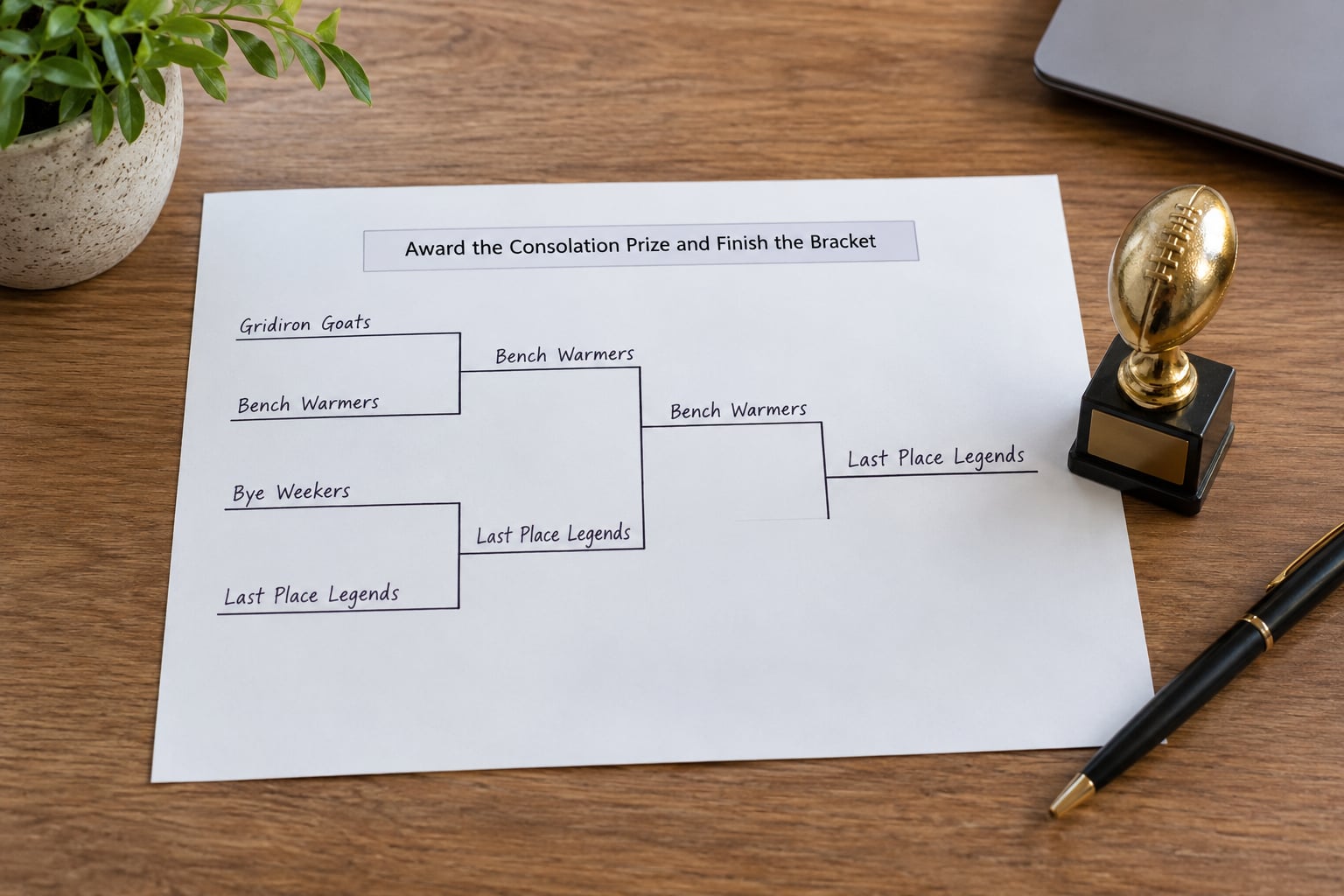
Decide the consolation winner the same way you decide the champion of the playoff bracket: last round standing, using the same advancement logic you used all season. If you used single elimination all the way, the consolation winner is the finalist who won the final consolation game.
Keep the original regular-season record intact. The consolation bracket is an extra competition, not a correction to the standings, and overwriting your season results causes more confusion than any seeding decision will.
Then publish the final order. List every non-playoff team with its consolation finish, name the consolation winner, and note that the regular-season record still stands for draft order and historical purposes. Then hand over the reward you promised, even a joke one. The managers who lost all season care about that final week far more than they expected to, which is the entire reason the format exists.
Common Mistakes
Changing rules once the bracket starts. This is the one that ends leagues. Fix every rule before round one and post them in the league chat. Managers trust written rules posted in chat, not the assumption that the app handles it.
Running an unclear scoring system. If two managers could read your rules and score a matchup differently, the rules are not written yet. Publish the scoring method, the round length, and the forfeit rule in one message.
Ignoring forfeits. An unaddressed auto-lock quietly decides a round. Apply the zero or league-average rule you agreed on and record the result in the bracket sheet the same day.
Confusing a consolation bracket with a toilet bowl. Consolation means the winner advances and the loser is out. A toilet bowl means the loser advances and the last-place owner keeps losing. Pick one and label it correctly in your rules, because most managers assume the two are the same format.
Letting a consolation bracket reward tanking. If you attach a real reward to the bottom of the standings, or use consolation results to set next season’s draft order for those teams, managers have a genuine reason to keep playing to the final week. A bracket with no stakes tends to produce the tanking it was meant to prevent.
Leaving managers to run their own postseason. Eliminated managers disengage the moment playoffs start, and nobody is coming back to fix the pairing table for you. One spreadsheet maintained by the commissioner is cheap. A bracket nobody can figure out is worse than no bracket.
Running a two-team consolation ladder. In small leagues this happens often and it feels anticlimactic, since the result is decided in one week. If your league is small, a head-to-head consolation game with a themed reward works better than a bracket.
Frequently Asked Questions
What is a consolation round?
A consolation round is the playoff game or bracket played by teams that missed the regular-season playoffs. Those teams compete head to head during the same weeks as the playoffs, and the winner of the final consolation game is recorded as the consolation winner for the season. It gives the bottom of your standings real games to play instead of weeks of nothing.
Who qualifies for a fantasy football consolation bracket?
Every team that finishes the regular season outside your playoff field qualifies. Most commissioners include all of them, though some platforms cap the bracket at the worst eight records. If you cap it, say so in writing and confirm that teams outside the field are not otherwise eliminated. The managers just below the cut line are usually the ones worth keeping engaged.
What does consolation winner mean?
The consolation winner is the manager who finishes first in the consolation bracket, having won every consolation round they played. It is a separate title from the regular-season record, which still stands unchanged. You can attach a small prize, a supplemental draft pick, or a punishment game to that title, and it is usually enough to keep eliminated managers setting lineups through the final week.
How does a fantasy playoff tiebreaker work inside a consolation matchup?
A consolation tiebreak uses the same ranked list you publish in advance, applied in order until the tie breaks. A common order is bracket seed, then head-to-head record inside the consolation bracket, then total points scored across consolation rounds, then points against. Check which tiers your platform can actually score, because several do not track head-to-head records within a consolation bracket at all.
How many non-playoff teams can fit in a consolation bracket?
A clean single-elimination bracket needs a field of two, four, eight, or sixteen teams. So five, six, seven, or nine non-playoff teams get rounded up to the next power of two, and the extra slots become byes given to the worst records. A 12-team league with six playoff spots therefore produces a six-team consolation bracket with two first-round byes.
Should my league have a consolation playoff bracket?
It helps most in leagues of eight teams or more, where half the managers are eliminated before the postseason starts. The bracket gives those managers games with stakes during the weeks when they would otherwise stop setting lineups. In a league of six, a single consolation game with a themed reward often works better, since a two-team bracket finishes in one week.
Conclusion
Write the rules first. Seed every non-playoff team by record, round the field up to a power of two, give byes to the worst records, and confirm how each round is scored. Then rank your tiebreakers, post both lists in the league chat, and name the consolation reward before the first game of the postseason.
That is twenty minutes of work in a week when you usually have none. Written rules are what make it easy to run a fantasy football consolation bracket without a single argument, and in return you get managers who still care in week fifteen, a bracket nobody has to argue about, and a season that ends with something for everybody.