To run an NFL pick’em pool, you need five things settled before anyone submits a pick: a format, a scoring rule, a deadline, a tiebreaker, and somewhere to keep the records. Set aside about an hour for setup, then ten minutes a week for the rest of the season and the job runs itself.
A pick’em pool is a season-long competition where each participant picks the winner of a set number of NFL games every week, earns points for the picks that land, and is ranked against everyone else on cumulative points until the final week. One player takes the top payout. This guide covers how to run an NFL pick’em pool end to end, from the first rules email to the final standings post, including the awkward parts most guides skip: postponed games, corrected scores, dropouts and ties.
Updated for the 2026 season. And a note before you start: a pick’em pool is a game of skill played with a small agreed prize among people who know each other. Set the buy-in at a level that would never embarrass anyone who loses it.
Table of Contents
- What You Need
- Step-by-Step: How to Run an NFL Pick’em Pool
- 1. Choose the Pool Format
- 2. Set the Schedule, Deadline, and Participants
- 3. Establish the Scoring and Tiebreaker Rules
- 4. Collect the Picks
- 5. Check Picks Before the Games Begin
- 6. Score the Pool and Resolve Ties
- 7. Announce the Results and Close the Pool
- Common Mistakes
- Frequently Asked Questions
- When should participants submit their NFL pick’em pool picks?
- What happens if two players finish with the same number of correct picks?
- Can participants enter more than once in an NFL pick’em pool?
- Can I use confidence points instead of straight picks?
- Conclusion
What You Need
Everything below costs nothing except your attention, and each item prevents a specific argument later in the season.
- A participant list. Names, contact details, and who counts as eligible. Decide whether a player’s spouse, kids or a coworker who never mentioned football gets an entry.
- The schedule for the weeks you are covering. Know exactly which games count, including whether you run Weeks 1 through 17 or the full 18-week regular season.
- A reliable scoring source. One place you check final scores, and one you tell players to check when they dispute a number.
- A pick deadline. A specific day, time and time zone, written the same way in every message you send.
- Scoring rules. What a correct pick is worth, what a push is worth, and what an incorrect pick is worth.
- A tiebreaker. A written chain that ends in a clear outcome, ideally including what happens if it never breaks the tie.
- A shared record. A spreadsheet everyone can see, or a hosted pool site that scores and ranks automatically.
- A payout ladder. How the pot splits between first, second, third and any weekly side prizes, written so a player can check your math.
The order matters. Write the scoring rule and the tiebreaker before you accept any money, because both are nearly impossible to change once results exist.
Step-by-Step: How to Run an NFL Pick’em Pool
1. Choose the Pool Format

Pick straight picks for a casual group, or against the spread once players have shown they can read a line. Those are the two formats that work for almost everyone, and the rest are variations worth knowing about.
- Straight picks. Each player names a winner, no spread involved. Simple to explain, brutal in a large field, because most of your group will pick the same obvious favourites every week.
- Against the spread. Each player takes a team to cover the point spread. A team favoured by three has to win by four. More players land near fifty percent correct, so the standings stay interesting deep into the season.
- Confidence points. Players assign point values to their picks before submitting them, and score the sum. Rewards real research, punishes carelessness hard.
- Survivor, or last man standing. One pick per week, and a wrong pick eliminates you. Short season, constant drama, and it needs its own rule about whether a team can be picked twice.
- Versus, or head-to-head. You are matched against one other player each week and scoring compares only those two. Great for an even number of entrants, awkward for an odd one.
- Playoff bracket. Only the postseason, everyone picks winners round by round. Runs five weeks instead of seventeen.
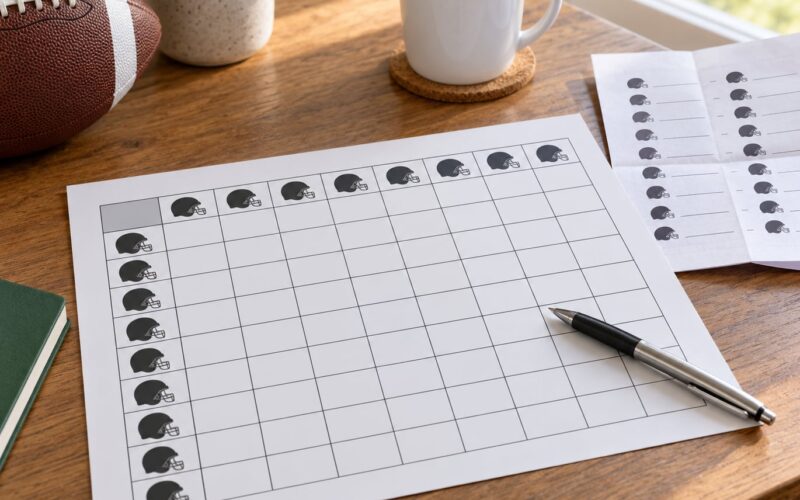
- Squares. A grid of numbers assigned to players before the game, and the winner’s number plus the losing team’s score lands on the payoff square. Needs no picks at all.
A mixed group is best served by straight picks in the regular season plus a bracket or squares contest running alongside it. It gives competitive players somewhere to go and keeps the casual majority from dropping out in November.
2. Set the Schedule, Deadline, and Participants
Decide which games are in scope. A common setup is five picks a week against the spread, which leaves a dozen games on the board and keeps weekly effort to a few minutes. Some pools run all sixteen games; that is a lot of work for the people who take it seriously.
Weeks 1 through 17 is the most common window. Week 18 is where lines get thin, several games mean little, and underdogs already record the outcome. If you do include it, say so explicitly, because players will notice the difference at the end.
The deadline needs three parts: day, time, time zone. Early Sunday afternoon is the most workable, because it sits after Thursday and Saturday night games but before Sunday kickoff. Whatever you choose, a deadline that falls after the first game of the week gives you a permanent headache, since someone will always submit late using a line that has already moved.
Then fix the entry rules: how many entries per person, whether late joiners are allowed, and how someone joins after Week 1. My default is two entries per person and a standing invitation for late joiners, whose first few weeks do not count and who start scoring from the next full week.
If the pool sits inside a workplace, check your employer’s policy on workplace contests before you open it, and keep the prize modest and clearly voluntary. Rules differ by country, state and employer, so ask before you collect anything.
3. Establish the Scoring and Tiebreaker Rules
Scoring is simple if you resist adding tiers. The most workable default I have seen awards two points for a correct pick, one for a push, and zero for an incorrect pick. The push point matters, because a whole number spread will occasionally produce a tie, and you want a scoring value for it before it happens.
Half-point spreads exist for exactly that reason. If your scoring source offers a line with a half point, it removes the push entirely, which saves an argument.
Write the tiebreaker chain in descending order and end it with a fallback. A workable chain: highest total points scored in the picks, then most wins starting from the most recent week and working backward, then a playoff result if you kept one, then an even split of the pot. A reverse-week comparison is a better tiebreaker than total points because it rewards the player who stayed hot when it mattered.
Send the rules as a single block before entries open, and ask everyone to reply with a thumbs-up. Silence is not agreement, but a visible acknowledgement gives you something to point back to when a dispute arrives in November.
4. Collect the Picks
Use one submission method for everyone: a form, a shared sheet with one column per player, or a hosted pool site. Mixed methods are how records get lost, and a lost record is a lost pool.
Require a name on every submission so you can match a pick to a player without guessing. Lock or close the form at the deadline rather than sorting out timestamps afterward, and take a screenshot of the final state so the record survives a cleared form.
Send one reminder, not five. A single message on Thursday saying picks close Sunday at 1 PM Eastern, with the rules and standings link attached, does more for participation than a week of nagging.
5. Check Picks Before the Games Begin
Spend five minutes before the first kickoff confirming three things: every submission came from an eligible player, every pick names a team actually on the schedule for a game in your window, and each submission arrived before the cutoff.
Handle mistakes in writing, using a rule you already published. My rule is that a player may correct a pick until the deadline, and after that a pick that names a team not playing simply scores zero. A pick naming a valid team stays as submitted even if it looks like a typo, unless the player flagged it before the cutoff.
Once the first game starts, the board is closed. Tell the group when you have verified it, and post the locked picks so everyone can see exactly what was submitted.
6. Score the Pool and Resolve Ties
Score from the same source you named in the rules, and do it once, after the last game of the week ends. Enter each final score, let the spreadsheet total each player’s points, and update the standings column in one pass rather than cell by cell.
Post the standings with the week in the heading. Weekly visibility is most of what keeps a season-long pool alive, and it gives players an early warning when they fall out of contention.
Apply the tiebreaker exactly as written, and show the work. If two players finish level on points, write down the tiebreak step you used and the number it produced, then paste that into the standings post. Disputes tend to fade when the arithmetic is visible.
If a scoring source corrects a final score after you have posted, update the standings and note the correction with the date and the reason. Same rule for a forfeited or postponed game: your written policy decides, not the mood of the moment.
7. Announce the Results and Close the Pool
After the final week, publish the complete standings, name the winner, and state the payout for each place in the money. Include your tiebreaker note if one was needed, and confirm the date the prize was sent.
Save the rules document, the locked picks and the final standings in one place. You will want them in week three of next season, when someone asks why a push counted the way it did.
Then ask the group one question before you close the book: what would you change for next year? Write the answers down. Keep what people asked for more of, and change one thing at a time.
Common Mistakes
Almost every commissioner dispute traces back to one of these, and all of them are cheap to prevent in September.
- Rules written too late. Fix: publish the full rules before the first entry, including push value and tiebreakers. If a rule was never written down, it is not a rule.
- Deadline confusion. Fix: state day, time and time zone in every message, set the deadline before the first game of the week, and treat anything later as submitted on time only if you said so in advance.
- Wrong games on the board. Fix: reconcile the pick list against the schedule every week. Flexed and moved games are the usual culprit, and a game that moved outside your window simply does not count.
- No tiebreaker. Fix: publish a chain and a fallback now. Ties are rare until the one week they are not.
- Spreadsheet errors. Fix: score the whole week in one pass, then have one other player check the totals against the picks. A single cell typed into the wrong row can hand the pot to the wrong person.
- Changing rules after the deadline. Fix: freeze the rules once entries are in. If something genuinely must change, announce the change and its reason to the whole group in writing.
- Unlimited entries. Fix: cap entries at two or three per person. Beyond that, buying more tickets beats picking well and the pool stops being a game of football knowledge.
- Forgetting to score. Fix: put the scoring task in your calendar with a fixed time, the same way you would a recurring meeting. A pool that goes unscored for two weeks is a pool people quietly leave.
Frequently Asked Questions
When should participants submit their NFL pick’em pool picks?
Set the deadline before the first kickoff of the week, usually early Sunday afternoon, and write the day, time and time zone the same way in every message you send. Some groups use Thursday evening so players can include early games. Whatever you choose, the deadline does not move once the first game starts, and late submissions are scored as submitted rather than quietly dropped.
What happens if two players finish with the same number of correct picks?
Apply the tiebreaker chain you published before the first week. The most common order is highest total points scored across your picks, then most wins starting from the most recent week and working backward, then an even split of the pot if the chain runs out. Announcing the chain in advance is what keeps a tie from turning into an argument.
Can participants enter more than once in an NFL pick’em pool?
Yes, but decide before entries open. Many groups allow two or three entries per person and score them separately, which rewards skill. Allowing unlimited entries turns it into a lottery, since buying forty entries beats picking well. A workable middle ground is one entry per person for the season-long pool, plus an open bracket or squares contest anyone can join.
Can I use confidence points instead of straight picks?
Yes. Confidence pools assign point values to each pick before submission, usually one for the least confident pick and the highest number for your best one, then score the sum. They reward research and confuse newcomers fast, so label the assignment clearly and cap the top value. Straight picks suit casual groups; confidence suits people who already follow the lines.
Conclusion
Four decisions do most of the work: choose a format the group can actually follow, publish the scoring and tiebreaker rules before the first pick, set a deadline that falls before the first kickoff, and keep one record everyone can see. Do those in September and the rest of the season is ten minutes of scoring and one post.
Start small, keep the prize modest, and post standings every week. A pick’em pool built that way survives contact with a full season, arguments included, and it is a lot easier to run than it looks on the day you decide to start.