DFS salary cap scoring works in two halves that beginners constantly mix up. First, you build a lineup of players with virtual salaries that must fit inside a fixed budget, usually 50,000 dollars for NFL. Then, when games start, those players produce real statistics that the platform converts into fantasy points using its scoring settings. Your total points rank you against every other entry in the contest.
Neither half feeds the other. A player’s price does not make him score, and a big score does not require a big price. Getting comfortable with that separation is the whole game, so this guide walks through the mechanics first, then the strategy that follows from them.
Updated for 2026. Scoring settings change between seasons and sometimes between platforms, so check the scoring rules tab inside your app before you lock a lineup.
Table of Contents
- How DFS Salary Cap Scoring Works
- What Is a DFS Salary Cap?
- This Is Not the NFL Salary Cap
- How Player Salaries Are Set
- Draftability: When a Price Tells You to Stay Away
- How DFS Scoring Is Calculated
- How scoring settings turn stats into points
- DraftKings vs FanDuel: the structural differences
- A Simple DFS Salary Cap Example
- Roster Construction Rules That Affect Scoring
- How to Use Salary Cap Scoring to Build a Better Lineup
- Common Salary Cap Scoring Mistakes
- Frequently Asked Questions
- Does a player’s DFS salary determine how many fantasy points he scores?
- Do I have to use my entire DFS salary cap?
- Does the flex spot score differently in fantasy football?
- What happens if my DFS lineup is invalid when it locks?
- Is there a salary cap in fantasy football, or am I confusing it with the NFL salary cap?
- What percentage of DFS players are profitable?
How DFS Salary Cap Scoring Works
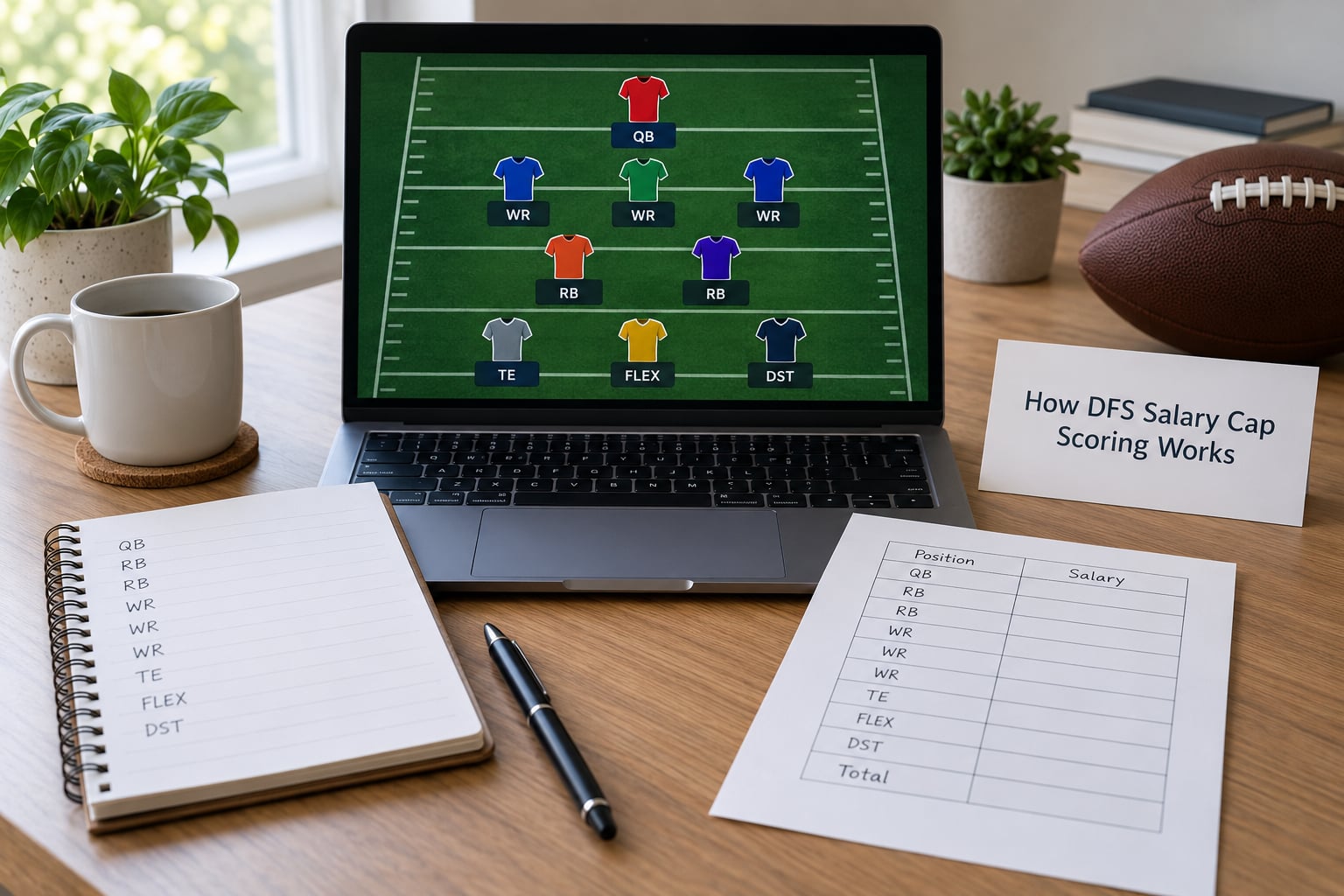
Six steps cover the entire system, from the moment a slate opens to the moment a payout lands.
- Every player gets a salary. The platform assigns each player on the slate a virtual price based on projection.
- You fill a fixed roster build. NFL rosters are nine spots: one quarterback, running backs, receivers, a tight end, a flex, a defense, and a kicker.
- The total must stay at or under the cap. 50,000 dollars is the standard NFL cap on DraftKings and FanDuel. Over the cap, the lineup is invalid.
- You lock the lineup before kickoff. Once the first game starts and the injury window closes, edits are gone.
- Live stats become points. Yards, touchdowns, receptions, interceptions, sacks, and bonuses convert to points in real time using the platform’s scoring settings.
- Your total ranks you. In a cash game you need to beat a percentage of the field. In a tournament you need a top finish against thousands of entries.
Scoring is a separate layer laid on top of roster construction. You can build a perfectly legal lineup and still score badly, because the cap never promised you production. It only decided who you were able to afford.
What Is a DFS Salary Cap?
The DFS salary cap is a virtual budget that every lineup on a slate has to fit inside. On NFL contests it is almost always 50,000 dollars, spread across nine roster spots, so the average spot carries roughly 5,500 dollars of budget if you spread it evenly. Nothing about the cap is connected to real money or real player contracts.
Treating the cap as a ceiling rather than a target is the first real lesson. You are allowed to finish a few hundred dollars under budget, and a lineup that spends 49,400 dollars is just as valid as one that spends exactly 50,000. Trying to spend every dollar to avoid “wasting” budget is one of the most reliable ways to end up with two players at the same price and no room for a value play.
The cap exists for a structural reason. Without it, the optimal lineup would simply be the nine best players on the slate, and every entry in every contest would be identical. The budget forces substitution, which is where most of the edge in daily fantasy sports actually lives.
This Is Not the NFL Salary Cap
Search results constantly conflate two completely different things. The DFS salary cap is a budgeting mechanic inside a fantasy app that resets daily, has no relationship to any contract, and affects only your entry. The NFL team salary cap is a real league rule that limits what an actual franchise can pay its players, and it has nothing to do with your lineup.
There is a third format worth naming: the salary cap league in season-long fantasy, where you draft a full roster once under an auction budget. That is closer to a real league salary cap in spirit, but it is a different contest type from DFS and the rules come from your league commissioner, not from a platform.
How Player Salaries Are Set
Salaries are not set by hand. They come out of a projection model that converts expected fantasy production into a price, and that is the half of the query most explainers skip.
- Projected fantasy points start the process. The platform estimates what each player will produce under its own scoring settings, so a receiver in a points-per-reception format is valued differently than the same receiver in a standard format.
- Recent and season production set the baseline. Historical production informs the projection, which is why a player coming off a 1,400-yard season carries more price than a rookie with identical projections.
- Role and opportunity adjust the number. Target share, red zone touches, and depth chart position matter more than raw talent. A backup who is projected to get a handful of carries will not price near a starter even if both players are equally athletic.
- Matchup and game environment get layered in. Weak opposing defenses and high projected team totals push prices up. The adjustment is not always complete, which is deliberate on the pricing side: a price is meant to be a crowd signal, not a perfect answer.
- Scarcity pushes prices higher. On a thin slate with few reliable wide receivers, the usable receivers get expensive together, because a few thousand dollars is a lot of budget when you can only roster three.
- Contest type shifts the demand curve. The same player is priced for one player pool across all contests on a slate, so a slate popular with casual players prices slightly heavier than it might otherwise.
Prices also move during the week. They rise and fall as team news lands, as a player sits in practice, and as the bulk of the field makes its picks. The salary you see at 11:00 on Tuesday morning is not always the salary you see at lock on Sunday.
Draftability: When a Price Tells You to Stay Away
Draftability is the practical read on all of this. A player priced so high that almost no one can roster him is undraftable in a tournament, because you gain nothing from a selection nobody else could make. In a large-field contest, mid-range and cheaper players are often where the finishing places come from, because a moderately priced player who outperforms his projection separates you from a field that all chased the same two studs.
Platforms do not display an official draftable threshold, so you estimate it. The rough approach is to ask how many roster combinations could afford the player, and the usual shortcut is to look at where the price sits relative to the position’s price range on that slate. On a nine-spot NFL roster, anything in the top tier of a position’s prices is usually off-limits in a GPP.
How DFS Scoring Is Calculated
Points come from what a player actually does on the field, valued by a lookup table. The table is not identical across platforms, and the numbers shift between seasons, so treat the categories below as the shape of the system and confirm the exact values in the scoring rules tab of the app you play.
How scoring settings turn stats into points
| Scoring category | Typical stat counted | How it is usually valued |
|---|---|---|
| Passing | Passing yards, passing touchdowns, interceptions | Points per yard, a flat value per touchdown, a negative value per interception |
| Rushing | Rush attempts, rushing yards, rushing touchdowns, fumbles lost | Points per yard, a flat value per touchdown, a negative value per fumble lost |
| Receiving | Receptions, receiving yards, receiving touchdowns | A flat value per reception in points-per-reception formats, a lower value or none in standard formats, points per yard, and a per-touchdown value |
| Team defense | Sacks, interceptions, fumbles recovered, safeties, return touchdowns, points allowed | A small value per defensive play plus threshold bonuses that increase as points allowed rise, and a penalty for giving up a certain number |
| Kicking | Field goals by distance range, extra points, points allowed | Tiered values by range, a flat value per extra point, and threshold bonuses for holding opponents under a scoring ceiling |
Bonus rules are the part beginners miss. Most platforms layer on extras for big individual performances, such as additional points for a quarterback throwing a certain number of touchdowns, for a defense recording multiple sacks, or for a kicker making a long field goal. The bonus can be worth more than a single red zone score, which is why a cheap kicker with a projected bonus is a legitimate way to add points without adding salary.
Penalties matter just as much. Interceptions and lost fumbles are negative points, and on a defense the points-allowed thresholds are where most casual mistakes happen. A defense projected for a low-scoring game can still finish negative if the game script flips early, which is a variance issue rather than a pricing one.
DraftKings vs FanDuel: the structural differences
The two big US platforms score NFL on the same general principles with a 50,000 dollar cap, but the roster builds are not identical, and that changes which players are usable.
| Setting | DraftKings NFL | FanDuel NFL |
|---|---|---|
| Roster spots | 9 | 9 |
| Running back spots | 1 plus a flex spot | 2, either of which can be a running back or receiver |
| Receiver spots | 3 | 3 |
| Flex eligibility | Running back, receiver, or tight end | Running back, receiver, or tight end |
| Scoring style | Points per reception | Points per reception, with additional touchdown-tier bonuses |
| Roster lock | First game kickoff, with a late injury window | First game kickoff, with a late injury window |
The extra running back spot on FanDuel changes what a reasonable roster looks like. Two running backs is harder to fill cheaply than one, which pushes more of your budget toward the position and makes the flex spot more valuable. A tight end can also go into a flex spot on both platforms, which is a cheap way to fill the last vacancy when the wide receiver prices are ugly.
Other platforms use a different model entirely. Some, including SuperDraft, use scoring multipliers instead of a hard salary cap: a player rostered multiple times is multiplied, and you build a lineup without a budget ceiling in the same sense. If you are moving between apps, read that app’s rules rather than carrying your assumptions across.
A Simple DFS Salary Cap Example
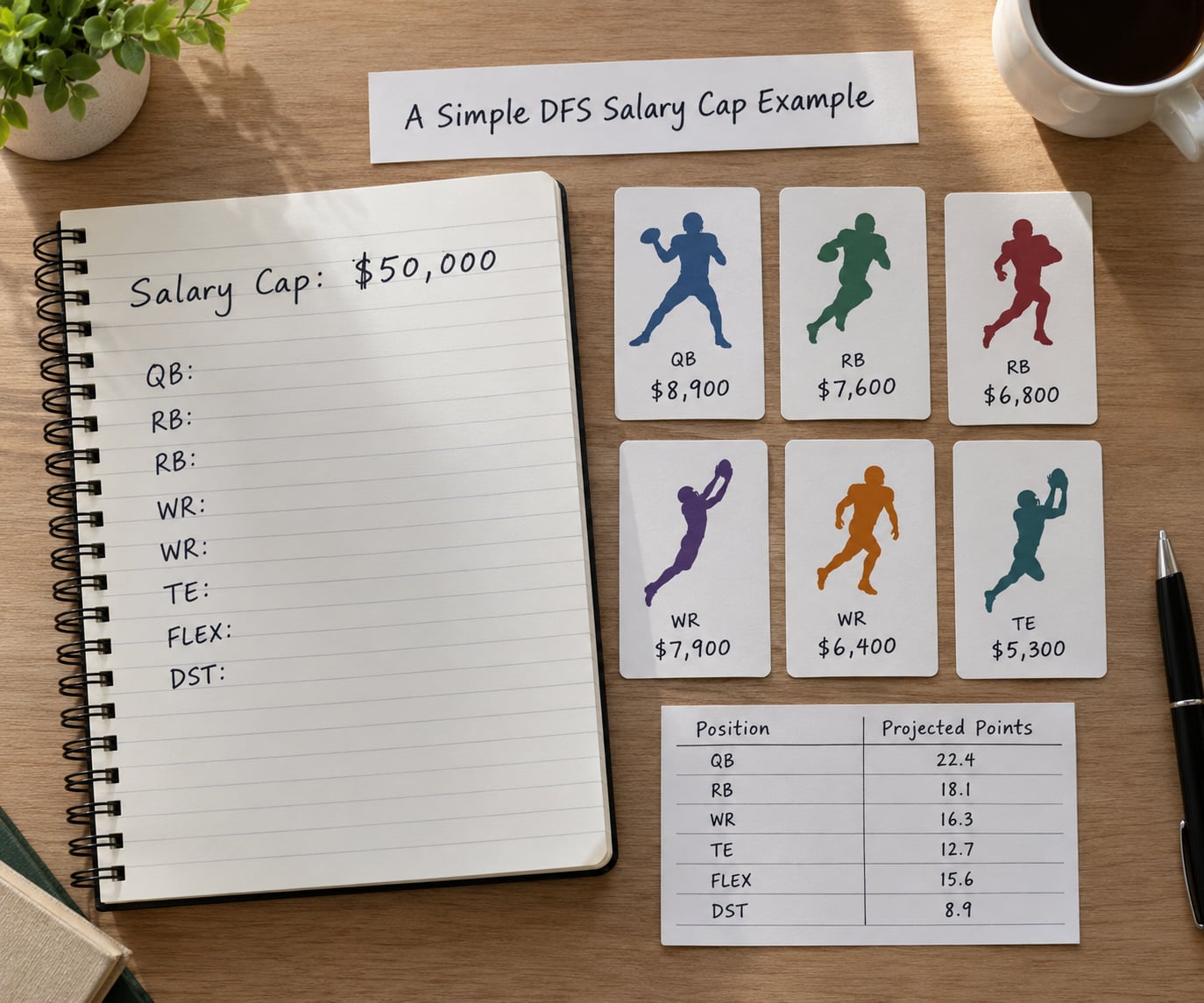
Here is the arithmetic in miniature. Assume a 50,000 dollar cap and these nine roster spots, each with a projected ceiling from that platform’s projections. These are invented numbers for illustration, not real slate data, and no projected total is a promise about Sunday.
| Roster spot | Player salary | Projected points | Points per 1,000 dollars |
|---|---|---|---|
| Quarterback | 8,200 | 22.5 | 2.74 |
| Running back | 6,400 | 17.0 | 2.66 |
| Receiver 1 | 6,900 | 15.5 | 2.25 |
| Receiver 2 | 4,300 | 11.0 | 2.56 |
| Receiver 3 | 3,100 | 8.5 | 2.74 |
| Tight end | 2,800 | 7.0 | 2.50 |
| Flex | 5,200 | 13.0 | 2.50 |
| Defense | 3,200 | 9.0 | 2.81 |
| Kicker | 2,400 | 8.0 | 3.33 |
Adding the salaries gives 42,500 dollars, which leaves 7,500 dollars unspent. That is a legal lineup, and one of the most common beginner mistakes would be to burn the remainder on a mid-tier receiver. The better move is to swap the flex selection or a receiver for a higher-priced upgrade and add the difference to the projected total, which is the entire point of having 7,500 dollars of slack.
Now the variant: take a 9,000 dollar quarterback at 26 projected points instead, and drop back to a 3,200 dollar receiver at 8 projected points to stay legal. Total salary lands at 46,100 dollars, projected points at about 94. Compared with the first build, you spent roughly 3,600 dollars more for about 4.5 more projected points. That trade is only worth making in a large-field contest, where the ceiling matters more than the most likely score. In a head-to-head, the second build is usually too close to call to justify.
Note the column that actually matters. Points per 1,000 dollars is the number to compare, and it is also the reason the cheap kicker looks attractive here. A high raw projection is not automatically a good buy.
Roster Construction Rules That Affect Scoring
Legal rosters are defined by a build, and the build decides which players are even available to you. The table below shows the standard NFL roster on both platforms, and it is the same shape on Yahoo and most other apps with different position labels.
| Roster spot | Count | Eligible positions | Notes |
|---|---|---|---|
| Quarterback | 1 | Quarterback | No flex access; you are locked into the position |
| Running back | 1 (2 on FanDuel) | Running back | Locked running back spots cannot take a receiver |
| Receiver | 3 | Receiver | Locked spots, same as running backs |
| Tight end | 1 | Tight end | The cheapest locked spot on most slates |
| Flex | 1 | Running back, receiver, or tight end | Fills whichever vacancy is cheapest to cover |
| Defense | 1 | Team defense | Scored on sacks, turnovers, and points allowed |
| Kicker | 1 | Kicker | Scored on field goals, extra points, and bonuses |
The flex spot is the one players misunderstand most, so here is the mechanical answer: the flex player scores exactly the same as he would in a locked spot. A receiver in your flex spot gets the same per-reception, per-yard and per-touchdown values as a receiver in a locked receiver spot. What flex changes is eligibility, not scoring. It lets you cover a position you cannot otherwise afford to fill, and it lets you roster a tight end as a receiver-shaped player when receiver prices are inflated.
Other rules that can invalidate a lineup:
- Duplicate players. Each player appears once per lineup. A player can appear across many different entries you submit, but not twice in the same one.
- Team limits. Most NFL platforms cap how many offensive players you can take from one team, usually four, with the defense and kicker often excluded. Check the build before you stack.
- Salary floor. Each platform sets a minimum individual salary, commonly 300 dollars, which exists to stop you from filling a spot with a deeply discounted player.
- Empty or unfilled spots. A lineup with a blank roster spot is invalid even if the salary total is fine.
- Roster lock and the injury window. Your lineup locks at the scheduled start of the first game. Most platforms also hold a brief late injury window before that, so a player who is out minutes before kickoff can be swapped; after the window closes, nothing moves.
Showdown contests are a different build. On a showdown slate, usually two teams playing each other with no other games, the roster is shorter and includes a captain or MVP spot whose score is multiplied, commonly at 1.5 times. The salary cap still applies, but the multiplier changes the optimization completely, because a captain’s ceiling is worth far more than a raw projection.
How to Use Salary Cap Scoring to Build a Better Lineup
Once the rules are clear, the process is repeatable. Seven steps take you from an open slate to a locked entry.
- Pick your contest before your players. A head-to-head wants a safe floor, a double-up wants to beat roughly 55 percent of a small field, and a large-field tournament rewards upside and unusual combinations.
- Set a per-spot budget target. Divide 50,000 by nine and adjust for your build. A rough ceiling of about 5,500 per spot keeps you flexible, and any spot you fill for 3,000 becomes money you can spend elsewhere.
- Sort each position by points per dollar, not by raw projection. The expensive player with the best projection is often just the least efficient player available, and the difference shows up in your other eight spots.
- Anchor one stud and stay flexible on the rest. Most winning entries include one genuinely expensive player, usually at quarterback or the top receiver price, plus value everywhere else.
- Use cheap spots to buy upside. Tight end and kicker are the two most common sources of a surprise score on a slate, because the strong options there are frequently cheap.
- Stack where correlation helps. Rostering a quarterback with one of his pass-catchers raises the ceiling of both, since a good passing game produces both scores. This is the single most repeated beginner tactic in fantasy forums, and it works because of game script rather than because of the cap.
- Verify the build before you lock. Check the salary total, the position requirements, the team limit, and the injury news. Most invalid lineups are a rushed duplication error, not a cap problem.
A word on tools. Lineup optimizers are useful for checking arithmetic and finding combinations you missed, and they are terrible at deciding what to do with variance. An optimizer set to maximize projected points will hand you a legal lineup every time and a predictable losing one just as reliably. Treat the output as a draft, then edit it with your own reads.
Common Salary Cap Scoring Mistakes
- Spending to the cap because unused budget feels wasteful. Unspent dollars are not a penalty. A 47,000 dollar lineup with good value usually outscores a 50,000 dollar lineup that bought two similar players. Fix: leave the slack until the roster is complete, then upgrade one spot deliberately.
- Chasing projected points without checking the price. The top projection on the slate is rarely the best buy. Fix: sort by points per 1,000 dollars and take the top three names at each position before you commit.
- Confusing projected points with actual points. A projection is a guess about a distribution of outcomes. Fix: use projections for construction, then accept that the score is decided entirely by what happens on the field.
- Building for a tournament and entering a head-to-head. Unusual and cheap lineups have a fat left tail in small contests. Fix: decide the contest first, then let that set the risk level of every spot.
- Ignoring team limits and duplicate players. A lineup that is perfect on salary and salary total can still be rejected. Fix: run the validation before the deadline rather than after.
- Carrying one app’s assumptions into another. The 50,000 dollar cap is standard, but roster builds, salary floors, bonus rules and roster formats differ by platform. Fix: read the scoring rules and build rules in the app you are actually entering.
- Missing late injury news. A player you rostered at 1:00 may be out at 1:05. Fix: know your platform’s injury window and check news in the final minutes before lock.
One more note on money. DFS entries cost real currency and no strategy guarantees a profit, including every strategy described here. The majority of accounts are not profitable over time, so treat any entry fee as entertainment spending you can afford to lose, and set a unit size in advance rather than chasing a loss.
Frequently Asked Questions
Does a player’s DFS salary determine how many fantasy points he scores?
No. A salary is the virtual price the platform assigns to help you fit a player inside your roster budget, and it reflects projection. It has no effect on the points a player produces. Points come only from live statistics valued under the platform’s scoring settings, so a 3,000 dollar kicker can outscore an 8,000 dollar running back on any given Sunday.
Do I have to use my entire DFS salary cap?
You do not. The cap is a maximum, not a target, and a lineup that finishes a few hundred dollars under budget is perfectly legal and scores the same way. Finishing under the cap is often the better outcome, because leftover budget is flexibility you can still use to upgrade a single spot before you lock.
Does the flex spot score differently in fantasy football?
No. A player in the flex spot scores with exactly the same values as he would in a locked position, including per-reception points in points-per-reception formats. Flex changes eligibility, not scoring. It lets you fill whichever position is cheapest to cover at running back, receiver or tight end, without a separate captain or MVP multiplier.
What happens if my DFS lineup is invalid when it locks?
An invalid lineup is normally scored as zero or disqualified, depending on the platform. The usual causes are a total salary above the cap, an empty roster spot, a duplicate player, a player used in a position he is not eligible for, or a team limit violation. Validate the build before the deadline, since a rejection at lock cannot be fixed afterward.
Is there a salary cap in fantasy football, or am I confusing it with the NFL salary cap?
There is a salary cap in daily fantasy sports, and it has nothing to do with the NFL’s real team salary cap. The DFS cap is a virtual budget, usually 50,000 dollars for NFL, that resets every slate and exists only to keep entries fair. The NFL cap is a real league rule governing team spending. Season-long salary cap leagues are a third, separate format.
What percentage of DFS players are profitable?
Most are not, and it is worth being blunt about that. Platforms publish the figures they are required to, and the broad picture is that a small share of accounts account for a large share of payouts, with the rest of the field losing money over a full season. Bankroll sizing and conservative cash game selection matter more than any single lineup trick.
Start with the mechanics, because everything else depends on them: the cap is a ceiling, the salary is a price signal rather than a promise, and the points come from the box score under the platform’s scoring settings. The practical first step is to build one lineup under 50,000 dollars, sort each position by points per 1,000 dollars, and see how much better the value names look than the stars. Once how DFS salary cap scoring works stops being a puzzle, the strategy layer gets a lot easier.