Best ball roster construction explained in one line: it is the plan for how many quarterbacks, running backs, wide receivers and tight ends you will select across your draft, written as shorthand like 2/5/8/3, so every pick on your board has a job. Because only your best week counts, the shape of that roster decides how many ways your team can spike. This guide walks through the framework, the target counts, the risk rules and a full worked example you can copy.
Most beginners lose best ball drafts on pick quality, not pick shape. That said, a roster with five tight ends cannot win even with good players, and a roster with no tight end has a hole no waiver wire can fill in a format where there are no waivers at all. Construction is the second-order lever, and this is how to pull it.
Table of Contents
- What Is Best Ball Roster Construction?
- How a best ball draft works
- Best Ball Roster Construction: The Core Framework
- How Does Best Ball Scoring Change Draft Strategy?
- Format changes the math
- How to Build a Champion Roster by Draft Position
- Early rounds
- Middle rounds
- Late rounds
- How Many Players Should You Target at Each Position?
- How Do You Balance Talent, Upside, and Risk?
- Why Do Best Ball Rosters Need More Depth?
- How Should You Construct Starting Lineups in Best Ball?
- What Does a Best Ball Roster Construction Example Look Like?
- What Are the Most Common Best Ball Draft Mistakes?
- Frequently Asked Questions
- How do you build a good roster in best ball fantasy football?
- Is it better to draft the highest projected player available in best ball?
- How many bench players should I target in a best ball league?
- Should I use a zero-running-back strategy in best ball?
- How does superflex change best ball roster construction?
- Can I make waiver claims in best ball leagues?
- Start With Your League Rules and Risk Limit
What Is Best Ball Roster Construction?
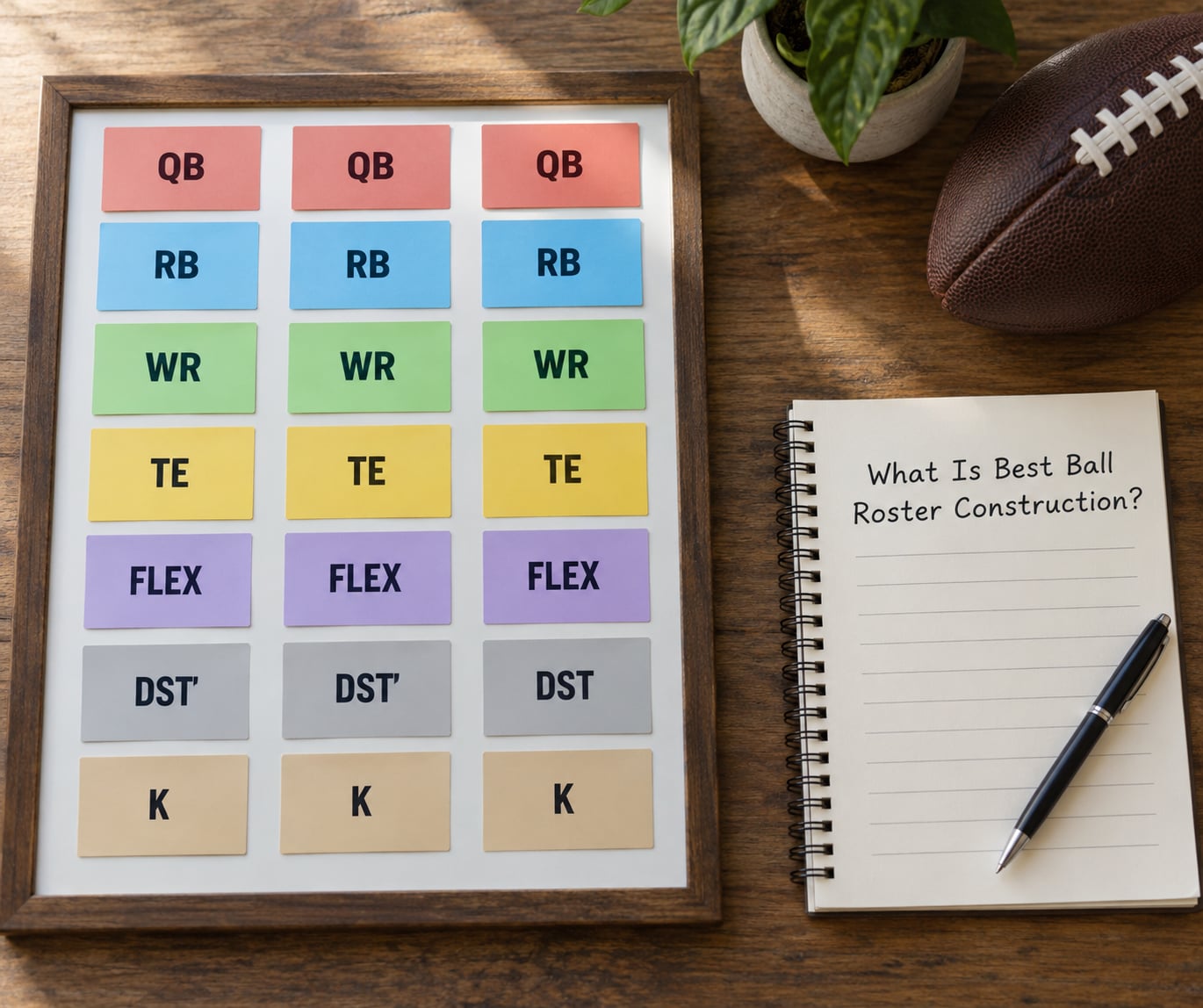
Best ball roster construction is the deliberate allocation of your draft picks across skill positions. You pick a player on every turn, the draft locks immediately, and your highest-scoring lineup of the entire season is the one that counts. The allocation is what separates a roster built from a plan from a roster that just happened.
Three things feed into it. Draft strategy tells you when to reach and when to wait. Roster rules tell you how many spots exist at each position and how many of them start. Risk management tells you how much injury and variance you can absorb before a single bad week ends your run.
This is for anyone entering a large season-long or single-week best ball tournament with one entry or a hundred, plus dynasty best ball players who want a repeatable default build instead of improvising at the clock. It is also worth knowing that most people asking this question are in redraft or home leagues, where a best ball plan is often the wrong plan.
How a best ball draft works
- You draft on a timer. Every team gets a set window, usually 90 seconds, to lock a selection or the pick passes.
- Your pick locks instantly. There is no changing it later, and there are no trades unless the draft host allows them.
- You never manage the roster in season. No waiver wire, no lineups to set, no bench decisions, unless you enter a format that allows them.
- Your best lineup is scored. Only the highest single-week score counts, so one huge week beats ten solid ones.
- Some weeks score higher than others. A quarterback throwing 28 fantasy points in a shootout is a very different asset than one grinding out 14.
- You cannot see the field’s plans. That uncertainty is why construction, not projection alone, sets your range of outcomes.
Best Ball Roster Construction: The Core Framework
The framework below is the checklist I work from before a draft starts. Fill in the right-hand column for your league and it becomes a repeatable draft plan rather than a reaction to the board.
| Framework Element | What You Decide | Why It Moves Your Finish |
|---|---|---|
| Draft position | Pick thresholds, not position labels | Round number is a truer signal of scarcity than the position on the board |
| Positional priority | Which position must be filled first in each round band | Decides who you take when two players share a grade |
| Target counts | How many QBs, RBs, WRs and TEs your roster needs | Turns a vague preference into a stop condition |
| Risk appetite | How many injury-prone, low-floor players you allow | Best ball punishes both timid and reckless variance |
| Roster rules | Roster size, flex slots, superflex, IDPC requirements | A 3TE league and a 1TE league need different counts entirely |
| Depth strategy | How many bench players you accumulate | Your single best week is likelier to come from your fifth tight end than your first |
Notice what is missing: there is no row for player talent. That is deliberate. Player quality decides most of your outcome, and construction decides the margin around it.
How Does Best Ball Scoring Change Draft Strategy?
Scoring is the single biggest input to construction, because it decides which player profiles can produce a ceiling week. A 4-point scoring format compresses the gap between a star and a starter, which makes wide variance cheaper and depth more valuable.
In half-PPR, published spike-week research from NBC Sports puts the ceiling for a winning week at roughly 28 QB points, 20 RB points, 20 WR points and 13 TE points. Tight ends score lower at their peak, so a tight end taken as a weekly starter costs you more of a ceiling than a receiver at the same position.
Format changes the math
- PPR versus standard. Per-reception scoring lifts receivers and tight ends, which shifts roster weight away from running backs.
- Superflex. A weekly starter requirement at quarterback makes QB count non-negotiable, usually three or four rather than two.
- IDPC. Defensive build is a separate roster with its own construction logic. Treat it like a second league with its own checklist.
- Dynasty. Youth and role security matter more than weekly ceiling. Rookie IDPs get drafted far earlier than their best ball counterparts.
- Single-week tournaments. Only one week scores. Construction shifts hard toward spike profiles and away from steady producers.
One research note worth remembering: analysts at 4for4 caution against treating any single season’s build trend as proof. Good strategy survives multiple seasons of data. A trend that lasted one year is not a strategy, it is a memory.
How to Build a Champion Roster by Draft Position
The NBC Sports Playoff Build offers a clean version of this with explicit pick thresholds: secure RB4 before round 14, WR4 before round 10 and TE1 before round 6. Those numbers are useful as starting points, then you adjust them for your own roster rules.
Early rounds
Take the best player available who fits your counts. Early picks are too valuable to spend on a reach, and the field has already thinned out. Your job in rounds one through four is talent, and construction decisions start around round five.
Middle rounds
This is where construction earns its keep. Use your round thresholds to force your positional targets. If you need two more tight ends and you are on round nine, you are drafting tight ends even though a wide receiver sits there.
Late rounds
Buy depth and take swings. Rookie quarterbacks, post-hype tight ends, second-year receivers breaking out and veteran pass catchers with dead depth charts all become useful. Nobody has ever won a best ball tournament by punting on the last four rounds.
The common beginner error is abandoning the plan because the draft feels slow. On r/BestBall, users repeatedly describe drafting well for eight rounds and then finishing on autopilot. That is the round where construction either holds or dies.
How Many Players Should You Target at Each Position?
These are baseline counts for a standard 12-team roster with one flex spot. Adjust from here rather than memorizing them.
| Position | Baseline Target | Adjust Up When | Adjust Down When |
|---|---|---|---|
| Quarterback | 2 | Superflex is on, or it is a single-week tournament | Standard scoring and a deep QB pool |
| Running back | 4 | Workload data points to a bell curve through the early rounds | PPR scoring and a committee-heavy league |
| Wide receiver | 7 | PPR, or your starting lineup needs three receivers | Standard scoring with limited flex |
| Tight end | 2 | Your lineup can start two, or 3TE construction fits your risk budget | A 3TE league already forces your hand elsewhere |
League size changes these more than most people expect. In 16-team leagues, replacement levels drop and you need one more player at every position. In 8-team leagues, four receivers and one tight end is often enough, and extra depth is wasted.
How Do You Balance Talent, Upside, and Risk?
Balance the floor against the ceiling rather than picking the highest projected scorer. A projection is an average week. Best ball pays for the best week, so a player whose average is slightly lower but whose upside is much higher often wins more drafts.
Score every candidate on five things:
- Weekly projection floor. What does he score when nothing goes right?
- Draft ceiling. What does a spike week look like given his role and target share?
- Injury risk. How many games might he miss, and what happens to your lineup without him?
- Age and role security. Is his job in trouble next season, or is he the future of the offense?
- Roster fit. Does taking him force a position you already have five of?
Role security is the most underrated of the five. A receiver already at 24 targets per game is more reliable than a rookie tight end with the same projection and a much wider range of outcomes.
On the flip side, do not sand every pick down to safe. r/fantasyfootball threads are full of people who reached two rounds past ADP for contrarian pride and whiffed. Take the player at ADP value; take the reach only when your roster needs that position.
Why Do Best Ball Rosters Need More Depth?
Depth wins because of how your best week is assembled. Your top scorer is not your only scorer. A lineup that scores well usually pairs one huge week from a starter with solid weeks from four to six other players, and every one of those is a chance for something better.
There are four concrete reasons extra bench players pay off:
- Replacement level. In 12-team leagues, the last starter on your roster is often the 12th best player at that position. One more body is a full starting slot.
- Injury replacement. There is no waiver wire in most best ball formats. If your starter is out, the only fix is a player you already own.
- Flex flexibility. Extra receivers and tight ends let your lineup absorb a dud without choking on it.
- Dart throw runway. Depth means more shots at a breakout, and breakouts are what place teams.
The practical version: at roughly 60% of your roster, stop taking the next-ranked player at your main position and start spreading the remaining picks across the board.
How Should You Construct Starting Lineups in Best Ball?
If your league auto-optimizes lineups, skip this. If you set them yourself, the rule is simple: build the highest floor you can with your flex and superflex slots spent on ceiling.
Starters at the positions with the most games played go in the safest slots, because games played are points before any stat category. Then place your two highest-upside players into the flex and superflex spots, where a down week costs nothing.
Do not bench a starter midseason because of a bad two-week stretch. Best ball scoring already protects you from slow starts. Benching usually costs you more upside than the slump costs you floor, and it removes the only weeks your roster can win.
What Does a Best Ball Roster Construction Example Look Like?
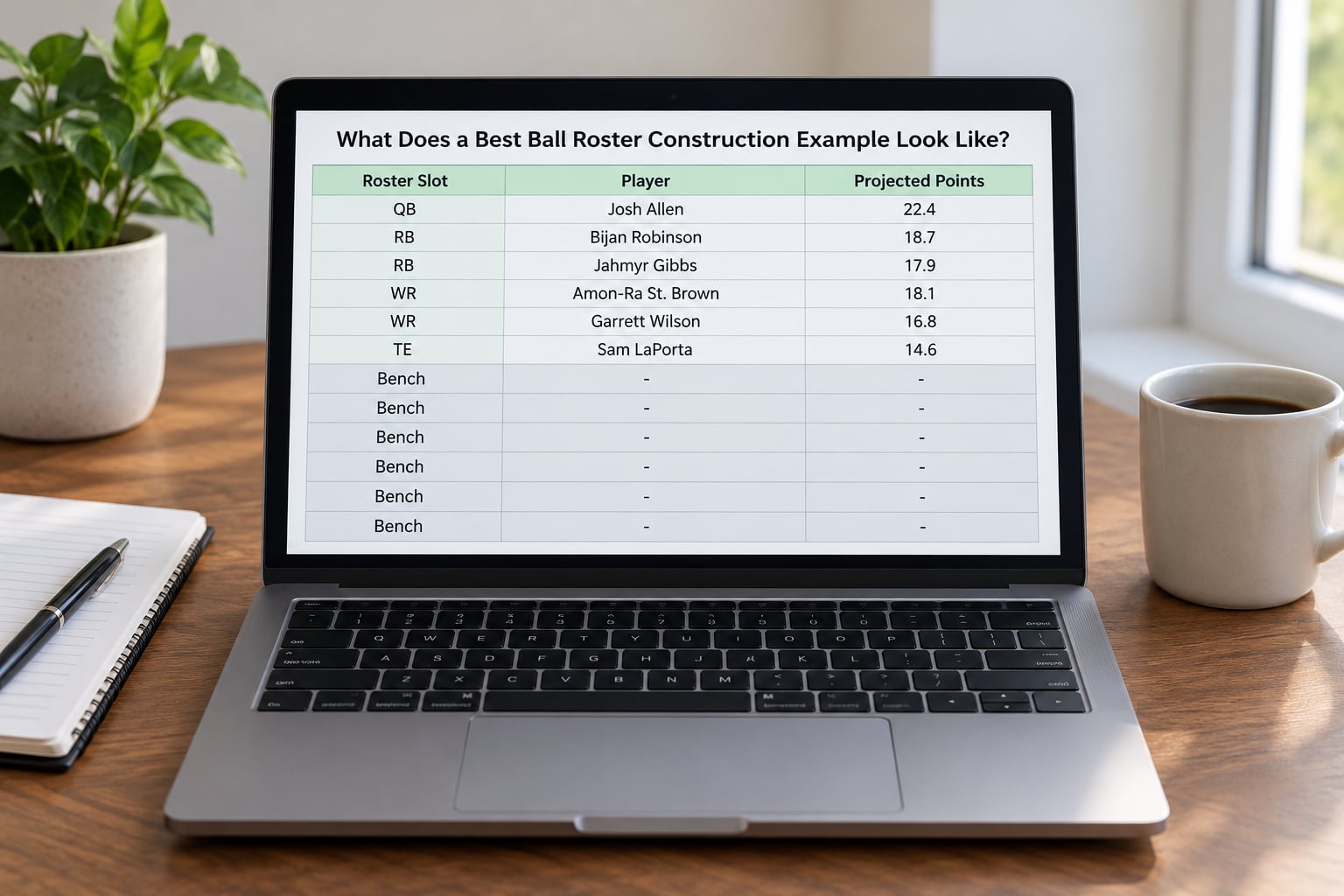
Here is an illustrative 12-team PPR roster after 14 rounds, targeting 2 quarterbacks, 4 running backs, 6 wide receivers and 2 tight ends with one flex add afterward. No real player names, because the point is the shape.
Rounds one to three. You take the best player available at QB, WR and RB regardless of position, using your flex counts as a soft guide. Three premium players, one at each skill position, and your construction is already on track.
Rounds four to six. Your thresholds say TE1 before round 6, so you take the top tight end at pick 18. At pick 22 you add a second tight end with target share upside. At pick 30 you add WR3.
Rounds seven to ten. WR4 before round 10 is the constraint that matters most. You now have four receivers, three running backs, two tight ends and one quarterback, which is a legal lineup plus bench pieces.
Rounds eleven to fourteen. You finish with a backup quarterback at 3.6 points per game, a veteran tight end on a low-volume offense, two rookies and a handcuff. Round 15 goes to a second-round rookie receiver.
Final count: 2/5/6/2 across 15 players, which starts nine plus a flex and holds six bench bodies. Nothing about it is exciting. It is simply legal, deep and unexploitable, which is exactly what a champion roster looks like in a format this random.
For context, current Underdog consensus build frequency data shows how narrow the field of shapes is: 3QB-5RB-7WR-3TE at 27.3%, 3QB-6RB-6WR-3TE at 19.6%, 2QB-6RB-7WR-3TE at 10.7%, 3QB-6RB-7WR-2TE at 9.7% and 2QB-6RB-8WR-2TE at 5.8%. Those top five shapes cover most of the field, which matters when you are entering hundreds of drafts.
What Are the Most Common Best Ball Draft Mistakes?
- Reaching at running back. RBs go earlier than they should every single year. Stick to your RB thresholds even when the board tempts you.
- Ignoring positional eligibility. If your league requires two tight ends to start, three tight ends is not optional depth, it is your construction.
- Drafting only on best ball. Players from home leagues and redrafts bring habits that cost you in a format that never lets you change a pick.
- No bench depth. Ending with five starters and nothing behind them leaves an injury with no answer.
- Taking avoidable injury risk. Two players with the same projection who both play half the schedule is a bet, not a portfolio.
- Abandoning the plan late. The draft feels slow, you improvise, and your roster has five of one position by round eleven.
- Entering many drafts with identical builds. Volume alone does not replace construction discipline, but identical entries needlessly duplicate your exposure.
- Treating one strategy as guaranteed. The forum consensus is clear that dogmatism about zero RB gets punished the moment the environment shifts.
The honest framing: construction is a second-order lever. A wrong build costs you a small amount, not a season. Take good players and your build will carry you to the money often enough.
Frequently Asked Questions
How do you build a good roster in best ball fantasy football?
Set positional targets before the draft, then use pick thresholds instead of position labels to hit them: RB4 before round 14, WR4 before round 10, TE1 before round 6. Take the best player available while your counts are satisfied, and stop as soon as a position is full. Depth matters more than any single archetype, so keep adding usable bench bodies to about 60% of your roster.
Is it better to draft the highest projected player available in best ball?
Early in a draft, yes, because the best player available is almost always the right one. But since only your best week counts, pure projection ignores the ceiling that wins tournaments, and the value of chasing upside collapses as the board empties. Take the best player available until your positional targets are nearly met, then draft by round threshold. Projection guides you early; construction guides you from the middle rounds onward.
How many bench players should I target in a best ball league?
Plan for bench players to be roughly 40 to 45 percent of your roster. In a 15-player roster that is six or seven bench spots, and in a 16-player roster it is seven or eight. Bench value comes from replacement level, from having an injury replacement in a format with no waiver wire, and from flex flexibility. Depth is the cheapest way to raise your team’s best possible week.
Should I use a zero-running-back strategy in best ball?
Only as one entry among many, not as your whole identity. Zero running back has produced genuine results in recent seasons, but the 4for4 research is blunt that a single-season trend is not proof. If you do run it, cap it at one or two entries out of a large slate and pair it with balanced builds elsewhere. Being dogmatic about one shape is the fastest way to end up with a roster that cannot field a lineup.
How does superflex change best ball roster construction?
Superflex makes quarterback the position you can least afford to get wrong. With two flex-eligible starting quarterbacks required, two quarterbacks is no longer enough, so push your target to three or four and take your second signal earlier in the draft. It also means your marginal bench players must include at least one quarterback, since a QB injury with no rostered backup ends your run outright.
Can I make waiver claims in best ball leagues?
In most tournament formats, no. Best ball drafts lock your selections permanently and run without a waiver wire, which is exactly why bench depth and injury replacement matter so much. A few hosted or dynasty-style best ball leagues add late adds or free agent moves, so check the specific rules before you rely on one. Plan every roster as if nothing can be added after your final pick.
Start With Your League Rules and Risk Limit
Do this before your next draft and best ball roster construction stops being a guessing game. Write down your roster rules, flex and superflex requirements, then set your positional target counts and the round thresholds that will get you there.
Next, set a risk limit. Decide in advance how many injury-prone, low-floor players you will allow yourself, because that number is the one you will break at pick 45 with a name on the board.
Then draft depth before you chase one more upside player. In a format where your best week is the whole story and nothing can be added later, an extra usable body is the most dependable leverage you have. Best ball roster construction explained properly is just this: player quality first, roster shape second, and both decided before the clock starts.