Most trade offers get rejected for the same reason: they are built around what the sender wants, not what the other manager is missing. To make a trade offer other managers accept, you read their roster until you can name their weakest position, package an asset that fixes it, and prove in a short note that both sides come out even. Ten minutes of homework is usually worth more than a week of sending offers.
I’ve been in the same slow, low-stakes dynasty league for years now, and the offers that get accepted are almost never the ones with the best player names attached. They’re the ones that look solved. This guide walks through the whole process, from what to gather before you write a single word to how to close a deal after two counters.
Table of Contents
- What You Need
- Step-by-Step: How to Make a Trade Offer Other Managers Accept
- How to Make a Trade Offer Based on a Partner’s Real Need
- Choose Assets That Help Your Side of the Trade
- Build an Offer With More Than One Value Tier
- Test Whether Both Sides Receive Fair Value
- Write a Short Message That Makes Accepting Easy
- Choose the Right Time to Send the Offer
- Negotiate Without Giving Away Your Best Outcome
- Common Mistakes
- Frequently Asked Questions
- How do I know if my fantasy football trade offer is fair?
- Should I make the first trade offer or wait?
- When does one manager’s roster need matter more than player value?
- Are two-for-two trades better than two-for-one offers?
- How do I negotiate after another manager sends a counteroffer?
- Can I make a trade offer after a league trade deadline?
- Conclusion: Start With One Clear Need
What You Need
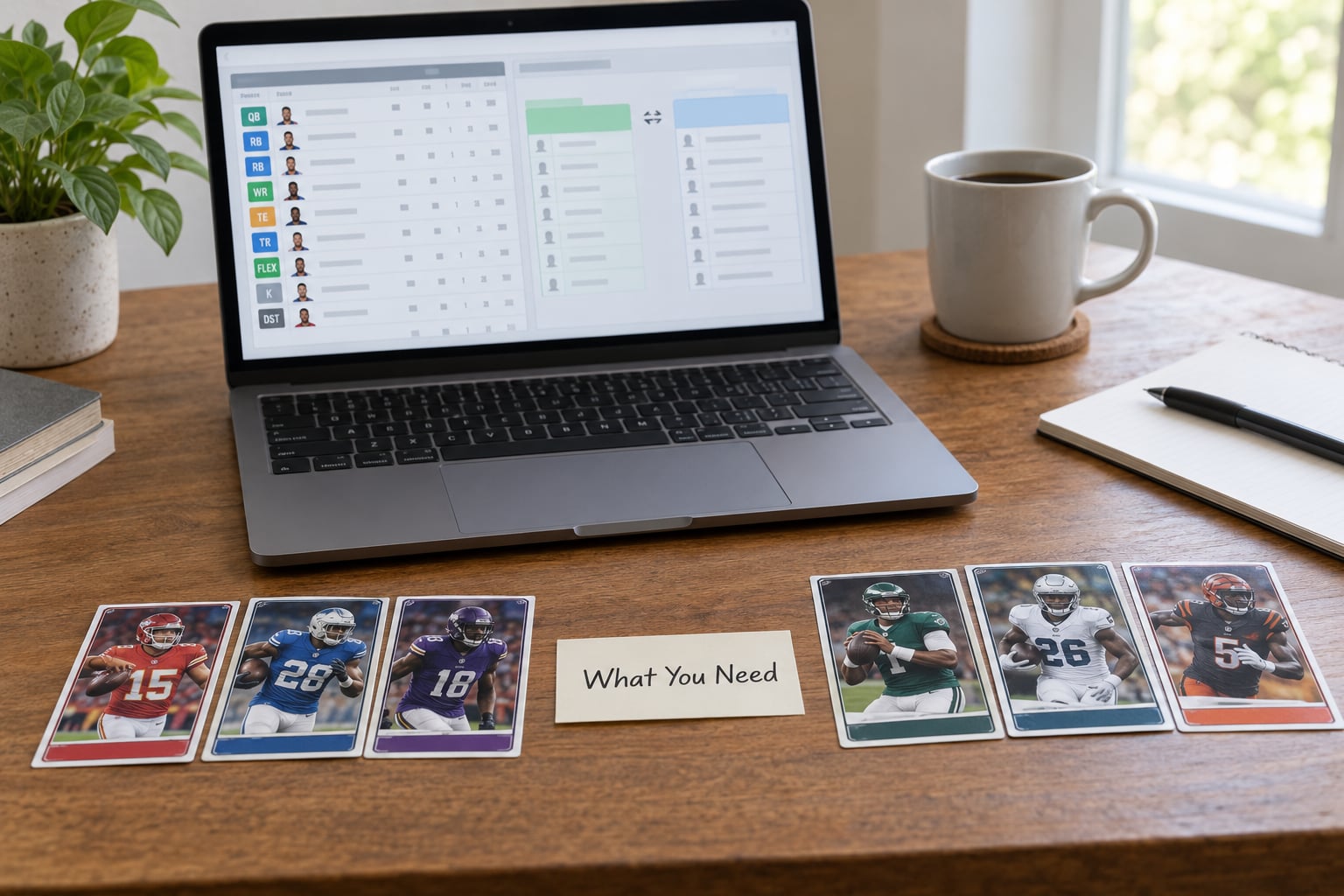
Before you message anyone, you need six pieces of information. Most managers skip straight to the player names, which is exactly backwards.
League settings and trade rules. Scoring format changes everything. In PPR, a target receiver is worth far more than the same player in standard, so your idea of a fair package might be built on the wrong scoring. Note roster size, bench spots, the trade deadline, whether deals need a vote, and how many votes it takes to kill one.
The other manager’s roster construction. You are not looking at a list of names, you are looking at a shape. Where are they thin on starters? Where do they have two players competing for one job? Which positions are loaded with guys who only matter in a specific format?
Your own surplus list. Write down the players you would trade at a discount without losing sleep. Everything else on your roster is off the table until you have a reason.
Current value anchors. Consensus rankings and the last three weeks of production give you a shared reference point. Managers trust data far more than vibes, and a number you can cite removes an argument before it starts.
Replacement options. Ask yourself what you’d realistically acquire for that player in a year-end draft. Replacement level is where most trade arguments get won or lost, and it’s the piece people skip.
Your walk-away point. Decide the exact return below which you say no, before you start negotiating. It is very hard to hold a line you set halfway through a conversation.
One distinction matters more than the rest. Absolute player value is what a player is worth on a neutral board. Positional need is what a player is worth on one specific manager’s roster, and the gap between those two numbers is the whole game. A running back ranked 18th overall can be a bigger upgrade than the running back ranked 8th if the 8th-ranked player already has one.
Step-by-Step: How to Make a Trade Offer Other Managers Accept
Read their roster, find the hole, pick an asset that fills it, check the value from both sides, and write a message that makes saying yes easy. The seven steps below take about ten minutes of prep and one short message, and most accepted deals come from offers built exactly this way. Work through them in order, because each step is cheaper than the one after it.
How to Make a Trade Offer Based on a Partner’s Real Need
Start with their starting lineup, not their bench. Look for a position where one starter is carrying the load and everything behind him is a downgrade you would not roster. That gap is the offer.
Next, check the whole roster for redundancy. Three tight ends where two starters are already locked in means the third guy is worth less to that team than he looks, and a manager will argue that point correctly every time.
Then think about strategy. A contender rarely needs a rookie with a ceiling, because that player costs them a roster spot without producing this year. A rebuilding manager may not want a declining veteran at all. In keeper and dynasty leagues, check the keeper rules first, since a player kept by another team has a completely different value than an identical player on a team with open keeper slots.
One more filter: timing of their schedule. A manager whose team faces three tough opponents in a month is less interested in a steep upward trajectory and more interested in a steady floor.
Choose Assets That Help Your Side of the Trade
An offer fails when it costs you something you actually wanted. Before anything else, list the players you would be annoyed to lose, then build the offer around what remains.
Surplus positions are your best currency. A third wide receiver on a two-receiver roster is a real asset, because he has nowhere to go on your team even if he would start on someone else’s. Redundant depth works the same way at every position.
Aging assets and players with limited future value are the two categories most managers hold too long. If a player’s role is shrinking and you have depth behind him, he is worth more today than in six weeks, and the other manager knows the window is closing.
Finally, check the fit. A player whose role already exists on the receiving roster is a downgrade no matter how good his numbers are. Ask whether he would actually start there, or whether you are asking that manager to bench one of his own players for a stranger.
Build an Offer With More Than One Value Tier
Never send a single package. Give the manager two options, and ideally three assets in one of them, so they can say yes to part of what you offered.
A tight two-for-one sends a message that you are desperate, and it gives the other side an easy opening to walk. Adding a third player to your package costs you nothing extra in effort, and forum regulars consistently note that depth-plus-star deals read as fair more often than strict one-for-one swaps do.
Mixing in a draft pick changes the shape of the negotiation. Picks are value-neutral across the league, which means a manager cannot argue about whose player they like more. That takes one argument off the table entirely. In dynasty, a future second is often easier for both sides to agree on than a contested player.
Test Whether Both Sides Receive Fair Value
Run any package through a trade analyzer before you send it, but treat the output as one input rather than a verdict. Consensus sites disagree with each other often enough that an average across two or three is more reliable than any single number.
Then weigh the things a score cannot see. Age curve and career runway matter enormously in dynasty and barely at all in redraft. Scarcity, meaning how many comparable players exist at that position, changes what a slot is worth. Injury history and the availability of a direct backup on that roster both belong in the math. In redraft, auction value and projected fantasy points per game under your specific scoring format are usually the cleanest anchors available.
Here is the test that catches most bad offers. Compare the package as if you were the receiving manager, and ask whether they would still take it in a league where you did not exist. If the honest answer is no, the gap is not in their valuation. It is in what you are asking for.
Write a Short Message That Makes Accepting Easy
Most managers skip the note, and a bare player swap is read as a lowball no matter how fair it actually is. Four or five sentences is enough.
The opener names the direction of the trade, ties it to their specific need, and leaves the door open:
Hey, I’ve got a surplus of tight ends and you’re running thin there. Would you be interested in talking about a package built around my TE2 for one of your receivers? Not locked in on anything specific, just want to see if there’s a fit.
The counter concedes a point without surrendering the deal, and names the one thing that matters most to you:
I can add the second receiver to make it three players across. The only piece I really need to move is the running back, though, so if that’s the part you want to keep, we may be far apart.
The close removes all doubt and makes accepting a single action:
If you send that back as-is, I’ll accept right now. I don’t need to think about it.
Keep the tone collaborative, name players instead of positions, and skip the conditional language. Offers that say something might work if a certain other player performs well read as pressure, and managers reject them for that reason alone.
On platform mechanics, the process is the same nearly everywhere. On ESPN you select players with the blue trade buttons, hit next at the top right, review the roster on the confirmation screen, then add your note and send. Yahoo follows the same path through the team page. Names and icon positions move between app versions, so check your own interface, but the sequence has not changed much in a few years.
Choose the Right Time to Send the Offer
Timing changes what a manager is willing to consider. The best windows are usually quiet ones.
Right after a league trade deadline passes, pressure comes off and managers suddenly have flexibility, which is the opposite of the week the deadline is announced. The day after an injury report is strong for buying a replacement asset, and less strong for selling a player in the same conversation. Before a manager plans a roster move, such as a keeper decision or a dynasty build, you can shape what they think they need. In the offseason, deals are easier because nobody is protecting a playoff spot.
Avoid acting on rumor or panic. An offer built on a single unverified report is easy to dismiss, and a manager who feels you are reacting to a hot or cold streak will negotiate harder against you.
Negotiate Without Giving Away Your Best Outcome
Before you counter, split your list into two columns. Must-have means the deal does not happen without it. Preferable means you would take it if the rest of the package is right. Conflating those two is how people end up giving up a player they needed to keep.
Count your rounds. Two counters is normal. Three is the ceiling before a conversation turns into work, and a fourth is where a manager stops reading. If you are at three with no agreement, the gap is not about wording, and the honest move is to let it go and try again later.
Focus on the differences that matter. A manager may want your top receiver back but only if the return includes a running back, and that one structural preference explains the entire negotiation. Find it and you can solve the trade in one message.
Know when to walk. If the return no longer improves your roster or your playoff path, accept that you misread the market and decline politely. A fair but unexciting trade still counts as a win if it fills a real hole, and a trade you regret in week 12 is a bad deal regardless of how it looked in the chat box.
Common Mistakes
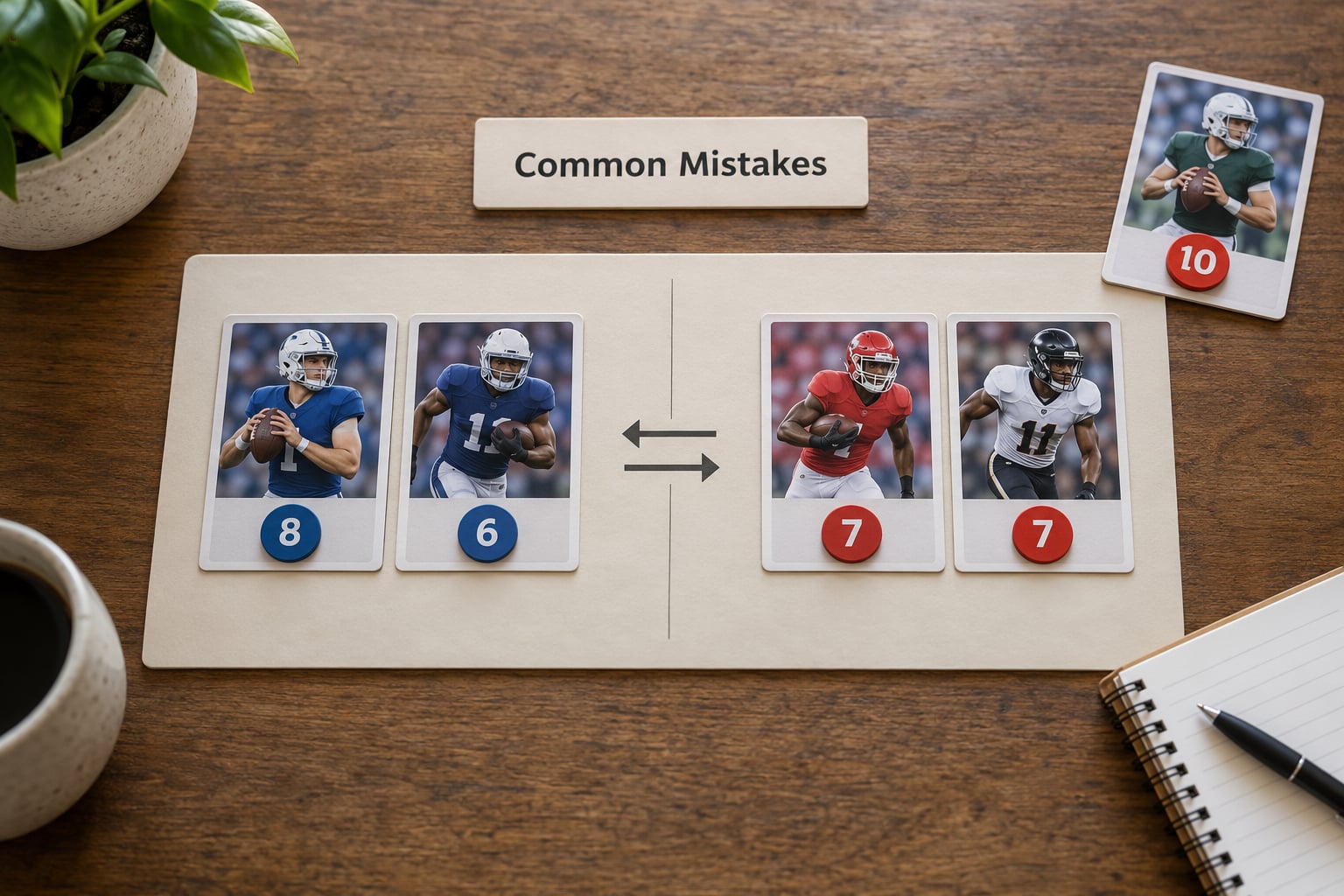
Almost every rejection traces back to one of the reasons below. Each has a straightforward correction.
Making the first offer too lopsided. The gap between what you send and what you would accept is the gap you are gambling on. A wide-open first offer just tells the other side to draft against your valuation.
Asking for too many players. Four players in, one out is not aggressive, it is a trade the other manager cannot evaluate quickly. If you need a three-for-one, make sure the added piece is a genuine upgrade rather than bench filler.
Ignoring their strategy. You do not know their season plan, and assuming you do is the fastest way to get declined. Ask what they are trying to do with the season, and let the answer reshape your package.
Using stale rankings. Rankings that predate a role change, a coaching change or a two-week slump will not survive contact with a manager who checks. Look at what has happened in the last three weeks, not just the season totals.
Presenting an unrealistic package. If you cannot explain in one sentence why the deal is fair, the note is going to do more harm than good.
Opening with excessive demands. Asking for everything you could possibly want reads as spam, and managers who receive a stream of them start ignoring all of them. Quality over volume is the whole reputation play.
Negotiating without a preset limit. Without a walk-away number you will keep going out of politeness, and politeness is an expensive way to lose a season.
Two habits prevent most of these. Keep a short log of what you send and what comes back, because managers repeat themselves in their declined offers and that log tells you their valuation faster than any ranking. And keep your league relationships intact, since most leagues are decided by ties and standings, not by genius moves.
Before you hit send, run through five checks. Does the offer name a specific need on their roster? Can you justify the return in one sentence? Is the value close enough that both sides can defend it? Have you included a note? Have you decided what you would walk away for?
Frequently Asked Questions
How do I know if my fantasy football trade offer is fair?
Compare both sides through two or more consensus sources rather than one, then adjust for age, positional scarcity, injury history and your league’s scoring format. A package is fair when the receiving manager would still take it in a league where you did not exist. If you cannot argue it in one sentence, it probably is not there yet.
Should I make the first trade offer or wait?
Move first when you have already found a real need on another roster, because initiative rarely matters once the value is right. Wait when you are still deciding whether a player is surplus, since a rushed opener is the most common reason managers get declined. Waiting on a clear need costs you nothing and rarely costs you the deal.
When does one manager’s roster need matter more than player value?
Need outranks raw value whenever a player fills an open starting job with no competition behind him. A modest player at a thin position on their roster can be a bigger upgrade than a better-ranked player whose position is already crowded. That gap between board value and roster value is exactly the window a good offer should target.
Are two-for-two trades better than two-for-one offers?
Two-for-two deals are usually easier to accept because the extra player gives the other side something to build on and read as effort rather than a one-sided ask. They also give you more places to adjust during negotiation. Keep a third player in your back pocket, though, since adding a piece to your side usually unlocks a deal that two-for-two stalls on.
How do I negotiate after another manager sends a counteroffer?
Split your targets into must-haves and preferences before you reply, then respond to the one structural difference driving the whole negotiation rather than every line item. Two counters is normal, three is the limit, and a fourth means the gap is real. A short, specific counter that names what you can add and what you need to move keeps the conversation moving.
Can I make a trade offer after a league trade deadline?
It depends entirely on your commissioner settings. Many leagues lock trades after the deadline, others allow them with no penalty, and a few let commissioners approve them individually. Check your league rules or message your commissioner directly, since the rules that also govern league voting are usually the same ones that decide whether a deadline trade can be processed at all.
Conclusion: Start With One Clear Need
Learning how to make a trade offer other managers accept comes down to one habit: find the need before you choose the player. Read the other roster, name the position that is hurting, pick an asset from your surplus that fixes it, and check the exchange from both directions before you write a word.
Then send two options with a short note attached and a walk-away number you decided on in advance. Most managers in most leagues are waiting for exactly that kind of approach.