
Cash games vs tournaments in daily fantasy comes down to one question: do you want frequent small wins or a rare big one? Cash games pay roughly half of every entry and reward a steady, high-floor lineup. Tournaments, usually called GPPs for guaranteed prize pools, pay only the top slice of a large field and reward upside over safety. For most beginners, cash games first is the honest answer.
I have played both formats across NFL, NBA and MLB slates for years, and the mistake I see most often is picking a format that fights the strategy the player is actually good at. A player who researches matchups well belongs in head-to-head contests. A player who loves chasing a contrarian running back at 5% ownership belongs in a large tournament.
Table of Contents
- Cash Games vs Tournaments in Daily Fantasy at a Glance
- How cash games vs tournaments in daily fantasy differ
- Payouts and Profitability
- Why minimum finishes matter more than top finishes
- Risk, Variance, and Bankroll Management
- Player Pools and Competition
- Strategy and Required Skill
- Skills that decide a 50/50 or head-to-head
- Skills that decide a large-field tournament
- Time, Tools, and Entry Decisions
- Which Should You Choose?
- Frequently Asked Questions
- Are cash games or tournaments better for beginners in daily fantasy?
- Is it better to play cash games or tournaments every day?
- Can you consistently win tournaments in daily fantasy?
- Should I use the same lineup strategy for cash games and tournaments?
- How much money should I start with in daily fantasy?
- Can cash games and tournaments be used together?
- Conclusion
Cash Games vs Tournaments in Daily Fantasy at a Glance
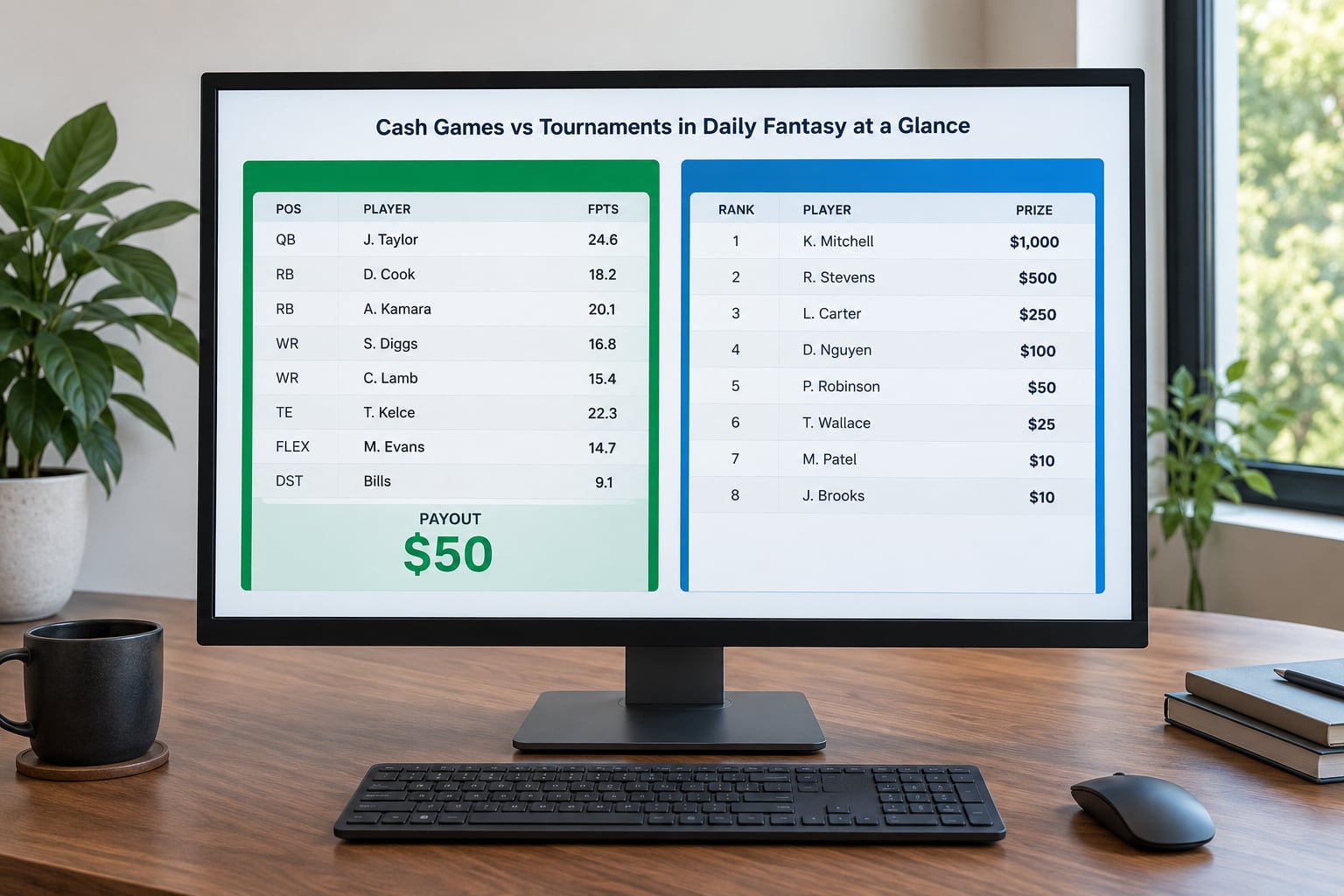
| Factor | Cash Games | Tournaments (GPPs) |
|---|---|---|
| Prize structure | Top half of the field splits an equal share | Top 5 to 25 percent split a top-heavy pool |
| Guaranteed return potential | High. Most entries return something in a 50/50 or double-up | Low. Most entries return nothing |
| Variance | Low to moderate | Very high |
| Entry decisions | Fewer, smaller entries, longer per-entry thought | Many entries, usually multiple lineups per slate |
| Competition | One opponent or a small pool of sharp regulars | Hundreds to thousands of lineups including casual players |
| Skill required | Projection accuracy and consistency | Differentiation, sequencing and nerve |
| Best suited for | Beginners, conservative managers, short sessions | Experienced players chasing a top payout |
How cash games vs tournaments in daily fantasy differ
A cash game pits your lineup against one opponent or a small pool. Win half the 50/50 entries and you roughly double your money back. In a tournament, you are one of many lineups and only the very top finishes get paid, so the winning condition moves from beating one opponent to beating everyone.
That shift changes what a good lineup looks like. Cash games reward the most likely reasonable outcome. Tournaments reward the outcome that a thousand other managers did not think to build.
Payouts and Profitability

A 50/50 pays every finisher in the top half the same amount, so a mid-range finish is a profitable finish. Double-ups work the same way with a smaller field. Head-to-head contests simply pay the winner, which is why opponent research matters so much there.
Tournament payouts are shaped like a pyramid. The top spot takes the largest slice, the next few take slightly less, and by the time you reach the bottom paying position the prizes are small relative to the entry. That means finishing 40th in a large field can feel like winning a 50/50 and finishing 3rd can feel like a career highlight.
The bigger advertised prize does not automatically mean a better opportunity. A large tournament with many entries and a heavy rake can return less in practice than a steady stream of small cash contests entered at the same total cost.
One more wrinkle is the rake, the platform’s cut of each entry. It runs higher on small cash games, where a bigger share of your money is taken to administer a short contest. On large tournaments the percentage is lower but the field is deeper and the losing tail is longer. Contest menus and fee structures shift between seasons, so read the current details on each app rather than trusting an old screenshot.
Why minimum finishes matter more than top finishes
Most profitable DFS accounts are not the ones with the biggest single tournament payout. They are the ones that collect enough small finishes to cover entries and still have capital for the occasional big finish. Cash games generate that steady stream, which is why most regulars treat them as the engine and tournaments as the upside bet funded by it.
Risk, Variance, and Bankroll Management
Variance is the honest dividing line between the two formats. A cash game has many mediocre outcomes and few brilliant ones. A tournament has mostly losses and a thin tail of very large wins. Two players can run identical lineups for a month and end up with completely different results in a GPP.
Losing streaks hit differently too. A four-game cold stretch in 50/50s is painful but survivable. A $200 tournament followed by another $200 tournament the next day can erase a good month. The second scenario is the single most common way accounts go broke, and it happens to players with real skill.
Bankroll splits that hold up reasonably well in practice:
- 90/10, cash heavy. Best for beginners, first-season players, and anyone who wants a stable learning environment. Tournament entries stay small enough that losing a few does not matter.
- 80/20, balanced. The most common setup once a player has three months of consistent cash results. Enough tournament volume to occasionally hit a meaningful payout.
- 70/30, aggressive. For players with a large bank and a proven tournament build. Even here, the cash portion is doing most of the stabilising work.
Most beginners settle on the 80/20 or 90/10 split, largely because it lets you learn contest types without punishing every mistake with a large entry.
Player Pools and Competition
A head-to-head opponent is one person with one lineup and usually one publicly visible record. You can see how they have built rosters lately, which teams they stack, and whether they fade or follow chalk. That information makes head-to-head the most researchable contest in daily fantasy.
A 50/50 has no single opponent to read, but the pool is still small enough that the people in it tend to be regulars with consistent habits. A large-field tournament is a different animal entirely. Casual players who entered once for a promo are part of the field, and they build lineups on instinct rather than research.
That is where ownership data changes the work. If a tight end goes from 12% to 40% projected ownership overnight because of a big news report, paying his salary is fine in cash and wasteful in a tournament. You want the plays your opponents are least likely to take.
Duplicate ownership works the same way in reverse. When the same popular running back shows up in a third of the tournament entries, every one of those entries is correlated to his outcome, so fading that exposure with a contrarian alternative can swing you several places up the standings.
Strategy and Required Skill
Both formats reward the same foundational work: read projections, respect the salary cap, build for the slate you are actually in. The difference shows up in how you spend the last hour before lock.
Skills that decide a 50/50 or head-to-head
Consistency and projection accuracy. You want players whose floor is high enough that a bad night still produces a usable score. Pay up for a starting quarterback or a primary receiver in a high-scoring matchup rather than reaching for a cheap name hoping for a bounce-back big game.
Matchup research also pays more in cash, because beating a known opponent is a solvable problem. Study their tendencies rather than the general consensus of the slate.
Skills that decide a large-field tournament
Differentiation and sequencing. Contrarian plays, correlated stacking such as a quarterback with pass-catchers from the same team, and fading players on unusually hot streaks all push a lineup away from the crowd.
Ceiling matters more than average. A player projected for a modest number who touches the ball twenty times beats a player projected higher who catches four short passes and leaves early. This is also why multi-entry tournaments reward a different core construction than single-entry ones, since a handful of correlated lineups pays a mixed result more often than one balanced roster does.
Beginners often think tournament strategy means ignoring projections. It does not. It means using projections as the starting point and then deciding where you can afford to be wrong.
Time, Tools, and Entry Decisions
Contest selection is the most underrated skill in daily fantasy. Playing every contest you qualify for is the same as playing none, because entry size is the main lever you control. Fewer entries in contests you have an edge in beats many entries in ones you do not.
Slate shape matters too. A five-game NFL slate with two clear chalk quarterbacks plays differently from a twelve-game slate where scoring is unpredictable. NBA late swaps are common because starters get rotated in or out of the lineup, so tournaments often reward checking lineups twice. MLB has nine games and bullpen uncertainty, which widens outcome ranges in both formats.
Time available changes the math. Cash games suit a short evening because research is narrow. Large tournaments reward the extra minutes spent comparing ownership percentages and constructing differentiated lineups, and they punish entering in a rush.
No tool replaces that judgment. Optimizers help you build legal lineups inside a salary cap, while projections, matchup data, ownership charts and Vegas team totals inform the decisions you still have to make about which lineup to submit and in which contest.
Which Should You Choose?
Choose cash games if you are new to daily fantasy, if you have under a few hundred dollars of starting capital, if you cannot afford to lose a large entry in a week, or if you prefer building the best projection-based lineup you can rather than chasing an outlier finish. Most beginners should live here for the first season.
Choose tournaments if you have a bankroll that survives long losing runs, if you enjoy volatility, if you have done the work on ownership and matchups, and if you want a shot at a payout that actually changes something. Enter smaller than feels comfortable at first.
A progression path that works: spend the first months on cash games until your finishing rate stops surprising you, add small-field tournaments with moderate fields, then add large-field tournaments with multi-entry. That order is the one most regulars describe, and they stress contest selection over raw roster construction at every step.
If you play both, keep them on separate mental ledgers. Cash entries fund tournament entries, and you will learn far more from tracking each format’s results separately than from one blended spreadsheet.
Frequently Asked Questions
Are cash games or tournaments better for beginners in daily fantasy?
Cash games are better for beginners. They pay around half of every entry, so a mediocre lineup still returns something, and the results show you whether your research process actually works. Tournaments punish the same mistake far harder because most of the field finishes with nothing. Learn the projection and roster construction side in cash games first, then move up in size.
Is it better to play cash games or tournaments every day?
It depends on your bankroll and your tolerance for bad days. Cash games suit players who want to play most days with limited risk. Tournament-only schedules suit players who prefer fewer, higher-stakes decisions and have capital to absorb long losing streaks. Most long-running accounts mix both on the same slate so their results can be judged separately.
Can you consistently win tournaments in daily fantasy?
Consistently winning large tournaments is rare, because the field is large and the payout is top-heavy. What regulars do win consistently is a long-run expected value: many modest finishes, occasional big ones, and a losing-streak tolerance built into their bankroll. Treat tournaments as an upside bet funded by steadier results rather than as the primary way to grow.
Should I use the same lineup strategy for cash games and tournaments?
No. Cash games reward the safest reasonable lineup built around high floors and paying up for dependable production. Tournaments reward differentiation, correlated stacking and low-ownership players with real ceiling. The foundation is identical, projections, salary cap and slate-specific research. What changes is where you accept being wrong.
How much money should I start with in daily fantasy?
Start with an amount you could lose without changing your life, and treat it as a cost of learning rather than an investment. Keep the vast majority in cash games and let tournament entries stay small enough that a cold week costs you a session rather than the whole balance. Raise the stakes only after several months of results you can honestly inspect.
Can cash games and tournaments be used together?
Yes, and most experienced players do. Cash games supply the steadier returns that pay for tournament entries and absorb variance. A common split is 80 to 90 percent cash and 10 to 20 percent tournaments while you are learning, shifting only once your cash results hold up. Track the two formats separately so you can see which one is actually carrying the account.
Conclusion
Cash games buy you consistency and a decent chance of a return; tournaments buy you a real shot at a payout worth talking about, funded by risk you have to be able to absorb. Pick the format that matches your bankroll, your schedule and the style of research you actually enjoy doing, then give it a full month before you judge it.