How to draft in a 14 team league comes down to one idea: you have to win at the draft because nothing meaningful is left on the waiver wire. Fourteen teams drain the player pool 14 picks deep every round, so running back and wide receiver talent disappears faster than in a 12-team league, and the free agents who remain in October are usually guys nobody wanted.
A good 14-team manager builds a value-based plan before the first pick, knows exactly what each round should look like, and never lets one bad reach derail the rest of the draft. This guide walks through the preparation, a round-by-round framework, and what to do when your target player is gone two picks before your selection.
Plan on spending two to three hours on preparation, plus roughly two hours at the draft itself. Updated for 2026.
Table of Contents
- What You Need to Draft in a 14 Team League
- The league settings that change your draft
- How 14 teams changes the scarcity math
- Step-by-Step Draft Plan
- Review the League Settings Before Ranking Players
- Create a Big Board and Tier Each Player Range
- Set a Value-Based Target for Every Round
- Follow a Simple Pick-Managing Rule
- Adjust When the Draft Becomes Unpredictable
- Common Mistakes and Tips to Avoid Them
- Frequently Asked Questions
- What is the best draft strategy for a 14-team fantasy football league?
- Should I draft running backs early in a 14-team league?
- How many players should I target at each position in a 14-team league?
- How do I recover when my preferred fantasy football player is drafted?
- Should I use a snake draft strategy in a 14-team league?
- Should I draft a kicker or defense early in a 14-team league?
- Conclusion: Start With Your League Settings
What You Need to Draft in a 14 Team League
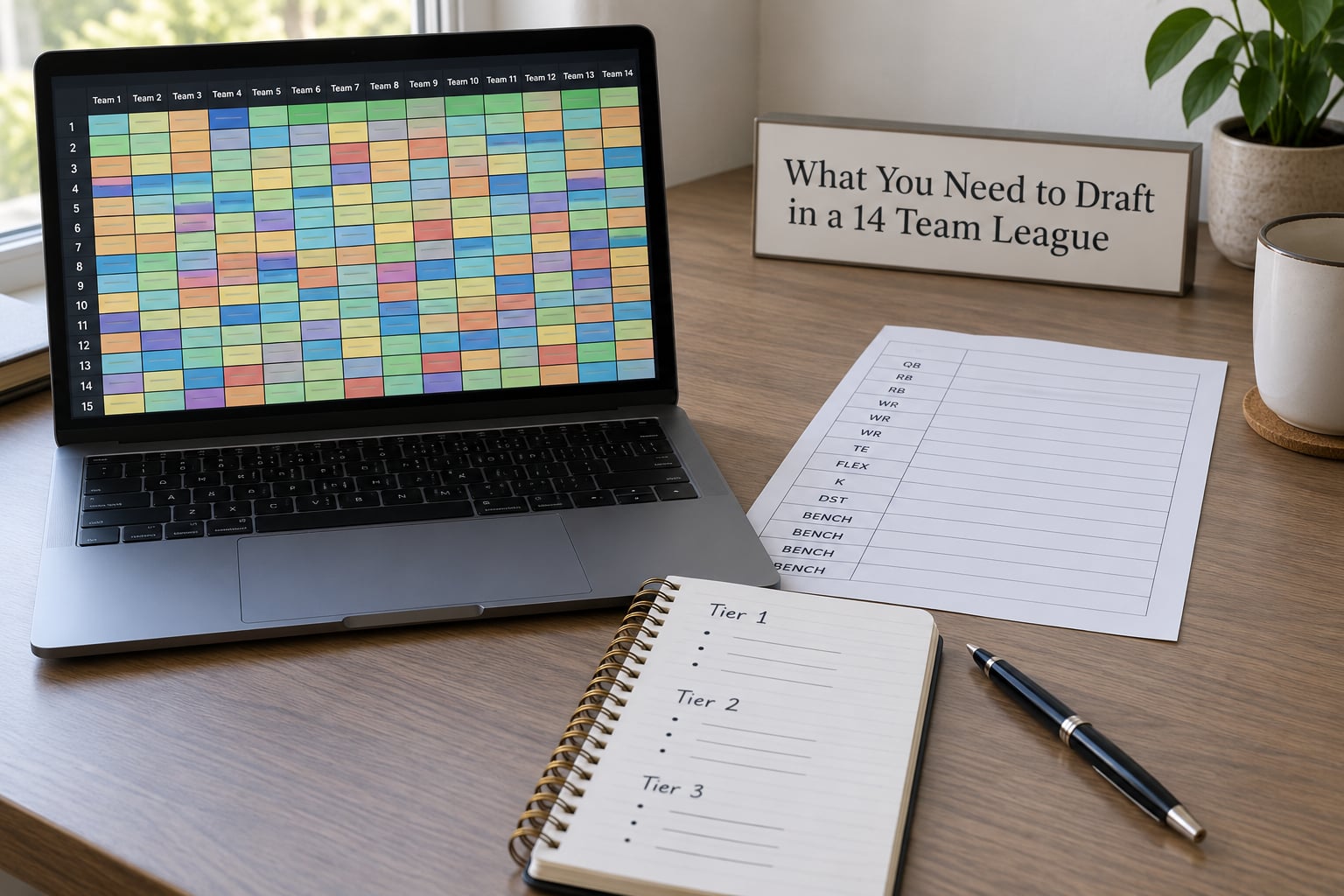
You need your league settings in front of you, a tiered player board built for 14 picks per round, and a written round-by-round target list. Everything else is a detail. The settings decide how the board is built, so read them before you rank a single player.
The league settings that change your draft
Roster limits. A 16-round draft with a 16-player roster leaves you zero bench. A 16-round draft with a 20-player roster gives you four bench spots that double as your injury buffer and your stash. In a 14-team league the bench matters more than usual, because your league mates are all replacing starters at the same time.
Starting slots. Count how many quarterbacks, running backs, wide receivers and tight ends actually start. Two flex spots change everything, because flex spots are usually wide receiver and running back eligible, which pulls those positions even deeper into your draft.
Positional eligibility. Some platforms let a tight end start at flex or in a superflex spot. Some let running backs at wide receiver. Note the rules, because they change which players you can safely punt.
Scoring format. PPR rewards receptions and volume, standard scoring rewards touchdowns, and superflex forces two starting quarterbacks. Each one shifts the round where a position gets drafted, as covered below.
Playoff roster rules. Some leagues lock rosters the week the playoffs start, others keep waiver changes live through the championship. If your league locks, the players on your bench at the cutoff need to be starters in name, not just in theory.
Tiebreakers. Head-to-head leagues break ties on a chain: winning percentage, then points scored, then points against, then division record, then random. Points scored is the most common one, which quietly turns passing on a scoring defender or a zero-round kicker into a real cost.
Your draft position and the format. Snake drafts reverse each round, so pick 6 becomes pick 9 in Round 2. Check whether your league is standard or snake, whether picks 1.13 and 1.14 are reversed to the top of Round 2, and whether the draft order is fixed or randomly generated each season.
Draft duration. A 14-team league produces 224 picks in a 16-round draft. At 20 to 30 seconds a pick that is about 75 to 110 minutes of picking alone, plus chat. If your league has a per-pick clock, know the limit and set your own timer.
How 14 teams changes the scarcity math
Here is the part most 14-team guides skip. Multiply teams by starters at a position, then multiply by games played, and you get how many games at that position your league actually consumes.
| Position | Starters per team | Teams | Games | Games consumed league-wide |
|---|---|---|---|---|
| Wide receiver | 3 | 14 | 16 | 672 |
| Running back | 2 | 14 | 16 | 448 |
| Quarterback | 1 | 14 | 16 | 224 |
| Tight end | 1 | 14 | 16 | 224 |
| Kicker | 1 | 14 | 16 | 224 |
| Team defense | 1 | 14 | 16 | 224 |
That 672 figure is why receivers are the first thing to go. A player who returns 100 catches in a healthy season will land near the top of the board, and there are only a handful of those. The same math explains why you can punt one quarterback in a standard league and be fine, and why punting one in superflex usually is not.
The football community has run this number before. One poster on a fantasy football forum laid out exactly this arithmetic for receivers, and the reaction was the usual one: nobody wants to hear that 672 games are consumed until they are on the clock with a board full of replacement receivers.
So is a 14-team league too much? Only if you draft like a 12-team league and expect the waiver wire to fix it. Managers who win 14-team leagues tend to be the ones with the most studs, and forum posters who describe a title run almost always point to a roster built on RB-RB-WR-WR or RB-RB-RB-WR, not to clever waiver work.
Step-by-Step Draft Plan
The plan has five parts, in order. Do them in this sequence and the draft runs itself.
Review the League Settings Before Ranking Players
Turn roster rules and scoring into a value plan before ranking anyone. The simplest version: for every position, decide how many usable bodies your league needs and how many games each of them has to survive. That number, not your gut, sets your target round.
Start with the bench. If your roster is 20 players in a 16-player starting format, you want at least 14 starting-caliber players and six usable bodies behind them. Now split those six by the injury rates you expect. Running backs get the largest share, because a committee backfield costs you multiple games a season when one of them is hurt.
Next, decide where premium positions are required. A superflex roster needs two quarterbacks who start. A two-flex roster in PPR needs receivers who are also flex-eligible, so the same player fills two of your slots. A standard roster with three receivers needs volume, not just touchdown upside.
Watch what happens to a zero-running-back build in these settings. Zero-RB is a strategy that leans on a scarce, shallow position, and a 14-team league is the worst version of that bet, because the replacement runners you plan to hoard were already drafted by the team picking behind you. It can work in a 12-team superflex league with a deep flex. In a 14-team league it usually ends with three bench backs and a defense you dropped.
Test the plan against scoring before you commit. In PPR, a receiver catching eight passes a game is worth more than a runner with the same yardage, so receivers get drafted earlier and you want at least four drafted receivers. In half-PPR, split the difference and expect three solid ones plus a gamble. In standard scoring, rushing work and goal-line roles matter more and one receiver on your bench can rot all year.
How to tell this step worked: you can say out loud, before draft day, roughly how many players you want at each position and by which round each group is finished. If you cannot, keep working on settings.
Create a Big Board and Tier Each Player Range
A big board is your full player list in one ranking. Tiers are the segments of that list, and each tier gets a draft range rather than an exact slot. Tier 1 might be picks 1 through 8, Tier 2 picks 9 through 20, and so on.
Ranges survive contact with reality. Exact slots do not. In a 14-team league you will be on the clock 14 times per round, and the board moves while you think, so a range lets you pick the best player left inside the range instead of panicking about a two-slot miss.
Build the tiers in this order:
- Tier 1, picks 1 to 14. Players who are automatic starters in every format. In recent drafts this group has included names like Josh Allen at quarterback and tight ends in the Trey McBride tier.
- Tier 2, picks 15 to 28. Solid starters whose ceiling is a top-10 finish.
- Tier 3, picks 29 to 45. Rotational pieces and the best remaining flex options.
- Tier 4, picks 46 to 80. Depth, committee members, and players whose role depends on injuries.
- Tier 5, picks 81 and later. Zero-round punt candidates: kickers, team defenses, and pure upside flyers.
Then adjust for league size. Because each of your picks is later in the round than it would be in a 10-team league, your true targets sit about four picks deeper per round. If you are used to taking a wide receiver in Round 2 of a 12-team league, expect Round 3 here, and plan your early board accordingly.
Adjust again during the draft for positional runs. When four running backs go in the first six picks, the rest of that position slides down a tier, and the receivers you wanted at 1.09 move up to 1.07. Let the run happen, then take from the position that just got richer.
How to tell this step worked: when a player you rated Tier 2 goes at pick 19, you lose one pick, not your draft.
Set a Value-Based Target for Every Round
Here is a round-by-round framework for a 14-team snake draft. It assumes a standard roster in a PPR league; shift it using the scoring notes underneath.
| Round | Position target | Roster goal | Why the 14-team math forces this |
|---|---|---|---|
| 1 | Best player available, RB or WR | One anchor | Twelve more teams still need a featured back or receiver after you |
| 2 | RB, WR or elite TE | Two anchors | The top 28 picks take out most of the clear-cut stars |
| 3 | RB and WR | Four anchors | By pick 42 the WR pool has lost its best weekly ceiling |
| 4 | WR, TE or QB depending on format | One starter plus depth | Flex spots mean your next pick must be flex-eligible |
| 5 | TE or QB, then RB2 depth | Position starters filled | Forum consensus: RB1 and RB2 secured by Round 5 or the group gets thin |
| 6 | RB3 and WR4 | Depth chart | Six rounds of 14 picks have removed the reliable backups |
| 7 | WR4, TE2 or first QB | Second-tier upside | Late-round upside comes from volume, which lives at WR |
| 8 | Backup QB or best RB committee piece | Insurance | Two QBs per league start if superflex; one if not |
| 9 | TE depth, handcuff, WR5 | Handcuff your lead back | Injury replacements are already gone in most 14-team drafts |
| 10 | RB4, WR5, rookie flyer | Rookie exposure | 14 teams means about 14 rookie WRs drafted; find the low-volume one |
| 11 | Stash and bench bodies | Six bench spots | Roster rules force you to spend picks on bodies now |
| 12 | Best remaining flex-eligible player | Last starter | Whatever is left is replacement-level, so take usage |
| 13 | Deviate from ADP on purpose | Two bench spots | Back-of-round picks rarely matter; buy a player you like |
| 14 | High-ceiling flyer, rookie | One bench spot | Only upside survives here |
| 15 | Best kicker available | Points stability | Teams still need points, and tiebreakers reward them |
| 16 | Best defense available | Last roster spot | Scoring settings decide whether this matters at all |
Two rules keep this framework flexible. First, treat it as a plan, not a script: if a great player is sitting there in Round 6, take him and shift everything down one pick. Second, revise the targets whenever big news lands. A serious injury at running back changes Round 3, not Round 12.
Average draft position, or ADP, is the consensus slot where a player is taken across drafts. It is a useful reference and a poor command. Take players roughly where the board has them, but not so exactly that you refuse to take someone two slots ahead of their ADP because you like the fit.
Follow a Simple Pick-Managing Rule
Before every pick, write down three names. One must-select, one fallback, one flyer. That list takes about 15 seconds and it is the difference between a plan and a scramble.
The must-select is the player you will take unless something unusual happens. The fallback is who you take if he is gone. The flyer is the player you would enjoy owning who is going later than he should, and he is the one you grab without thinking.
When your preferred player goes two picks earlier than you expected, the fallback is the whole point of the exercise. Do not reach four picks early to take the next name on your big board if the fallback is still sitting there at your spot. Spend the difference on a position you need.
Here is a concrete version. You are at 1.07, your tier board has a receiver at 1.08 and a tight end at 1.10. Pick 1.06 took your receiver. Take the tight end at 1.07, and your flex-eligible spot at 1.08 stays open. Next round you still take a receiver. Nothing is lost.
The version that loses drafts is the opposite one. You take a running back at 1.07 to avoid a reach, then take another reach at 1.08, and by Round 4 you have three running backs and no tight end.
Adjust When the Draft Becomes Unpredictable
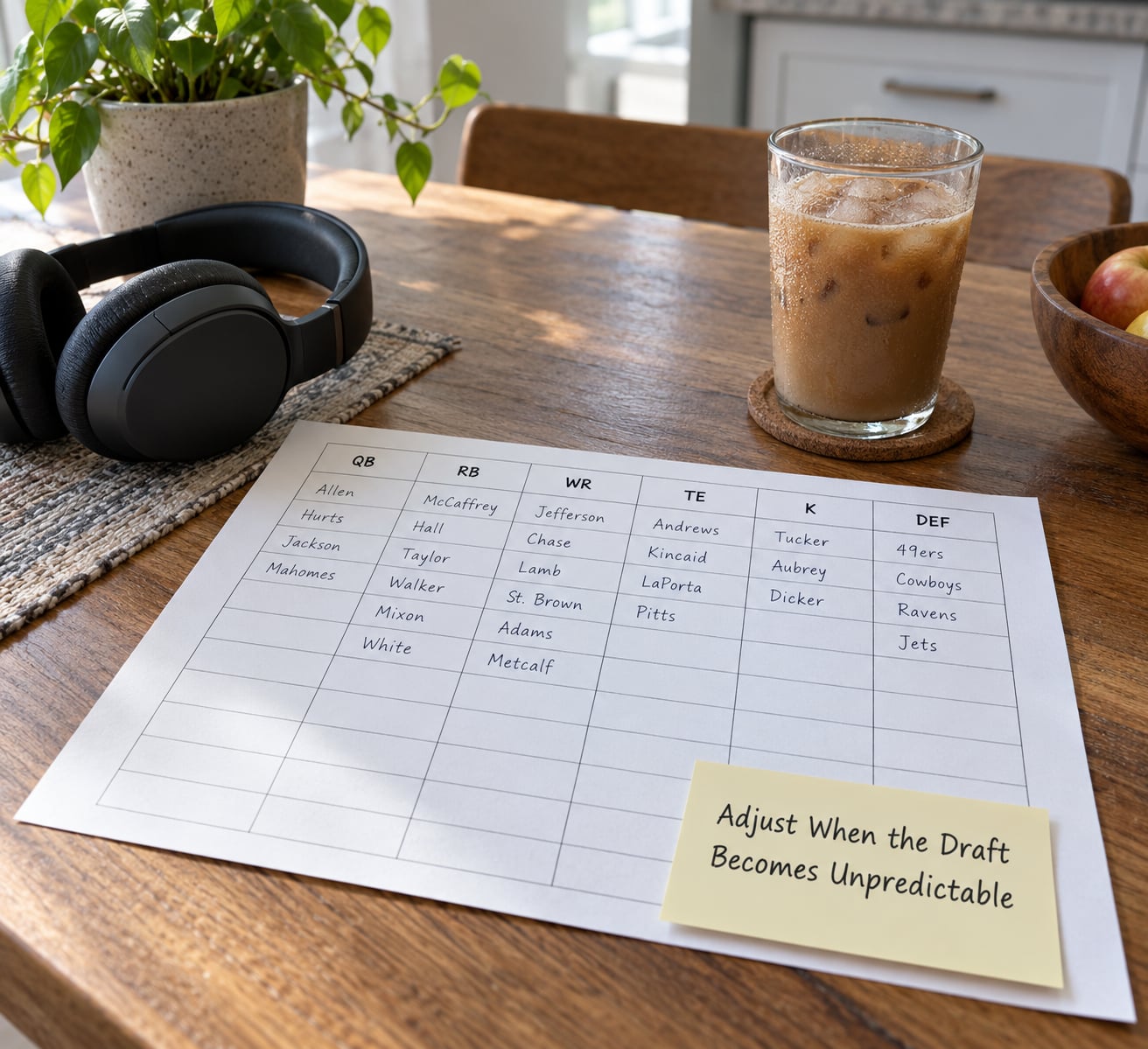
Drafts go off script. These five disruptions cover almost everything, and each one has a recovery rule that keeps the rest of the board intact.
Early running back run. Four backs go in the first seven picks. Recovery rule: stop forcing it. Take the best player available and come back to running back in Round 3, where committee pieces are still being taken at a discount.
Quarterback scarcity. Three or four quarterbacks disappear early, usually because of superflex demand. Recovery rule: if you need two quarterbacks, take the second one by the end of Round 3, no matter what the board says. Forum discussion on this point is consistent, and the warning case is familiar: pass at the first turn in a 14-team superflex league and the best quarterback left is a mid-tier backup.
Wide receiver drops. Receivers go in a clump and then the 20th receiver on the board looks like a 30th. Recovery rule: judge each receiver on role and target volume, not on board position. A slot receiver on a top-15 offense is still a start.
Injury news. A player you drafted goes down in the pre-draft season. Recovery rule: draft your contingency in the same round if you can. Take the handcuff if he is available, because in a 14-team league the alternative replacement is usually already gone.
Unexpected reaches. Someone takes a tight end at 1.02. Recovery rule: do not chase. Re-rank your board from scratch, because the reach changes what stays available for you. One manager’s reach is your opportunity two rounds later.
The overall rule: after any surprise, rebuild the top 30 on your board before you take your next pick. It takes two minutes and it stops small surprises from turning into a bad roster.
Common Mistakes and Tips to Avoid Them
These are the errors that show up most often in 14-team drafts, with the correction for each.
- Drafting your league need instead of the best player. You need a tight end, the tight ends are gone, and you take a fourth receiver. Correction: only take a need when the need is still available at a fair price.
- Ending the draft with no bench. You drafted 12 starters and four random players. Correction: fill every bench spot with a starter from another position who has playoff-week upside.
- Treating a positional run as a reason to abandon your board. Correction: let the run move the price, then buy from the position it enriched.
- Taking a kicker or defense before Round 13. A scoring defense in the second round is a top-10 weekly score with no upside. Correction: punt both to the final rounds and use the early picks on players.
- Ignoring tiebreakers. If your league breaks ties on points scored, your punted kicker cost you real standings points in April. Correction: check the tiebreaker chain in settings and draft for it.
- Overvaluing a single current kicker or defense. Both are week-to-week, and both swing by double digits without warning. Correction: treat them as filler, and only pick them for floor and schedule, not ceiling.
- Skipping bye-week planning. Twelve managers in your league also have a player out that week. Correction: when a bye week is announced, check your bench and your weekly flex options for that week before waivers clear.
- Reaching to avoid an injury risk. You pass on three backs because one has a hamstring history. Correction: reach once, on the player with the best floor, then move on.
- Drafting only the first round of each position. Six receivers in the first six rounds sounds great until week 6. Correction: count your depth at each position by Round 6 and fix the weak one.
- Ignoring your draft position on the clock. Pick 1.13 and pick 1.14 are the two worst spots to be reactive in, because the players left are the players nobody wanted. Correction: have your two least important slots pre-selected before those picks.
Now the practical tips that follow from all of it:
- Secure two quality running backs by the end of Round 3 in a standard 14-team league, or by Round 5 at the latest.
- Target roughly 4 receivers in PPR, 3 in half-PPR, and 2 solid ones plus upside in standard.
- Draft at least one quarterback in the top 8 picks in superflex, and two quarterbacks before Round 4.
- Handcuff your lead running back if he is a clear workhorse.
- Stash one rookie wide receiver on your bench in Round 10 or later.
- Leave the last two bench spots open for post-draft adds on the waiver wire.
- Check the draft order rules for picks 1.13 and 1.14 before you build your board.
- Write your fallback name down. Every pick, no exceptions.
Frequently Asked Questions
What is the best draft strategy for a 14-team fantasy football league?
The best strategy is value-based drafting on a tiered board built for 14 picks per round. Secure two quality running backs and two to four receivers inside the first five rounds, fill flex-eligible slots early, punt kickers and defenses to the final rounds, and handcuff your lead back. Because 14 teams leave a nearly empty waiver wire, the draft is where the season is decided.
Should I draft running backs early in a 14-team league?
Yes, and earlier than in a 12-team league. Fourteen teams consume about 448 running back games a season, so the tier of backs that stays available shrinks fast. Most managers target two quality backs by the end of Round 3 and accept committee members with a larger role share as their third. The exception is a superflex roster where quarterback scarcity can be worse.
How many players should I target at each position in a 14-team league?
Aim for two starting running backs plus two committee pieces, four receivers and one flex-eligible receiver in PPR, three receivers in half-PPR, and two solid receivers plus two flyers in standard scoring. Fill one tight end starter and one bench tight end, and carry two quarterbacks in superflex or one starter plus one backup otherwise. Bench spots should hold injury replacements and one rookie stash.
How do I recover when my preferred fantasy football player is drafted?
Write a fallback name before every pick, so the substitute is decided before the panic. When your target goes two picks early, take the fallback instead of reaching four slots early for the next name on your board. Then rebuild the top 30 of your board, because the reach that took your player probably moved several other players closer to you.
Should I use a snake draft strategy in a 14-team league?
If your league uses a snake draft, play to it: your Round 2 pick comes 15 spots earlier in the round than your Round 1 pick, so pair your early reach with a cheap value target. In a standard linear draft, every pick is equivalent, which favors taking the best player available late. Check the league rules, since some platforms reverse the final two picks to the top of Round 2.
Should I draft a kicker or defense early in a 14-team league?
No. Both are week-to-week and swing by double digits without warning, so neither is worth a second-round pick. Punt both to Round 15 and Round 16, and pick for a reliable scoring floor and a soft schedule. The one exception is a league that breaks ties on points scored, where a full season of kicker points is worth more than the bench spot you give up.
Conclusion: Start With Your League Settings
Your first action is simple: open your league settings and confirm the roster limits, starting slots, flex eligibility, scoring format, playoff roster rules and tiebreakers. Everything else in a 14-team draft is downstream of those choices.
From there, build a tiered board for 14 picks per round, set a target range for every round, and write a must-select, a fallback and a flyer before each pick. That is the process, and it holds up from pick 1.01 through pick 16.14.
Still deciding? Tell me your draft position and scoring format and I can tell you which round your first big target should land in.