Draft a kicker in the final round of your draft, or skip the position entirely and add one on waivers before Week 1. That is the right answer in nearly every redraft league, and when to draft a kicker in fantasy football comes down to league size, scoring settings, and how much weekly movement your platform gives you. A pick spent on a kicker is a pick you did not spend on an upside running back.
I have run this draft in leagues from 8 to 16 teams, and the pattern holds every time: the kicker is the last thing on the board, if it is on the board at all.
Table of Contents
- When to Draft a Kicker in Fantasy Football
- How Late Should You Draft a Kicker?
- When to Draft a Kicker: Round-by-Round Plan
- What Scoring Format Changes Your Kicker Strategy?
- Which Kicker Profile Is Most Draftable?
- How Many Kickers Should You Target in Each League Size?
- Should You Draft a Kicker in Redraft, Keeper, and Dynasty Leagues?
- How to Avoid Kicker Draft Mistakes
- Frequently Asked Questions
- Are zero-point return kicks worth drafting?
- What is the best strategy for a kicker with a bye week?
- Should I panic when other teams start drafting kickers early?
- Can I replace a drafted kicker with a waiver-wire add?
- Do 2-point scoring leagues make kickers more valuable?
- Final Draft Take
When to Draft a Kicker in Fantasy Football
Take a kicker in the last two rounds of your draft, and treat the final round as a ceiling rather than a floor.
- 12-team standard redraft: rounds 14 and 15, or not at all.
- 10-team redraft: rounds 9 and 10, because there are only ten rounds and no true waiver tail to lean on.
- 12-team or larger with active waivers: drafting zero kickers is a legitimate, often better, plan.
The reasoning is simple. Kickers earn points almost entirely from field-goal and extra point volume, and that volume is decided by game script, weather, and coaching decisions you cannot control. The gap between the best kicker and the tenth-best kicker in a season is usually a rounding error compared with the gap between the best and tenth-best running back.
It is worth saying the other side too, because the position is not worthless. Kickers are scoring more than they used to. FantasyPros reported that four or more kickers averaged double-digit fantasy points per game for a second straight season, and a recent leader finished with 202 points on 41 makes in 48 attempts plus nine kicks from 50-plus yards. A season like that is a real season. It is just not a reason to burn a pick in round five.
Kickers also hold the league together. Your roster needs a K in the starting lineup every week, so the real decision is not whether to have a kicker but whether to pay a draft pick for one.
How Late Should You Draft a Kicker?
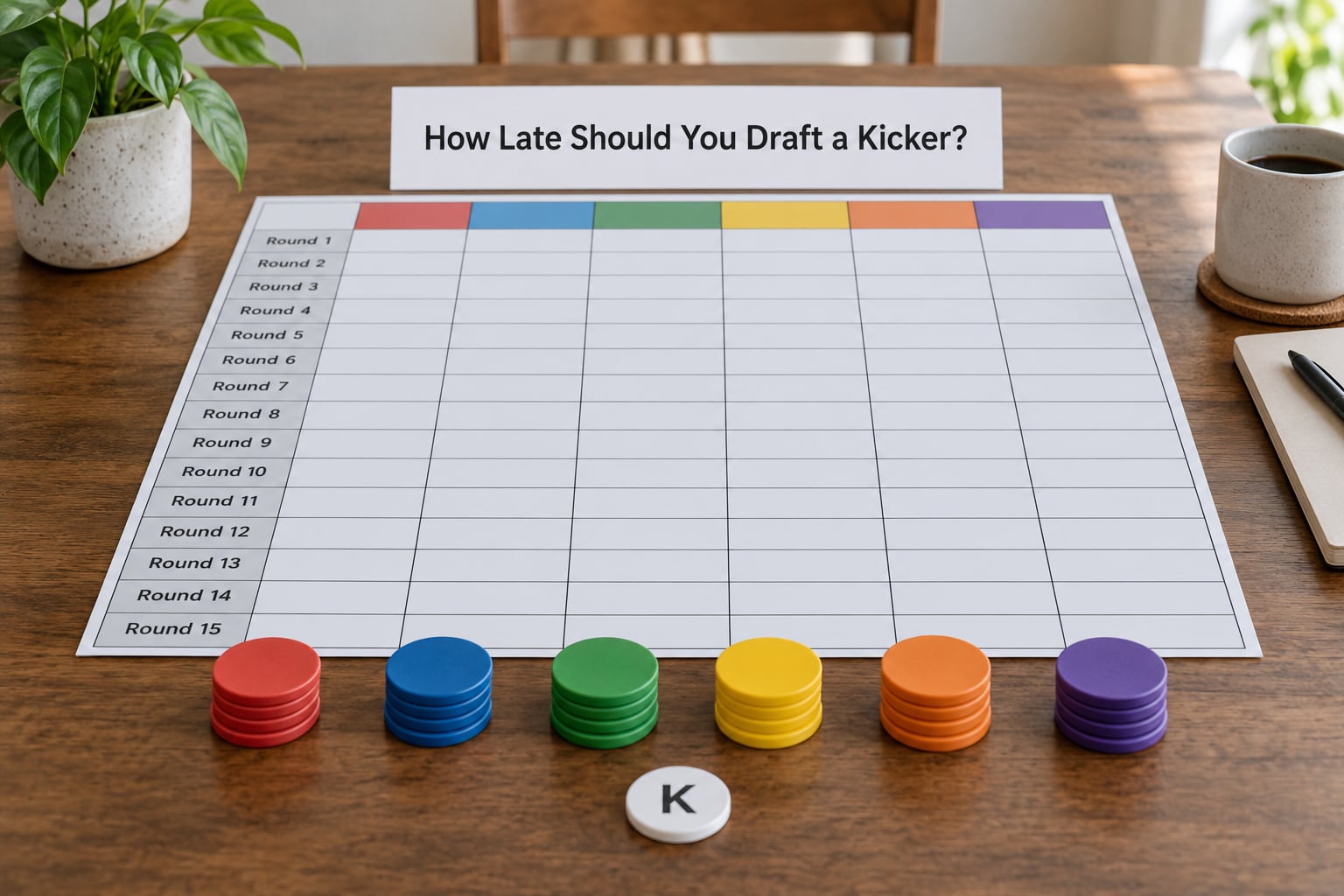
Go later than your gut says in a 12-team league, and no earlier than the second-to-last round anywhere. Here is the round-by-round answer by league size, with what to do with the pick instead.
| League size | Recommended rounds | Use the pick for |
|---|---|---|
| 8 teams | Rounds 7 and 8, or stream | An upside receiver or a second backup tight end |
| 10 teams | Rounds 9 and 10 | A deep bench wide receiver and a defense in the other spot |
| 12 teams | Rounds 14 and 15, or stream | A late rookie wide receiver or a streaming defense |
| 14 teams | Rounds 13 and 14, or stream | A bench tight end with upside at tight end |
| 16 teams | Round 16, or stream | A low-ADP running back on a rookie contract year |
Two exceptions to the table, both narrow. If your league has shallow benches, meaning three or fewer bench spots and no IR slots, or if your commissioner limits weekly transactions, take one in the second-to-last round rather than risk arriving at Week 1 with nothing.
Also, if your draft happens before training camp or the preseason ends, skip the kicker entirely. A job change in August can wipe out a kicker you spent a pick on, and you can re-address it in free agency with better information.
When to Draft a Kicker: Round-by-Round Plan
Work the draft in this order and the kicker question resolves itself without much thought.
- Rounds 1 through 4: running backs, receivers, and quarterbacks. No exceptions, regardless of league size.
- Rounds 5 through 8: tight ends, upgrade your receivers, fill flex spots. Defense becomes reasonable in the back half of this range.
- Rounds 9 through 11: bench depth and your last meaningful offensive upside. This is the round where premature kicker picks usually happen.
- Rounds 12 onward: defense, then kicker, then bench lottery tickets. A kicker in round 12 of a 12-team league is almost always a pick you did not need to make.
Watch the early kicker run rather than joining it. Two or three kickers going in the first three rounds tells you the league is deeper at offense than yours, and it is a signal to add a defense a few picks earlier than planned. It is not a signal to take a kicker yourself.
When you do finally take one, decide the defense question first. Kickers have a steadier floor and a lower weekly ceiling; defenses have a higher ceiling and a harder floor. Most managers should resolve it with scoring, as shown here.
| Factor | Kicker | Defense |
|---|---|---|
| Weekly floor | Steady on a good offense | Zero in rough weeks |
| Weekly ceiling | Four to five field goals in a good game | Six-plus sacks or turnovers |
| Scoring sensitivity | Long-range bonuses and extra points | Turnover, sack, and return bonuses |
| Best fit | Low-bonus, standard scoring | IDP bonuses and return scoring |
If your settings reward turnovers, sacks, or return yards, take the defense first. In a plain standard league, the kicker is the safer of the two.
What Scoring Format Changes Your Kicker Strategy?
Scoring settings decide whether a kicker is a round-15 pick or a round-8 pick, more than league size does.
| Setting | Effect on kicker timing |
|---|---|
| Standard scoring, no bonuses | Latest possible pick, round 14 or 15 in a 12-team league |
| Bonus for field goals of 50-plus yards | Pulls accurate long-range kickers forward by one or two rounds |
| Bonus for field goals of 40-plus yards | Moves the kicker up again, especially in cool weather climates |
| Return yards and return touchdowns counted | Creates genuine weekly upside, worth an earlier pick in custom leagues |
| Points-per-game scoring formats | Penalizes bye weeks, so a mid-round dependable pick makes sense |
| Superflex and IDP leagues | Every roster spot is scarce, so a kicker competes for a bench slot you may want elsewhere |
The direction matters more than the exact round. Bonuses and return scoring create earlier demand because they separate kickers who would otherwise tie. Without them, the top ten kickers are close enough that draft order barely changes your finish.
One note on matchup scoring. Some platforms add points for a kicker facing a defense that allows a lot of field goals. If yours does, check it before the draft rather than after, since it can make a mid-round pick defensible in a single-year league.
Which Kicker Profile Is Most Draftable?
The best late-round kicker has a secure job, an offense that finishes drives but does not run the score out of reach, a stable indoor or warm-weather home stadium, and a repeatable leg from about 45 yards out.
Check these six things before you take the name off your board.
- Offensive rank between roughly 5th and 15th. Teams near the top of the league kick too many extra points because they score touchdowns deep, which is a smaller scoring event than a field goal.
- Stall rate. A team that drives into the red zone and comes away empty gives a kicker repeated field goal attempts all year.
- Stadium type and climate. A dome removes weather variance. Among the top ten kickers in one recent set of rankings, only two played cold-weather outdoor stadiums.
- Range. A kicker with a proven 50-plus yard leg scores more in bonus leagues and loses fewer weeks in neutral ones.
- Job security. A veteran on a multi-year deal is the lowest-variance pick available at this position.
- Accuracy over the last two seasons, not the last one. Kickers who scored double figures in only 7 of 17 games the year before are usually recency bait.
Three profiles come up every year, and they are worth telling apart.
Dependable veterans on warm-weather or indoor teams are the safe late pick. Brandon Aubrey and Harrison Butker are the standard examples of that profile, and the appeal is that their floor rarely moves.
Rookie kickers with a settled job such as Cam Little offer more weekly upside because they arrive on a good offense without a long sample of fantasy results to inflate or deflate them. The cost is uncertainty about their job security, which matters in redraft only for one season.
High-variance specialists are the ones streamers pick up on a good matchup week. Drafting one of these in round 12 is how a manager ends up benched by their own league mates in week five.
A useful sanity check: in the season one RotoBaller guide examined, the second-ranked kicker finished only 11 points ahead of the tenth-ranked kicker. Nobody’s ceiling is worth a pick at the cost of a real player.
How Many Kickers Should You Target in Each League Size?
One kicker, and never two, in any conventional redraft league.
League size changes how hard that one is to replace, not how many you need.
- 8-team leagues: draft one in round 7 or 8. The bench is short, and a bad kicker week with no replacement hurts proportionally more in an eight-player playoff field.
- 10-team leagues: draft one in round 9 or 10. A minimal bid in auction, or a late pick in a snake draft.
- 12-team leagues: stream it, or take one in round 14. There are enough kickers available every week to find a top-ten option.
- 14 and 16-team leagues: stream it. The waiver pool is deeper and your bench is longer, so a replacement is free.
Two kickers is a roster mistake, not a strategy. Veterans on r/fantasyfootball have made the point plainly that you can pull a top-15 kicker off the wire most weeks, so the second kicker is dead roster space. A second kicker only makes sense in a best ball format, where the cost of an empty slot is a lost playoff week, and there the correct answer is still one kicker or none.
Check your platform’s roster rules before you plan around a kicker. Some leagues on certain apps no longer require one at all, while others will void your lineup without it. Knowing which league you are in saves an entire round of confusion.
Should You Draft a Kicker in Redraft, Keeper, and Dynasty Leagues?
Redraft favors waiting, keepers can justify an earlier pick, and dynasty rewards young kickers with job security. Best ball says draft none, and auction says bid the minimum.
Redraft. Value resets every season, so the kicker you take in 2026 is irrelevant next March. Wait until the last two rounds, or stream. This is the format the advice on most of the web is written for, and it is correct for it.
Keeper leagues. A kicker becomes a keeper if you can plausibly keep him three or more years, which means job security and a young or durable profile. A veteran on a long-term deal taken in the final round is a reasonable keeper target. A hot rookie taken in round 10 is not.
Dynasty. Young kickers with a multi-year job do carry real value, and that is the one setting where an earlier kicker pick can be correct. Aim for a kicker on a rookie-record deal on a team that expects to contend, and expect the return to arrive slowly.
Best ball. Zero kickers drafted is the standard approach. In a format where you never manage a roster, the only thing that matters is avoiding a zero at your kicker spot in your best season, and the last round of every snake draft is full of accurate kickers on good offenses.
Auction. Bid the minimum that wins the bid. A dollar or two is typical, and any bid above the rest of the league’s kickers is money better spent on a tight end who finishes 20 points ahead of your replacement.
How to Avoid Kicker Draft Mistakes
Six mistakes account for nearly every bad kicker pick, and each one has an obvious fix.
- Reaching on average draft position. Fix: ignore the kicker ADP chart entirely. It tells you when other managers pick kickers, not when they produce points.
- Treating last year’s top kicker as this year’s top kicker. Fix: check two seasons of volume and accuracy, not one. Rookie kickers and new coaching staffs reset this position constantly.
- Assuming a team will keep its kicker. Fix: if a new head coach or a general manager arrived this offseason, either verify the job or wait until Week 1 and let the waiver wire tell you.
- Ignoring punts and return chances. Fix: in leagues that score returns or punts, check the kicker’s role before you take the name, because return work is the only real ceiling at this position.
- Taking a kicker before core offensive players. Fix: no kicker should come out before your last two wide receivers. A sixth receiver who lands in the top ten beats a stable 8.5 points per week kicker nearly every year.
- Building a weak bench around a set-it-and-forget-it pick. Fix: if you draft a kicker, use the other final-round pick on an upside offensive player. Never use two consecutive late picks on kicker and defense and leave yourself with nothing on offense.
There is a social cost too, and it is real. League mates notice an early kicker pick, and the commentary runs for the rest of the draft. If you want to take a kicker in round 9 to win a side bet, fine. If you want respect from the group chat, wait.
One last check before you finalize your plan. Drafting before the preseason ends means injuries, camp cuts, and coaching changes are unresolved, and the kicker position is the one where those variables are most likely to hit you on draft day. Drafting in late August or later gives you the clearest picture of the whole board.
Frequently Asked Questions
Are zero-point return kicks worth drafting?
Rarely on their own. A return touchdown is worth drafting around only in a custom league that scores return touchdowns, and even then the kicker must be the starter and the returner. In standard leagues, return chances are upside you get for free, not a reason to move a pick up. Judge the kicker on his kicking job, then treat return scoring as a bonus.
What is the best strategy for a kicker with a bye week?
Take the bye week as a scheduling fact, not a red flag. Every kicker has one, and the points-per-game formats that penalize them are rare. The one case where it matters is a playoff schedule that lands on your kicker’s bye in the first round, which you can check at draft time. Otherwise, take your normal pick.
Should I panic when other teams start drafting kickers early?
No. An early kicker run usually means that league drafted offenses deeply, not that kickers are suddenly valuable. The useful read is on the rest of the board: if defenses are also going early, the league is heavy on specialists, and you may want to add your own defense a few picks sooner. It is never a reason to take a kicker in the same round.
Can I replace a drafted kicker with a waiver-wire add?
Almost certainly, in a 12-team or larger league. Veterans in the r/fantasyfootball community note you can land a top-15 kicker most weeks through waivers, and streaming a kicker is a well-worn approach. Check your league’s transaction limits and your bench spots first, because a league with two bench slots and a weekly acquisition cap is the one case where drafting a kicker makes more sense.
Do 2-point scoring leagues make kickers more valuable?
Not much, on their own. Extra points are worth 2 instead of 1, which adds a few points a year, but kickers make very few extra points compared with field goals, so the total gain is small. Two-point conversion scoring helps quarterbacks and receivers far more. Kicker value moves with field goal volume, so look at bonuses for long field goals and return touchdowns instead.
Final Draft Take
Draft a kicker in the final round of your draft, and treat the pick as optional. Before kickoff, pick out three dependable kickers on offenses projected between 5th and 15th, in domes or warm climates, and note the round each one is likely to fall. If your league rules and the board cooperate, take the best of them with your last selection. If not, add one on waivers before Week 1 and move on with your life.