Streaming quarterbacks means dropping a stable starter and adding whichever quarterback has the best matchup that week, starting him immediately, then reassessing the following week. Learning how to stream quarterbacks each week takes about 20 minutes on Tuesday, 10 on Wednesday, and one final check Sunday morning. That rhythm beats picking a name from a listicle published by a stranger on Tuesday night.
Most guides publish picks. You need a process, because the picks change every week and your league-mates are reading the same ones. The managers who stream well are the ones running the same four checks in the same order, then stopping.
Last updated October 2026. This page is evergreen and updated weekly during the NFL season.
Table of Contents
- What You Need Before You Pick a Quarterback
- Step-by-Step: How to Stream Quarterbacks Each Week
- Review the Weekly Quarterback Picture
- Eliminate Quarterbacks With Unfavorable Situations
- Check Quarterback Injury and Depth-Chart News
- Project Pass Attempts and Scoring Opportunities
- Find the Best Backup and Low-Owned Quarterback
- Make the Final Streaming Decision
- Common QB Streaming Mistakes to Avoid
- Frequently Asked Questions
- How late in the week can I add a QB streamer?
- Does a rushing threat matter when streaming quarterbacks?
- How do I handle a quarterback who is questionable on the injury report?
- When is holding a real starter better than streaming?
- What rostered percentage makes a quarterback streamable?
- Conclusion
What You Need Before You Pick a Quarterback
Streaming only works if the information is in front of you before the waiver claim window opens. Here is the list I use, roughly in the order I touch it.
- The weekly schedule and bye dates. Know which teams are off, including your own starting quarterback’s bye, two weeks ahead rather than the week it happens.
- The official injury report. Designations drop Wednesday afternoon and get updated through Sunday. That is the single most important input for streaming.
- Depth chart and practice report notes. Who took the reps in practice, and who threw to the first-team offense.
- Matchup data. Fantasy points allowed per game to opposing quarterbacks, sacks allowed, and interception throws.
- Team scoring totals and implied totals. A team expected to score 23 points throws more passes than a team expected to score 14.
- Snap counts and target distribution. Proves whether a quarterback is actually being pushed or merely listed as a starter.
- Your league settings. Rostered percentage thresholds, bench spots, waiver priority position, whether the league uses chaos settings.
None of that is exotic. It is the same data fantasy analysts use, just arranged in the order that kills the most bad picks first.
Step-by-Step: How to Stream Quarterbacks Each Week
The process has six passes. Run them Tuesday, re-run the news pass Wednesday, and confirm Sunday morning. If you only do one thing on one day, make it the injury and depth-chart check.
Review the Weekly Quarterback Picture
Start by writing down every quarterback with a soft opponent and a confirmed start, regardless of whether you would ever roster him. That list is your candidate pool, and it is usually eight to twelve names.
Sort it by team scoring total, not by name recognition. A quarterback on an offense projected for 27 points has a materially better path to 20-plus fantasy points than a quarterback on an offense projected for 17, even if the second quarterback is far more famous. Then sort it again by recent form to catch anything the projections missed, such as a quarterback quietly averaging 22 fantasy points over his last three games on low volume.
The mistake here is defaulting to the quarterbacks everyone else is starting. In a 12-team league, the popular plays are already owned. Your waiver claim on them is a wasted slot.
Eliminate Quarterbacks With Unfavorable Situations
Now cut the list. These are the eliminations that do the most work, and most of them are disqualifying rather than merely discouraging.
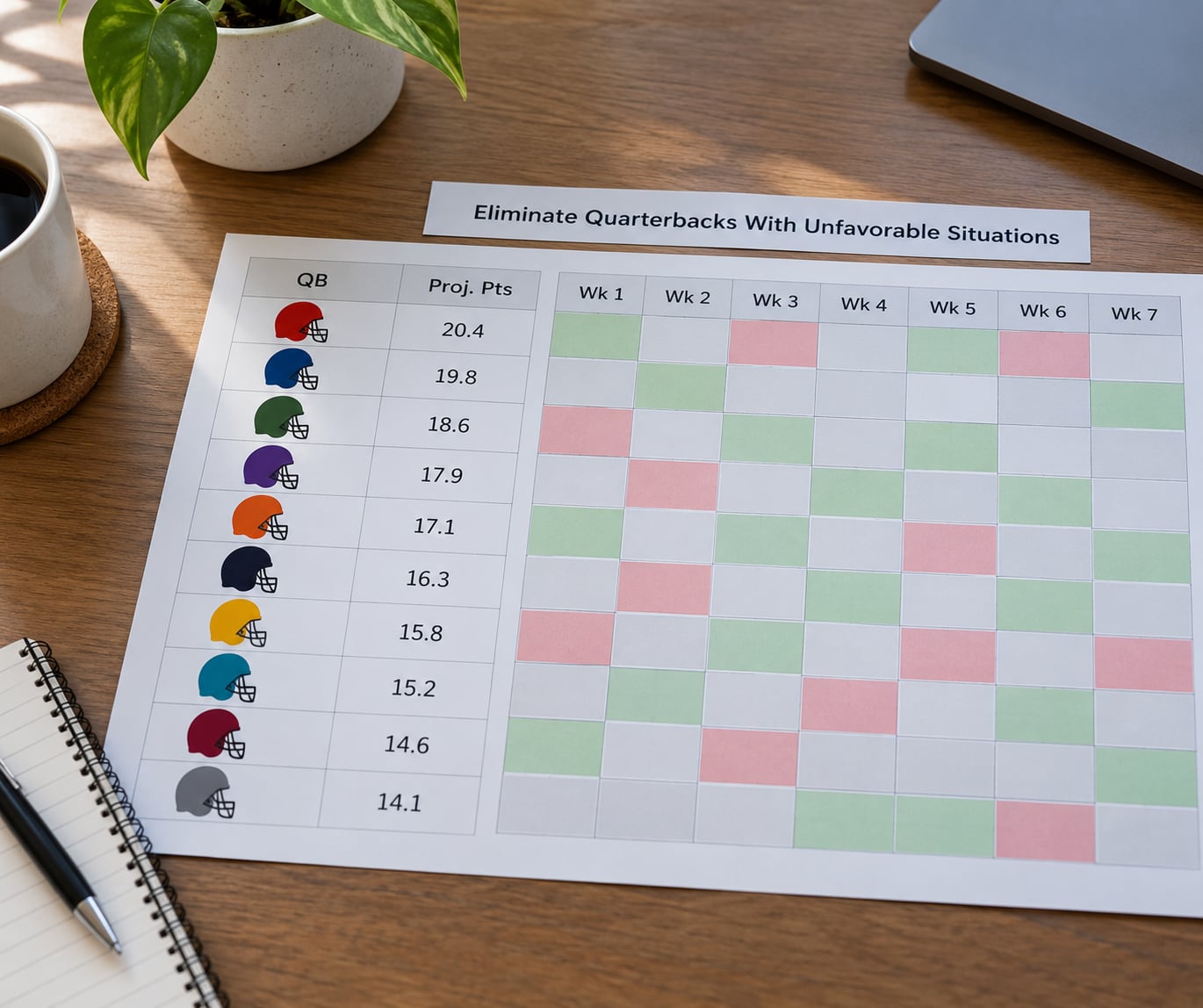
- Elite pass defenses. If the opponent ranks in the top half of the league against the pass by EPA per dropback, the name is off your list regardless of what the projection says.
- Quarterback competitions. A backup listed as a starter with no clarity on who throws the majority of snaps is a coin flip, not a stream.
- Low red-zone volume. Teams that pass rarely in the red zone cap a quarterback’s ceiling, which is the only thing you are paying for when you stream.
- Offenses that do not need to pass. A team projected to win comfortably and run the ball out of clock will not produce a usable number.
- Heavy pressure rates. A quarterback whose offensive line allows pressure on a high share of dropbacks loses the volume you are counting on.
What survives this pass is usually three or four names. That is the correct size for a candidate list.
Check Quarterback Injury and Depth-Chart News
Everything above is a projection. This step is reality, and it is the step most often skipped. Official designations come out Wednesday afternoon, and the meaningful updates land on Friday and Sunday morning.
Read four things: the team’s injury report, the practice participation notes, the head coach’s press conference, and the offensive coordinator’s comments. A quarterback listed as limited on Wednesday and practicing full on Friday is a different player than one who missed two sessions in the same window. Concussion protocol questions are their own category, and managers have been burned enough times to treat a “questionable” tag on a third-string quarterback as a non-starter until he is officially cleared.
Depth-chart news travels differently. A coordinator saying a change “will be evaluated week to week” usually means an even split. When you are deciding how to stream quarterbacks each week, that kind of language moves a name down your board, not off it.
Project Pass Attempts and Scoring Opportunities
Fantasy points come from attempts, completions, yards, touchdowns, and turnovers. Estimate attempts first, because everything else follows from volume. Team pace adjusted for opponent, plus the opponent’s pressure rate, plus the expected game script, gets you a realistic number.
Add the game script. A team projected as a heavy favorite that loses the coin toss is a better passing environment than the raw total suggests, and a team projected to lose by two scores is the best environment a streamer can find. A close projected game usually means fewer attempts from both offenses.
Then check target distribution. A quarterback throwing 45 passes last week to one target is a different streamer than one spreading 35 passes across six receivers. The second one survives a bad game more often, which matters when you only have one week to make the pick count.
Finally, weigh the rushing floor. A quarterback with designed carries and a goal-line role has a realistic path to 8 points without throwing a touchdown, which is exactly why r/fantasyfootball managers keep telling each other to prefer rushing upside over pure passing volume. In standard scoring that floor matters even more, because the passing categories that separate one quarterback from another often do not.
Find the Best Backup and Low-Owned Quarterback
Your candidate list is longer than the list of quarterbacks you can actually get. Filter by rostered percentage, which is the most useful number on the waiver report for this purpose. In 1QB leagues, anything under roughly 50% rostered is realistically available. In superflex and two-QB leagues, the useful threshold drops to under about 25%, because every league-mate is chasing the same low-owned names for their second quarterback slot.

Check waiver priority position before you commit. If you pick up a priority early in the week and drop a dead starter, you fall to the bottom of the next order. Waiting for the best value to clear, then dropping, keeps your position intact for the week you actually need it.
On double-bye weeks, every manager in the league hits the wire in the same hour, and your waiver priority plus your league’s chaos setting decide who wins the claim. In a chaotic league, the same add can be processed in a different order than the previous week, so do not build a plan that only works if you get first pick.
One r/fantasyfootball thread asked why the recommended streamer was gone before waivers cleared, and the answer was the obvious one in hindsight: eleven other managers had run the same process. Treat the top two names on your list as contested and have a third ready.
Make the Final Streaming Decision
At this point you should have three names left with projected attempts, a matchup grade, a floor, and a ceiling. Pick the one with the best combination of projected attempts, a completion-friendly opponent, confirmed availability, and weekly ceiling. A quarterback projected for 40 attempts against a bottom-ten pass defense who is officially starting beats a quarterback projected for 32 attempts against a stingy secondary.
Add the player, start them immediately, and set a reminder for the following Tuesday. The default move is to drop the streamer and re-run the whole process next week, because the value that made them streamable disappears after one game.
There are weeks to skip streaming entirely. In superflex and two-QB leagues, positional scarcity makes a weekly stream expensive. In keeper leagues, a low-end starter drafted as a flier often outlasts the streaming plan. And once you are in the playoffs with a realistic title path, a dependable floor usually beats a two-week ceiling, as one r/fantasyfootballadvice manager who streamed the position all season and still earned a top seed told the thread, describing weeks 14 and 15 as the point where the math stopped working.
Common QB Streaming Mistakes to Avoid
Trusting a projection without checking the news. The fix: never claim a player before reading Wednesday’s designations and the Friday practice report. Projections do not know about a reported concussion.
Ignoring the team scoring total. The fix: sort your candidate list by implied team total before anything else. A quarterback on an offense projected for 21 points has a lower weekly ceiling than one on an offense projected for 28, and that ceiling is the reason you streamed.
Overvaluing a familiar opponent name. The fix: look at the opponent’s pass defense efficiency, not its record. Plenty of winning teams give up more passing yards to quarterbacks than the teams people describe as soft.
Using a stale depth chart. The fix: treat any chart older than this season as a starting guess. Depth charts get rewritten after two games, and a backup listed as a starter in August may be the starter now.
Streaming a quarterback with no path to a full game. The fix: require at least 25 to 30 projected attempts before you claim. A quarterback who might be pulled after an interception or a three-and-out cannot produce a weekly score, no matter how good the matchup looks.
Waiting until Sunday night to make the add. The fix: claim by Wednesday or Thursday. Some platforms process claims into the next week’s games, and a late add can leave you scrambling for a replacement when your starter gets hurt.
Streaming defense, tight end, and kicker into the same bench spots. The fix: decide your bench priority in a fixed order, usually quarterback first, then tight end, then defense, then kicker. Managers who stream everything at once end up with four players and no one to start in a spot that matters.
Frequently Asked Questions
How late in the week can I add a QB streamer?
Add Wednesday for most leagues, and no later than Friday. Some platforms process claims into games the following week, so a Saturday add may not start. The exception is a late injury: if your starting quarterback goes down Sunday, check whether the backup who replaced him in-season is owned. If he is available, he is your stream, even on a bad matchup.
Does a rushing threat matter when streaming quarterbacks?
Yes, more than most guides admit. A quarterback with designed carries and goal-line work has a realistic path to a usable score without a passing touchdown, which protects you in a low-scoring game. In PPR and superflex scoring, those points are worth more, since rushing is usually the difference between a 9-point dud and a 14-point week.
How do I handle a quarterback who is questionable on the injury report?
Treat questionable as a non-starter if he is a third-string option, and check the update on Sunday morning before kickoff. If he is your only option, start the best available backup instead of gambling on a player who may not take a snap. Concussion protocol changes are the least predictable news in the position, and a zero points is a worse outcome than a mediocre one.
When is holding a real starter better than streaming?
Start with your league format when you are weighing how to stream quarterbacks each week. Stream in 1QB leagues, where a weekly best matchup usually beats a mid-tier starter. Hold a starter in superflex and two-QB leagues, where a stable backup is scarce and expensive. Also hold from the playoffs onward, where a dependable weekly floor is worth more than one extra ceiling week.
What rostered percentage makes a quarterback streamable?
Under roughly 50% rostered in 1QB leagues, where the waiver report usually reflects real availability. In superflex and two-QB leagues, look under about 25%, since league-mates roster extra quarterbacks and the same low-owned names get claimed by everyone. If a quarterback is above those thresholds, treat him as a rostered starter and pick your stream from a different tier.
Conclusion
The process is short enough to run every week: check the schedule, read the injury report, sort the candidate list by team scoring total, cut the bad matchups, confirm the starter, and add the best available name before the waiver window closes. Start with the injury report and the schedule, because those two answers eliminate more bad streams than any projection ever will. Then run the rest of the checks in order and stop before you overthink it. That is how to stream quarterbacks each week without burning your whole Tuesday afternoon.