Late round quarterback strategy means punting on the position through the early and middle rounds, building your roster at running back, wide receiver, and tight end, then taking one or two quarterbacks with your final three picks. You are betting that a quarterback drafted last can still finish as a top-10 signal-caller, because the difference between the sixth and twelfth quarterback off the board is small and the league only needs one starter per week.
That is the whole idea, and it works more often than it has any right to. The rest of this guide is the practical part: how to spot a target worth punting on, what round is too late, how league size changes the math, and when to abandon the plan entirely.
This page is the roadmap to read once, before your draft, not a weekly checklist. Most of the details that change week to week belong in your own league settings and injury reports.
Table of Contents
- What Is Late Round Quarterback Strategy?
- Three things it is not
- How Do You Identify a Late-Round Quarterback?
- Why Wait Until the Late Rounds?
- How Do You Evaluate the Best Late-Round Quarterbacks?
- What Is the Best Late Round Quarterback Draft Plan?
- How Do League Settings Change the Strategy?
- What Mistakes Should Fantasy Football Managers Avoid?
- Frequently Asked Questions
- When should you take a quarterback in fantasy football?
- How late is too late to draft a quarterback?
- Should I draft a quarterback or stream instead?
- Does late round quarterback strategy work in superflex and 2-QB leagues?
- How can a quarterback lose points in fantasy?
What Is Late Round Quarterback Strategy?
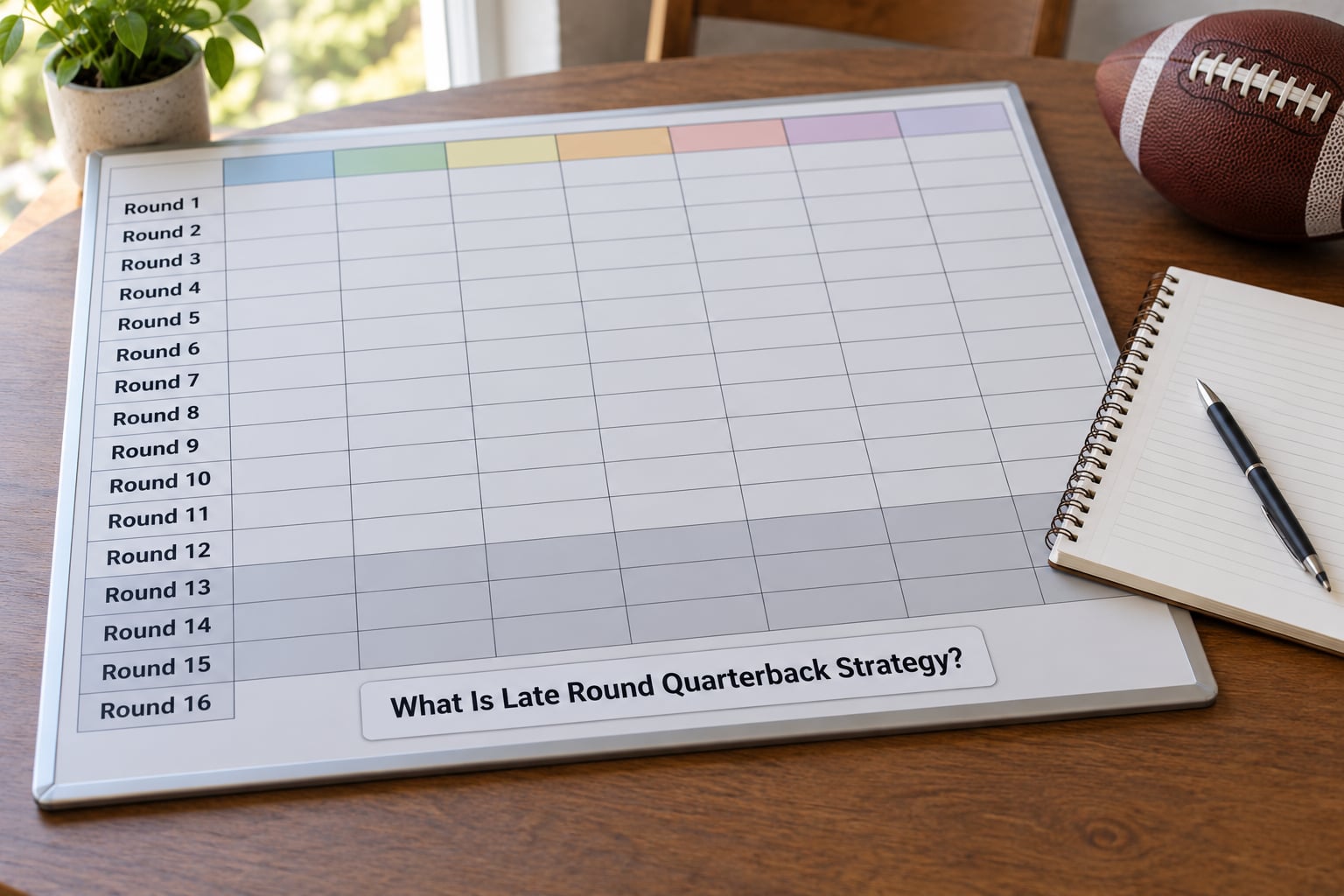
The late round quarterback strategy is a draft approach where you pass on quarterbacks in the early and middle rounds, build your roster at running back, wide receiver, and tight end, then select one or two quarterbacks in the final two or three rounds. It relies on the position’s year-to-year volatility, betting that a quarterback drafted late can still finish as a top-10 fantasy signal-caller at a minimal draft cost.
Two terms come up constantly and are worth defining before anything else. A QB1 is a quarterback you expect to finish in the top ten at his position. A QB2 is everyone else, and a QB2 is not a failure, it is just the default outcome for a late pick.
The strategy came from fantasy analyst JJ Zachariason, better known as @LateRoundQB, and it has been part of mainstream draft theory for more than a decade. When Pat Fitzmaurice hosted an AMA, a user credited Zachariason as the person who “literally wrote the book on late-round QB strategy,” and pointed out that the opportunity cost of taking a quarterback early has grown every year as the position gets deeper. Long-time r/fantasyfootball regulars still post the same annual endorsement: another good year to go late round QB.
Three things it is not
It is not a promise of weekly 25-point production. The median late-round pick is a streaming-friendly option that you will start when the schedule cooperates. It is not the same as never drafting a quarterback, which is pure streaming. And it is not a free pass to take a bad player because the quarterback spot “looks empty” on your board.
How Do You Identify a Late-Round Quarterback?
A good late-round target is defined more by opportunity than by talent. Rich Hribar calls dual-threat rushing ability the “cheat code” for late-round quarterbacks, and that is where most of the signal comes from, but rushing upside alone does not carry a pick.
Look for these six signals in order:
- Rushing involvement. Scramble rate and designed carries matter more than raw rushing totals. A quarterback running near the goal line is getting points without passing.
- Real passing volume. Pass attempts per game and air yards show whether the offense actually leans on him. A low-volume offense caps the ceiling no matter who throws the ball.
- Weapon quality. One dependable target beats three names you have never heard of. Target share concentrated on a strong receiver is a good sign.
- Offensive line stability. New lines and new schemes are the most common reason a late pick flops. Continuity is worth a full tier of your ranking.
- Coaching continuity. A coordinator who has run the same system for three years is a safer bet than a first-year hire, even for an older quarterback.
- An early schedule that flatters. Two or three soft opponents in the first four weeks can turn a replacement-level asset into a top-12 scorer before the league writes you off.
Age and injury history go on the same page. A 30-year-old backup with a clean record is a fine flier in a redraft league. A 24-year-old with a torn labrum is a dynasty consideration, not a redraft one, and the two leagues want opposite answers.
Why Wait Until the Late Rounds?
Because the cost of being early is much higher than the cost of being late. The quarterback you take in round three costs you a player with a genuine path to a top-15 finish. The quarterback you take in round twelve costs you almost nothing, because the pick would otherwise become your third tight end.
Replacement level is the number that matters. You need roughly a top-12 quarterback to be competitive at the position in most 12-team redraft leagues, and the historical spread of the 6th through the 12th quarterback taken is far tighter than the gap between the first and the sixth. Late round strategy works because you are collecting from the flattest part of the ranking.
| Approach | Typical round | Opportunity cost | Risk profile |
|---|---|---|---|
| Take a QB1 early | Round 1 to 2 | Highest. Gives up a top-tier RB or WR. | Low variance, but the whole season rides on one player. |
| Elite tier only | Round 2 to 4 | Moderate to high. | Low, and you still need a late backup. |
| Mid-round comfort pick | Round 5 to 7 | Moderate. | Low floor, limited ceiling above the replacement baseline. |
| Late round strategy | Round 10 to 13 | Low. Only surplus picks at other positions. | Wide range, from replacement level to a genuine top-10 hit. |
| Double dip at the position | Rounds 10 and 12 | Low, but burns a rare roster spot. | One injury, and the second pick becomes dead weight. |
One caveat: the reason there is so much value at the position is also the reason a single bad season feels so bad. Quarterback production swings more year to year than any other position. That volatility is the source of the value and the source of the pain.
How Do You Evaluate the Best Late-Round Quarterbacks?
Evaluate a late target on a projection you can defend, not on a name you have seen highlighted. Most fantasy sites publish consensus ADP, so when a quarterback is still available in round twelve, consensus already views him as replacement level, and your edge has to come from something the market has not priced in.
Run through this framework:
- Projected starts. Multiply your weekly projection by the number of games you expect to start him. Fifteen projected points across twelve starts is a usable season.
- Turnover risk. Interceptions are the fastest way a quarterback loses points. Check his interception rate and whether the offensive line creates pressure.
- Ceiling versus floor. Late picks need some ceiling, because a pure floor player is a wasted pick. Dual-threat ability is the cheapest source of it.
- Age curve. In redraft, a quarterback in his late twenties with starter job security is a safer flier than a 23-year-old on a bad team.
- Positional competition. If a backup is one bad week from a job change, look at the player above him on the depth chart instead.
- Schedule shape. Count the soft opponents in the first six weeks. That stretch often decides your position rank before the playoff picture firms up.
For calibration, here are quarterbacks who were taken outside the top 150 and finished inside the top 12 at the position, which is the outcome the strategy is built around.
| Season | Player | Usual draft range | End-of-year finish |
|---|---|---|---|
| 2018 | Matt Ryan | Late round, often undrafted | Top 6, Pro Bowl year on a cheap Falcons offense |
| 2019 | Dak Prescott | Round 4 | Top 5, led the league in passing touchdowns |
| 2020 | Josh Allen | Round 3 | Top 3, dual-threat scoring |
| 2021 | Jalen Hurts | Round 10 to 12 range | Top 3, MVP-calendar efficiency |
| 2022 | Tom Brady | Round 12 and beyond | Top 5 at age 45 |
| 2023 | Baker Mayfield | Mid-to-late round | Top 8 after the Bucs offense change |
| 2024 | Lamar Jackson | Early round | Top 3, the outlier that proves the ceiling case |
Read that table honestly. Most late-round hits came with a scheme change, a coaching upgrade, or a late-career reset. None of them happened because a manager was patient. The patience only bought the ticket.
What Is the Best Late Round Quarterback Draft Plan?
Here is the plan I would follow in a 12-team redraft league. The late round quarterback strategy works when it is executed on a schedule, and it falls apart when it is treated as a vague intention to grab “whoever is there.”
Before draft day, set a hard round. Most managers should commit to a quarterback by the end of round ten, and the last acceptable pick is the first round you take where three quarterbacks on your board still project to at least 15 points per game. Write the round down. A number you decided in August is worth more than a feeling you have in round eleven.
The three-round commit rule. If a quarterback you rate meets your threshold in round eight, take him and accept a later pick elsewhere. If you reach round eleven and nothing meets the threshold, take the best player available overall, because a bad quarterback pick costs a full season while a good non-quarterback costs you flexibility.
Build the board in tiers, not names. Tier one is a quarterback you would happily take in round five. Tier two is a draft in rounds eight through ten. Tier three is a flyer. If tier one is gone by round seven, the strategy is already failing and you should know it.
Know the abandon triggers. Abandon the approach and take the best player on the board when any of these happen:
- Two of your tiers are gone before round seven because the league drafted quarterbacks early.
- Your own early running backs and wide receivers fell in ADP and you have no value at those positions.
- The remaining late quarterbacks all project under 14 points per game.
- You are in a league where two quarterbacks must start and you have already taken one by round six.
Plan the first three weeks. Keep a replacement quarterback on your bench or drop your lowest-round wide receiver. In weeks one through three, compare your starter’s output to the top streaming option on the waiver wire. If he is below replacement for three straight weeks, swap him. Do not hold a sunk cost for the rest of the season because he cost you a thirteenth-round pick. That is the whole trap.
How Do League Settings Change the Strategy?
The same plan produces very different results depending on format. League settings matter more than almost anything else here, and the difference between an 8-team league and a superflex league is larger than the difference between any two player targets.
| Format | What changes | Recommended adaptation |
|---|---|---|
| 12-team PPR redraft | Volume wins, floor is valuable | The strategy’s home format. Punt to round ten, target a dual-threat passer with a clean schedule. |
| 10-team redraft | Fewer players, more weekly competition | Tighter talent pool. Consider a mid-round fallback option in round six or seven rather than the last round. |
| 8-team redraft | Elite scarcity is brutal | Punting is usually a mistake. If you are not taking a top-8 quarterback by round four, take one. |
| 2-QB or superflex | Two quarterbacks must start | Do not punt. Two late quarterbacks is a requirement, not an option, and one must be drafted by round four. |
| Best ball | No weekly management, variance dominates | Earlier upside matters. Push a dual-threat ceiling pick up rather than taking a safe floor. |
| Dynasty or keeper | Age replaces weekly projection | Draft young. A 24-year-old with rushing upside is worth a fifth-round pick, and a 34-year-old flier is not. |
| Standard scoring | Passing yards and rushing yards are the only value | Volume matters even more. Prefer quarterbacks with 40-plus attempts per game. |
A SleeperApp user put the small-league problem plainly: in a 10-team league your starting talent matters more, so the idea is not dead, the pool is just smaller. That is the right read. Shrink the league and you should shrink your punt by a couple of rounds too.
What Mistakes Should Fantasy Football Managers Avoid?
Most failures of late round quarterback strategy are execution errors, not concept errors. These are the ones that show up every year.
- Drafting a quarterback because he is the only one left. Availability is not evaluation. If the last quarterback on your board projects below 13 points per game, take the best running back available instead.
- Wasting draft capital on stacks you do not need. Forum complaints about the strategy usually turn out to be complaints about the roster. Three running backs and four tight ends is a bad draft, no matter what you did at quarterback.
- Having no post-draft plan. Decide in advance how many weeks of bad production you tolerate and what your budget is on the waiver wire for a replacement.
- Burning a roster spot on a second quarterback. In standard redraft, a second QB is a dead pick unless he might start.
- Ignoring strategy saturation. This is the complaint you will see most often in draft rooms right now. If every manager punting on quarterbacks is also using this strategy, the free pick is gone by round ten, and the value evaporates. Check the league’s draft history before you lean on it.
- Using one plan in every league. The reddit chatter about “the strategy is dead” is usually a manager in a superflex league applying redraft logic. Format mismatch, not a dying idea.
- Holding a sunk cost. A thirteenth-round pick is a small price for twelve weeks of streaming. Cut it and move on.
One more failure mode deserves naming: overvaluing raw production. A quarterback who throws for 300 yards in a shootout has not necessarily produced value, and a quarterback who throws two interceptions against a good secondary has not necessarily lost it. Weekly scoring rewards matchups, and the whole appeal of punting late is that you get to pick the matchup yourself.
Frequently Asked Questions
When should you take a quarterback in fantasy football?
In a 12-team redraft league, take your quarterback in the final three rounds, and treat the end of round ten as a hard deadline. A good reason to go earlier is a format problem, not a player: in superflex and 2-QB leagues you need two quarterbacks early, and in 8-team leagues the talent is too concentrated to punt. If a quarterback you genuinely rate is still available in round eight, take him and take your lumps elsewhere.
How late is too late to draft a quarterback?
Too late is when the remaining options stop projecting as replacement level. A top-12 season is the goal, so your last acceptable pick is the first round where at least three quarterbacks on the board project to 15 points per game or better. In a 12-team league that usually lands around round ten. In a 10-team league, move that deadline up by two rounds, because the pool of usable quarterbacks is smaller.
Should I draft a quarterback or stream instead?
Drafting is usually better if the late quarterback projects to at least 15 points per game, because streaming costs you waiver priority and a roster spot every time you switch. Stream instead when your drafted quarterback has an injury, a losing record, or a brutal four-week stretch of opponents. The practical answer is to do both, with a bench spot and a small FAAB budget set aside for the first three weeks.
Does late round quarterback strategy work in superflex and 2-QB leagues?
No, not the way it works in redraft. A superflex or 2-QB league needs two starting quarterbacks, so waiting until the final rounds leaves you with two players your rivals cannot start, which is worse than the opportunity cost you were trying to avoid. In those formats, draft one quarterback by round four and treat the second as a mid-round value pick. Rookie quarterbacks with rushing upside are popular there for good reason.
How can a quarterback lose points in fantasy?
Interceptions are the fastest way. Three picks in a game can erase a strong day, and a quarterback on a bad offensive line will produce them. Other point-killers include a low-volume run-heavy offense, a red zone that never reaches him, weather, and a week off in a matchup you were counting on. Blocking a pass-catcher who is his favorite target hurts more than it looks, since points that never reach you cannot be recovered.
Late round quarterback strategy is a way of buying optionality, not a way of avoiding a decision. Pick your deadline round now, name three quarterbacks who meet your bar, and decide in advance which one you drop in week three if the numbers are ugly. Everything else on draft day is just waiting.