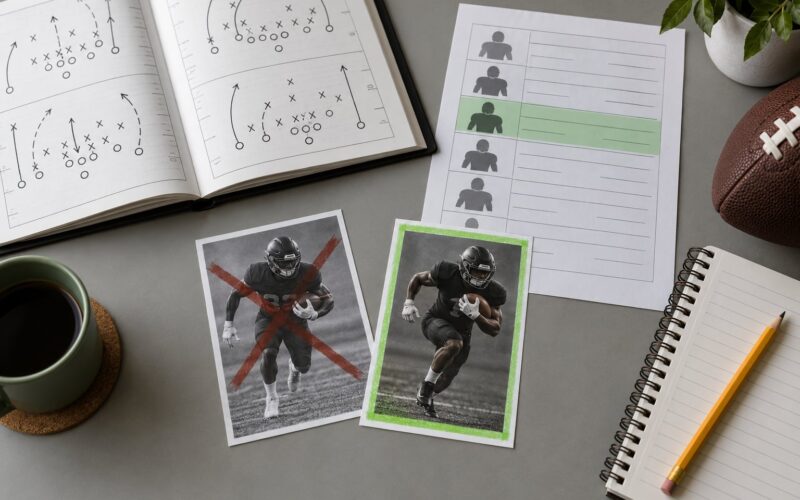
When one of your running backs goes down, the response is a fixed order of operations, not a panic drop. Confirm the diagnosis and the expected window, check whether the same-team backup is actually available, project where the touches go, size a waiver bid against your remaining budget, and line up graded replacements before the popular ones disappear.
Running back is the most injury-prone position in the sport and the thinnest on any given waiver wire. A week of guessing costs more than the injury itself, so I run this same seven-step routine every time a starter gets hurt.
Table of Contents
- What You Need to Plan Around a Running Back Injury
- Step-by-Step: How to Plan Around a Running Back Injury
- 1. Confirm the injury and expected timeline
- 2. Determine whether the player is a true downgrade
- 3. Identify the expected replacement opportunity
- 4. Check the offensive line and matchup context
- 5. Review backups before adding anyone
- 6. Decide whether to stash, start, or drop the injured player
- 7. Monitor updates through the next waiver window
- Common Mistakes
- Frequently Asked Questions
- Should I drop a starting running back immediately after an injury?
- How do I know which running back will replace an injured starter?
- Is a low-owned backup running back worth adding after an injury?
- Should I stash an injured player in a dynasty league?
- When should I make a move after a running back injury?
- Conclusion
What You Need to Plan Around a Running Back Injury
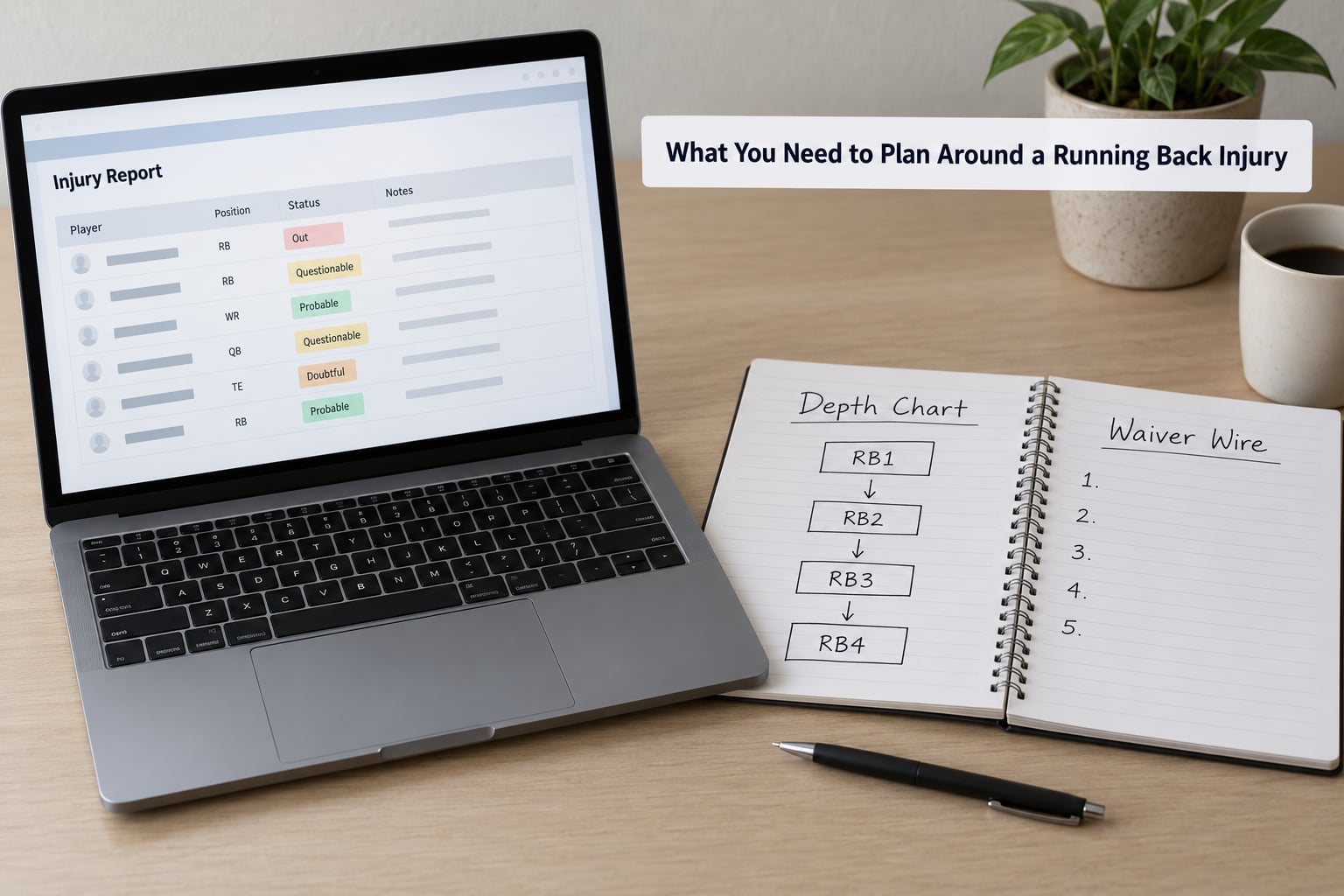
Before you touch your roster, you need four things lined up. Everything else is guesswork without them.
Official status, not rumors. The NFL injury report gives you out, doubtful, and questionable, plus a game-time decision tag on anything questionable. Practice reports add DNP (did not participate), LP (limited participation), and FP (full participation). Those letters tell you more about a return timeline than anything a beat reporter posts at 11am.
The role, measured. Carry share, touches, goal-line work, and targets over the last four weeks. An RB who carried the ball 60% of the time is a bigger loss than a committee back averaging 12 carries, even if the committee back has the better name.
Backup health. Check whether the handcuff is available this week, not just for the rest of the season.
League mechanics. Whether you bid with FAAB or hold waiver priority, how far ahead of kickoff claims process, how many IR slots you have, and whether your league charges a transaction fee.
Step-by-Step: How to Plan Around a Running Back Injury
1. Confirm the injury and expected timeline
Wait for the team, not the timeline on social media. Reporters speculate constantly and most of it is wrong.
Then map the injury type to a rough window. Soft tissue injuries like a hamstring or groin usually mean three to four weeks. Ligament or tendon damage runs four to eight. A fracture is six to ten. Concussions follow the league protocol and can clear fast or drag on for weeks.
Rough is fine. You are not forecasting a date, you are sorting short-term from season-long.
2. Determine whether the player is a true downgrade
Not every absence costs you the same weekly points. Compare the injured player’s role to what you get in return.
A bell-cow running back averaging 22 touches and a share of the goal-line snaps is a genuine downgrade. A third-string back splitting carries with two other guys is a swap of one mediocre week for another. The second one does not need panic action.
3. Identify the expected replacement opportunity
When a starter goes down, coaches do not just hand the job to the next guy on the depth chart. Carries get spread across the starter’s backup, the receiving backs, and sometimes a player who was only on the field on third down the week before.
Look for three things: who takes the early-down carries, who handles the two-minute and passing-down work, and who gets goal-line snaps. Whoever wins all three is the real replacement, and that is often a different name than the one on the depth chart.
The forum data backs this up. In a 2016-2024 study of 44 running back pairs posted on r/Fantasy_Football, the same-team backup inherited a comparable or larger role in 67.6% of injury cases. Carry share actually rose from 58.9% to 73.2%, and weekly PPR output climbed from 14.9 to 16.7, because the promoted back absorbed part of the old third-down back’s work too.
The remaining third is the reason handcuffing is not a guarantee. When the role does not transfer, carry share collapses from 73.8% to 26.4%, opportunities fall from 19.5 to 8.4 per game, and weekly PPR drops from 15.8 to 7.0. Darren McFadden in 2017 is the clean example: drafted specifically to cover a suspended Ezekiel Elliott, he got one opportunity because Dallas gave the carries to Alfred Morris instead.
4. Check the offensive line and matchup context
Replacement ceilings are set by context more than by talent. A backup running behind the same blocking group that was already giving up pressure will not fix anything.
Also check who you are streaming against. Opposing defenses that rank poorly against the run hand the replacement a better floor, and a team that falls behind early creates more passing downs, which helps the receiving back more than the straight-ahead runner. Team pace matters too, since a slow, clock-managing offense hands its starter maybe 16 carries no matter who is healthy.
5. Review backups before adding anyone
This is where most managers lose value. The same r/Fantasy_Football study found the handcuff was unavailable at the moment it was needed in 11.6% of injury cases, roughly one in nine. Nick Chubb went down in 2021 with Kareem Hunt already on IR. Alvin Kamara missed Week 10 that year with Tony Jones on IR. Antonio Gibson missed Week 17 with McKissic unavailable.
So never add a player because his starter got hurt. Check four categories in order: the same-team backup, other teams’ lead backs who are actually starting, low-owned running backs with a path to touches, and receiving production that survives a running back being out of the picture.
On value, the opportunity-cost math is genuinely close. Handcuffed backs averaged 110.1 PPR points over a season against 109.0 for comparable running backs drafted within twelve RB slots of them. Insurance is not a bad bet. It is also not free insurance.
6. Decide whether to stash, start, or drop the injured player
The decision framework runs on league format, return timing, and what the roster spot is worth to you.
Stash when the window is short, the player is your starter for the rest of the season, and you have an IR slot or a bench spot you would happily use on a flyer. Three weeks of soft tissue is easy to wait out.
Start when the practice report shows limited or full participation, the injury was not structural, and the matchup is soft. Track his snap count in the first game back rather than his yardage, because coaches ease guys in over two or three weeks.
Drop when the window is eight weeks or more, the player is a committee back whose workload was already shrinking, or you need the roster spot more than you need the upside. In a playoff race with no bench, an injured starter is a dead spot and you should be actively replacing him.
In dynasty formats, the same facts play differently. Keep the player on IR if the injury is soft tissue, bank the draft capital if it is structural, and only consider a rebuild if the player was a multi-year core.
7. Monitor updates through the next waiver window
Once you have acted, keep the loop running: practice designations each afternoon, updated injury report statuses Wednesday through Saturday, depth-chart news after every game, and any reported setback.
Most managers check twice a week and are surprised when the popular pickup is gone. Checking the report on your lunch break costs you nothing and lets you react on the same timeline as the rest of the league.
Common Mistakes
Acting on rumor news. An unverified report moves a waiver bid by two or three points for no reason. Wait for the team designation, then react the same day.
Assuming the handcuff inherits everything. Roughly a third of the time the role does not transfer at all. Look at actual touches and target share after the first game rather than drafting the depth chart.
Overvaluing the name. A famous backup with four opportunities a game is worth less than an unknown with 15. Reputation is not a workload.
Ignoring your league rules. FAAB leagues and waiver-priority leagues call for different moves, and IR slots change whether a stash is even possible. Check the settings before you bid.
Bidding before confirming the timeline. A three-week soft-tissue injury and a torn ACL call for very different spending. Know the window first.
Waiting for the next waiver run when there is a playoff race. Bye weeks and playoff weeks remove the luxury of patience. If your starter is out and you are in a playoff game, the replacement you need now is a downgrade you can live with, not the ideal one you can wait for.
Frequently Asked Questions
Should I drop a starting running back immediately after an injury?
Usually not. If the window is short, roughly three to four weeks for a soft-tissue injury, and the player is your starter for the rest of the season, stashing on IR or a bench spot costs you little and preserves the role for later. Drop immediately when the timeline stretches past six weeks, the player is already a committee back losing carries, or a playoff race leaves you no room for an empty spot.
How do I know which running back will replace an injured starter?
Watch who takes early-down carries, who handles passing-down snaps, and who gets goal-line work. The backfield rarely hands the job to the listed backup alone. In a 2016-2024 study of 44 running back pairs, the same-team backup inherited a comparable or larger role in 67.6% of injury cases, with carry share rising from 58.9% to 73.2%. In the rest, the role largely disappeared.
Is a low-owned backup running back worth adding after an injury?
It can be, if he is the same-team backup and healthy this week. Low ownership just means fewer managers competing for him, which is useful in FAAB leagues. But add him for a workload, not for availability alone: roughly one in nine injury cases leaves the same-team backup unavailable too. Check his injury status, then check whether the touches are actually his.
Should I stash an injured player in a dynasty league?
Yes when the injury is soft tissue and the player is a long-term starter, since a three-to-four week absence barely moves his season projection. Treat structural injuries differently: an ACL or fracture is a reason to re-bank the draft capital and rebuild elsewhere. Reserve a rebuild for players who were multi-year cores, not season-plus filler.
When should I make a move after a running back injury?
Act the day the official designation lands, not the day the rumor appears. Confirm the timeline first, then work the wire before the popular pickup is claimed. Keep checking practice reports through the week so you can react to a setback or a full-participation upgrade before kickoff. In a playoff race, act within hours rather than days.
Conclusion
Start with three things today: pull the official injury report and pin the expected window, identify where the touches actually go, then review the best waiver or roster alternative before the next games.
Running back injuries will keep happening, and no plan makes them painless. A process you run the same way every time is what keeps one bad injury from turning into a lost season.