Knowing how to plan for bye weeks in your draft comes down to one habit: print the current team-by-team bye schedule, mark every week your drafted players are out, and build a bench spot for each of those weeks before you sit down at the draft table. It takes about 30 minutes of setup and saves you from a roster that scores zero in four straight weeks.
The mistake most managers make is treating a bye like a small asterisk next to a player’s name. One bye costs you almost nothing. Three starters sharing the same week costs you a game, and in a twelve-team league that can be the difference between a playoff berth and a tenth-place finish.
What follows is the method I use: a six-step plan built around a single spreadsheet and your normal draft board. It works in redraft, keeper and dynasty leagues, and it holds up even when the schedule shifts, which it sometimes does.
Table of Contents
- What You Need
- Step-by-Step: How to Plan for Bye Weeks in Your Draft
- 1. Map Every Bye Week Before You Draft
- 2. Know Which Bye Weeks Matter Most
- 3. Set Replacement Targets for Thin Positions
- 4. Protect Weekly Starter Depth in Your Draft Board
- 5. Build a Replacement Plan for Each Vulnerable Bye
- 6. Check and Adjust the Plan After Every Round
- Common Mistakes
- Frequently Asked Questions
- When should I check the NFL bye-week schedule before my fantasy draft?
- Should I avoid every player who has a bye week during my draft?
- How many bench players should I target for each bye week?
- What is the best way to replace a starter during a bye week?
- How do bye weeks affect keeper and dynasty draft strategy?
- Your Bye-Week Plan: Start This Week
What You Need
You need five things before the draft, and four of them take under an hour between them.
- The current NFL team-by-team bye schedule. Find it on your league’s platform first, then cross-check against the official schedule. Schedules get reshuffled between the summer and September, so pull the newest version within a few days of your draft.
- A fresh player pool for the current season. Last year’s ADP does not know which team a player is on now, and trades move almost every name in August.
- Positional scarcity notes. Know roughly how many starting-caliber quarterbacks, tight ends and defenses you expect to be available before the position runs cold.
- A replacement-value worksheet. One column per position, one row per bye week, filled with the player you would happily start instead.
- A draft board or roster-planning tool. Anything with a bye-week column and a filter works. A plain spreadsheet is fine if your league site does not have one.
If your league is a startup or auction draft, add one more item: a rough ceiling on what you are willing to spend on a bye-week replacement, so a flier and a real backup do not get confused in one afternoon.
Step-by-Step: How to Plan for Bye Weeks in Your Draft
Learning how to plan for bye weeks in your draft comes down to one question at every pick: if this player is out, who plays his position that week? If you have an answer on your board, the bye is an inconvenience. If you do not, it is a hole, and holes get expensive.
1. Map Every Bye Week Before You Draft
Open a new tab and list all 32 teams with the week each one is off. That single column is the foundation for everything else. Then flip it around and organize by week instead of team, because that is the order that matters on your draft board.
Now scan each week and count how many players from the same offense or defense you own. A week with two players from one offense is a real conflict, because the game script, the offensive line and the coaching decisions are all correlated. One team’s bad game kills both of your players, not just one.
Here is the shape of the sheet I build. Replace the sample row with your league’s real data.
| Week | Teams on bye | Number of teams | My starters out | Backup plan |
|---|---|---|---|---|
| 3 | Sample City | 2 | 1 | Handcuff RB on roster |
| 4 | — | 0 | 0 | Full lineup |
A week with zero teams on bye does not exist in the modern schedule, but weeks with only two teams do. Those are your free weeks, and you should know where they fall before you build your roster.
2. Know Which Bye Weeks Matter Most
Not all byes are equal. A Week 4 bye in a season that starts in September is cheap: your bench players are healthy, the waiver wire is wide open, and nobody is panicking. A Week 11 bye in November is expensive, because injuries have piled up, replacements are gone, and your league mates are all hunting the same two available tight ends.
Pay special attention to byes that land in your league’s divisional rivalry weeks, where a single bad loss can drop you several games in the standings. The bye and the tough matchup landing in the same week is what people mean when they call a week bye-mageddon.
Position matters more than the week number. Quarterbacks are nearly impossible to replace mid-season. Low-volume tight ends with no dynasty value are easy to replace. A kicker and a defense you can simply drop and re-add. Rank your positions by how painful a single week off would be, and spend your planning effort on the top two.
3. Set Replacement Targets for Thin Positions
Define a weekly replacement level for every position before you draft, then write the name of a real player next to it. This is the part that turns bye weeks from a worry into a plan.
Some starting-caliber examples to work from:
- Running back: a committee back on your own roster who would get 10-plus points in a plus matchup.
- Receiver: your third stringer, who still has a shot at a touchdown.
- Quarterback: the backup on the same team, or a low-owned streamer with two good matchups.
- Tight end: anyone with a red-zone target rate worth a start.
- Defense and kicker: a streamable option off the wire. These carry no planning cost at all.
Once your target exists, a bye stops being a reason to avoid a player. A second-round running back who shares a bye with your starter is a small problem if his handcuff plays that week. It is a large problem if nobody on your roster can catch a pass, and the answer there is not to run away from the bye, it is to draft a tight end in a round where you would otherwise take a backup tight end anyway.
4. Protect Weekly Starter Depth in Your Draft Board
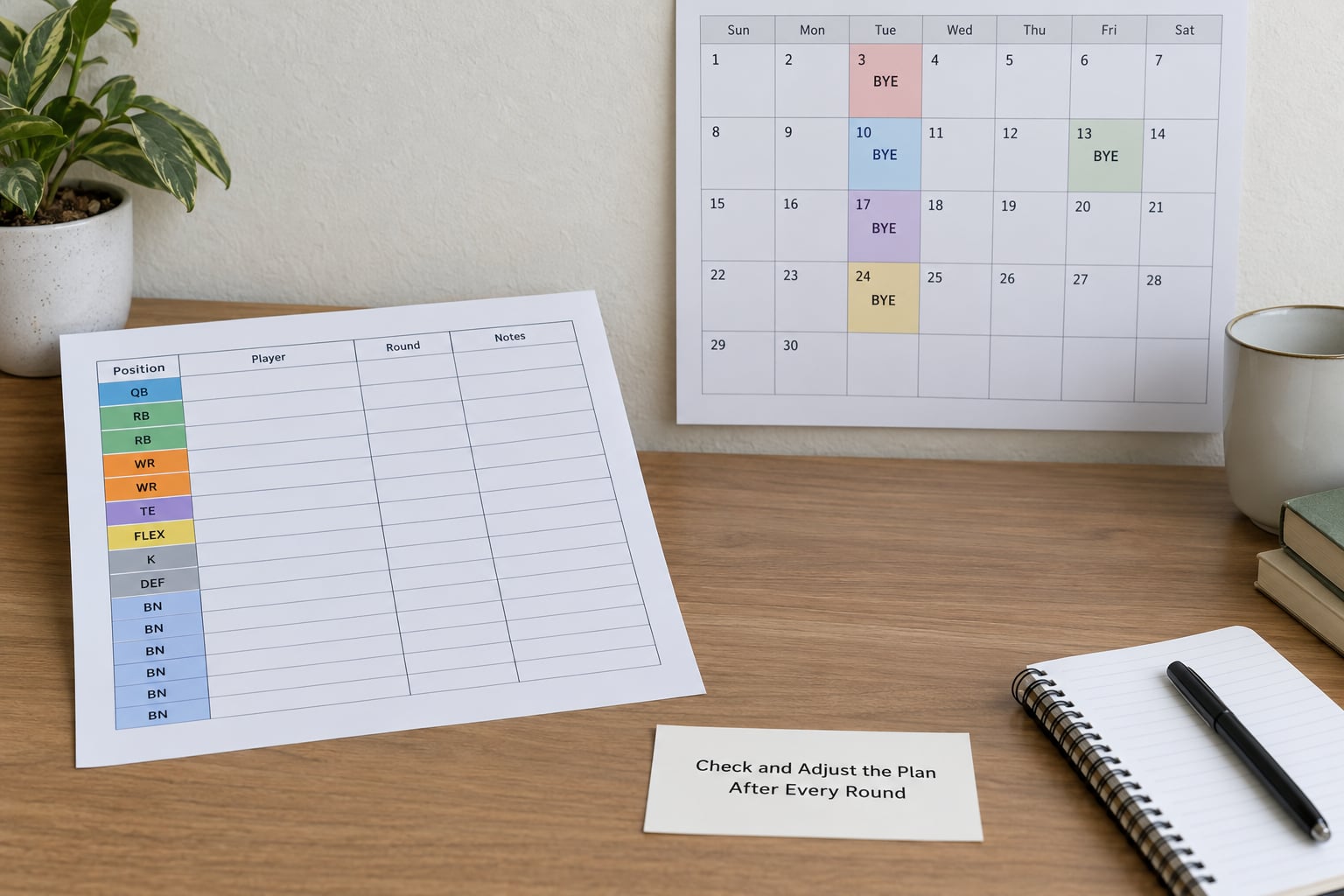
Add a bye-week column to your board and sort by it. Then color-code anything that would leave you short: red for weeks where two or more of your projected starters are out, yellow for one, green for none. The red weeks are the only ones that should change your pick order.
The practical target is a full lineup every week, which in most leagues means protecting 11 starting spots, plus one flex spot and a bench replacement at each scarce position. That is a lot of coverage, and it is why depth matters more than any single bye.
Do not delete early-round stars from your board over a bye. Taking the best player available in rounds one through four is almost always right, and the replacement for one week is cheaper than the talent you passed on. Bye logic belongs in the middle and late rounds, where a second tight end is a real asset rather than a wasted pick.
5. Build a Replacement Plan for Each Vulnerable Bye
For every red week on your sheet, decide now where the replacement comes from. Naming a source in August is far easier than figuring it out in November.
| What went wrong | When to fix it | Where the fix comes from |
|---|---|---|
| Two quarterbacks on bye | Draft, then every week after | Handcuff on draft board, or the cheaper backup on the same team |
| Tight end starter out with no backup | Before your final bye week | Late-round tight end whose team has not yet had its bye |
| Receiver corps out together | Any time | Trade from a position of strength for a player whose team plays that week |
| Kicker or defense out | The week of | Drop and re-add from the wire; no roster spot needed |
| Running back with no handcuff | Draft night | Take the backup one round later, even at a small discount |
Trades work best when you are giving up something your partner wants and receiving a player with a different bye. Nobody wants to hear that you are desperate, which is exactly why a trade shaped around your roster’s strengths tends to get accepted. Sorting your own board by position tells you which of those offers you can actually make.
6. Check and Adjust the Plan After Every Round
At the end of every round, count how many weeks your roster can field a full lineup. If the answer is below sixteen, you have a coverage problem, and the cheapest fix is almost always another player at your thinnest position rather than another name at your deepest one.
Draft board software will do this count for you with a filter on the bye column. A spreadsheet does the same thing if you add a row that totals your starters by week. What you are looking for is the week where a starter has no backup, and that single cell usually tells you what to do with your next two picks. Anyone learning how to plan for bye weeks in your draft will hit the same cell, so build that single check into your routine rather than rebuilding the sheet every round.
Common Mistakes
Treating every bye as equal. The fix is to rank your weeks by difficulty and ignore the cheap ones. Early-season byes on positions you stream anyway barely register.
Drafting from an old schedule. Rosters change every offseason. Re-pull the bye chart within a few days of your draft and update the column on your board before you sit down.
Avoiding every player who has a bye. This is overcorrection. In redraft leagues your roster turns over so much that draft byes matter less than most people fear, and dodging them can push you into worse picks all draft long.
Protecting only your low-end bench players. Depth is about your starters. A bench of interchangeable guys with the same bye week gives you nothing in the week that counts.
Overvaluing a small bye disadvantage. One lost week at running back is worth far less than one extra start at tight end across sixteen weeks. Weigh the bye against the opportunity cost of the pick you would rather make.
Forgetting that replacements disappear. A bye week with six teams on it is the week the wire gets picked clean. Plan your source first, then commit to it a week early.
Ignoring injuries while planning byes. Bye planning assumes a healthy roster, which is a fiction by October. Keep one bench spot flexible so you can absorb a bad injury without a second crisis.
For redraft managers, the simplest version of all this is to protect one backup at quarterbacks and tight ends and let the rest of the roster take care of itself. For keeper and dynasty managers, prefer players on teams with younger cores and unknown coaching, since their bye week is a smaller share of a longer, more uncertain tenure. In every format, the bye column is a tiebreaker, not a strategy.
Frequently Asked Questions
When should I check the NFL bye-week schedule before my fantasy draft?
Knowing how to plan for bye weeks in your draft starts with checking twice. Pull the schedule when you begin your prep, then re-check within a few days of draft night, because teams get shuffled between the summer and September. If your league software carries its own bye column, trust that version as the final word, since it is what actually scores your lineup.
Should I avoid every player who has a bye week during my draft?
No. Avoiding every bye player pushes you into worse picks for the whole draft and only solves a problem you may never have, since rosters turn over constantly in redraft. The only byes worth reacting to are clusters that hit your starters at a position you cannot replace, usually quarterback or tight end. Judge each player by who plays his position that week, not by the week itself.
How many bench players should I target for each bye week?
One real replacement per bye week is the practical minimum, and that replacement only needs to be good at one position. In practice that means a quarterback backup and a tight end body on every roster, plus a running back committee behind your starter. If a league gives you fewer bench slots than that, you are relying on the wire, so plan to add the quarterback replacement early in the year rather than in November.
What is the best way to replace a starter during a bye week?
It depends on the position. Quarterbacks come from the wire or a backup already on your roster. Running backs usually mean a committee member or a trade. Kicker and defense are simple: drop the player and add a streamable option that week. Before you do any of it, know which week is coming and line the source up a week early, because heavy bye weeks get picked clean fast.
How do bye weeks affect keeper and dynasty draft strategy?
In keeper and dynasty leagues the bye week matters less than age, role and the length of your window. A player in his third year has three or four byes left to survive, while a rookie may have six. Weight current role and career runway more heavily, and use byes mainly as a tiebreaker between similar players. Startup and dynasty drafts made before the schedule is published cannot plan around byes at all.
Your Bye-Week Plan: Start This Week
Start with the calendar, not the player pool. List all 32 teams and their bye weeks, then flip the sheet so weeks run down the page.
Mark the densest weeks, assign a replacement target at quarterback and tight end, and count how many full lineups your roster can field out of seventeen. Protect a full lineup every week, and if a week has no backup, spend your next pick there instead of adding depth to a position that already has three options.
Do all of that before September, and bye weeks stop being the thing that wrecks your season. They become one column on a board, checked alongside scoring opportunity and role, where it belongs.