Most NFL players with an uncomplicated high ankle sprain miss somewhere between four and eight weeks, and severe Grade 3 injuries push that to 10 to 12 weeks or longer. So if you are asking how long does a high ankle sprain keep players out, the honest answer is weeks, not a date. Three things decide whether a player lands at the short or long end: how badly the syndesmotic ligaments are damaged, how that player responds to rehab, and what his position asks of the ankle every snap.
I have watched enough injury updates to know the pattern managers complain about most. A team says “week to week” on Tuesday, a beat reporter says six weeks on Wednesday, and by Sunday the player is on the injury report with a five-week estimate. Nobody is lying. They are all reporting different pieces of an incomplete picture.
This guide breaks the timeline into stages you can actually track, explains why two players with the same diagnosis miss different amounts of time, and turns all of it into roster decisions. General information only, no treatment advice — every individual case belongs with a qualified healthcare professional.
Table of Contents
- How Long Does a High Ankle Sprain Keep Players Out?
- Typical High Ankle Sprain Recovery Timelines
- Why NFL Return Dates Differ From Average Healing Times
- How Position and Playing Style Affect the Timeline
- What Medical and Performance Milestones Matter Before Return?
- How Fantasy Football Managers Should Respond During the Injury
- When Should a Player Be Evaluated by a Medical Professional?
- Frequently Asked Questions
- How many weeks does a high ankle sprain usually keep an NFL player out?
- Can an NFL player return from a high ankle sprain in less than three weeks?
- What is the difference between a high and low ankle sprain?
- Does a high ankle sprain require surgery or immobilization?
- What fantasy football signs suggest an injured player is close to returning?
- Conclusion: What to Do First
How Long Does a High Ankle Sprain Keep Players Out?
The short answer: roughly 4 to 8 weeks for a Grade 1 or Grade 2 syndesmosis injury managed without surgery, and 10 to 12 weeks or more for a severe injury or one that requires fixation. Skill position players who have to cut on a planted foot often sit at the longer end of that range.
A high ankle sprain is not a standard ankle sprain. The damage sits in the syndesmosis, the band of ligaments and the interosseous membrane that hold the tibia and fibula together above the ankle joint. When those structures are torn, the two bones start to separate under load, and the joint no longer feels stable through a cut or a shove.
That difference explains why high ankle sprains behave the way fantasy managers find frustrating. A lateral ankle sprain often lets a player back in two or three weeks. The same athlete with a syndesmotic injury can still be limping at week six, because the ankle has to hold together under rotation, not just flexion.
Published estimates cluster in the same neighborhood. Foot and ankle practices commonly quote six to twelve weeks depending on severity, injury analysts covering the NFL have used four to eight weeks for non-operative cases, and PFF has put the average return to play at four to six weeks when a high ankle sprain is confirmed. Expect to land between those numbers, not on any of them exactly.
Typical High Ankle Sprain Recovery Timelines
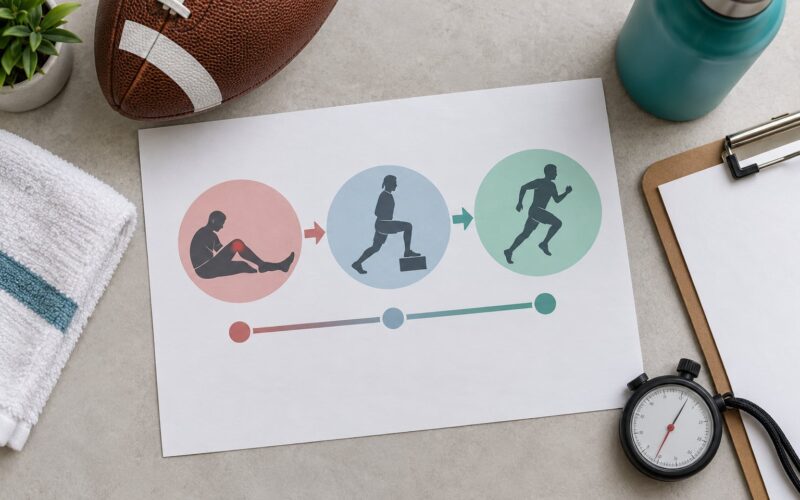
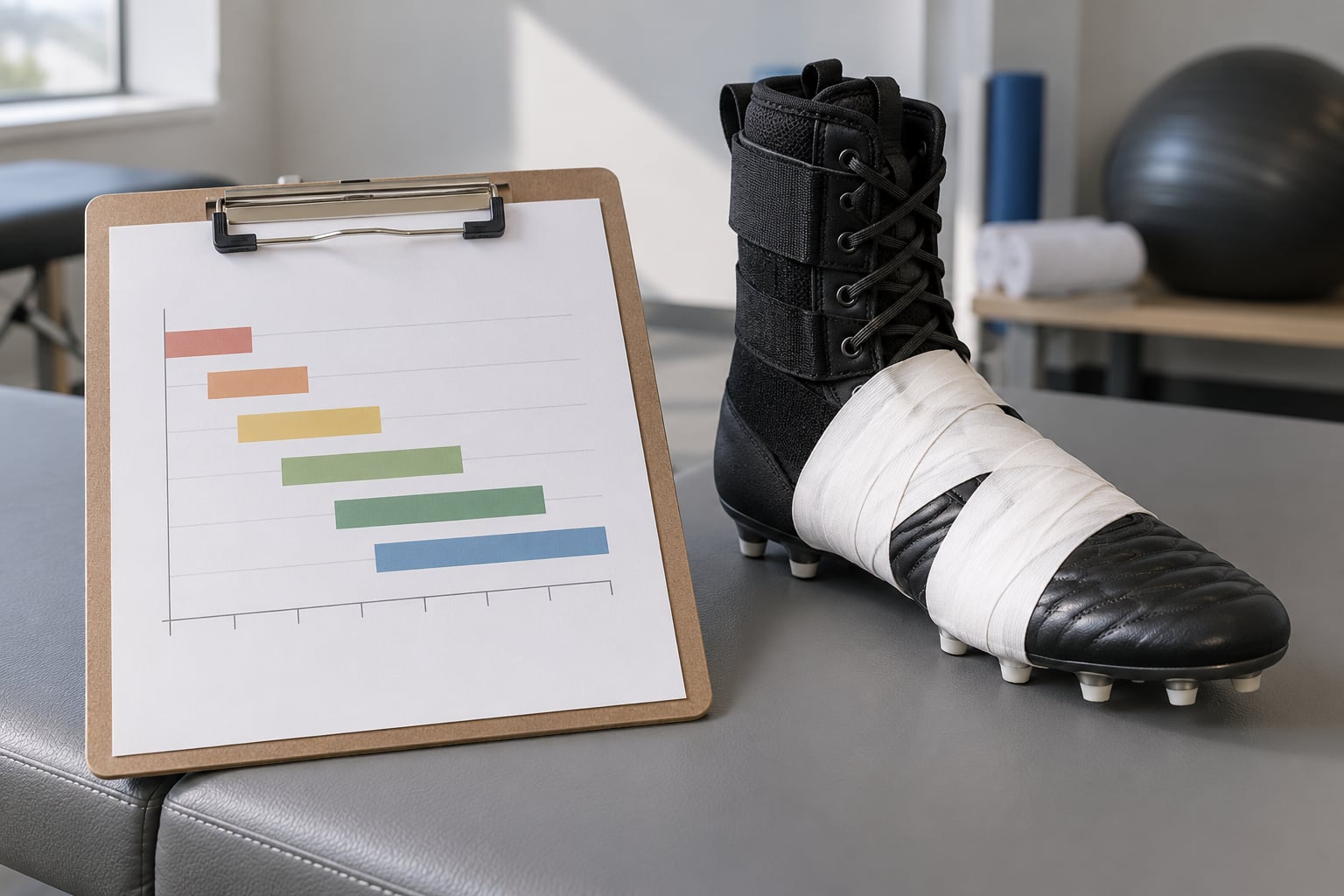
Recovery runs in phases, and each one has its own pace. Managers who track the phase instead of the headline estimate get useful information weeks before the player is officially cleared.
| Recovery stage | Typical range | What it looks like for fantasy managers |
|---|---|---|
| Protection and pain control | Days to roughly 2 weeks | Out of uniform, limited practice participation, reported as out or doubtful |
| Walking and mobility | 1 to 4 weeks | Player moves around the facility, jogs lightly, limited individual drills |
| Strength and conditioning | 3 to 6 weeks | Full team drills begin, but no live contact or full-speed cutting |
| Sport-specific work | 5 to 10 weeks | Cutting, blocking and route work, still held out of contact |
| Return to play and full participation | 6 to 12+ weeks | Cleared for game action, snap counts may still climb for a few games |
These are general estimates for planning, not medical predictions for a specific athlete. The early stage is often the least dramatic and the most frustrating to read, because a player can walk and even lift weights while still nowhere near playing football.
Weight bearing is usually the first gate. Until an injured player can take weight through the leg without pain or a limp, nothing else in the rehab matters for a roster. Non-weight-bearing periods commonly run several days to a couple of weeks depending on severity, and some players use a walking boot during this stretch.
The middle phase is where most managers get fooled. A player jogging on the sideline at practice looks healthy in a photo and still cannot cut, plant or take a hit. Running in a straight line uses a fraction of what a route tree or a run-blocking assignment demands.
Team practice reports matter most in that window. Limited participation means the player joined individual drills. Full participation means something else entirely. And a player cleared to play on Sunday may still be on a managed snap count, which is a very different fantasy asset from a healthy starter.
Why NFL Return Dates Differ From Average Healing Times
Ligament damage sets the floor. A Grade 1 stretch of the anterior inferior tibiofibular ligament behaves differently from a complete tear of multiple syndesmotic structures, and imaging grades do not always line up with how unstable the ankle feels under game stress.
Bone involvement adds weeks. When a high ankle sprain comes with a fibula fracture, the timeline stretches because bone has to heal before the ankle can be trusted under rotation. Injury reports that mention both a high ankle sprain and a fracture should be read as a longer absence than either label alone suggests.
Swelling behaves unpredictably. An ankle that stays quiet for a week can swell again after a heavy rehab session, which pushes the next stage back. Chronic instability adds another layer, because an ankle that has been unstable once often needs longer balance and proprioception work before it is trusted with contact.
Then there are the off-field complications. A player who reinjures the same ankle mid-rehab, or who has a separate issue develop in the boot, restarts portions of the timeline. Competing injuries are common in the NFL precisely because a player compensating for a bad ankle loads other joints differently.
Individual response is the last variable and probably the biggest. Two players can receive the same diagnosis on the same Sunday and return three weeks apart. Managers who have been burned by one optimistic update tend to plan with the longer estimate and get pleasantly surprised.
Historical cases in the research show the spread clearly. Jerry Jeudy missed six weeks in 2021 and looked limited in his first two games back. Saquon Barkley returned in roughly three weeks from a mild high ankle sprain in 2019 and about four weeks from a more moderate one in 2021. David Njoku missed about four weeks in 2022 as a tight end, and Mike Williams was out roughly six weeks that same year without regaining his earlier explosiveness.
How Position and Playing Style Affect the Timeline
The grading matters, but the job description matters just as much. Two players with the same injury can be cleared for play on the same day and have very different ceilings once they are back, because the ankle is asked to do different things.
| Position | Primary ankle demand | Typical return pattern |
|---|---|---|
| Quarterback | Scrambling, sliding, avoiding contact in the pocket | Often tolerates reduced cutting better than expected, but mobility matters late in games |
| Running back | Repeated cutting, receiving contact, pass protection | Takes the longest on average; production usually dips before it recovers |
| Wide receiver | Sharp cuts on routes, contested catches, blocks | Cutting routes drive the timeline more than route running in general |
| Tight end | Blocking, seam routes, red-zone volume | Blocking rehab can lag receiving rehab and delay clearance |
| Offensive lineman | Pass protection, run blocking, lateral movement | Fewer cutting demands, but contact volume raises reinjury risk |
| Defensive backs | Coverage footwork, tackling, high change of direction | Change-of-direction volume keeps timelines toward the longer end |
| Linebackers | Sideline-to-sideline speed, coverage, tackling | Conditioning often limits return more than the ankle itself |
| Special teams | Maximal sprinting, kicking and punting technique | Small roster makes the loss felt hardest in season-long formats |
Quarterbacks are the clearest case of position beating grade. A quarterback can sometimes play through a high ankle sprain because the job can be done with less cutting, though mobility in the pocket tends to suffer quietly in the fourth quarter. Mac Jones in 2022 came back in about four weeks but his mobility looked compromised for much of the season, which is exactly the pattern managers underestimate.
Running backs sit at the other end. Cutting, absorbing contact and picking up blitzes all load the same ankle repeatedly in a game. Fantasy analysts have observed running backs losing a meaningful share of expected production in the first few games back, and that dip is a planning input, not bad luck.
Tight ends show how blocking changes a timeline. Njoku’s four-week absence in 2022 was described as hitting his blocking more than his receiving, and a player who is cleared to run routes can still be withheld from a full-blocking role.
Special teams players deserve their own line. Punt returners, kickers and long snappers have limited practice opportunities, which slows the gradual reintroduction that return-to-play protocols depend on. That can turn a four-week soft timeline into a longer wait.
What Medical and Performance Milestones Matter Before Return?
Time alone is a poor clearance tool. A player can be six weeks out and still not be able to cut, and another can hit every milestone inside four. Team medical staff and performance staffs work through a progression that looks something like this.
- Pain control. Symptoms settle at rest, with walking and with light sport activity, without a limp or increasing swelling.
- Range of motion. Dorsiflexion and plantarflexion come back close to the uninjured side.
- Strength. The injured side matches the healthy side on key measures, including calf and hip strength that supports the ankle.
- Balance and proprioception. Single-leg stability and landing control match the other side, because a sprained syndesmosis leaves balance deficits long after swelling goes.
- Walking, then jogging, then acceleration. Each step is added before the next, usually over days rather than in one session.
- Cutting and change of direction. Planned cuts and reactive cuts at game speed, which is the step that separates a functionally ready player from a hopeful one.
- Sport-specific and contact work. Position-specific drills, then full team participation, then clearance.
For a fantasy manager, the useful signal is not a report that says the player looks good. It is a report that says he is running full speed, cutting in practice and taking contact. Until all three are true, treat the player as a roster placeholder rather than a contributor.
When surgery enters the picture, the progression restarts from the beginning and stretches out. Syndesmotic fixation has been done with screws or with suture-button or tightrope techniques, and the goal of the newer approaches is to avoid the hardware removal that screws sometimes require. Outcomes still vary, and managers should treat a surgical report as a multi-month timeline by default.
How Fantasy Football Managers Should Respond During the Injury
Once you know why the timelines differ, the roster question becomes mechanical. Where in the season the injury happens matters as much as how severe it is.
Read the report by participation, not by adjectives. Out means no practice work. Limited means individual drills only. Questionable with a designation of full participation means the player practiced fully and the team is protecting him. Words like day to day carry almost no information on their own.
Estimate from grade, not from optimism. A reported Grade 1 or Grade 2 with no surgery mentioned is a four-to-eight week problem. A Grade 3, an unstable ankle or an accompanying fracture is a longer one. Build your own range and then widen it, rather than adopting the shortest number anyone reports.
Time the IR decision by calendar. An injury in Week 3 almost certainly leaves time for a return before the fantasy playoffs. The same injury in Week 11 may not, depending on your playoff week and how many roster spots you have. Short-term IR slots are valuable for players who will be back inside a month and useless for a season-ending grade 3. Jonathan Taylor’s 2022 season, when a foot injury ended his year in Week 15 despite being described as not significant, is the cautionary version of that math.
Stash on a graded injury, drop on a vague one. If a report names a high ankle sprain and a grade, the player is worth a stash in a league with space. If the report is an unspecified ankle with no grade and no timeline, you are gambling on information you do not have.
Replace in the same breath. Find a comparable player on your waiver wire before your injured guy returns, because the post-return snap count is rarely a full snap count. Plan your lineup for a player working back to full participation, not a player who was simply listed as active.
Adjust for dynasty length. In dynasty and keeper formats a single missed month matters less than long-term production, so hold through the timeline and re-evaluate at the point where two missed months have passed without a return. In redraft, weeks out are almost the entire value of the player.
One last habit worth building: keep a small log of the exact date and wording of each update. When the player returns, you will want to know whether the ankle held up in practice before you trusted him in a start.
When Should a Player Be Evaluated by a Medical Professional?
Any suspected ankle injury deserves prompt assessment by a qualified healthcare professional, and some signs deserve same-day attention. A player who cannot bear weight at all, or whose swelling keeps increasing rather than settling, should be evaluated quickly.
So should severe or worsening pain, numbness, tingling, a visible deformity, or any suspicion of a fracture. Inability to take four steps, pain over the bony bumps of the ankle or midfoot, or significant swelling are all reasons to stop waiting it out.
That advice matters for athletes and parents reading this, not only for NFL players. Ankles that feel “probably fine” in week one can turn into a chronic instability problem when loaded too early, and the diagnosis step, whether imaging or clinical testing such as the squeeze test or external rotation test, should come from a professional.
This article is general information about recovery timelines and fantasy roster management. It is not a diagnosis, a treatment plan or a prediction of any individual player’s return.
Frequently Asked Questions
How many weeks does a high ankle sprain usually keep an NFL player out?
Most NFL players miss four to eight weeks with a Grade 1 or Grade 2 high ankle sprain treated without surgery. A severe Grade 3 injury or one that requires fixation commonly stretches to 10 to 12 weeks or more. Skill position players who cut repeatedly usually sit at the longer end of the range. Individual response and any accompanying injury can move the timeline in either direction.
Can an NFL player return from a high ankle sprain in less than three weeks?
It happens, but it is the exception rather than the rule. Returning inside three weeks usually means a low-grade injury with no fracture and a player who responds quickly to rehab. Because the syndesmosis has to hold together under rotation, an early return can carry reinjury risk. Most published estimates put non-operative cases at four weeks or longer.
What is the difference between a high and low ankle sprain?
A low ankle sprain injures the lateral ligaments on the outside of the ankle, usually by rolling inward, and often settles in one to three weeks. A high ankle sprain injures the syndesmotic ligaments and interosseous membrane that connect the tibia and fibula above the joint, usually through a planted foot with rotation. That deeper injury takes longer and is less stable under cutting.
Does a high ankle sprain require surgery or immobilization?
Most high ankle sprains are managed without surgery, using protection, a walking boot in some cases, progressive weight bearing and structured rehabilitation. Surgery is generally reserved for severe or unstable injuries, or when a fracture is present, and it adds months to the timeline. Immobilization is common early on to control symptoms before rehab begins. A qualified clinician should decide the approach for any individual case.
What fantasy football signs suggest an injured player is close to returning?
Watch for full participation in practice, running and cutting at game speed, contact work in practice, movement in the unofficial injury report, and a return from limited to full designation. A player practicing fully and cleared in the report is the closest thing to a reliable signal. A name on the active list after a limited week often still means a managed snap count.
Conclusion: What to Do First
Treat a high ankle sprain as a multi-week absence with a range, not a countdown with a date. Four to eight weeks covers most non-operative cases, and Grade 3 injuries or syndesmotic surgery run far longer.
Then manage the roster from participation data rather than from adjectives. Watch practice reports, note the grade when a report gives one, line your IR decision up against your playoff calendar, and pull a replacement before your starter is back, because the first games after a return are rarely full games.
Anyone managing an actual injury in this article should see a qualified healthcare professional rather than use a timeline from a fantasy site as a target.