A hamstring strain costs an NFL player about 2 to 3 weeks on the mild end and 6 weeks or more when the muscle is badly torn or the injury has happened before.
The frustrating part for fantasy managers is that the official NFL injury report never says any of that. It says “hamstring” and nothing else, so everyone fills the gap with a guess, and the guess is usually optimistic.
Think of the numbers below as a range to plan around, not a calendar to set your lineup by. A team’s medical staff decides when a player plays, and they base that on function, not on the calendar.
Table of Contents
- How Long Do Hamstring Injuries Sideline NFL Players?
- Hamstring Injury Grades and Recovery Ranges
- Mild Hamstring Strains
- Moderate Hamstring Strains
- Severe Tears and Recurrent Injuries
- What Determines When an NFL Player Can Return?
- How the Injury Location Changes the Timeline
- What Treatment and Rehab Milestones Matter?
- How NFL Position Affects the Return Window
- What Fantasy Football Managers Should Track
- Frequently Asked Questions
- How long does a mild hamstring strain keep an NFL player out?
- Do NFL players usually return to football within a month?
- Can a player play again after a hamstring injury without losing strength?
- Why are recurring hamstring injuries harder to recover from?
- Does an estimated return date mean a fantasy football player will play?
- Conclusion: Plan Around Range, Not a Single Date
How Long Do Hamstring Injuries Sideline NFL Players?
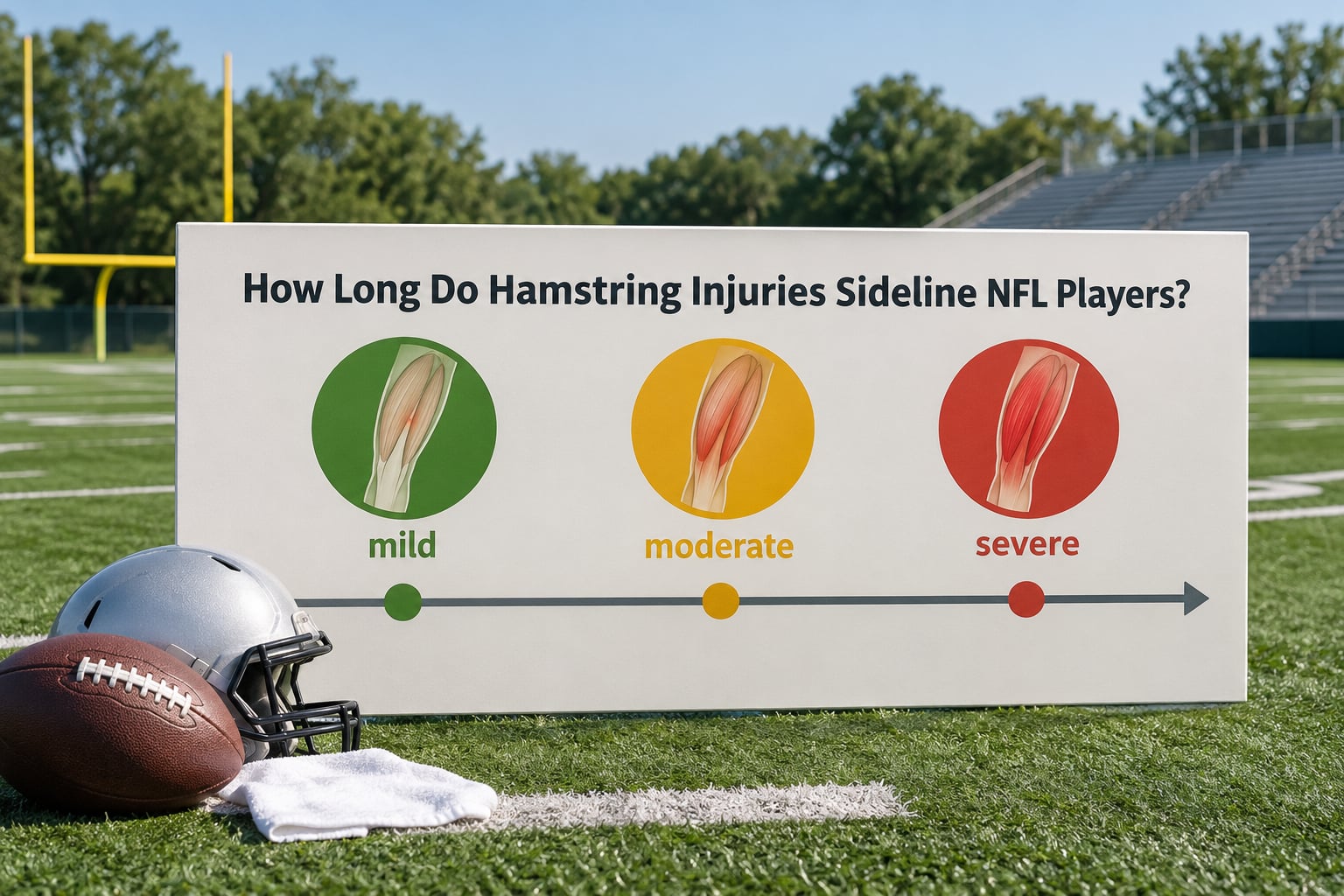
Mild hamstring strains usually sideline an NFL player for roughly 2 to 3 weeks, moderate strains for about 3 to 6 weeks, and severe or recurring tears for 6 to 12 weeks or longer, sometimes including surgery.
The real return date depends on pain resolution, restored strength, the ability to sprint and cut, the player’s position, and the medical staff’s own testing.
Those four ranges line up closely with the general clinical literature on hamstring injuries in field sports, where return-to-play timelines for the lower grades cluster in the low-to-mid twenties in days. An NFL version of that number tends to run longer for one simple reason: a team will not put a starting receiver on the field at 80 percent.
Hamstring Injury Grades and Recovery Ranges
Clinicians grade hamstring injuries by how much tissue is damaged, often combining what they feel on exam with what an MRI shows. NFL teams usually do not publish the grade, which is why the designation rarely tells you much on its own.
| Grade | What it means | Broad return window | Fantasy football implication |
|---|---|---|---|
| Mild (grade 1) | A few fibers stretched or torn, minimal bruising, strength mostly intact | About 2 to 3 weeks | A few games. Stash on IR or find a bye-week replacement. |
| Moderate (grade 2) | A partial tear with visible bruising and real loss of function | About 3 to 6 weeks | A month of football. Waive-priority target in dynasty, not a season saver. |
| Severe (grade 3) | A complete rupture, often proximal, sometimes requiring surgical repair | 6 to 12 weeks or more | Plan the season around him. Usually out until the playoff push at best. |
| Recurring injury | A repeat strain in the same muscle, often within the same season | Adds 1 to 3 weeks to any estimate | Treat the second absence as part of the first one when you decide. |
Grade labels are not standardized across every club, and two medical staff can describe the same tear differently. Read these as buckets, not verdicts.
Mild Hamstring Strains
A mild strain is a handful of fibers, not a hole. The player can often walk and jog a few days later, which is exactly why managers see “day-to-day” tags on these and assume the player will be active for the weekend.
Two to three weeks is reasonable when the player responds well to early loading and has no history with the muscle. Pain disappearing is not the same as readiness. The hamstring can feel fine while walking and still fail a sprint test.
Moderate Hamstring Strains
Moderate injuries come with bruising that shows up days later, along with a noticeable drop in sprinting speed and sometimes pain sitting down or driving. Three to six weeks is the usual window, and the position determines how painful the top of that range feels.
A moderate strain for a wide receiver costs you his routes. The same grade for a quarterback may barely register on the stat sheet, so the severity is not the whole decision.
Severe Tears and Recurrent Injuries
Complete ruptures, injuries at the proximal musculotendinous junction, and tears in previously damaged muscle all push toward six weeks, three months, or a surgical repair with a longer rehab behind it.
Recurrence is the part nobody budgets for. Research consistently finds that a player who has already had a hamstring injury is at meaningfully higher risk of doing it again, especially if the return was rushed. Clearance then rests on functional testing, not a calendar date the club picked early.
What Determines When an NFL Player Can Return?
Teams use a sequence of gates rather than a single checkpoint, and reading them in order tells you more than any report line.
- Pain at rest and with motion. A player who still hurts lying down has not started the clock yet.
- Full range of motion. Especially extension at the hip with the knee straight, which is where hamstrings feel tight last.
- Strength symmetry. The injured side needs to match the healthy side on an eccentric test such as the Nordic curl, not just look equal in the weight room.
- Sprint ability. Submaximal running comes first, then near-full-speed running, then repeat sprints. Progressing early to the last step is a common route to reinjury.
- Change of direction and cutting. Cutting and planting load the hamstrings differently than running in a straight line.
- Position demands. A tight end who blocks on nearly every snap faces a different bar than a kicker.
- Reinjury history and medical evaluation. The medical staff’s judgment closes the process, and it is not a step you can vote on.
When those gates are met quickly, you see a player back sooner. When one stalls, timelines drift by weeks with no new headline to explain why.
How the Injury Location Changes the Timeline
The three hamstring muscles, the biceps femoris, semitendinosus, and semimembranosus, do not all behave the same when they tear. The biceps femoris accounts for the largest share of these injuries, and it is usually the one that runs long.
A proximal injury near the muscle’s tendon junction is treated more cautiously than a distal muscle-belly strain. Proximal tears tend to carry more scar tissue, and tissue that heals with heavy scarring has less stretch left in it, which matters for a sport built on maximum-length strides.
Intramuscular injuries, where the tear sits inside the muscle away from the tendon, can deceptively look small on a scan and still keep a player out for weeks. Imaging tells you the size and location of the damage. It does not set the return date, and treating a scan as a schedule is one of the most common mistakes in reading these injuries.
What Treatment and Rehab Milestones Matter?
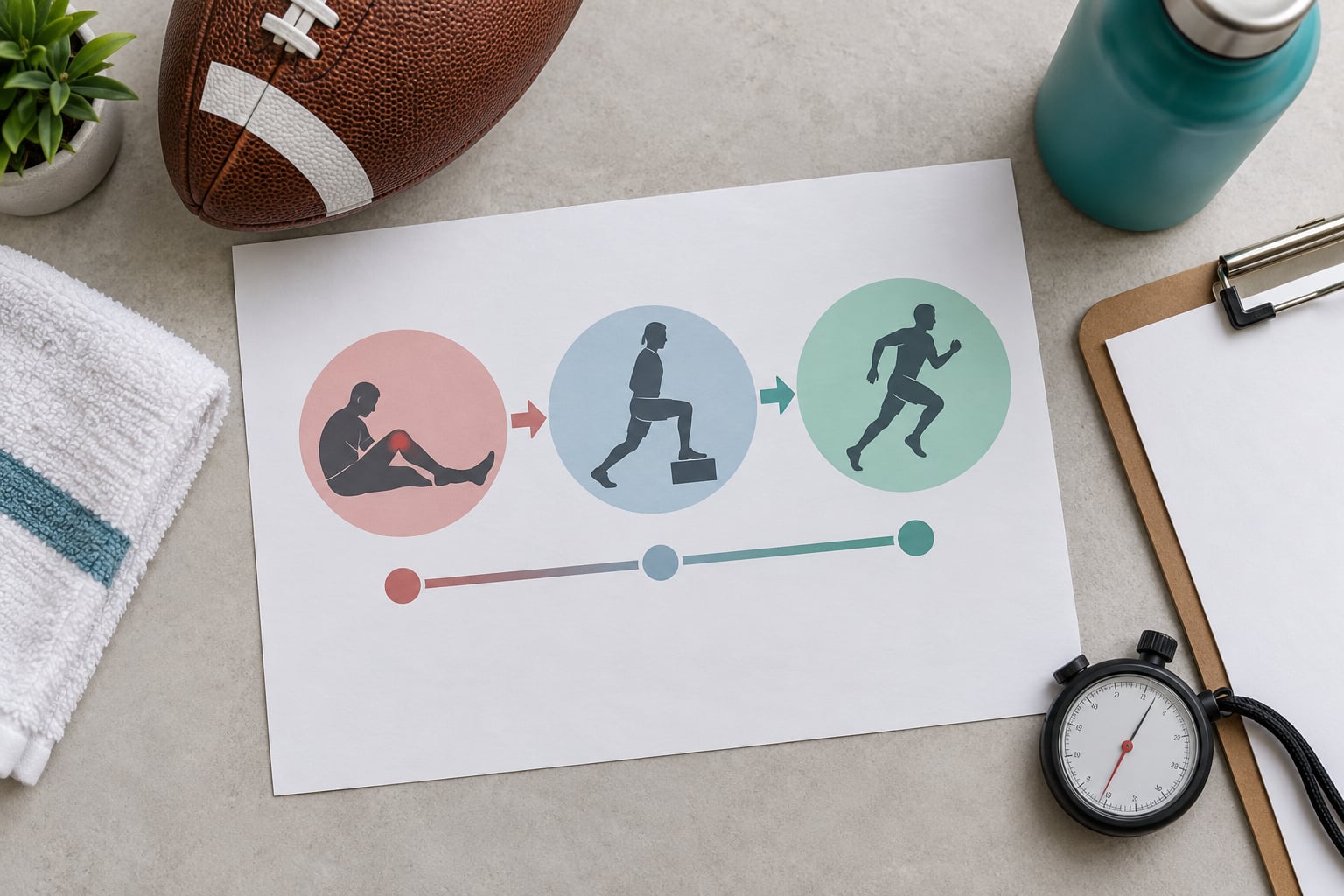
Rehabilitation moves through four broad stages, and the order matters more than the calendar.
- Protect the injury. Early stages manage pain and swelling and limit harmful stretching of the damaged tissue.
- Restore motion and strength. Range of motion first, then progressive loading, including eccentric work, which is where a lot of the tissue remodeling happens.
- Progress running and change of direction. Straight-line running, then acceleration and deceleration, then cutting and pivoting.
- Pass sport-specific performance criteria. Sprinting and cutting at full intent, often under supervision, before the player is cleared.
That final stage is where the calendar and reality disagree most often. The rehab might be clinically finished on a Thursday and the player still cannot reproduce game-speed cutting, so he sits out another week.
This is general information about how hamstring rehabilitation is generally staged. If you are dealing with symptoms yourself, get evaluated by a doctor or physical therapist rather than working from a timeline you read online. Seek prompt care for a pop with immediate pain and bruising, numbness, a heel that cannot lift, or a limb that looks deformed.
How NFL Position Affects the Return Window
Same grade, different cost. The medical timeline barely moves by position, but the number of fantasy games it wipes out changes a lot.
Running backs and wide receivers live on acceleration and cutting, so they sit out longer at the same severity and lose more expected games. Their production also drops in the first weeks after a return, before the hamstring tolerates full sprint volume again.
Offensive and defensive linemen push off explosively from a crouch and absorb contact, so they are frequently cleared for limited work before they are cleared to play full snaps. Watch practice participation closely with linemen; the designation moves a step behind the actual return.
Linebackers cover ground in every direction and chase laterally at full speed, which makes them slow to regain cutting confidence. Their absences tend to run long even on modest grades.
Quarterbacks and tight ends usually lose less because throwing and route running stress the hamstrings less than sprinting does. Special teams players are a different story. Returned kicks and punts are pure sprinting, and a hamstring-tight returner is frequently deactivated rather than risked.
What Fantasy Football Managers Should Track
Six signals give you a better read than the word “hamstring” ever will.
- Practice participation. Limited participation usually means the player is moving through the early stages. Did not practice is a slower signal. Full participation is a genuine step toward active status.
- Estimated return date. Useful as a target, but it slips more often than it holds. Build in a buffer of at least a week.
- Injury designation and the IR clock. Players on injured reserve cannot be activated until their designated period ends, which adds missed games that have nothing to do with healing.
- Position. A hamstring problem for a running back should move you to act sooner than the same problem for a quarterback.
- History. Check whether this is a recurrence. If it is, plan for two absences instead of one.
- Timing in your season. A hamstring in training camp costs reps the player never had, so early-season production projections deserve a haircut.
The rule I fall back on: keep a replacement option ready until the player is medically cleared, and treat the first week back as partial production rather than a full return.
Frequently Asked Questions
How long does a mild hamstring strain keep an NFL player out?
A mild grade 1 strain typically sidelines an NFL player for about 2 to 3 weeks, which usually means two to three games. Some players return sooner, particularly when the initial report reads limited practice participation. Pain resolving does not guarantee readiness, because a hamstring can feel settled while walking and still fail a sprint test. Expect the player to work through staged running, cutting and full-speed work before being cleared.
Do NFL players usually return to football within a month?
Often, yes, for the lower grades. Mild and low-grade moderate strains frequently clear inside four weeks. Higher-grade partial tears tend to run three to six weeks, and complete tears or recurrent injuries can take six to 12 weeks or longer. The NFL version of these timelines runs a bit longer than general research because clubs rarely return a player at partial capacity, especially at skill positions where sprinting is the job.
Can a player play again after a hamstring injury without losing strength?
Most players do return, but not always at their previous level. Research consistently shows that athletes who have had a hamstring strain are at higher risk of reinjuring the same muscle, and first-step acceleration often takes several weeks to fully return even after clearance. Strength testing at return is one tool, but sprint and cutting ability tell you more about real readiness than a weight-room number does.
Why are recurring hamstring injuries harder to recover from?
Scar tissue replaces some of the damaged muscle and does not stretch the same way healthy tissue does, which reduces the length a player can take at maximum speed. Reinjury also tends to happen in the same location. Clubs respond by being more conservative with progression and testing, so the calendar stretches, and the player may spend more time in the rehab phase than a first injury would require.
Does an estimated return date mean a fantasy football player will play?
No. An estimated return date is an early target set before rehab is finished, and it slips regularly. Use it to decide whether to stash a player on injured reserve or start looking at the waiver wire, not to set your lineup. Wait for a full practice participation report, active status on game day, and ideally a bye week of real snaps before you treat the player as fully available.
Conclusion: Plan Around Range, Not a Single Date
Mild strains cost roughly two to three weeks, moderate strains three to six, and severe or recurring tears six weeks to three months. Injury location, position demands and prior hamstring history decide where inside that range a player actually lands.
Start with the injury report, then watch practice participation week to week, treat a recurrence as part of the original absence, and keep a replacement ready until the player is medically cleared. If you are dealing with a hamstring problem yourself, talk to a doctor or physical therapist before using any timeline on this page as your own.