
How to set waiver claim order is simpler than most managers make it: open your league’s waiver page, add the players you want to your claim list, then drag them into rank order from the player you most want down to the one you would happily settle for. On ESPN, Yahoo, and Sleeper that drag-and-drop list is the whole job, and it takes about ten minutes before the waiver period closes.
The catch is that the order only decides anything in a priority league. Some leagues run a rolling priority queue seeded by reverse draft order, some run FAAB where a blind bid beats any ranking, and some mix the two. Get that wrong and your beautiful list changes nothing. I checked every path below in October 2026, and the settings screens do move around between seasons, so look for the setting name rather than the exact wording.
What follows is the process I use: check the rules, split the list into needs and speculation, rank by replacement value, react to news in small moves instead of rebuilds, and submit early so a failed claim costs you nothing.
Table of Contents
- What You Need
- How to Set Waiver Claim Order Step-by-Step
- Review Your League Rules and Claim Window
- Separate Immediate Adds from Speculative Claims
- Rank Players by Fantasy Value and Need
- Adjust the Order for Injury and Opportunity News
- Check Opposing Rosters and Downstream Players
- Submit Claims Early and Review the Results
- Common Mistakes
- Tips for Maintaining Your Order Throughout the Week
- Frequently Asked Questions
- How do I set waiver claim order in fantasy football?
- Should I put my best player first on the waiver wire?
- Does waiver claim order determine who gets a player first?
- How often should I update my waiver claim order?
- Should I drop a player to make a waiver claim?
- What happens if two managers claim the same free agent?
- Conclusion
What You Need

Waiver claim order is not a setting you set once and forget. It is a short list you rebuild every week, and it works far better when you assemble the pieces in a fixed order instead of reacting to the first name that looks exciting.
- League rules. Whether you are a manager or the commissioner, you need the waiver type, the waiver period, how many claims you can submit, how ties break, and how many roster spots are open. Commissioners also need access to change these for everyone.
- Your roster. Know which spots are genuinely open and which players are droppable without hesitation. Ranking a replacement you will never drop is wasted effort.
- The free agent pool and the waiver wire. These are two different systems. An undrafted player can be added instantly if your league allows it; a dropped player sits on the waiver wire and has to be claimed in order. Mixing them up is the single most common beginner mistake.
- Injury and roster news. Beat the queue with information, not with a reputation list. Depth chart changes, starter declarations, and suspensions move add lists overnight.
- Projections and matchup data. You do not need a spreadsheet. You need an honest view of what the player would have produced on your roster and whether a cheaper free agent gets you most of it.
- The processing deadline. ESPN defaults to a two-day waiver period that runs Wednesday morning, Yahoo processes early Wednesday, and Sleeper processes nightly. Knowing your exact clock is half the strategy.
If you skip straight to ranking without the first item, you will build a beautiful list for a system that is not even running in your league.
How to Set Waiver Claim Order Step-by-Step
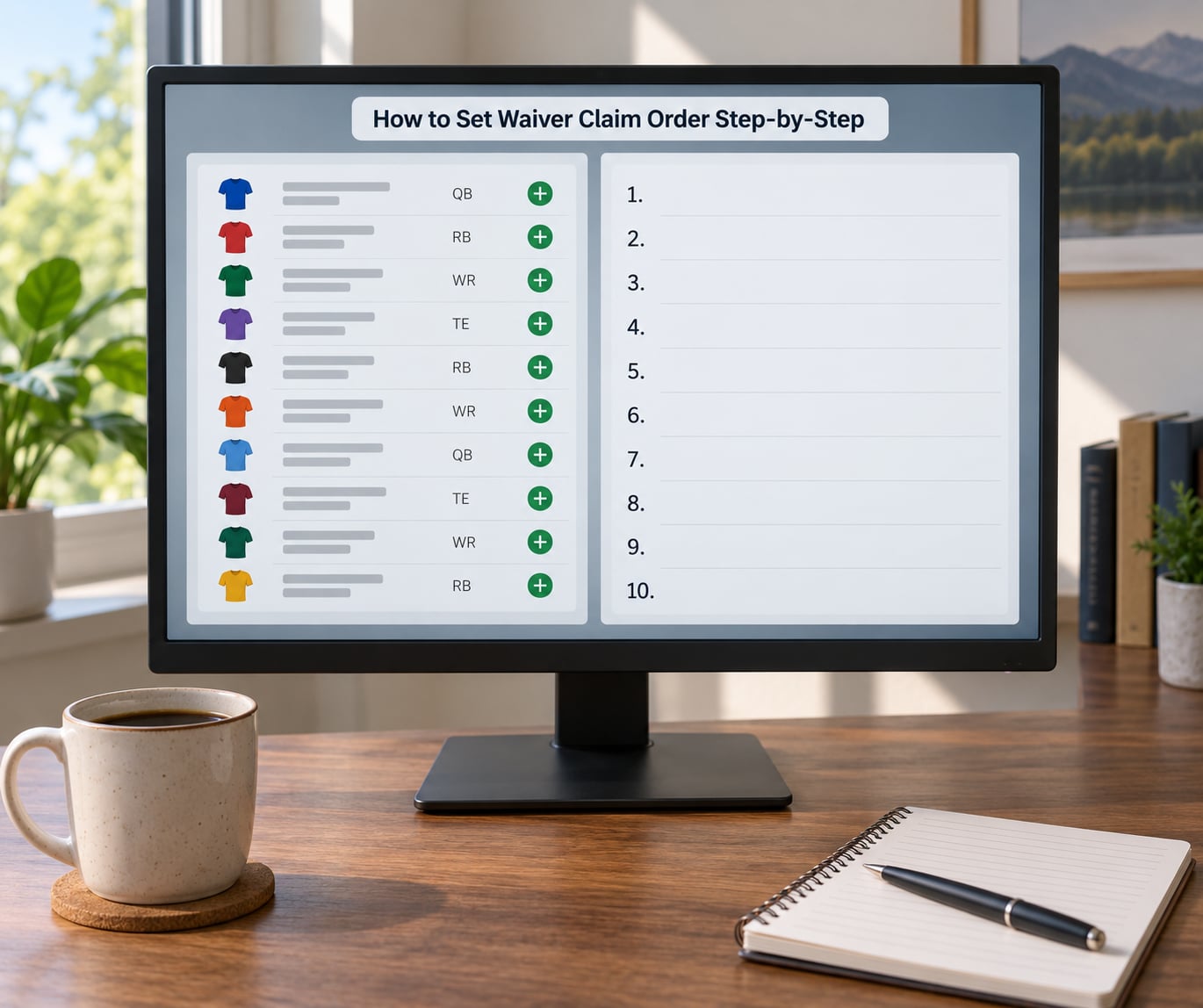
Review Your League Rules and Claim Window
Start by opening the league settings and writing down three things in plain language: how order is determined, what happens to your position after a successful claim, and exactly when claims process.
On ESPN, a manager opens League Manager Tools and works into Acquisition and Waiver Rules, where the waiver type selector sits alongside the waiver period setting. The default there is a continual rolling list, seeded from the reverse of draft order, which means you go to the back of the line every time a claim succeeds. On Sleeper the setting lives under League Settings and the default is FAAB, a blind auction with a starting budget of roughly 100, with claims processed nightly. Yahoo runs its own acquisition rules and processes early Wednesday.
On r/SleeperApp, managers keep asking the same question about their own league settings rather than platform defaults, and the answer is usually the same: the commissioner may have changed it in week three and nobody noticed. If you run the league, this is the moment to check whether the system still matches the league you meant to create.
You have done this step properly when you can name the system and the processing time without opening another screen. Take thirty seconds to confirm whether ties break by standings, by most recent waiver activity, or by draft order, because that decides how close claims get resolved.
Separate Immediate Adds from Speculative Claims
Most claim lists fail because they mix two different jobs in one ranking. An immediate add solves a problem you have right now: your starting running back is out, your tight end slot is empty, your kicker got hurt. A speculative add bets on something that has not happened yet, like a rookie who has not taken a snap or a backup who might start next month.
Put the immediate adds at the top. They are the only claims where the difference between first and second on the list actually matters, because they are claims you intend to win. Then park the speculative names underneath them. Sleeper users describe the same pattern in practice, since adding a player drops you to the back of the queue and you do not want a flyer costing you an injury replacement you needed now.
If a speculative claim needs you to drop someone you would rather keep, attach a conditional drop so the league only processes it when the matching player goes. That keeps your real needs at the front without forcing an unnecessary roster cut.
Rank Players by Fantasy Value and Need
Rank by what the player would produce on your roster, not by how famous he is. Start with the value of the name you are replacing. If you are dropping a borderline running back for a marginally better one, the claim is noise; if you are dropping a nothing player for a starting-caliber receiver, it is a season.
Three questions do most of the work. How many points per game does the replacement level at that position actually give me? How scarce is this position compared to what is sitting in the free agent pool? And does this player improve a starting unit, or just fill a bench spot?
A practical test: if a free agent would give you roughly 80 percent of the production, take the free agent and move on. Positional scarcity is the exception, not the rule. In a 12-team league, the second-string tight end on the wire is worth more than the third-string running back because of how few starting tight ends exist right now.
Then order the list from highest expected marginal value to lowest, and stop. A list of two to four claims is plenty; a list of twelve is a wish, and it slows down every edit you make later.
Adjust the Order for Injury and Opportunity News
News is supposed to adjust your order, not replace it. When a starting quarterback is limited in practice or a back is demoted to third string, move the affected players one or two slots and check whether anyone new just entered the conversation.
The instinct to rebuild the entire list after a single report is exactly what costs managers their spots. A headline that moves a player from fringe to relevant changes one entry, not eight. Re-check the wire once in the morning and once in the evening during the league’s claim window, and treat anything you hear second-hand as a prompt to verify rather than a reason to reorder.
Roster moves deserve the same restraint. A signing to a practice squad may matter in a two-QB league and mean nothing in your 12-team PPR league, so let your roster construction decide how much the news counts.
Check Opposing Rosters and Downstream Players
Before you submit, look at who else might want what you want. If the manager above you in priority already has a claim in for that receiver, your position on the list is a formality, and it might be worth bidding on it in an FAAB league instead.
Also check whether the player you are adding competes with someone you already own. Adding a backup halfback when your starter is already that player’s teammate can quietly damage your ceiling. And check the downstream effect: a claim you make changes what the manager below you should target, which means their behaviour may change your own odds on a later claim this week.
In leagues using reverse standings, expect the teams that are already out of contention to bid hardest on low-upside depth. Knowing that in advance saves you from overvaluing a filler you will never start.
Submit Claims Early and Review the Results
Submit your claims as soon as the list is reasonable rather than in the final minutes of the window. Processing order is decided by priority position, not by when you clicked submit within the period, so there is no advantage to waiting. The only thing you gain by waiting is a chance to talk yourself into a worse player.
When results post, work through them in order. A failed claim costs you nothing, which is the fact most managers get wrong and most forums repeat as a worry. Priority is only spent on a claim that succeeds. If a claim failed because your roster spot was full, add the drop you are willing to live with and resubmit. If it failed because someone above you won the player, decide whether the next name on your list is worth staying on the wire for.
Keep in mind what a success costs you. In a rolling priority league, a successful claim moves you to the back of the queue for the rest of the period, so put one or two insurance claims below your main target rather than a single lonely claim.
Common Mistakes
Ranking by name recognition. The most-talked-about player is not automatically the best add. Sort by expected value against your own replacement level instead.
Assuming the platform default applies to your league. Commissioners change waiver types, periods, and claim limits, sometimes years in. Read your league’s settings, not the platform’s help page.
Stacking one position at the top. Filling your list with tight ends because they are scarce leaves you exposed if two go on the wire at once. Spread your top three across positions.
Ignoring how ties break. If several managers claim the same player and two end up tied, the tiebreaker decides it. Know whether yours runs on standings, draft order, or recent waiver activity before you bid.
Saving everything for the last hour. Managers often end up filing a claim after the deadline has passed, then assuming they lost priority. Check the processing time, not just the deadline.
Believing a failed claim hurt you. It did not. Resubmit and move on.
Tips for Maintaining Your Order Throughout the Week
Rebuild the list at two fixed moments: once right after the injury reports and again in the morning your claims process. That is usually enough. Continuous reordering produces a list optimised for noise.
After your fantasy games resolve, check what the box scores revealed. A team that ran the ball 40 times to one back is a real signal, and it is the kind of thing that outlasts a single news headline.
During the playoffs, keep claiming even if you are eliminated, because roster spots stay open and your league settings may still process waivers. Off-season and dynasty leagues behave differently again: managers on r/DynastyFF note that priority is typically seeded from the most recent draft order rather than from last season’s standings, so check with your commissioner before assuming your queue position carried over.
If you are a commissioner, changing the waiver type mid-season is usually possible but will scramble everyone’s expectations. Announce it before the next claim window, not during it.
Frequently Asked Questions
How do I set waiver claim order in fantasy football?
Open your league’s waiver page, add the players you want to your claim list, then drag each one into the position you want it to hold, from your top target down to your filler. On ESPN the list lives on the waivers page and the rules behind it are in League Manager Tools under Acquisition and Waiver Rules. Submit before the waiver period closes, then review results the next morning.
Should I put my best player first on the waiver wire?
Rank by expected value on your roster, not by talent or fame. The right number one is the claim that fixes a real hole or replaces an injury you already know about. A bigger name sitting further down your list is fine as long as you are honest that you would take him second. Two to four ranked claims is plenty, and keeping the speculative ones low protects the urgent ones.
Does waiver claim order determine who gets a player first?
Only in priority leagues. In a rolling or reset priority system, whoever sits highest on the waiver order when claims process gets the player. In an FAAB league, your claim order is ignored and the highest blind bid wins, with ties broken by the league’s tiebreaker setting. Some leagues run both, so confirm which system your commissioner selected before you build a list.
How often should I update my waiver claim order?
Twice a week is plenty for most managers: once after the injury reports and once in the morning your claims process. Update any time news genuinely changes the value of a specific player, such as a starter being ruled out or a back moving down the depth chart. Rebuilding the whole list after every rumor is the habit that costs people their best claims.
Should I drop a player to make a waiver claim?
Drop only what the add is worth. Work out what the incoming player would have produced against what your outgoing player actually produces on your roster, and drop the weaker one. If you are not willing to lose the outgoing player in a straight swap, use a conditional drop instead so the add only processes if the matching player is dropped.
What happens if two managers claim the same free agent?
An undrafted free agent goes to the first manager who adds them, usually instantly, with no queue involved. If two managers claim the same dropped player on the waiver wire, the league resolves it by waiver priority in a priority league or by bid in an FAAB league. If everything ties, your league’s tiebreaker setting decides, so it is worth knowing which one your commissioner chose.
Conclusion
Knowing how to set waiver claim order is less about dragging names around and more about the three decisions before you touch the list. Check your league’s waiver type, claim window, and tiebreaker, because a well-ranked list is worthless under the wrong system. Then put the injury replacement and the empty roster spot at the top, rank everything else by what it would actually add, and submit before the window closes so a failed claim costs you nothing.