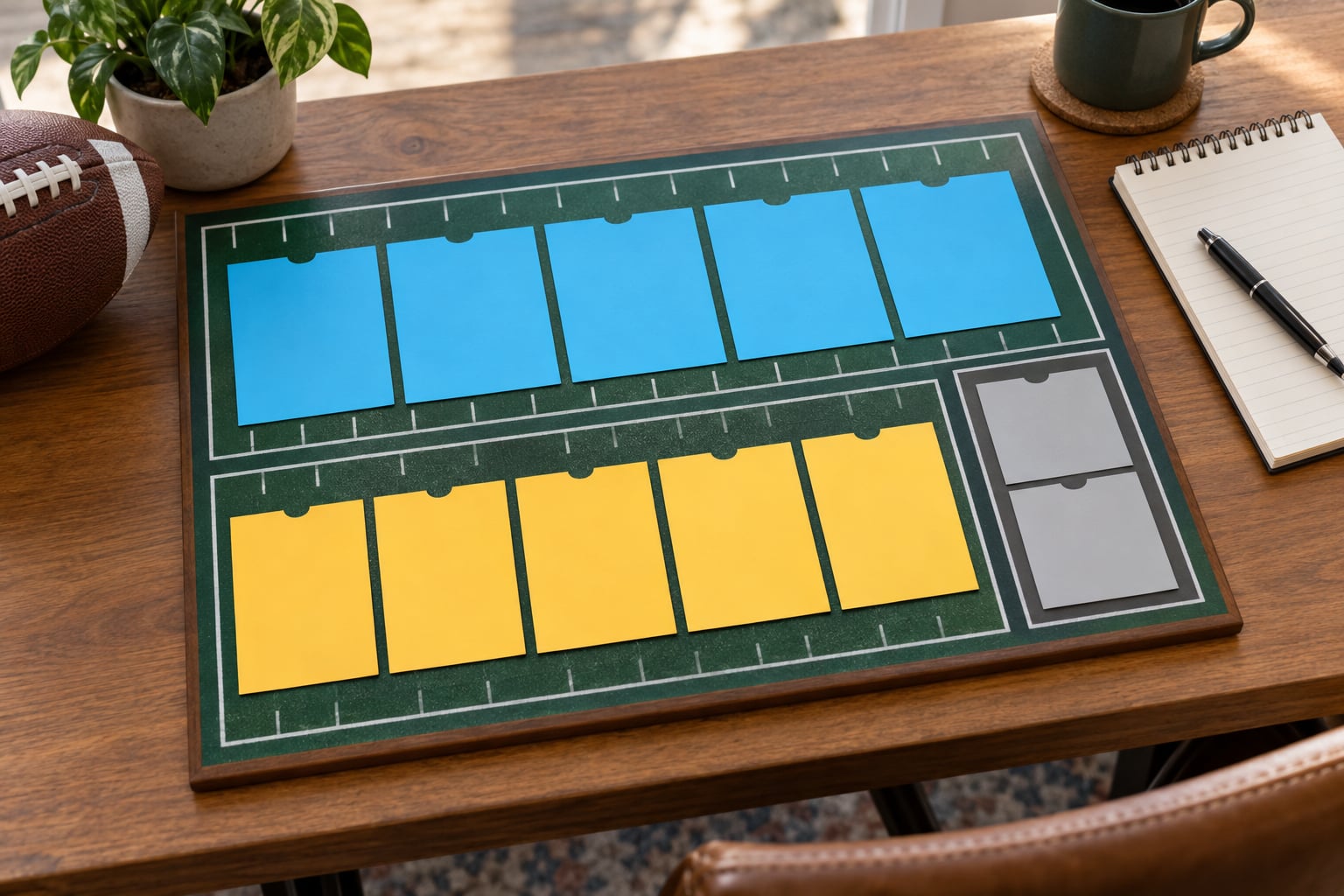
Most managers land on five to seven bench spots. For a standard 12-team redraft league, six bench spots plus one or two IR slots is the range that works, while eight-team leagues usually need five and superflex or dynasty formats want far more. The number that matters most, though, is the one your platform and your commissioner actually allow.
There is no magic number here, and anyone telling you there is has not run a league with a thin waiver wire. Bench size is a consequence of your starter count, your format and how often you expect to need a replacement player. Get those three right and the answer falls out pretty quickly.
Last reviewed for the 2026 season, this guide breaks the answer down by league size, format and scoring, then gives you a five-step framework for picking your own number.
Table of Contents
- How Many Bench Spots Should a Fantasy Team Have?
- How many bench spots should a 12-team redraft league have?
- What counts as a short bench?
- How many bench spots is too many?
- What Is a Bench Spot in Fantasy Football?
- How Many Bench Spots Do Common League Formats Use?
- How Many Bench Spots Should a Fantasy Team Have by League Format?
- What Changes the Ideal Bench Size?
- How to Choose the Right Bench Size for Your League
- Bench Size, IR, and Taxi Squad: What Is the Difference?
- Should You Fill Every Bench Spot?
- Frequently Asked Questions
- What is the average number of bench spots in fantasy football?
- How many bench spots for a 10-man league?
- Does the bench count in fantasy football?
- Which positions should I fill my bench with?
- Is 7 bench spots too many?
- What does 80% roster mean in fantasy settings?
- Conclusion
How Many Bench Spots Should a Fantasy Team Have?
For most people the answer is six. That covers bye weeks, one bad injury, and one speculative stash without turning your roster into a parking lot. Small leagues can get away with five, big redraft leagues usually want six or seven, and anything with superflex slots or a dynasty format should go much deeper.
How many bench spots should a 12-team redraft league have?
Six, plus one or two IR slots. That is the setting most competitive 12-team redraft leagues land on, and it lines up with the roster maths: nine starters, six bench, two IR, seventeen total spots.
What counts as a short bench?
Six or fewer. That is the working industry definition of a shallow roster, and it is a useful line because short-bench leagues play differently. You cannot afford to carry a player who starts once every three weeks, and your waiver claims have to be sharper.
How many bench spots is too many?
Seven in a redraft league is where hoarding tends to start. A manager running a 10-team PPR league with seven bench slots and one IR concluded that seven was too many, because the league filled with three tight ends and three quarterbacks stashed purely to keep them off the wire.
What Is a Bench Spot in Fantasy Football?
A bench spot is a roster position outside your starting lineup. The player on it does not score, but once a week you can swap him in for any starter without dropping anyone. That substitution rule is the whole reason benches exist.
Some platforms also let you add a free agent to your bench and start him directly, which softens the difference between a bench spot and an IR spot in practice. Check your settings before you build a strategy around it.
From there, separate four things people constantly mix up:
- Bench spots hold healthy players you can insert into your lineup.
- IR slots hold injured players who cannot be started until they pass a time gate.
- Reserve or taxi slots are used mainly by dynasty leagues to hold rookies blocked from starting.
- Practice squad is a dynasty-only holding area that carries no lineup weight at all.
Bench spots add directly to your total roster size. Five bench spots on a nine-starter lineup gives you fourteen players, and every one of them is drafted by your league mates too.
How Many Bench Spots Do Common League Formats Use?
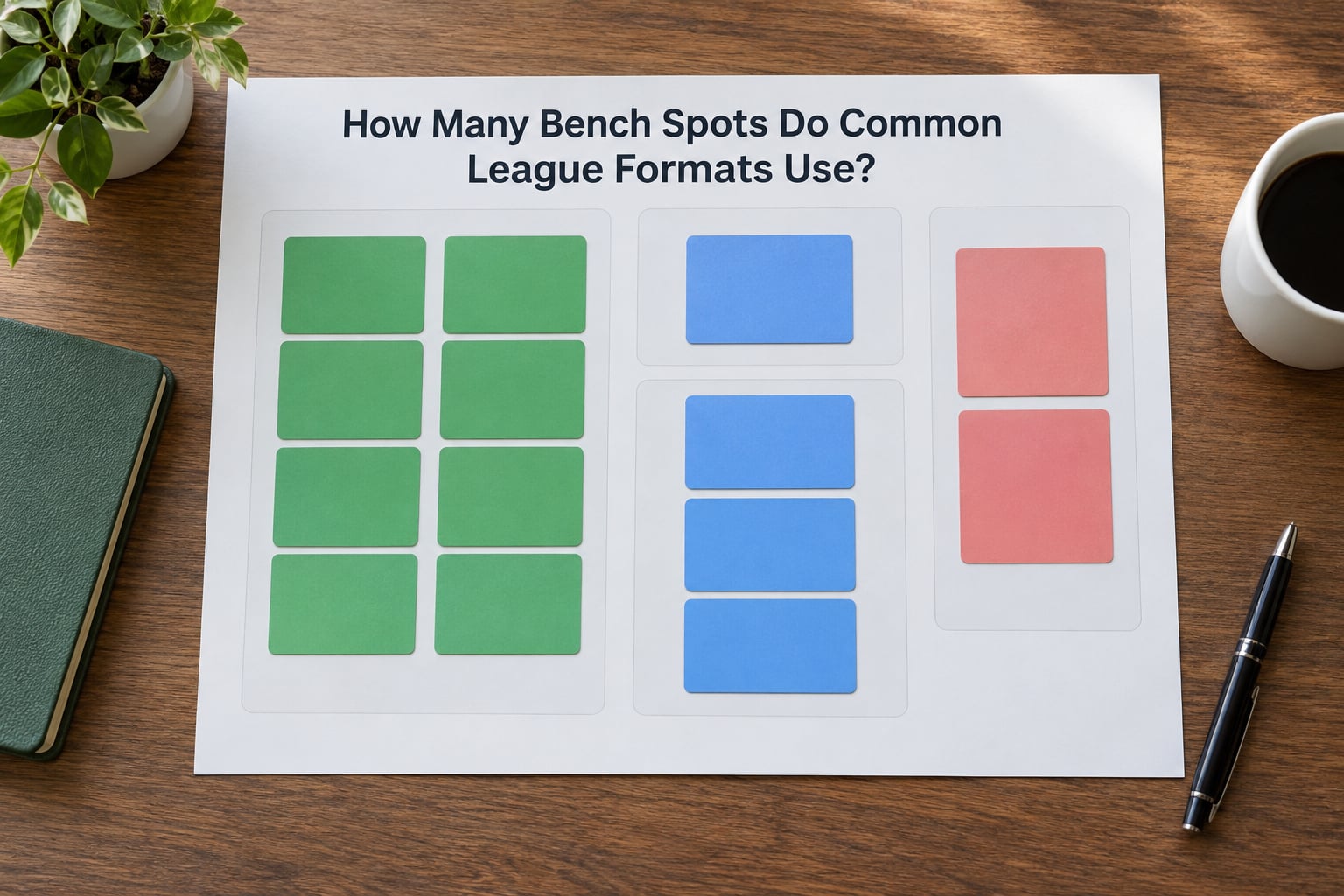
Formats differ more than most guides admit. A short-season awards league and a super dynasty league cannot share a bench setting, and copying a number from a league that plays a different game is the most common settings mistake I see.
| Format | Typical bench spots | Who it suits |
|---|---|---|
| 9-player mature or awards league | 4-5 | Casual and celebrity leagues with few managers and short seasons |
| 10-player redraft | 5-6 | Friends leagues with tight drafts and a healthy wire |
| 12-player redraft | 6 | The competitive standard, in PPR or standard scoring |
| 14-player redraft | 6-7 | Leagues where injuries and waiver pickups drive standings |
| 16-player redraft | 5-6 | Wide leagues where an overbuilt roster slows every draft |
| Superflex or 2QB redraft | 8-10 | Leagues needing a real backup at every starter type |
| Dynasty startup | 10-14 | Multi-year rosters built from rookies and young upside |
| Super dynasty startup | 14+ | Long rebuilds that hoard prospects for years |
Dynasty sits in a different universe because the roster has to hold developing players, not just replacements. One startup dynasty manager runs 14 bench, eight IR and five taxi spots, and notes that most leagues keep total roster spots somewhere between two and three times the number of starting slots.
Others disagree sharply. Sleeper dynasty users routinely say ten bench spots is too short for a start-20 league. That spread is normal, and it usually comes down to whether your commissioner expects rookies to be held for years or rotated out.
How Many Bench Spots Should a Fantasy Team Have by League Format?
Scale the bench to the number of teams, then adjust for format. More teams means a longer draft, more players off the board and a thinner waiver wire, so a bigger league needs a deeper bench to cover the same injury risk.
| Teams | Starters | Bench spots | IR spots | Total roster spots |
|---|---|---|---|---|
| 8 | 9 | 5 | 2 | 16 |
| 10 | 9 | 5-6 | 2 | 16-17 |
| 12 | 9 | 6 | 2 | 17 |
| 14 | 9 | 7 | 2 | 18 |
| 16 | 9 | 5-6 | 2 | 16-17 |
League size itself matters less than people think, though. Eight is often considered too small to be interesting, and sixteen is widely described as miserable, with twelve named the sweet spot by most of the manager community. Whatever you land on, the roster maths has to work: nine starters across twelve teams is 108 starting slots, which a 16-round snake draft covers comfortably.
Scoring changes what a bench spot is worth, not how many you need. In PPR, a benched running back is a real weekly threat, so a spot spent on an upside RB has genuine value. In standard scoring, a quarterback goes six weeks without a start, which makes a bench spot tied to one position a waste.
Two more formats deserve their own answer. Best ball leagues use auto-lineups, so bench spots barely matter; you need IR and taxi slots for your drafted prospects, not bench depth. Keeper leagues need one extra slot per keeper, so a 12-team keeper league with three returns usually sits at seven bench spots.
What Changes the Ideal Bench Size?
Starter count is the biggest lever. Each distinct starting position is a separate injury risk, and the standard nine-slot lineup has roughly nine positions worth of coverage, which is where the five-to-seven range comes from.
Flex and superflex slots add more. A superflex starter lineup needs a genuine backup at quarterback and at every other position, which is why those leagues jump to eight through ten bench spots.
Scoring format matters less than people claim but not zero. PPR makes bench players more interesting because receiving work shows up in weekly output. Standard scoring rewards depth at running back and wide receiver and punishes a third tight end.
Waiver activity is the underrated factor. In deep redraft leagues, replacement-level players go quickly, so a shallow bench leaves you scrambling. In 8-team leagues the wire stays fat all season, so extra bench spots add little.
Injury volatility is the other big one. A league with a strong injury report at running back rewards two backup RBs over one QB3. If your league is full of reliable oldies, you can cut a bench spot and put the roster spot toward a starter.
Finally, consider how competitive the league is. In a league with drop-heavy managers, keeping more players on your roster protects you from a Thursday pickup. In a patient league, roster spots wasted on low-owned fliers are a drag.
How to Choose the Right Bench Size for Your League
Start by counting the distinct starter positions, not the starters themselves. A 1QB, 2RB, 2WR, 1TE lineup has five distinct types, which points to a bench of five as a floor. Add one for flex, and you land at six.
Next, count how many substitutions you realistically make in a season. Two injury replacements plus a bye week covers roughly three to four changes, and any bench spot beyond that is for upside, not survival.
Then estimate waiver demand. Multiply your starter count by your team count and you have the number of league-wide starting slots; if your draft already exhausted that pool early, deep benches pay off. If not, they do not.
After that, decide how much speculative stock you want to hold. Two upside players is a normal ceiling in redraft. Anything past that tends to turn into hoarding, and the league notices.
Finally, pick the smallest bench that covers your needs. A short bench is a feature, not a compromise, as long as you know which player you are dropping when it bites.
Bench Size, IR, and Taxi Squad: What Is the Difference?
This is the most-asked question in the manager forums and almost nobody answers it cleanly. Bench spots hold active players you can start. IR slots hold injured players you cannot start until the league’s time gate passes. Taxi slots hold rookies blocked from a starting job. They are not interchangeable.
The common mistake is treating an IR slot as a general-purpose replacement spot. Once you park a player on IR, most platforms will not let you start him even if he returns early, so that spot gives you nothing during the weeks you most want flexibility.
Two IR spots alongside a six-slot bench is a common setup, and commissioners in r/FFCommish report anything from four or five bench plus two IR up to seven bench in the same thread. There is no consensus because there is no right answer, only trade-offs.
For dynasty, add taxi squad slots on top. Most platforms require a minimum number, commonly two to five, and they exist so your blocked rookies are not wasted.
Should You Fill Every Bench Spot?
Usually yes, but not always with the same player. A filled bench is better than an empty one because it gives you optionality, and you can always drop a bad pick later in the week.
Priority one is the handcuff of your lead back. When a workhorse goes down, the backup usually takes that volume immediately, and in redraft leagues that single pickup decides a playoff matchup.
Priority two is a cheap breakout at a position you start two of. A fourth-round wide receiver with a clear route to the WR1 role is a better use of a slot than a third tight end.
Priority three is a low-owned player you would happily start. If ten percent of your league has him, the waiver priority ordering will hand him to you and you will feel clever.
Backup quarterbacks and third tight ends are where benches get wasted. Hold one backup QB if your starter could lose his job or miss multiple weeks. Otherwise, that spot is a luxury.
Leaving slots empty is reasonable in volatile redraft leagues where you plan to rotate weekly. The trade is real, though: every empty spot is a player someone else gets first.
Frequently Asked Questions
What is the average number of bench spots in fantasy football?
Most leagues run five to seven bench spots. Six is the common choice for a 12-team redraft league, five works well in 8- and 10-team leagues, and 14-team or superflex formats often go to seven or more. Platform defaults vary, so check your league settings rather than assuming a standard.
How many bench spots for a 10-man league?
Five bench spots plus one or two IR slots covers a 10-team league well. You need enough room for bye replacements and one injury, and your waiver wire stays deep enough that you can fill gaps during the week. Six is fine if you like holding upside players, but seven tends to invite hoarding.
Does the bench count in fantasy football?
It depends on the platform, so read your league settings. Some let you add a free agent directly to your bench and start him, which makes bench and IR behave almost the same. Others require every player to live on your roster first. The bench never scores points on its own, whatever the rules allow you to do with it.
Which positions should I fill my bench with?
Start with the handcuff of your lead running back, then add a cheap breakout at a position you start twice. Add a low-owned player you would happily start, and hold one backup quarterback if your starter is a risk. A third tight end is usually the first thing to cut.
Is 7 bench spots too many?
In a redraft league, often yes. Seven bench slots in a 10-team PPR league pushed managers toward stacking three tight ends and three quarterbacks just to block opponents, which one league owner called out as too deep. Six keeps the draft fast and the wire honest, though dynasty and superflex leagues justify more.
What does 80% roster mean in fantasy settings?
It means your total roster size is 80 percent of the number of teams multiplied by your total roster spots, a setting used to keep league rosters in proportion. It matters for bench size because it caps how many players the league can hold, which changes how deep the waiver wire runs.
Conclusion
Check your platform’s roster limits first, since those set the range you can actually choose from. Then pick the smallest bench that covers your league’s waiver depth, injury risk and player-development plans: five for small leagues, six for a 12-team redraft, seven or more for big or superflex formats, and ten-plus for dynasty. A tight bench you actively manage beats a deep one you fill with players you never look at.