To monitor beat reporters for injury news, you build a private list of the reporters who cover your teams, turn on alerts for your players’ names, and check in during the fixed windows when practice and game status reports drop. Treat every post as an early signal, then confirm it against the official team report before you change a lineup. Most managers get this backwards: they react to the fastest rumor instead of the most reliable one.
That inversion is why injury news feels chaotic. Forty reporters cover the same two backs, each with a different certainty level, and the official designation that actually matters doesn’t arrive until the day before kickoff. The fix is not more sources. It’s a smaller number of sources, watched on a schedule, with a way to record what you decided and why.
This guide sets up that system, updated for 2026. It takes about an hour to build and about ten minutes a day to run.
Table of Contents
- What You Need
- Step-by-Step: How to Monitor Beat Reporters for Injury News
- 1. Build a trusted beat reporter watchlist
- 2. Set alerts for injury-related terms
- 3. Check official team updates first
- 4. Read the context of each report
- 5. Verify the player, practice, and game-status layers
- 6. Record the update and adjust your fantasy plan
- Common Mistakes
- Frequently Asked Questions
- How often should I check beat reporter updates?
- Which sources are most reliable for NFL injury news?
- Should I trust a beat reporter over the official injury report?
- What do practice participation designations mean for fantasy lineups?
- What should I do when two beat reporters conflict?
- Conclusion
What You Need
The tools are unglamorous. Five pieces get you from scattered feeds to a defensible lineup decision.
- A private list on X or Bluesky built around the teams your league actually cares about. A private list beats following everyone, because following everyone is the same as following no one.
- Keyword alerts for the players who decide your weekly lineup, plus generic injury terms. Alerts do the watching so you can batch-check instead of scrolling.
- The official team and league channels as your confirmation layer: the team’s injury report designation, the coach’s availability comments at the press conference, and the league’s official game status report.
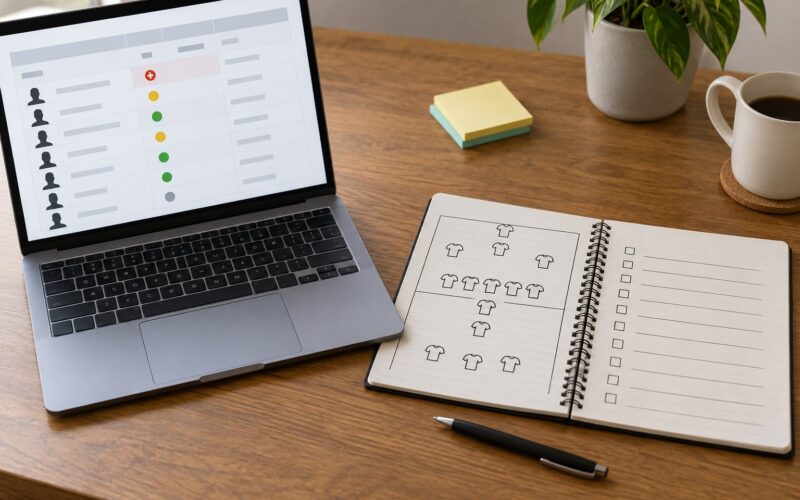
- A log — a note, a spreadsheet, a shared league note, whatever you’ll actually open on your phone. Source, time, certainty, expected status, action.
- One aggregator for the second read. A fantasy news roundup after practice tells you what other managers already saw. It’s a cross-check, never your primary source.
That last point matters. Roundups are fast, but they recycle. Forum users in r/NFLNoobs describe reporters posting on social platforms as the primary real-time channel, and a recurring community habit there is cross-checking claims because rumor runs ahead of confirmation. Speed first, then verification.
Step-by-Step: How to Monitor Beat Reporters for Injury News
1. Build a trusted beat reporter watchlist
Start with the teams that can actually change your week. For each one, add the reporter assigned to that team full time, since a beat reporter attends practice, travels with the team and talks to players and coaches daily. Then add one or two national reporters with a track record on injuries and roster moves, and skip every account that reposts without sourcing.
Organize the list by team, not by fame. A list where all 32 teams sit side by side is a feed you will scroll past. A list for “the four teams in my starting lineup plus my two waiver targets” is short enough to read in four minutes.
2. Set alerts for injury-related terms
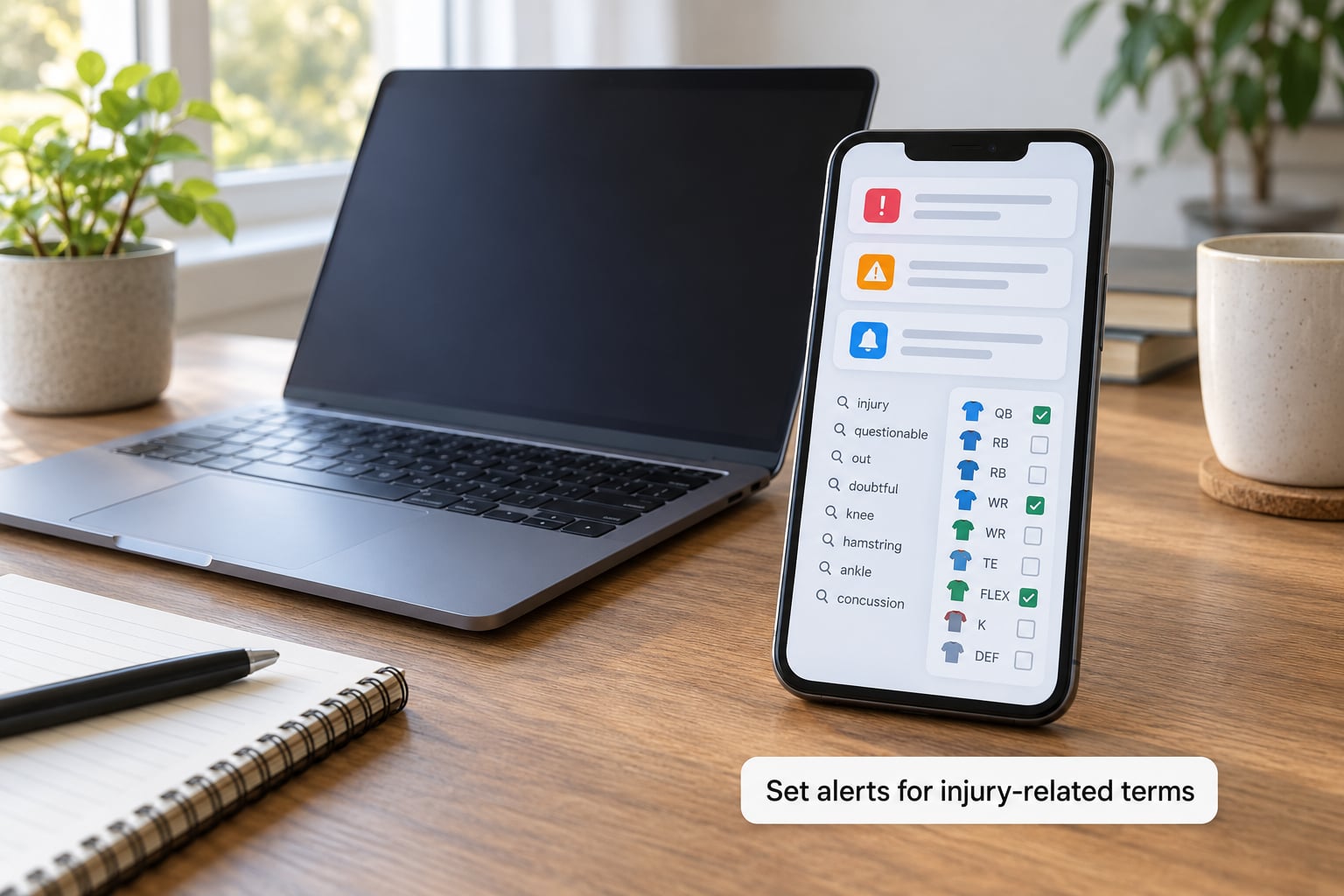
Alerts work best when they’re narrow. Set one per player on your start/sit board using their full name, plus team terms and the words that signal a status change: ruled out, out for the season, IR, PUP, cleared to practice, limited, full participation, questionable, doubtful, active.
Then set the quiet hours. League-scouting posts at 11 p.m. don’t change your lineup. Turning off notifications between your sleep and your first morning check is what keeps the system usable in week nine, not week two.
One warning about alert hygiene: alerts are a first-pass filter, not a conclusion. If your alert volume makes you want to throw your phone, you’ve set too many, and every alert you ignore teaches you to ignore alerts.
3. Check official team updates first
Once a reporter post gets your attention, the order of verification is fixed. Check practice participation first, because a designation of DNP, LP or FP is the league’s own accounting of what a player actually did. Then check team statements and coach comments, which often explain the mechanism of injury. Then check availability at the press conference, which usually arrives the afternoon before an early game. The official game status report is the last layer, not the first.
Reporters work ahead of that timeline on purpose. Their value is the hours between a practice session and a published designation.
4. Read the context of each report
The words in a post tell you how much weight it carries. Read the verb before you read the headline.
- “Has been seen” or “was on the field” — observed fact. High confidence, usually from practice.
- “Is expected to” or “should be good to go” — an informed expectation, not a confirmation. Adjust, don’t react.
- “Hopes to” or “could play” — the reporter is relaying a player’s ambition. Treat it as an intention, not a status.
- “I’m told” or “sources say” — sourced but unconfirmed. Look for a second independent reporter before you act.
- “Uncertain” or “being evaluated” — an MRI, a second opinion, a decision that hasn’t been made. Check back, don’t guess.
The same word can hide two different meanings. “Limited” in a practice report is a designation; “limited” in a tweet is a description. Only the first one is official.
5. Verify the player, practice, and game-status layers
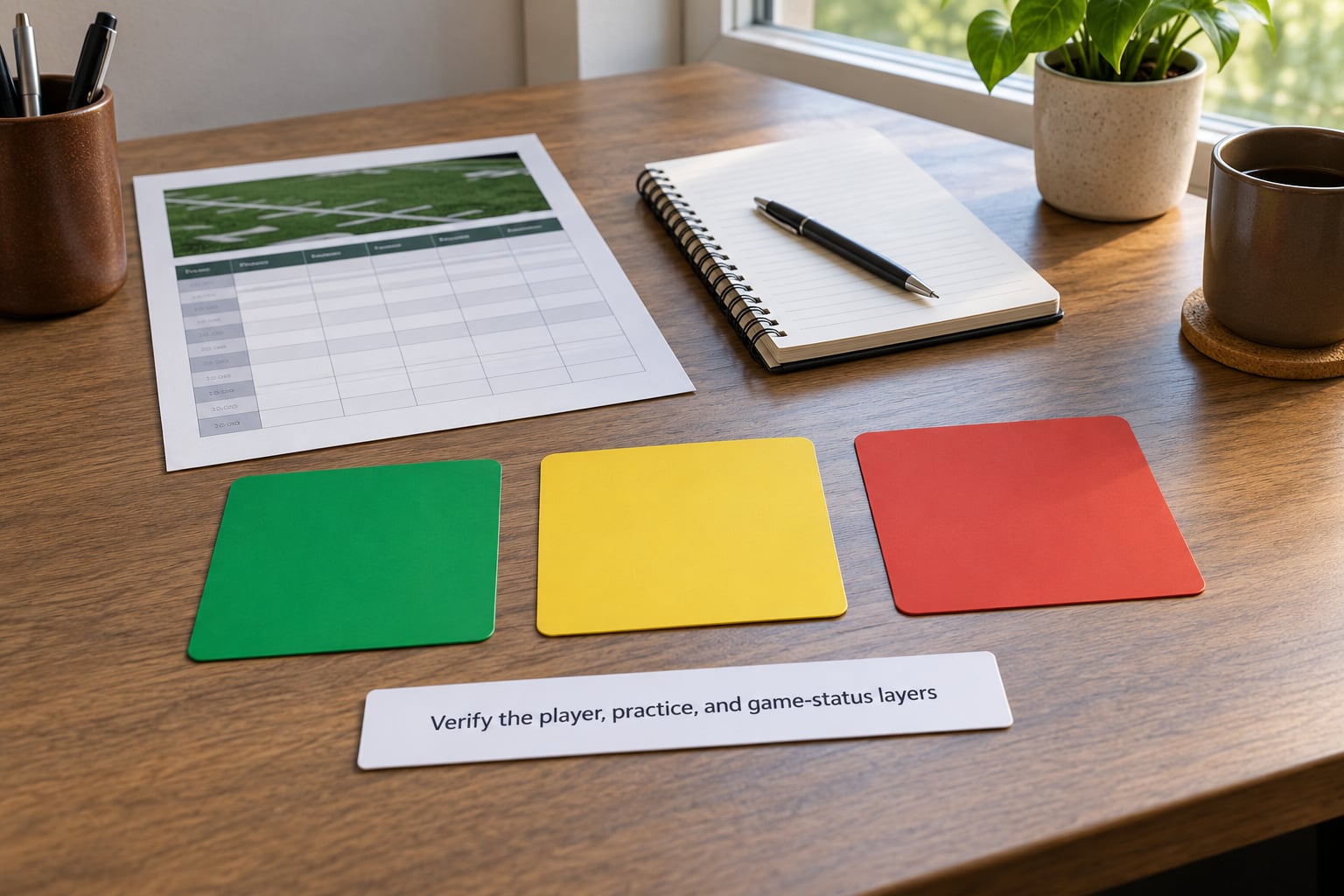
Split every update into three separate checks. First, is the player actually hurt, and is it new or a continuation? Second, what changed in practice participation? Third, is he expected to be active for your game? Most bad decisions come from skipping straight to the third question.
| Designation | What it means | Fantasy read |
|---|---|---|
| DNP | Did not participate in practice at all | Treat as concerning until a report explains it |
| LP | Limited participation | Playable in most cases, not a downgrade |
| FP | Full participation | Green light barring a new report |
| Out | Ruled out of the game | Plan the replacement now |
| Doubtful | Less likely than not to play | Bench in standard lineups |
| Questionable | 50-50 chance of playing | Check your matchup and replacement |
Use that 50% line as a working rule for Questionable versus Doubtful. It’s a habit of thumb, not a guarantee, but it stops you from stashing a doubtful player and hoping.
6. Record the update and adjust your fantasy plan
Write five things down: the reporter, the time, what was actually observed, the expected status, and what you decided to do about it. That’s it. Thirty seconds per update.
The log is what stops you from re-litigating a decision on Thursday night because a retweet suggested a second opinion was being sought. It also gives you a track record, so in week 12 you know which reporters have been right for your teams this season.
Then translate: a downgrade on a starter becomes a bench-and-stream decision, a downgrade on a borderline flex becomes a waiver target the moment he clears protocols, and an injury to a low-information player means your next read is now his backup.
Common Mistakes
Almost every bad lineup call traces back to one of these five.
Treating every post as final. A reporter describing what they saw at practice is doing a job, not issuing a ruling. Wait for the designation before you bench a starter two days early.
Ignoring official confirmation entirely. The official report can contradict a reporter hours later, because players get cleared, restricted or ruled out after observation. Whichever way you read it, the league’s report wins ties.
Reading LP as healthy and DNP as season-ending. LP is routine and often favorable. DNP is routinely a rest day for a veteran, a personal day, or a scheduled non-participation under the rules, and not always an injury at all. Look for an explanation in the report before you react.
Chasing speculation from accounts that repost other accounts. Forum posters repeatedly ask how to verify what they’ve seen. A post with no named source, no team context and no observation is not information. Two independent reporters agreeing is a signal; one anonymous account is noise.
Failing to record the time and source. Without a timestamp, an old post looks like breaking news. This is the single cheapest habit to build and it prevents most of the rework.
A few tips that tie it together. Check in at fixed windows rather than continuously: after Wednesday, Thursday and Friday practice, then the day-before game status report, then a short sweep Sunday morning for scratches. Cross-reference rather than scroll — two reporters on one team beat ten reporters on teams you don’t roster. And give unofficial listings a hard look before you accept them, because a player can appear on an injury list for reasons that have nothing to do with a new injury.
Frequently Asked Questions
How often should I check beat reporter updates?
Four or five times a week in the NFL season is enough: after Wednesday, Thursday and Friday practice, once when the official game status report drops the day before a game, and once Sunday morning for late scratches. Continuous monitoring makes you slower, not faster, because most posts do not change a decision.
Which sources are most reliable for NFL injury news?
Start with the reporters assigned full time to the teams you roster, then add one or two national reporters with a strong injury and roster track record. Confirm both against the official practice participation report and the coach’s availability comments. Aggregators and roundup sites are useful as a second read, since they recycle older posts.
Should I trust a beat reporter over the official injury report?
No. Reporters are usually earlier and more detailed, but the official report is the league’s ruling and it can change after a post goes out. Use a reporter post as your leading indicator, then let the official designation and game status make the final call for your lineup.
What do practice participation designations mean for fantasy lineups?
DNP means the player did not practice, which is concerning until explained. LP means limited work and is usually still playable. FP means full participation and is a green light. On the game status side, Out means bench and replace, Doubtful means bench in most formats, and Questionable is roughly a 50-50 call worth checking against your matchup.
What should I do when two beat reporters conflict?
Check which one actually observed practice and which one is relaying a source, then wait for the official designation rather than picking a side. If both are on the same team and both are qualified, the conflict usually resolves within hours. Log the conflict and your reasoning so the pattern is obvious later.
Conclusion
Start with one action: build the private list for the teams in your starting lineup and add alerts for those players’ names tonight. From there, check in after practice, read the reporter’s verb before the headline, confirm against the official designation, and write down what you decided. The managers who win on injury news aren’t the ones who saw it first. They’re the ones who acted on it once, at the right time.