A concussion diagnosis in the NFL does not come with a fixed penalty on your fantasy team. It puts the player into a staged return-to-play process where he can practice, then go full contact, then still miss a game, and the schedule moves at the pace of his symptoms and the independent neurologist’s sign-off.
Because of that, a diagnosed concussion creates three separate questions: is he on the field this week, will he be limited in practice, and if he plays, will his role be the same. Those get answered at different points in the week, from different sources, and usually not all of them.
The part that trips people up is that “he practiced” is not a clearance. A player can take part in a full practice wearing a shell, run every play, and still be ruled inactive ninety minutes before kickoff. Managers who build a lineup around the first optimistic report are the ones who end up with a zero.
Table of Contents
- What Concussion Protocol Means for Fantasy Football Players
- How Each Concussion Protocol Step Affects Lineup Decisions
- How Concussion Protocol Affects Fantasy Projections at Each Stage
- What the Five-Day and Seven-Day Rules Do and Do Not Mean
- How the Designation Changes Your Fantasy Lineup
- How to Plan Replacement Options by Position
- Quarterback
- Running back
- Wide receiver
- Tight end
- Kicker
- When to Trust Reports, Confirmations and Final Active Lists
- How to Manage Dynasty and Keeper Leagues During an Absence
- Frequently Asked Questions
- Should I drop a fantasy football player immediately after a concussion?
- How long should I expect an NFL player with a concussion to be unavailable?
- Can a fantasy football player return to the lineup on limited practice participation?
- Which position is most affected when a fantasy football starter misses time?
- Should I stash a backup player after a concussion in a dynasty league?
- Conclusion
What Concussion Protocol Means for Fantasy Football Players
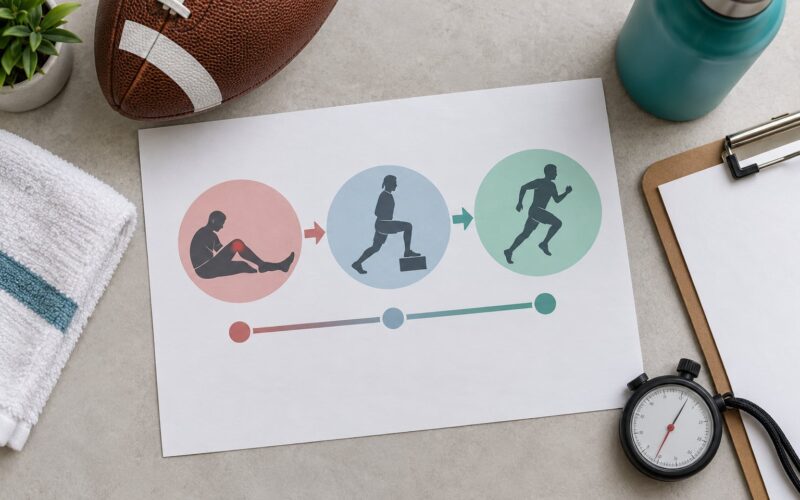
In the simplest terms, concussion protocol makes a player unavailable for a variable stretch of games, then returns him gradually, then lets him back in once medical staff and the league’s independent neurological consultant sign off. The NFL structure is a five-phase progression: symptom-limited activity, aerobic exercise, football-specific exercise, non-contact participation, and full contact. A player cannot skip ahead, and each step requires being symptom-free while completing the previous one.
What that means for your lineup is that availability moves in stages rather than switching on and off. There are three statuses worth separating in your own notes.
Out for the week. The player was not in the active roster or the inactive list math clearly means he will not play. Plan around it.
Uncertain participation. He may show up for practice in a limited or non-contact capacity, which tells you very little about Sunday. These are the designations that appear on injury reports Wednesday through Friday, and they are about practice, not the game.
Active with an unclear role. This is the one people forget. A player can be fully cleared and still be a low-volume option because another healthy player took the snaps while he was out.
So the designation is the first layer. Underneath it sit two separate questions that fantasy managers routinely blend together: will he play, and how much will he be used if he does.
How Each Concussion Protocol Step Affects Lineup Decisions
Each step in the process changes your information, and each one changes a different part of your decision. The early phases tell you he is out. The middle phases tell you he is close. The last phase tells you the deadline, but only for the following week.
When a player is pulled from a game, the priority is the sideline evaluation, often in the blue tent, plus removal from the game. He is out that week by definition. The next stretch is the quiet one: rest, medical evaluation and neurocognitive testing. No practice participation, no fantasy value. This is where most of the calendar time actually goes, and it is the phase nobody reports on, which is why managers hear nothing for several days.
The graded exertion steps follow. Early symptom-limited activity, then aerobic exercise, then football-specific exercise. These are still not contact work, so they stay off the fantasy radar. When you start seeing non-contact participation in a practice report, you are at the club-based non-contact stage and the calendar is inside a typical week.
Full contact practice, then final clearance, is the last gate. Once he is cleared for contact and takes full reps in a live practice, the realistic ceiling for the return is the next game week, not the current one, because clearance late in the week means no meaningful practice availability before Sunday.
How Concussion Protocol Affects Fantasy Projections at Each Stage
Timelines below are the shortest realistic path, not a promise. Symptoms, recurrence, position and individual recovery all change the schedule, and any single stage can repeat.
| Protocol stage | Typical player status | Fantasy effect | Manager response |
|---|---|---|---|
| Identification and sideline evaluation | Removed from the game, out for the week | Zero projection for that week | Bench immediately, identify the replacement path |
| Rest and medical evaluation | No participation, limited reporting | Still zero, timeline unknown | Set a news alert, keep him on the roster |
| Phase 1 to 2, symptom-limited and aerobic activity | No contact work, rarely reported | Zero for at least the coming week | Stop projecting a return week |
| Phase 3, football-specific exercise | Individual work, no team practice | Low, at least one more week out | Check the depth chart for who filled in |
| Phase 4, non-contact participation | Listed limited or DNP in reports | Possible return the following week | Prepare both the start and the replacement |
| Phase 5, full contact and clearance | Full practice participation | Restorable, with role questions | Confirm role before restoring the projection |
What the Five-Day and Seven-Day Rules Do and Do Not Mean
Those waiting periods are minimums, not return dates. They set the earliest point at which a diagnosed player can be allowed back on the field for evaluation, with a longer hold applied when the situation is more serious, such as a player held for observation rather than walking off on his own. That difference is the entire practical content of the rule.
A five-day hold and a seven-day hold both mean the player will not be a starting option in the game immediately after the diagnosis. A longer hold shifts your replacement plan forward by a week and often another, which is the practical difference that matters for waiver claims.
What the waiting periods do not do is decide the outcome. A player can clear every step and still be held, and a player who has served the minimum can take longer if symptoms return at any stage. Managers who treat the number as a countdown usually get disappointed on a Saturday afternoon, which is the worst possible time to learn it.
If you want a concrete comparison, footballguys.com forum threads have owners describing quarterbacks held late in the week and forcing last-minute roster swaps. That pattern repeats because the medical schedule and the fantasy schedule run on different clocks.
How the Designation Changes Your Fantasy Lineup
Designations tell you practice availability, not game availability, and most injury-report drama comes from that gap. A player listed as limited on Friday did everything he was medically permitted to do, which may have been nothing more than individual route work.
Here is the useful way to read each one:
- Did not participate. No practice work at all. Still in the earlier phases. Treat the coming week as unavailable.
- Limited participation. Some work, often non-contact. Closer, but not cleared for contact, so not a start.
- Full participation. A full practice. This is the first designation that genuinely changes your projection, and even then the question is when it happened, not that it happened.
- Questionable or out. Game designations from team media, separate from practice reports and issued later in the week.
- Active, role unclear. Cleared medically and now competing for snaps again.
The most important line is the last one. In redraft leagues you can slot in a healthy replacement and think about it Sunday. In dynasty, a return that changes a player from a starter to a committee back means the role itself has moved, and the health news only starts that conversation.
Matchup matters as much as the label. A cleared receiver facing a coverage scheme that already suppresses his target share is a different bet from a cleared receiver against a weak secondary, even if both players share the same designation.
How to Plan Replacement Options by Position
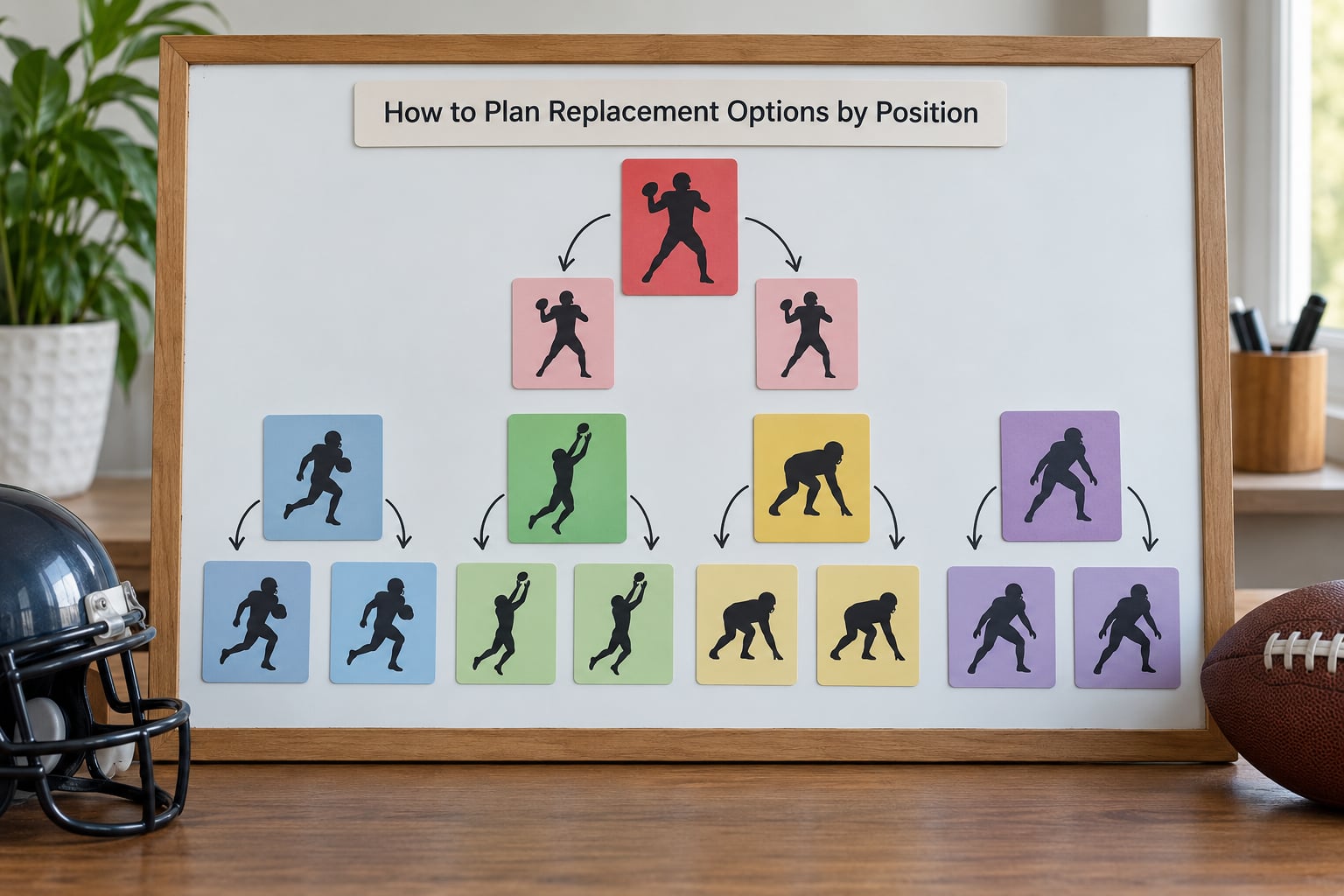
The goal is to know your backup before you need him, because the good ones get claimed within hours of the news. Work down this list the moment a starter enters protocol.
Quarterback
Start with the declared backup, then check whether the backup is actually a functional starter. Some teams have a backup who threw for under 150 yards a game. If a starter is out, check whether the team uses a committee and whether a third-stringer gets meaningful rushing work, which is the one thing that can offset low passing volume.
Running back
Backups are the least reliable replacement in fantasy, because committees split carries in ways that hurt the starter and help the backup. Look at goal-line work, which is often a fixed role regardless of who starts, and at whether a receiving back has a real target share.
Wide receiver
Volume is the number that matters: targets per game over the season, not reception count. A backup who was on the field for 80 percent of snaps as a slot receiver may be a genuine upgrade over a healthy-but-low-volume starter on your bench.
Tight end
Replacements are usually pieces of a committee, so look at red-zone targets rather than raw catches. A second tight end with a live goal-line role can be a usable stream even in an offensive scheme that limits passing.
Kicker
Only the team matters here, so the replacement is automatic. What you need to check is whether a kicker returning from concussion is a fantasy starter, which depends on scoring rules and on offense quality, not on the kicker’s personal history.
Across all five positions, the same factors decide the pick: snap share, target or carry volume, goal-line work, team incentives, and the opponent’s matchup. Add independent data on defense, since a favorable matchup for the replacement matters more than the name on the waiver wire.
When to Trust Reports, Confirmations and Final Active Lists
Not all sources carry the same weight. Ranked from weakest to strongest:
- Early injury reports, which describe practice availability and say nothing about Sunday.
- Beat reporting, useful when it names a specific phase rather than describing progress in general terms.
- Team statements, particularly when a coach explains the medical step rather than the calendar.
- Practice participation on Friday, which is the last real data point before game day.
- The official game-day inactive and active lists, released roughly 90 minutes before kickoff. This is the only authoritative list.
Forum owners in r/fantasyfootball routinely describe the pattern of conflicting reports, where a team source sounds optimistic while the league side stays quiet. When the two disagree, treat the less optimistic one as the working assumption.
Before you lock a lineup on Sunday morning, check three things: the injury report’s wording, whether he was full participation or limited, and whether anyone on the team confirmed a role change. If two of the three are unclear, your replacement is the safer lineup and there is no shame in it.
How to Manage Dynasty and Keeper Leagues During an Absence
The format changes what the absence costs you. In redraft, an absence is a scheduling problem. In dynasty, it is an asset problem, and it should be handled with the same patience you would give any injury recovery.
Owners of quarterbacks with multiple protocol stings regularly debate sell versus hold, and the honest answer is that you cannot resolve it during an absence. The information you need, real role share, comes later.
Two dynasty rules that save seasons. First, acquire the replacement properly: if a young backup is playing meaningful snaps, he is worth a real prospect price rather than a throwaway, because you may have to buy him back later. Second, do not panic-stash a replacement for a player who may return in a week and end up with two redundant pieces.
Medical experts in fantasy football forums, including commentary tied to the NFL’s head, neck and spine committee, have argued that concussion history alone should not drive a draft decision and that style of play matters as much as the count. That is a reasonable guard against reacting to one protocol stint.
A temporary absence also creates opportunities. When a starter misses two games, his backup’s role, the team’s target distribution and the snap counts of every other receiver get clearer. Sometimes the starter comes back to a reduced role, and that reshapes the whole offense.
Frequently Asked Questions
Should I drop a fantasy football player immediately after a concussion?
Almost never. A protocol diagnosis tells you he is out for the coming week, not that his season is in danger. Keep him on the roster, add the position’s replacement, and reassess when he reaches full contact participation. Dropping a starter in week two of an absence rarely pays off, because most players return before managers have found a better option.
How long should I expect an NFL player with a concussion to be unavailable?
The minimum path runs about a week, since full contact clearance still has to happen before the next game. Most absences land between one and three games, with longer returns driven by symptom recurrence, position and individual recovery. Treat any specific date as an estimate rather than a schedule, because the stages can repeat at any point.
Can a fantasy football player return to the lineup on limited practice participation?
Limited participation means he did some practice work, often non-contact, which is not the same as being cleared for contact. His game status stays uncertain until the inactive list is released roughly 90 minutes before kickoff. Some managers start him as a desperation play when the matchup is strong, but the official list is the only reliable answer.
Which position is most affected when a fantasy football starter misses time?
Running backs hurt most in weekly formats, because carries are split across a committee as soon as the starter is unavailable. Quarterbacks can be steadier when a team has one real starter, though the backup’s role may be low volume. Kickers are the least affected, since only the team and the scoring format matter.
Should I stash a backup player after a concussion in a dynasty league?
Yes, if the backup is a young player already getting meaningful snaps in the starter’s place. That is a real role worth owning, not a panic add. Avoid stashing two players for the same position when the starter may return inside a week, because redundancy quietly costs you roster spots for the rest of the season.
Conclusion
A concussion diagnosis is a scheduling problem, not a verdict on the player’s season. Bench the player, find the likely replacement before the waiver wire fills up, and line up the next credible update.
Only stable full participation plus the final active list justify restoring a player’s normal projection, and even then check the role he will have before you hand the job back to him. In dynasty, patience usually beats the panic move.