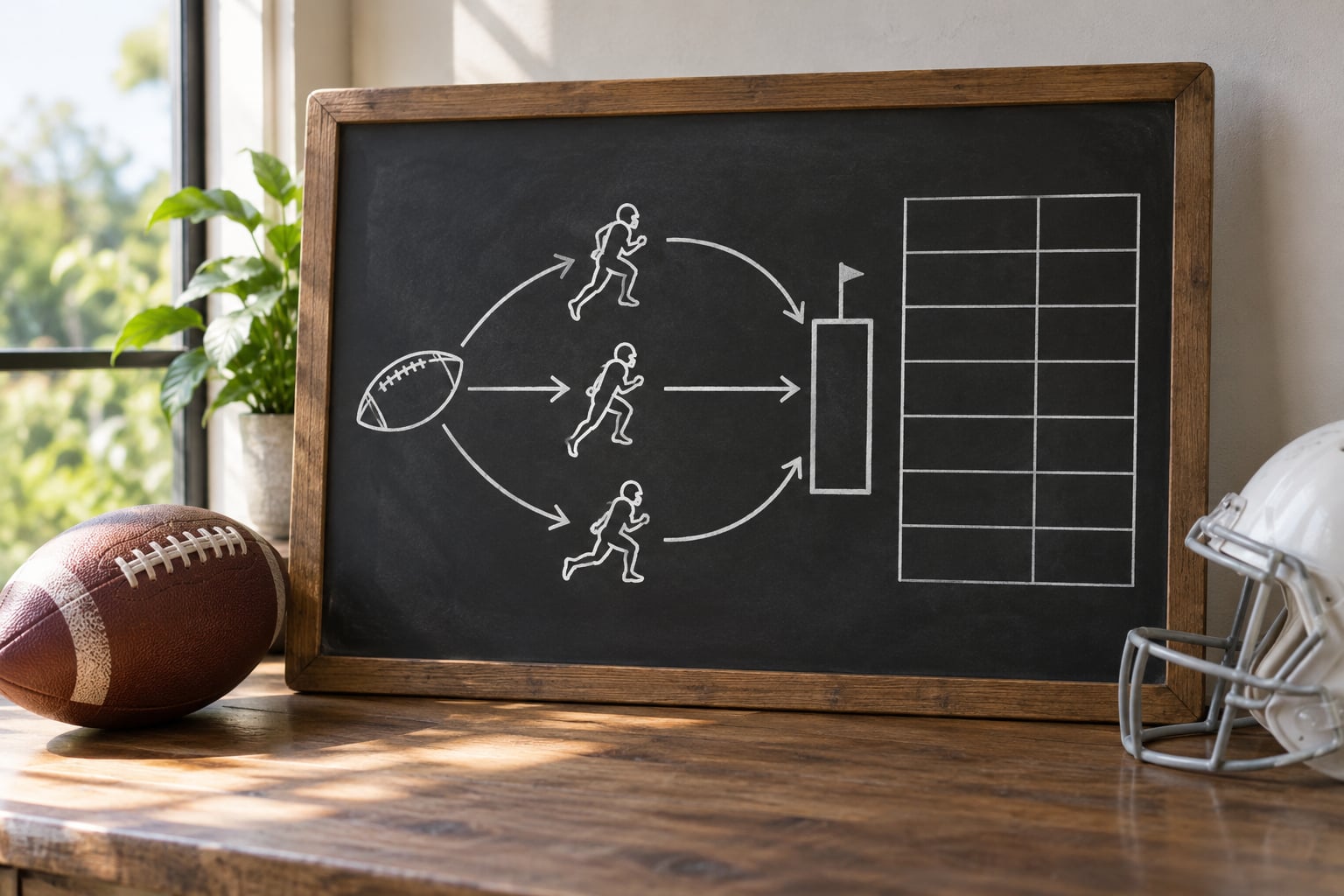
Stacking in fantasy football means starting two or more players from the same NFL team, most often a quarterback with one of his receivers. It works because offense is correlated: when a passing game gets going, several players on that offense benefit at once. The strategy raises your ceiling week to week and lowers how often you need luck to compete.
It is not the same as just picking one team and hoping. Correlation is the part that does the work, and understanding why it happens tells you when a stack is worth the risk. This guide covers how stacking creates points, the common patterns by position, when to use one, and how to build one in redraft, dynasty, keeper, and draft formats.
Table of Contents
- What Is Stacking in Fantasy Football?
- How Does Stacking Create Fantasy Points?
- What Is Stacking in Fantasy Football by Position?
- When Should You Use a Stack?
- How Do You Stack in a Redraft League?
- How Do You Stack in Dynasty and Keeper Leagues?
- How Do You Use Stacking in Drafts?
- What Are the Risks of Stacking?
- Common Stacking Mistakes to Avoid
- Frequently Asked Questions
- Is stacking the same as picking all players from one NFL team?
- When should I avoid stacking two players on the same team?
- Does team stacking work better in PPR or standard scoring?
- Should I stack two running backs or a running back and tight end?
- How much of my fantasy roster should come from one NFL team?
- Conclusion
What Is Stacking in Fantasy Football?
Stacking in fantasy football is the practice of starting two or more players from the same NFL team in a single lineup or roster, usually a quarterback paired with a wide receiver or tight end. The bet is that both players are involved in the same offensive production, so one strong game lifts your whole lineup instead of just one slot.
Picking three players from one team is not automatically a stack. If they never share a game script, you have simply concentrated risk. The difference is correlation: the players need to feed off each other, most often through one quarterback throwing to multiple targets.
Stacking never guarantees a win. It changes the distribution of your weekly scores, and that is worth understanding before you commit roster spots to it.
How Does Stacking Create Fantasy Points?
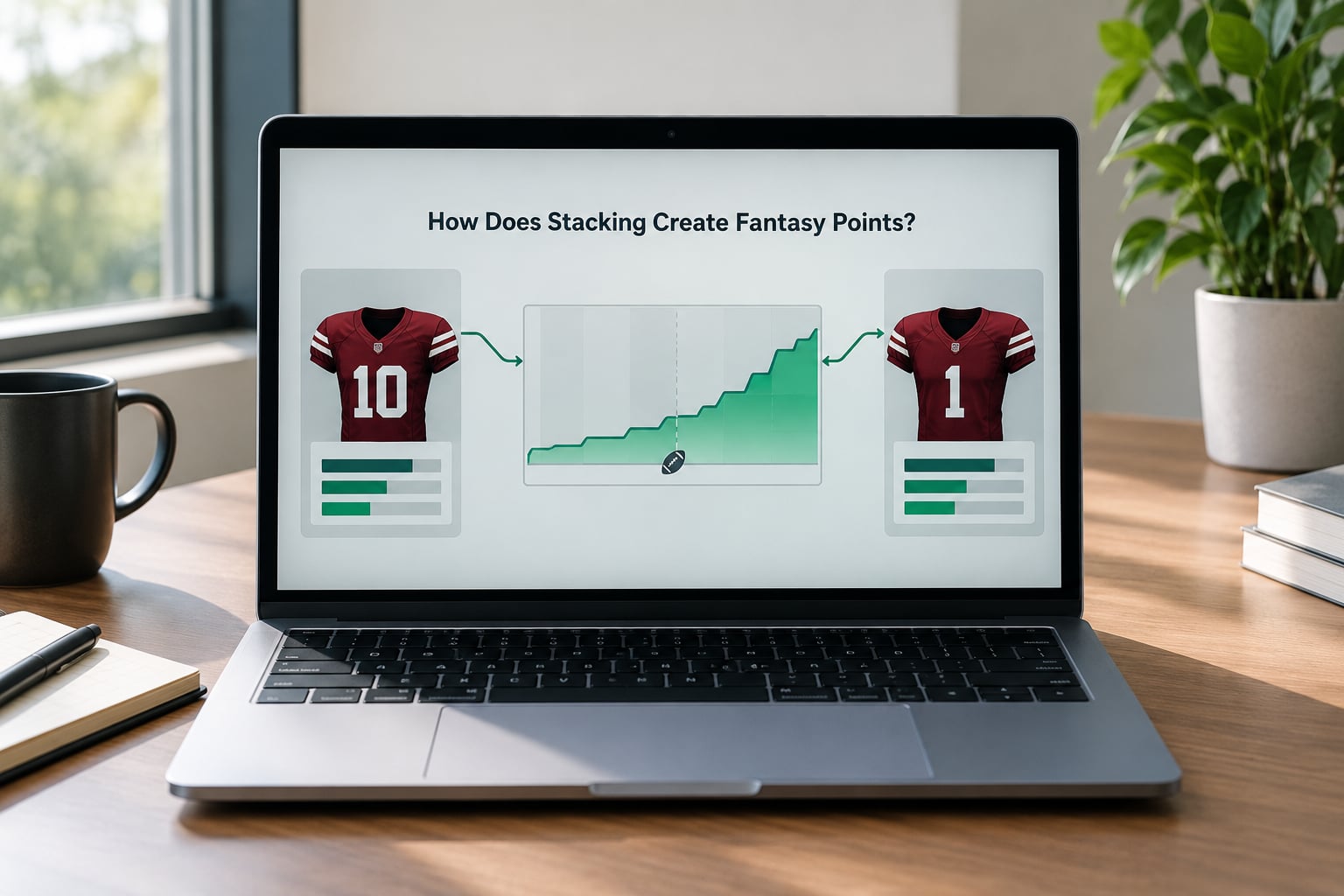
The double-dip is the simplest part. When your fantasy quarterback throws a touchdown to your fantasy receiver, you score passing yards and a touchdown for the quarterback, then receiving yards and the same touchdown for the receiver. One play, two scores.
The bigger effect is game script. Imagine a team trailing late in a shootout. Their quarterback has to throw, their star receiver gets more targets, their other receiver benefits from defensive attention, and even a tight end scoring a late goal becomes realistic. Three players you started all gain from the same environment.
It runs the other direction too, which is the part people forget. If the team is up big and playing conservative football, every one of those players underperforms in the same afternoon. Correlation cuts both ways, and that is exactly why stacks are riskier than diversified lineups.
Stacking in fantasy football by position is not a single move, though. Different combinations rely on different game scripts and behave differently depending on how your league scores. The comparison table below breaks down the most common setups by position, the supporting cast that works best, which scoring formats suit them, and the caveats to keep in mind.
What Is Stacking in Fantasy Football by Position?
| Stack Type | Best Supporting Cast | Scoring Formats That Favor It | Main Caveat |
|---|---|---|---|
| QB plus pass catcher | A receiver or tight end with real target share | PPR, especially half-PPR | One bad passing day hurts two slots at once |
| Running back plus passing game | The team’s primary receiver or tight end | PPR, any format | Needs a team that actually throws when trailing |
| Tight end plus passing game | A tight end on a high-volume passing team | PPR heavily | Standard scoring may not justify the volatility |
| Offense plus team defense | A defense whose offense can sustain drives | Standard and PPR | Turnovers and field position can sink both at once |
| Two running backs, one team | A backfield that stays on the field in committee | Standard scoring | Goal-line work concentrates into one player |
The quarterback plus receiver pairing is the foundation most managers build on, but the passing game plus running back version often gets overlooked. A back who catches a lot of passes pulls from the same volume as the receivers, so he fits into the stack without needing a goal-line touchdown.
When Should You Use a Stack?
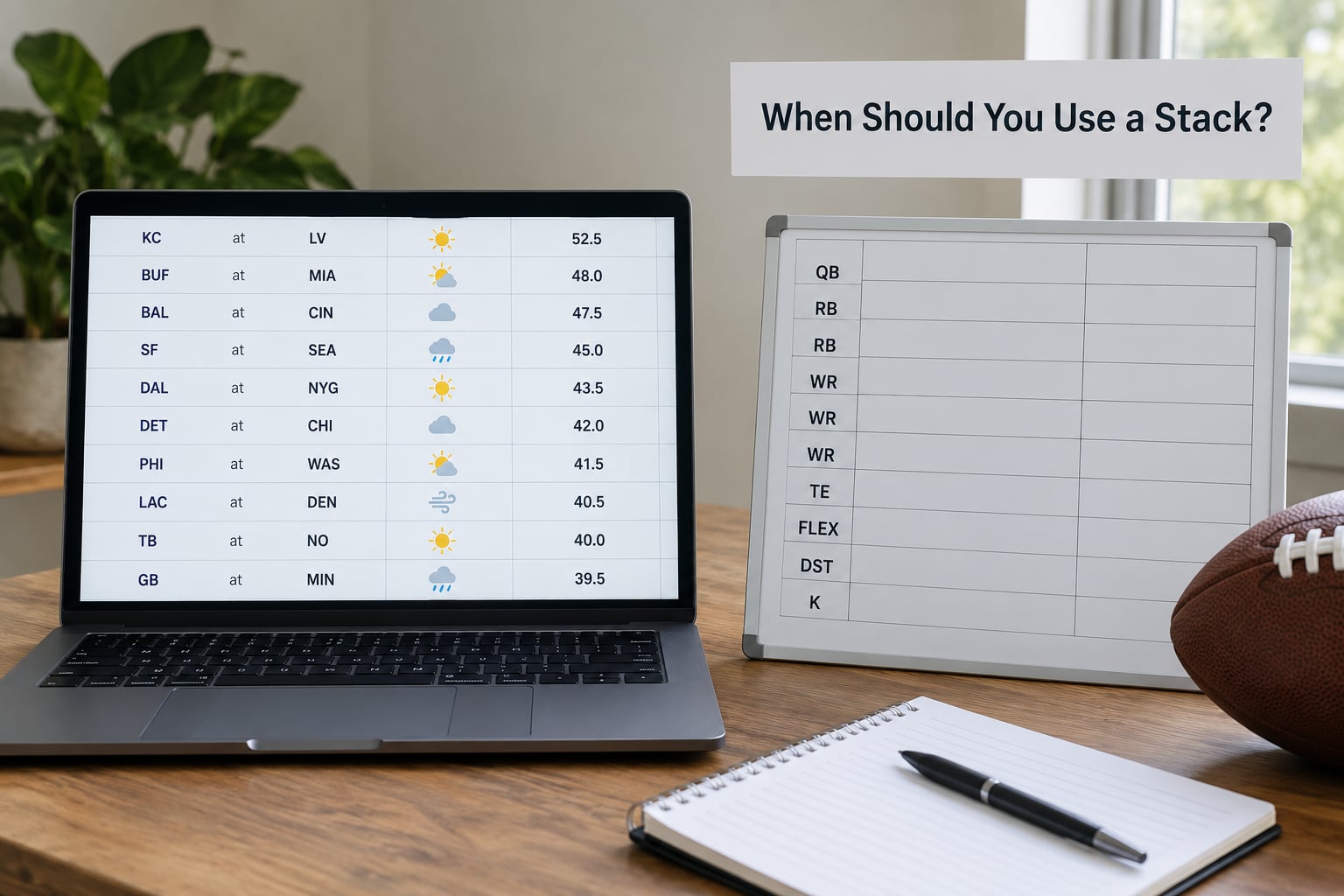
Use a stack when the conditions support a specific scenario, not because it is a general rule. Strong wind, a dome, or an expected one-sided game can all shift how an offense attacks, and those are the situations where correlation tends to pay off.
Start with the game script. If a team is a heavy favorite, its stars may be running out the clock rather than filling the stat sheet. If a team is a big dog with a quarterback who can make throws, a comeback script is plausible, and that helps everyone you started from that offense.
Matchups matter as much as the team itself. A stack faces a secondary that allows a high completion percentage and gives up explosive plays more easily than one facing a ball-hawking unit. Wind, cold, and indoor air change the picture too, and December and January are when those swings hit hardest.
Scoring format tells you how many players a stack needs. In PPR, one dominant receiver can carry a quarterback pairing. In standard scoring, a receiver with a stretch of goal-line touchdowns often matters more than one who gains yardage without scoring.
Ownership is the piece beginners miss. In a large-field tournament, popular stacks get picked, so owning one has less value. In a small league against a handful of opponents, taking the same players everyone else has can be the best path to a weekly win.
My own rule is that stacking should support a lineup, never be the lineup’s whole identity. Start with the players you would start anyway, then add one teammate if the game script supports it.
How Do You Stack in a Redraft League?
Weekly stacking in a redraft league is a process, not a fantasy. Start by checking the schedule for every player on your roster and note which teams face the weakest projected opponents.
Next, look for a game script you can believe. Trailing teams late in close games generate extra passing volume, and that volume lands on specific players rather than being spread evenly across an offense.
Compare your options before committing. If you already run one high-volume pass catcher, a quarterback-plus-teammate pairing adds less than it would on a roster with no exposure to that offense.
Check injury and role news before every start. A receiver sitting out with a hamstring or a quarterback losing his starting job kills a stack faster than any matchup trend, and role changes often surface a day or two before kickoff.
Use one of your own players as the anchor. Take the player you trust most, confirm the game script supports him, then add a teammate whose volume rises in the same scenario.
How Do You Stack in Dynasty and Keeper Leagues?
Dynasty rewards thinking in seasons, not weeks, so a stack has to hold up over years. Shared schedule windows matter most, since two players on the same offense usually peak together and you want them healthy in the same championship week.
Age curves change the math. A veteran quarterback and a rookie receiver can be a great pairing for two or three seasons, then the quarterback declines while the receiver is still ascending, and the stack falls apart without you noticing.
Role stability is the real test. A receiver who is currently the top option but faces a strong offseason addition next year is a weaker foundation than a second-round pick who will be the primary target for years.
Long-term quarterback setups matter too. Holding a young quarterback while accumulating his future receivers means a single bad season early on affects a payoff several years out, and that timing risk needs to match your rebuild or contention window.
Asset value is the part that decides whether you trade. In a dynasty league, stacked prospects are expensive, so acquiring the main quarterback of an offense often means giving up your own picks, which is worth it only if that offense has multiple usable receivers.
How Do You Use Stacking in Drafts?
Draft stacking is a plan you set before your draft, not something you improvise. Decide which offenses you want exposure to and let that shape your picks, especially once you get past the early rounds.
Average draft position is the reference point. When two teammates are drafted far apart from each other, the gap usually means someone in the draft disagrees about the offense, and that disagreement is your opening.
Start late with correlation. Once you hold one player from an offense, the cheapest teammate is the logical target. Every additional pick from that offense raises the chance you score multiple big weeks.
Building around a late quarterback has become a standard approach because it comes with built-in correlation. Grabbing another pass catcher on the same team costs almost nothing in expected loss and gives you a real shot at a top week.
Zero-running-back builds lean on this heavily. If you hold no backs, every productive running back week from that offense gives you a bench piece, and teammate passing games tend to produce those extra chances.
Popular stacks are not automatically wrong, but they can be priced in. When a cluster is so common that many teams build the identical offense, you need a genuine reason to think it works, or you fade it and let the field carry it.
In large best ball tournaments, fading popular stacks is often the sharper move because a moderately owned quarterback with two teammates can outperform a heavily owned stack with the same outcome already priced into your standing.
What Are the Risks of Stacking?
Correlated failures are the main risk, and they hit harder than a single bad game normally would. When an offense has an early collapse, a quarterback, two receivers, and a running back can all be wrong in the same afternoon.
Bad weather takes out a specific game script. Heavy wind or freezing air can kill what looked like a promising high-total matchup, and everyone you hold from that offense loses together.
A weak scoring environment does similar damage. Even a productive offense can manage a low-scoring night, and your stack still finishes under its weekly projections.
Unexpected benching ends it outright. A coach changes the plan in the fourth quarter, a healthy player sits for rest, or a receiver loses his job to a healthy scratch, and the player you stacked to fill a role no longer has one.
Playing multiple players from the same team against a strong opponent is the version that hurts most. You get the downside of one bad offensive night with none of the diversification you would have had.
Byes and injuries concentrate risk too. Two teammates hit by the same hamstring pull on the same practice field is a low-probability event, but it is exactly the kind of outcome that decides a championship week.
Common Stacking Mistakes to Avoid
Stacking without a game script is the first one. If you cannot describe the scenario that makes both players score well, you are just taking two players from one team and calling it strategy.
Mixing unrelated offenses is the second. Players from different teams have nothing to do with each other, so their results are independent and you gained no correlation.
Chasing popularity wastes draft capital. Building the same stack as most of your league buys you nothing, so pick the version you can argue for yourself rather than the loudest one.
Taking two low-volume players is a trap. Two players who rarely see targets or touches give you a string of small weeks and almost never a ceiling, which defeats the purpose.
Sacrificing too much starting-level talent hurts most. A stack built by reaching for backups in five rounds leaves your lineup thin everywhere, and the correlation rarely pays for the empty roster spots.
Ignoring your opponents is the quiet one. Two managers running the same stack in a small league means shared ceilings and shared floors, and one bad week can hand the whole league to somebody else.
Frequently Asked Questions
Is stacking the same as picking all players from one NFL team?
No. Picking several players from one team only counts as a real stack when those players share offensive production, usually through one quarterback. Three running backs from the same team on a heavy run play count as concentration of risk, not correlation, because their usage is decided separately. Stacking in fantasy football depends on a shared game script, not on a shared roster address.
When should I avoid stacking two players on the same team?
Skip it when the game script is unclear, when the team is a heavy favorite likely to protect its lead, or when the opponent’s defense rarely allows big plays. It is also a bad idea if you already run two of that team’s players, or if you are building a cash-game lineup where a safe floor matters more than a ceiling. Correlation only helps when the scenario actually appears.
Does team stacking work better in PPR or standard scoring?
PPR favors stacking more, because extra targets translate directly into fantasy points for receivers, running backs, and tight ends. In standard scoring, receivers must find the end zone to matter, so a stack built around yardage alone can disappoint. A quarterback plus a red-zone receiver pairing works in either format, while running back plus passing game stacks lean on point-per-touch scoring to pay off.
Should I stack two running backs or a running back and tight end?
A running back and tight end from the same team is usually the better pairing, because a passing-heavy game script lifts both when the team trails. Two running backs from one team depend on committee usage that can shift week to week, and one player usually owns the goal-line work. In PPR the running back and tight end pairing gains more from added passing volume, so it holds up in more scoring formats.
How much of my fantasy roster should come from one NFL team?
Two or three players is the usual range for most league formats. Four or more leaves you exposed to a single offensive collapse and usually costs you starting-level talent elsewhere. In best ball and large-field tournaments, taking more teammates is often correct because you only need the ceiling. In redraft leagues, three from one offense is usually the ceiling before you start giving up roster balance.
Conclusion
Stacking works because offenses produce points together. One quarterback’s day lifts his receivers, his running back, and sometimes his defense, which gives you a higher ceiling than any single player can offer alone.
Start with one credible game script, anchor your stack with a player you would start regardless, then add only teammates whose roles rise in that exact scenario. Two players from one offense is usually enough in a redraft league, and more pays off when you only need the upside.
What you should do first: pick one offense you believe in this season, check the schedule and the opponent’s secondary, and see whether your existing roster already gives you a reason to add a teammate.