Handling collusion in a fantasy league comes down to process, not instinct. Check your league’s written rules for a collusion clause, document the transaction pattern, speak privately with each manager, and then apply a remedy that follows the rule rather than your mood. Set aside two to three hours the first time, and expect it to be uncomfortable.
That’s the honest version. The reason most collusion situations turn into a disaster isn’t that the evidence is weak; it’s that nobody has a procedure ready when it happens, so the league guesses. A member posts “Team A and Team B are cheating” in the group chat, three people reply with screenshots, the accused managers quit or block everyone, and the league is finished by week six.
Collusion is the rarest accusation in fantasy sports and the most damaging one to get wrong. So the goal of this guide is a process you could hand to a substitute commissioner and have them run it without you in the room.
Table of Contents
- What You Need Before You Handle Collusion in a Fantasy League
- Step-by-Step: How to Handle Collusion in a Fantasy League
- How to define collusion in a fantasy league so the rule is enforceable
- How to collect evidence before confronting anyone
- How to speak with the managers involved
- How to decide whether a violation occurred
- How to apply penalties or reverse an unfair outcome
- What the ruling looks like in practice
- How to prevent collusion in future seasons
- Common Mistakes
- Frequently Asked Questions
- What if two managers make a trade that looks unfair but may not be collusion?
- Can a fantasy commissioner reverse a trade after the season starts?
- Should I use private messages as evidence of collusion?
- What if both suspected managers deny trading unfairly?
- Can a league remove a manager for collusion without proof?
- How can a league prevent collusion in future drafts?
- Conclusion
What You Need Before You Handle Collusion in a Fantasy League
You can investigate a suspicion in an afternoon, but you can only act on it if you already have six things lined up. Gather them before you talk to anybody, because the conversation itself is the point where leagues usually fail.
- The league rules or constitution, specifically the trade section. Find the trade approval process, the trade review window, whether the commissioner can reverse an approved trade, and whether collusion is addressed at all. Many leagues have no written clause, which is why the argument becomes about power rather than rules.
- The full transaction log. Every trade, waiver claim, roster add and drop, with dates and times. On Sleeper, ESPN, Fantrax, MyLeague, Yahoo and Ottoneu this is exportable or viewable from the league’s transaction page, usually filtered to trades.
- Communication records, if any exist in-platform. Trade notes, league chat, and direct messages. Keep screenshots with dates visible. Where a message lives only in a personal group text, record the date, who was in the thread and what was said, and understand that you may not be able to produce the original.
- Standings and playoff settings. Who the trade benefited, who it hurt, and whether the swing decided a playoff seed, a bye, or a title. This is the difference between a bad trade that happened to help a rival and an agreement that was designed to.
- Roster and draft details. Draft slot order, original pick owners, any traded draft capital, and roster construction. Collusion often shows up in the shape of the roster rather than any single transaction.
- A decision process nobody can argue about later. Who decides, what evidence is required, how a vote is counted, and how ties break. If you are the commissioner and one of the suspected managers, write down who handles the ruling instead. That is your recusal plan.
If the league has a constitution, link it in the league chat before you start, not after. Members who can read the rule you are applying are far harder to dismiss than members who are told you decided something.
Step-by-Step: How to Handle Collusion in a Fantasy League
Six steps, in this order. Skipping ahead to the penalty is the most common error, and it is the one that ends leagues.
How to define collusion in a fantasy league so the rule is enforceable
Collusion in a fantasy league is a secret agreement between two or more managers to cooperate rather than compete, usually to trade wins, manipulate waiver priority, or fix a playoff result. It is not the same as a lopsided trade, and it is not the same as tanking, even though all three get called “cheating” in league chat.
That distinction is the whole ballgame. If you cannot say which of the three you are accusing someone of, you will end up punishing a manager for a bad negotiation.
| Conduct | What it is | What it looks like | Typical remedy |
|---|---|---|---|
| Normal trading | Two managers negotiating in good faith for value | A trade that looks lopsided in hindsight because the market moved | None |
| Unbalanced trade | A transaction that is bad value, with no agreement behind it | A questionable trade, a bad squeeze, one team giving up more | Trade review or veto, if the rules allow one |
| Collusion | An agreement to stop competing against each other | Quid pro quo trades, coordinated waiver claims, blocking a rival, splitting earnings | Reversal, penalty, or removal under the written rule |
| Tanking | Deliberately fielding a weaker lineup to change a seeding or keep a high pick | Sitting starters late in a season, protecting a playoff spot, dodging a bye | Fine, forfeit, or removal, usually a separate rule from collusion |
Write that definition into the rules in plain language before you need it. A single paragraph covering prohibited cooperation, trade abuse, roster manipulation, and strategic behavior gives you a standard to point at later, and it stops ordinary ruthless roster management from being mistaken for a rules violation.
How to collect evidence before confronting anyone
Collect first, confront second. Conversations conducted without documentation become debates about who has a better memory, and you will lose that debate more often than you expect.
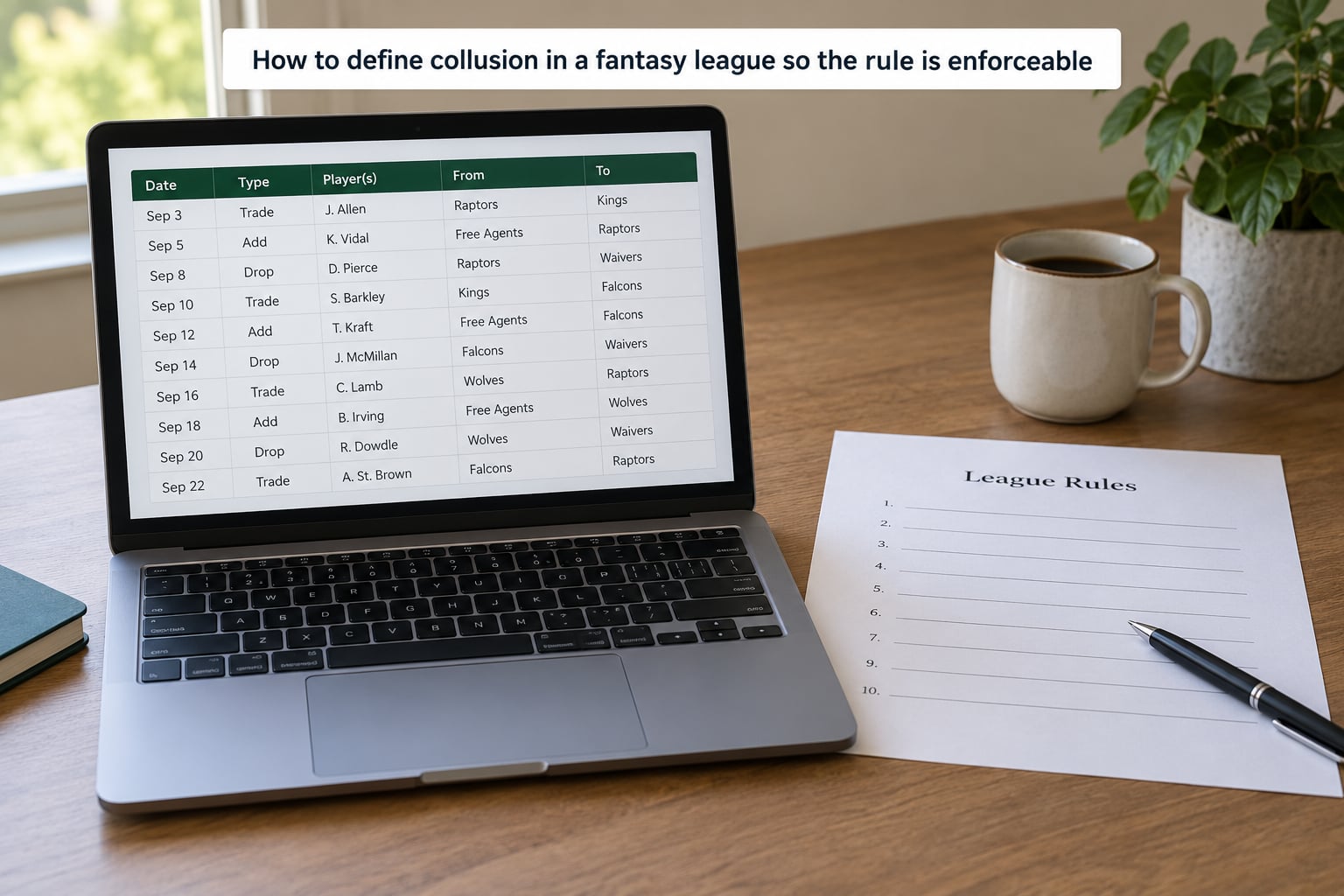
Pull the transaction history for the full season, not just the trade that upset people. Patterns matter more than incidents: trades that only ever happen between the same two teams, the same pairing reversed weeks later, waiver claims that appear one second apart, and a manager who keeps acquiring a player another manager needs and then moving them a day after a favourable draw.
Check the timing rather than assuming intent. A trade made after a big injury and before a bye is suspicious in context. A waiver claim filed at 11:59 pm the night before a matchup against a manager sitting out is the same story.
What counts as evidence:
- Dated trade history and waiver timestamps from the platform’s own log
- Written messages, trade notes, or a written admission in any form, in-platform or in a group chat with identifiable participants
- A pattern of reciprocal value moving in one direction across multiple weeks
- Roster construction that no single manager would build alone, or trades that repeatedly pair the same two teams
What does not count as evidence:
- A trade you personally dislike
- Two managers who are friends, related, or roommates
- A manager needing a specific player or wanting to make a contender
- Suspicion that stays suspicion once the transaction log is actually read
Save originals. Screenshot with the date and league name visible, keep the export rather than a retyped list, and note the time you took it. When you write up your findings, stick to what the record shows. “Trade 6 on 12 Oct moved a player Team B waived on 9 Oct back to Team B” is checkable. “Team B is clearly gaming us” is not, and a good cross-examiner will make you regret writing the second one.
How to speak with the managers involved
Talk to each manager separately, by direct message, before anything goes in league chat. Public accusation is the single most damaging move available to you, and it is worth almost nothing procedurally.
Open with the specific conduct, not a character description. “The trade on 12 October and the waiver claim on 3 November both moved assets between your two teams, and I want to understand the thought process” lands differently from “I think you’re cheating.”
Give both people a real chance to answer. A useful shape:
- State the transaction or pattern factually, by date
- Ask what prompted it, without implying you already know the answer
- Explain what in the rules the question touches
- Tell them what happens next and when they will hear it
Do not announce the penalty in advance, and do not threaten removal to get a confession. A manager who feels cornered either folds or leaves, and you learn nothing either way. Take notes on what they say, including the parts that do not help your case.
If the commissioner is a suspect or a possible beneficiary, hand the conversation to someone else before it starts. Commissioners running the inquiry into themselves is the structural risk most leagues never plan for, and it discredits a correct ruling faster than a wrong one.
How to decide whether a violation occurred
Compare what you found against the rule as written, and separate deliberate cooperation from questionable tactics. Intent is the test: did two managers agree to stop competing, or did one manager simply make a bad trade?
Apply a consistent set of questions, and write the answers down:
- Is there a written rule that covers the conduct, and does the conduct meet its terms?
- Is there a pattern, or one transaction that can be explained by bad timing or a bad week?
- Would the same behaviour be harmless if it happened between two managers who are strangers?
- Did the exchange move value in one direction across more than one week?
- Is there a statement, timestamp, or roster shape that a manager could not plausibly explain away?
Two things to hold onto. A trade can be fair in a vacuum and still be part of a collusive arrangement, so “the value was even” is not a defence. And an accusation can be wrong, which is why the standard of proof belongs in the rules in advance: conviction on the balance of evidence is a reasonable bar for a friends league, and beyond reasonable doubt is not achievable with a transaction log and a group chat.
Where the facts support a finding, write a short decision: the rule cited, the evidence relied on, the parts of the record that cut against the finding, and the remedy. Four short paragraphs. Post it once, in league chat, and let it stand.
How to apply penalties or reverse an unfair outcome
Proportionate remedies, roughly lightest to heaviest:
- Warning or a written note in the league record for an ambiguous case, when the conduct is bad but the rule is unclear
- Trade review or veto when the rules already provide a review window and the trade is still inside it
- Trade reversal when a collusive exchange is confirmed and the rules grant reversal authority
- Forfeiture of a buy-in, a fee, or a future draft pick where money or draft capital was the mechanism
- Suspension from trading, or from the league for a deliberate scheme, especially one repeated after a warning
Two structural points on reversal. Most platforms only allow a commissioner to reject a trade during the review window; once a trade is approved, your ability to undo it depends entirely on the rule you wrote, not the setting you inherited. And on the famous Fantasy Judgment-style remedy, you can separate the tainted trade from the tainted asset: reject the collusive trade, bar the two managers from trading with each other for the rest of the season, and leave any legitimate waiver acquisition that came through proper channels where it is. That is a defensible, proportionate ruling, and it keeps you from sweeping away innocent parts of the season.
What the ruling looks like in practice
A worked example, because the abstract version of this is hard to picture. Imagine a 12-team redraft league where Team A and Team B make four trades over five weeks, every one of them moving value in the same direction, and the third one lands on a Tuesday when Team A’s second-best running back was inactive. Team B then drops a player Team A claims on waivers the following morning.
Read against a collusion clause, that is a pattern with a mechanism: the waiver claim creates the need, the trade relieves it, and the timing lines up with the matchup. Read against a league with no collusion clause, the same facts are a series of debatable trades and a rule change waiting to happen. Same evidence, different outcome, entirely because of what was written in the off-season.
Now the remedy. Under the bylaw above, the commissioner can reject the trades, bar those two managers from trading with each other for the remainder of the season, and require the player acquired through the waiver claim to be returned to the waiver list rather than stay where a tainted trade put them. Nothing in that ruling touches the rest of the season, and every line of it traces back to a rule the league agreed to before the first pick.
The counter-case matters just as much. If the same four trades had gone between two strangers who never spoke, and the waiver claim had been made by a third manager with no connection to either party, you would have a market inefficiency and a proposal to tighten trade review. You would not have a case. The difference is the agreement, and no amount of suspicion substitutes for finding it.
Do not over-punish. A warning for a first offence is not weakness; a removal for a first offence usually costs the league four managers, including the innocent ones who leave with them. Members are watching how you handled the first one, and that sets the ceiling for the next.
How to prevent collusion in future seasons
Prevention is cheaper than investigation, and it is the part of this article most leagues skip. Before the draft, write an anti-collusion clause and set the enforcement process in the league settings. Copy this and adjust it:
Section: Trades and Collusion
Trades require approval by a majority of league members within a review window of [48] hours. Any member may request a review by posting the transaction and a brief reason in the league chat; the request needs a second member to support it before the vote opens.
Collusion means any agreement, written or verbal, between two or more managers to cooperate instead of competing, including quid pro quo trades, coordinated waiver claims, trading a win or a playoff seed, or agreeing to split any prize money. Deliberately fielding an inferior lineup to change a playoff seed or avoid a bye is tanking and is a separate violation.
The commissioner may reject a trade inside the review window. After approval, the commissioner may reverse a trade found to be collusive, may require the return of any player or pick obtained through the collusive act, and may apply a penalty of a written warning, forfeiture of a future draft pick or buy-in, suspension from trading, or removal from the league. A penalty proportionate to the offence may include a mix of these.
Any member found acting as commissioner in a matter where they are a party, a beneficiary, or a close personal associate must recuse, and the league appoints a replacement for the duration of the matter by a simple majority vote of the uninvolved managers.
Where the rules are silent, behaviour that a reasonable person would describe as gaming the league for a shared advantage is subject to a commissioner ruling after both managers have been heard.
Pair the rule with the settings that make it work:
- Turn on a trade review vote and set the window in league settings rather than leaving it to custom messages
- Set waiver windows to consistent, league-wide times so claims are not decided by who was awake at midnight
- Use a shared trade board or message thread for all trade discussions so offers and replies are on the record
- Keep league communication in-platform wherever you can; personal group chats are the hardest evidence to verify later
- Set a defined penalty schedule before the season, and keep the same one for the life of the league
- Run a short written dispute process: who decides, what evidence is required, how a vote is counted, and where the ruling is posted
Set trade review rules and waiver discipline before the first pick, not after the first accusation. In dynasty and other long-running formats, collusion pays best because a single coordinated trade can bank value for years; some leagues address that specifically by ruling that prospects and future picks acquired through a collusive act must be returned alongside active players.
Common Mistakes
Reacting to a single trade. One ugly deal is a negotiation, not a conspiracy. Read the whole transaction log before you say anything, because acting on one trade is how commissioners end up apologizing to an innocent manager.
Treating every coordinated pick as collusion. Two managers picking the same sleeper in the same round is a coincidence, a public ranking, or a shared read of the board. Collusion requires an agreement, and an agreement leaves a pattern you can point to.
Posting accusations in league chat or a public group. This is the fastest way to end a league. Bring concerns to the two managers privately, and if it is going further, follow the written process instead of the group chat’s opinion.
Applying a different penalty for each person involved. If one manager gets a warning and the other gets removed for the same trade, the ruling is about favouritism, not the rule. Decide the penalty before you know who you are giving it to.
Ignoring the written rules and ruling on principle. If the league has no collusion clause, you can still act, but you are relying on personal authority. Fix the rules in the off-season. A member whose only recourse is a league-wide vote has a real argument when the commissioner is also a competitor.
Becoming personally combative. Accusations go badly when they are framed as an insult. Describe the transaction, cite the rule, and give the manager a real chance to explain. A private conversation that ends with an explanation you find plausible costs you nothing; a public post that ends with four managers leaving costs the league a season.
Forgetting the manager who is being accused. Due process matters more than winning the argument. Both managers get heard, both get the specific facts, and both get told what happens next. A ruling that skipped that step tends to be reversed the moment someone escalates it to the platform.
Reporting internally only. If the conduct is serious, the platform has its own process. On Sleeper, ESPN, Fantrax, MyLeague, Yahoo and Ottoneu, suspected rule violations can be reported to the platform’s support team with your screenshots and timeline attached, and the platform may act where a commissioner cannot. Use your commissioner’s process and the platform’s process, not one instead of the other.
A few things that help. Tell members up front, before an incident, that a collusion clause exists; a warned league rarely has this problem twice. Keep your own decision record, even the ones nobody will ever read. And if you are the accused manager, answer the questions, ask what rule is being cited, and consider whether you would rather fix the rules or leave the league. The recurring advice from members who have been there is simple: raise it with the commissioner now, and if the league lets it stand, push for rule changes in the off-season or move on.
Frequently Asked Questions
What if two managers make a trade that looks unfair but may not be collusion?
Treat it as an unbalanced trade, not collusion, until the record shows otherwise. Check the transaction log for a pattern: trades that only ever happen between the same two teams, repeated in both directions, or paired with coordinated waiver claims. If there is no agreement behind it, use the trade review or veto your rules allow, and treat this as a market problem to fix in the off-season rather than a misconduct case.
Can a fantasy commissioner reverse a trade after the season starts?
Usually only if your league rules say so. Most platforms let a commissioner reject a trade during the review window, but once a trade is approved, reversing it depends on authority you wrote in advance, not on the setting you inherited. That is why the anti-collusion clause matters: it should spell out whether a confirmed collusive trade can be undone and whether players or picks obtained through it must be returned.
Should I use private messages as evidence of collusion?
Yes, but handle them carefully. Messages in the platform’s own league chat and trade notes come with platform timestamps, which makes them much easier to defend. Personal group texts are harder: record the date, who was in the thread and what was said, screenshot the original rather than a retyped version, and expect the other side to dispute that the screenshot is complete. Corroborate with the transaction log wherever you can.
What if both suspected managers deny trading unfairly?
Denial is not the end of the process. Weigh the written record against the explanations: a trade history showing repeated one-directional value movement is difficult to explain away, and a roster nobody would build alone stands up better than a message thread. If the evidence does not clear the bar you set in your rules, say so plainly, document the reasoning, and fix the rules for next season rather than escalating on suspicion.
Can a league remove a manager for collusion without proof?
Not safely. Removing a manager without evidence invites a platform report, gives the accused a grievance, and costs the league the innocent members who leave with them. Suspected rule violations can be reported to the platform’s support team with your evidence attached, and the platform may act where a commissioner cannot, but a league vote should be based on a documented finding under a rule that existed before the season started.
How can a league prevent collusion in future drafts?
Write the rules before the first pick. Add a trade review vote with a fixed window, set league-wide waiver times so claims are not won by who was awake last, keep trade discussion in-platform where the record is automatic, name a penalty schedule in advance, and include a clause requiring the commissioner to recuse in any matter where they are a party or a beneficiary. Dynasty formats should add a rule on returning prospects and picks acquired through a collusive act.
Conclusion
If you are the commissioner facing a suspected collusion case right now, do the first three things in order: open the written trade rule, pull the full transaction log and save it, and message each manager separately with the specific dates and transactions you want explained. Hold the ruling until you have both answers, then apply the remedy your rules already allow and post the reasoning once.
Whatever happens this season, fix it in the off-season. Add a collusion clause, a review window, a penalty schedule, and a recusal rule before the next draft in 2026. A league with those four things rarely has this problem twice.