If you have come here searching how to value draft picks in dynasty leagues, the honest answer is that you need one number per slot: the fantasy production that pick’s player is expected to add to your roster over a three-to-five year window, adjusted for the slot, the strength of the rookie class, and your league’s format.
The reason that answer matters is that a pick is not the same asset as the player who eventually takes it. A rookie receiver you buy today has a fixed ceiling you can see on a stat sheet. A pick is a probability you get to re-price every week, and managers consistently confuse the two in both directions — hoarding worthless third-rounders and selling elite capital at a discount.
If you want the short version: value a pick by estimating the median outcome at that slot, converting that player into a veteran you’d actually roster, then checking the conversion against your own league settings before you accept anything.
Table of Contents
- What You Need Before You Value a Pick
- Step-by-Step: How to Value Draft Picks in Dynasty Leagues
- How to value draft picks in dynasty leagues by identifying the player they represent
- How to value draft picks in dynasty leagues using expected future production
- How to value draft picks in dynasty leagues by applying league context
- How to value draft picks in dynasty leagues by adjusting for uncertainty
- How to value draft picks in dynasty leagues for trade decisions
- When Pick Value Peaks and Troughs in the Year
- How to Build Your Own Dynasty Draft Pick Value Chart
- Common Mistakes That Misprice Every Pick
- Frequently Asked Questions
- How valuable are second round picks in dynasty?
- How valuable is a 3rd round pick in dynasty?
- Are draft picks valuable in dynasty?
- How do I value future draft picks?
- Why do trade calculators price the same pick differently?
- When is the best time to sell future picks?
- Conclusion
What You Need Before You Value a Pick

You need eight inputs. Missing any one of them turns a valuation into a guess, and the guess will lean on whatever the other managers in your league believe rather than what the data says.
- The exact pick slot. Not “a first-rounder” — 1.03 and 1.10 are different assets in almost every league.
- The year of the pick. A pick three years out carries draft-order uncertainty you have to price in.
- Rookie class strength at that position. A thin receiving class compresses the value of every receiver pick in the range.
- Your league format. One quarterback, superflex, tight end premium, two-point scoring, roster size, and how many future picks you hand out each year.
- Replacement level. The player who would be your 12th-best running back or 4th-best tight end, since surplus value is measured against him.
- Position scarcity on your own roster. The pick that fills a hole is worth more to you than the same slot on a roster that has no need.
- For comparison players: their age, role, recent production, and contract situation. This is what lets you convert a pick into something you can actually roster.
- A source of historical rookie outcomes. Six seasons of draft results is enough to see which slots hit and which slots fill rosters with guys nobody remembers.
All eight are available before your season starts. The only one that changes week to week is the rookie class evaluation, and that is exactly why pick value has a rhythm rather than a fixed price.
Step-by-Step: How to Value Draft Picks in Dynasty Leagues
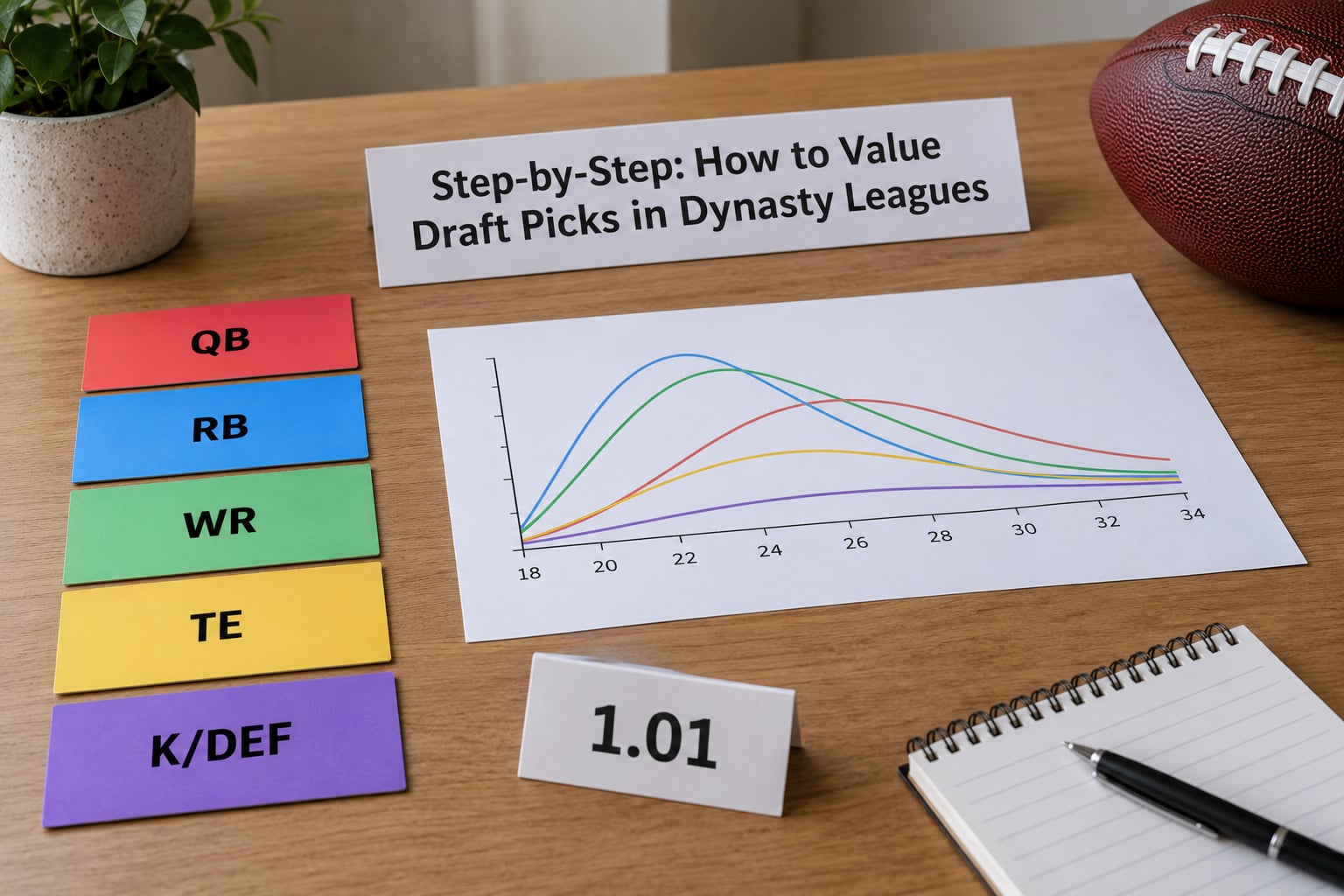
The process below takes one pass per pick and gets more accurate the more slots you run through it.
How to value draft picks in dynasty leagues by identifying the player they represent
Start with the name attached to the slot, not with a generic chart. A pick’s value depends on who is plausibly still available when you make it, and the position that gets drafted changes everything about what a hit looks like.
Two picks four slots apart are only equivalent if the players behind them play the same position. When they do not, the earlier pick carries extra value precisely because the later one is forced into a thinner group. Position scarcity is the quietest driver of pick value and the one most managers ignore.
Run the slot against your league’s positional depth chart too. In superflex, a pick likely to produce a starting quarterback carries a ceiling nothing else on the board matches. In a one-quarterback league, that same pick usually produces a receiver or running back, and the value flattens out.
How to value draft picks in dynasty leagues using expected future production
Estimate what a median outcome at that slot produces for three to five seasons, then subtract replacement level to get surplus value. Surplus is the only number that compares fairly across positions and across age groups.
The table below comes from published rookie-draft mapping work, including a long-running breakdown of 2017-and-later drafts on r/DynastyFF and a hit-rate study covering the 2018-2023 rookie drafts. The point is not the exact percentages — samples shift as leagues change. The point is the shape.
| Pick slot | What it historically returns | How to price it |
|---|---|---|
| 1.01-1.02 | No recorded bust rate in the mapped samples; the safest asset on the board | Value it near the top of your chart and refuse to discount it for a player |
| 1.03-1.04 | Roughly a 61% hit rate and an 18% bust rate | Command a premium in superflex, where the expected player is a starter |
| 1.05-1.08 | Hit rate falls and volatility climbs; production is heavily position-dependent | Anchor to the median outcome, never the ceiling |
| 1.09-1.12 | Late firsts spike when a strong receiving class sits above them on the board | Trade with it, draft with it reluctantly |
| 2.01-2.06 | Genuine starters in roughly half the cases, mostly running backs and receivers | The best pick-to-player swap available in most trades |
| 2.07-2.12 | Dart throws and usable depth pieces | Price as part of a package, not alone |
| 3rd and later | Roughly a 7% hit rate and a 60% bust rate | Near zero on their own; use them to move up or close a deal |
Notice how non-linear the curve is. Value does not fall at a constant rate round to round — the drop from 1.04 to 1.08 is much steeper than the drop from 1.08 to 1.12, which is why treating rounds as equal units is the most common error in the sport.
By position, first-round running backs have the lowest bust rate of any group but the shortest useful life, first-round receivers carry the highest bust rate at roughly half and behave like luxury items, tight ends are the safest picks that rarely hit hard, and quarterbacks land near a 50% hit rate with by far the highest upside. When you build your own chart, weight those profiles differently or your numbers will not match anyone else’s.
How to value draft picks in dynasty leagues by applying league context
The same slot is a different asset in every league, and the gap is large enough to flip a trade. Adjust in this order:
- Format. Superflex pushes early picks up most, because the scarce outcome is a starting quarterback rather than a flex player.
- Roster size and bench depth. Deep rosters make replacement players worth something, which lifts the middle and late rounds.
- Scoring. Two-point and custom scoring lift the value of the specific positions your scoring favors, which pulls on early picks at that position.
- Number of future picks per year. When your league hands out a lot of picks, capital is abundant and every pick is worth a little less.
- League size. A 1.14 in a fourteen-team league is a deep first-round pick. In an eight-team league it is the eighth-best player available. Small leagues shorten the distance between picks.
- TEP and positional scarcity. If your league treats tight ends like receivers, the tight end pick in the top five stops being a luxury item.
Rebuilders and contenders should not use the same chart. A contender wants the median outcome of a slot, because a low ceiling does not help them. A rebuilder wants the tail, because only the top outcome changes their standing. Value the pick twice, once for each mode, and decide which mode you are trading from before you accept a number.
How to value draft picks in dynasty leagues by adjusting for uncertainty
Uncertainty is not a reason to skip the math, it is a discount you apply. Three things deserve one.
Time is the biggest. A pick two or three years out carries both draft-order uncertainty and the risk that your league’s format or membership changes. A common adjustment is to knock roughly ten percent off a pick for each year beyond the next draft, on top of the slot discount.
Then adjust for the player himself. A prospect whose landing spot is contested, whose role is a backup, or who has a medical question attached gets a further cut because you are paying a slot price for a discounted version of the median outcome.
Finally, price the liquidity. A pick is worth more than the player it produces, because you can trade it today without waiting for a second opinion on a medical report. That premium is why one third of a first is often the right ask in a trade for a veteran, and why two calculators can both be right while returning different numbers.
How to value draft picks in dynasty leagues for trade decisions
Use the number as a range, then let the roster context do the last part of the work. Convert the pick into an equivalent player, check your roster, and see whether the deal helps both sides.
A few habits pay off. Package late picks — two third-rounders are a real asset precisely because they are nearly worthless alone, and the other manager needs both of them to move. Trade back at 1.02 or 1.03 to convert one pick into two and pick up the extra slot in the next round, which is a well-known move among sharp managers. And move up when the player you want is still there and the price to get him is under the surplus value he produces.
Decline a pick when the roster cannot use what it produces. If you have five starting tight ends already, the premium on a tight end pick is negative for you regardless of what the calculator says.
When Pick Value Peaks and Troughs in the Year
Pick value has a season. Managers who sell in February and buy in April give away the whole spread, and it is the most reliable edge in the topic because almost nobody times it deliberately.
| Window | Where pick value sits | What to do |
|---|---|---|
| Post-draft through the season | Near its low; rookies are unproven and managers discount what they cannot scout | Buy picks from contenders who need proven production now |
| League startup draft | Rising, and inflated by rookie hype | Sell selectively, or trade back for more capital |
| Offseason before the rookie draft | Climbing as the class gets scouted | Hold most of what you own |
| Rookie draft week | The peak, because everyone is buying their way up | Good place to acquire, poor place to sell |
| Months after the draft | Settles once the rookie season gives real numbers | Re-price your whole chart before trade season |
Most managers report selling picks near the trough and buying at the peak. Moving your buying and selling to the opposite end of that curve is free value and requires no opinion about which rookie will be good.
How to Build Your Own Dynasty Draft Pick Value Chart
Building your own chart takes about an hour and it beats any generic list, because it is calibrated to your league’s scoring, roster spots, and the last six years of drafts. The result is a number per slot you actually trust.
- List the last six rookie drafts slot by slot. Every player taken, in order, with his position and age.
- Score each player against your own tiers. Use the slot bands in the table above as your hit/mid/miss definitions, adjusted to how your league scores. A receiver who finishes as your 20th-best wide receiver in a two-point league is a different result than the same player in a points-per-reception league.
- Convert every outcome into surplus value. Estimate his three-to-five year production, subtract what your replacement player at that position would produce, and keep the difference.
- Average the surplus value inside each slot band. That average is the pick’s fair price in your league. Two or three slots per band gives you a workable chart; a dozen is better.
- Add a liquidity premium and a time discount. A pick trades above the player it produces, so nudge the number up. Subtract roughly ten percent per year for picks beyond the next draft.
- Re-run it every offseason. League settings change, scoring gets customized, and the player pool shifts under you.
The habit that makes this stick is to write the chart down and refer to it while a trade offer is on the screen. A number you looked up in a hurry is a number you talked yourself out of.
Common Mistakes That Misprice Every Pick
Treating rounds as equal units. The gap between 1.04 and 1.08 is several times larger than the gap between 2.04 and 2.08. Fix: value slot by slot, never round by round.
Using one trade calculator as gospel. Calculators price picks differently on purpose — one weights pick liquidity, another prices a pick as exactly equal to the player taken at that slot. Managers on r/DynastyFF argue about this constantly. Fix: use two, and treat the gap between them as a negotiating range rather than an error.
Overvaluing rookie quarterbacks. The upside is real and the bust rate is not low. Fix: price the median outcome, and accept that the same slot in a one-quarterback league is usually a different position entirely.
Ignoring age when converting a pick to a player. A twenty-four-year-old second-year receiver and a twenty-seven-year-old veteran can produce similar stat lines with very different remaining lifespans. Fix: convert on surplus value over the same three-to-five year window every time.
Failing to adjust for league settings. Advice written for one-quarterback leagues misprices superflex picks badly, and the error runs in both directions. Fix: re-run your chart whenever settings change.
Hoarding late picks out of sentiment. Past the third round, a pick produces a roster clogger more often than a starter, and the manager keeps it because they remember the one exception. Fix: value 3.01 and later at near zero and trade them away for a real player.
Assuming value is additive. Five players at equal value do not make one elite player. The same is true of draft capital, and it is the reason a package of mid-tier pieces rarely beats a single star.
One habit ties the whole framework together: re-price your chart at least twice a year. Rookie classes shift, leagues change settings, and a chart built eighteen months ago is quietly costing you trades.
Frequently Asked Questions
How valuable are second round picks in dynasty?
A second-round pick produces a genuine starter in roughly half of cases, mostly at running back and receiver. That makes it the most efficient pick-to-player swap in most trades, since the equivalent veteran is usually older and closer to a decline curve. In a superflex league a second that lands a starting quarterback is worth well more than the median case.
How valuable is a 3rd round pick in dynasty?
Third-round and later picks hit at roughly a 7% rate and bust near 60% in published rookie-draft analyses. On their own they are close to worthless as draft capital. They still have use as trade filler, stacked with another late pick to move up a round or attached to a deal to close a small gap. Price them at near zero and stop hoarding them.
Are draft picks valuable in dynasty?
More than in redraft, because a pick is a multi-year asset in a league that keeps rosters. It also carries a liquidity premium, meaning it usually trades for more than the rookie eventually taken at that slot, since you can sell it before you know how that rookie will pan out. That premium is why selling first-round capital is usually a mistake.
How do I value future draft picks?
Value the slot first using your own chart, then discount for time. A common adjustment is about ten percent for each year beyond the next draft, covering draft-order uncertainty and the chance your league’s format changes. Then adjust for the class itself: a pick from a year with a strong receiving cohort is worth more than the same slot in a thin one.
Why do trade calculators price the same pick differently?
The calculators answer different questions. Some price a pick as equal to the player taken at that slot. Others add a liquidity premium because a pick is tradable before its outcome is known. Add a difference in format settings and you get the spread managers complain about. Use two calculators, and read the gap between them as a negotiation range.
When is the best time to sell future picks?
Avoid rookie draft week, when value peaks because everyone is trying to trade up. The better window is right after the draft, when rookies are unproven and managers discount what they cannot scout, or during the season when a contender needs immediate production and a rebuilder is happy to sell. Buy at the peak only if you have the cash equivalent ready to deploy.
Conclusion
Start with the pick in front of you. Identify the player it most likely produces, estimate his median three-to-five year surplus value against your replacement level, discount for time and uncertainty, adjust for your format and roster, and then convert the result into an equivalent veteran before you compare it to anything being offered.
That is the whole method. Learning how to value draft picks in dynasty leagues comes down to identifying the expected player, estimating median surplus production, discounting for time and uncertainty, and adjusting for your format and roster before you compare the result to any offer on the table.
Then do the thing most managers skip: check the calendar. Value is lowest right after a draft and highest during draft week, and the gap between those two moments is free money for anyone willing to wait. Updated for 2026, this framework is the same whether you are trading one pick or rebuilding an entire roster.