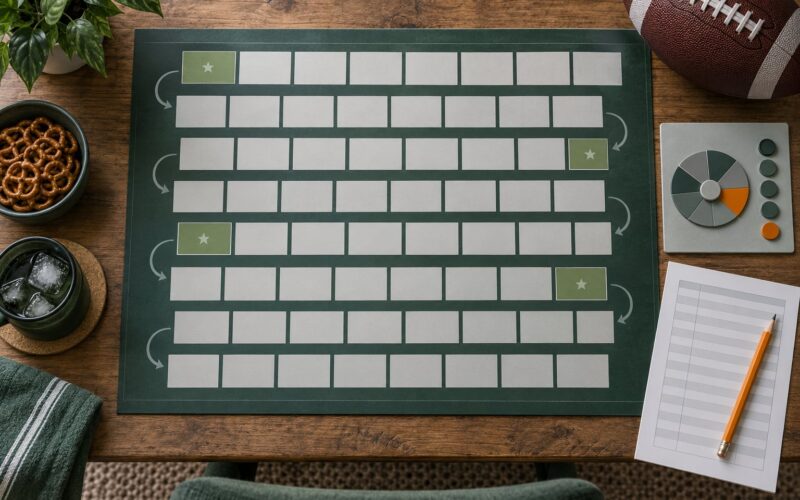
A dynasty rookie draft is the short annual draft a dynasty league runs each offseason, usually a few weeks after the NFL Draft, where managers select incoming rookies to add to the rosters they kept from last season. If you are searching for how dynasty rookie drafts work, the short version is this: your league settings decide everything, and the order is usually linear, not snake. Updated for 2026, here is the full mechanics guide.
New managers tend to arrive with startup-draft instincts. That is the single biggest source of confusion, so I will start with what a rookie draft is not, then walk the whole process in the order you will actually experience it.
Table of Contents
- What Is a Dynasty Rookie Draft?
- How Dynasty Rookie Drafts Work From Start to Finish
- How Dynasty Rookie Drafts Work in Most Leagues
- How Draft Order Is Determined
- How the Rookie Player List Is Created
- How Rookie Draft Strategy Works
- How League Settings Change the Draft
- What Roster Spots Should You Target?
- Can You Trade During a Dynasty Rookie Draft?
- How to Prepare Before Your Dynasty Rookie Draft
- Frequently Asked Questions
- How many rounds is a dynasty rookie draft?
- Are all dynasty rookie drafts snake drafts?
- Does a dynasty rookie draft happen automatically?
- Can you trade during a dynasty rookie draft?
- What happens to rookies after a dynasty rookie draft?
- What Should You Do First?
What Is a Dynasty Rookie Draft?
A dynasty rookie draft is a separate draft from the one you ran at the start of your league. In a startup draft, an empty roster gets filled from every NFL player on the board. In a rookie draft, every roster already carries players, and the only players available are the incoming rookies from this year’s class.
That difference changes everything about how the draft runs. You are not building a lineup from scratch, you are adding to a foundation you or your league mates built a year ago. A player who goes at pick 6 in the rookie draft is pick 6 for the whole draft, then the next round starts again at whichever team has pick 1.
| Format | When the draft happens | Who is on the board | What carries over |
|---|---|---|---|
| Startup dynasty draft | Once, when the league is created | All NFL players, vets and rookies | Nothing, rosters are empty |
| Dynasty rookie draft | Every offseason, after the NFL Draft | That year’s rookie class only | Every roster, exactly as you finished the season |
| Redraft league | Every season | All NFL players | Nothing, every roster is wiped and redrafted |
Rookie drafts and redraft leagues look similar from the outside and are opposites in practice. In redraft you get everyone again each year. In dynasty, a mistake at rookie pick 3 is a problem you own until you fix it.
How Dynasty Rookie Drafts Work From Start to Finish
The process always runs in the same sequence. Here is how dynasty rookie drafts work step by step, in the order it happens.
- Confirm the league rules. Rounds, order type, player list, trade windows and roster limits are all set by the commissioner before draft day.
- Generate or enter the rookie class. Most platforms pull in the real draft class automatically. Some leagues require manual entry.
- Lock the draft order. Usually reverse standings, sometimes a lottery or a custom wheel.
- Build your targets. Tiered boards work better than strict rankings for this format.
- Make selections. Manual pick, autopick, or a draft room where everyone picks at once.
- Finish the configured rounds. The draft ends after the round count in settings, not when players run out.
- Record the transactions. Every pick is logged as a transaction, and the rest of the league sees the results.
Steps five and six are where most beginners get caught. If your league is set to four rounds and you own two picks, you draft twice in round one and twice in round four. There is no second wave of late picks after round four.
How Dynasty Rookie Drafts Work in Most Leagues
Most rookie drafts are linear. That means every round repeats the same pick sequence, so the team picking at 6 in round one picks at 6 in every round. Snake drafts, where the order flips each round, are the exception rather than the rule in dynasty.
| Round | Linear order (12 teams) | Snake order (12 teams) | What each one rewards |
|---|---|---|---|
| Round 1 | 1 through 12 | 1 through 12 | Same. First pick belongs to the same team in both formats. |
| Round 2 | 1 through 12 | 12 back to 1 | Linear repeats the order, snake hands out near-adjacent picks in a row. |
| Round 3 | 1 through 12 | 1 through 12 | Linear keeps the gap between your picks constant all draft. |
| Round 4 | 1 through 12 | 12 back to 1 | In linear, the owner of pick 1 also owns the draft’s final selection. |
Rookie drafts have another wrinkle most startup drafts do not. Plenty of leagues only run three to five rounds, sometimes up to eight. A two-round rookie draft in a deep roster league leaves most of the class undrafted and sitting on the waiver wire within hours of the draft ending.
How Draft Order Is Determined
Order is a league setting, not a universal rule. The most common setup gives pick 1 to the team with the worst record and pick 12 to the champion, but plenty of leagues do something else because the reverse-standings setup creates its own problem.
| Order system | How it works | What it rewards | What it creates |
|---|---|---|---|
| Reverse standings | Worst record picks first, champion picks last | Rebuilders get the top prospects | Temptation to lose games on purpose for pick 1 |
| Playoff-based | Missed playoffs pick first, champion picks last | Playing the full season to reach the draft | Little reward for winning regular-season games |
| Champion picks last | Full standings reversed except the champion slot | Plain old reverse order | Removes part of the tanking incentive |
| Lottery | Weighted random draw for the first picks | Nothing. Order is luck | Removes tanking but can hand a pick to a contender |
| Wheel or custom | Commissioner sets slots, sometimes rotating | Nothing structural | Needs a league vote and a clear rule |
Order matters because it decides who reaches which player. If you own pick 2 and two players you want are taken at 1 and 3, the guy who drafted first got both. Straight drafts make that outcome obvious, which is why reverse standings remain the default in most leagues.
Before you plan anything, open your league settings and read the order setting out loud. Forum answers on this topic disagree constantly because real leagues genuinely differ, and the only version that counts is yours.
How the Rookie Player List Is Created
Most platforms generate the rookie class automatically from the NFL Draft and add the eligible undrafted free agents. Some leagues build the list by hand, which matters more than beginners expect.
When a league enters rookies manually, the commissioner decides the position eligibility and sometimes the player count. That means a running back could be absent from the board entirely, or every UDFA could be excluded so the class is exactly the drafted players. Check how your league treats undrafted rookies before you build a board around them.
Verify eligibility rather than assuming it. Some platforms let you draft only players at positions on your roster, others let you draft anyone. If you are playing in a superflex league, verify that a quarterback or a tight end is actually draftable as a flex before you build around that plan.
How Rookie Draft Strategy Works
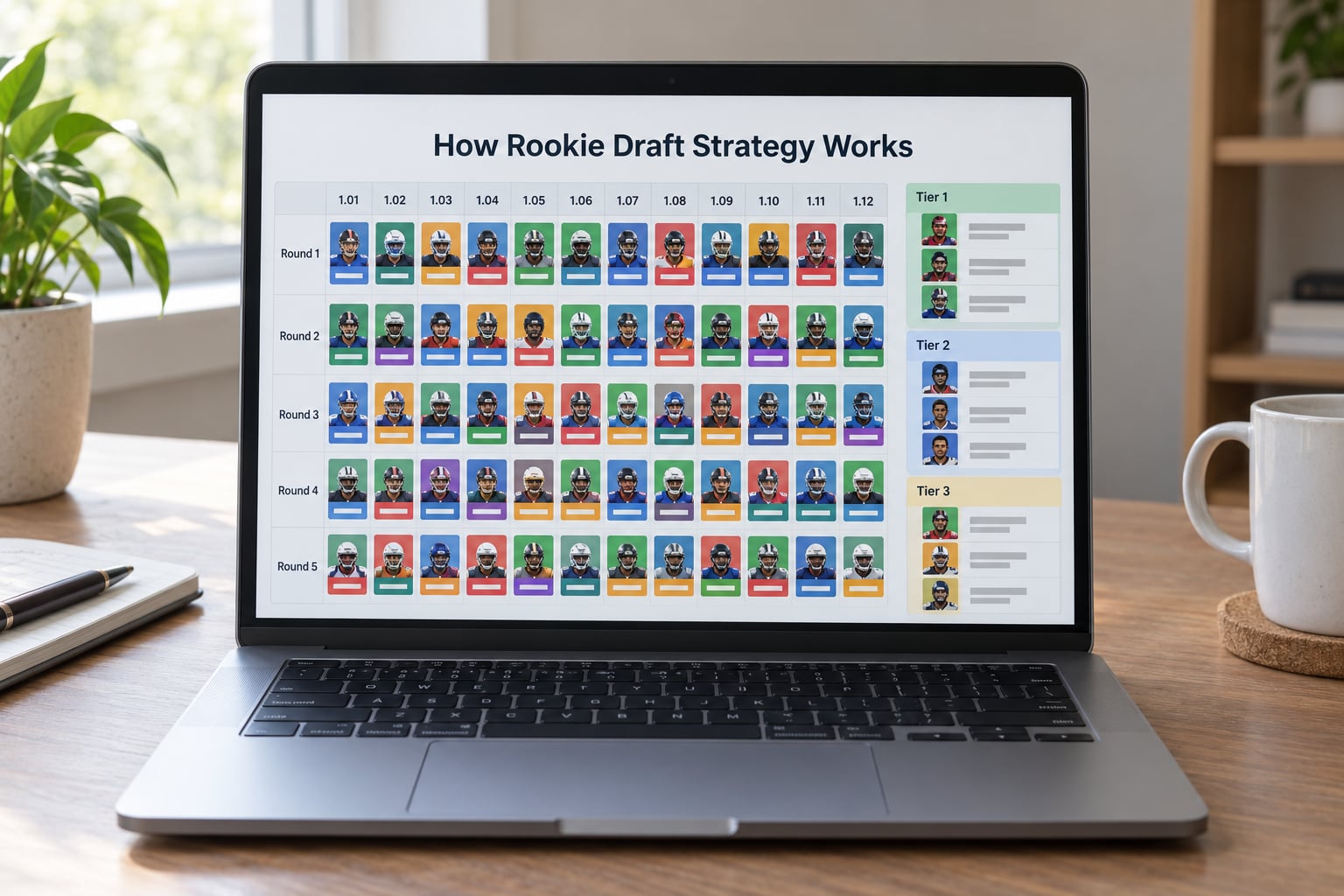
Tier boards beat rigid rankings in this format. Because only rookies are available and the draft is short, a gap on a ranking sheet tells you far less than a clear statement about what is still on the board at your pick.
Build three or four tiers, then add two things on top. Positional scarcity matters more in dynasty than in redraft because a rookie you pass on does not come back next year, and roster needs matter only after scarcity, never before.
- Model the range. Before the draft, estimate when each tier will be exhausted and compare that to your pick.
- Watch the run. If three wide receivers go in the first eight picks, the position you wanted at 20 is gone. Adjust in real time rather than following a board that no longer matches the board.
- Match the prospect to your window. A rookie joining a stable veteran core may sit in taxi for two years. That is fine if you are building for years three and four, wasteful if you need points now.
- Plan a trade at every pick. Decide in advance what it would take to move up or down, so a mid-draft offer is a decision rather than a reflex.
Do not draft more players than you have open roster spots. One thing about how dynasty rookie drafts work catches nearly everyone: a pick you cannot roster is a wasted year of that pick’s value, and a rookie cut on draft night becomes a free agent you have to bid for with waiver priority.
How League Settings Change the Draft
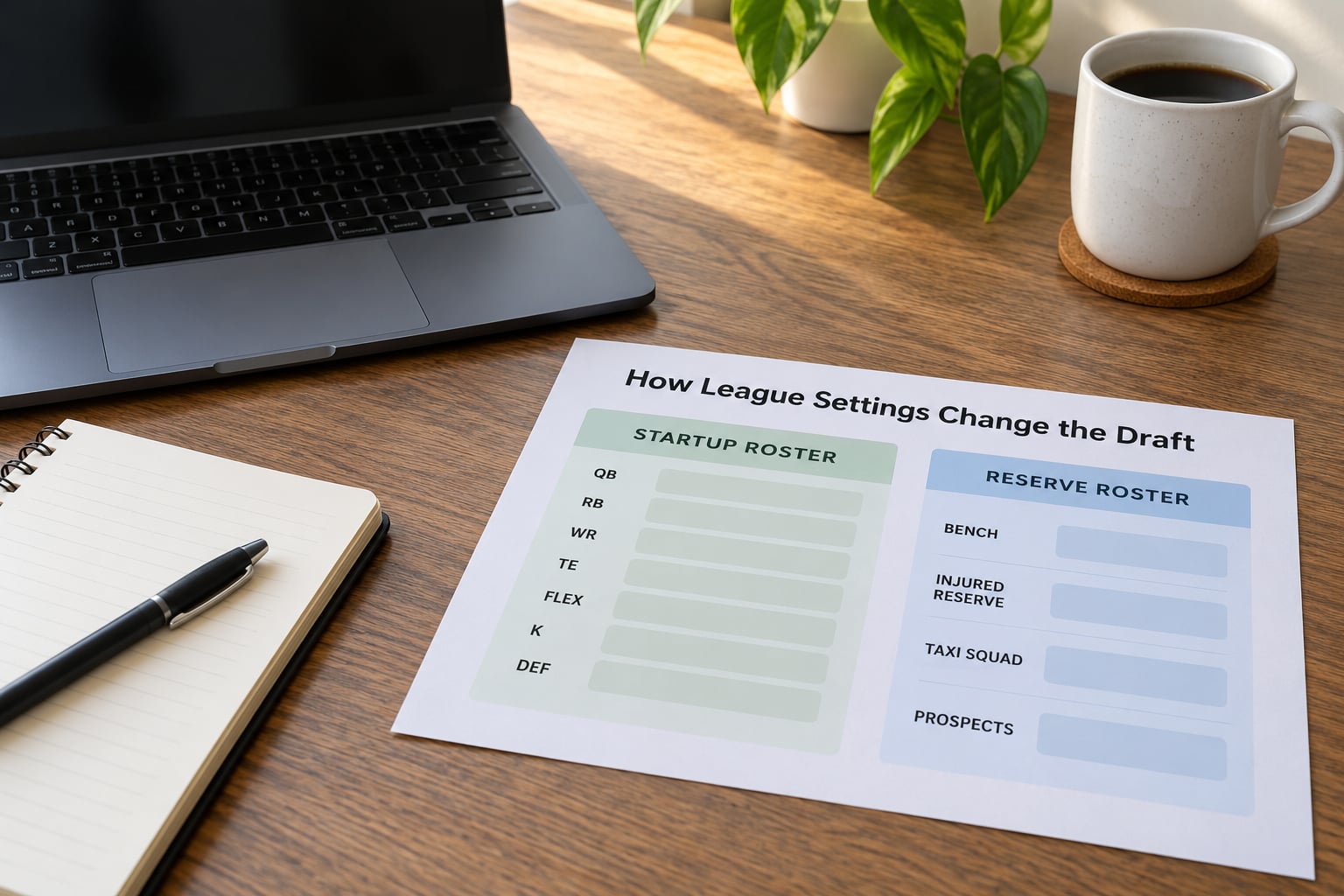
Two leagues with the same twelve teams can have completely different rookie drafts. Every strategy worth having depends on the settings underneath, so these are the ones to check before you plan.
| Setting | Typical effect | Question to ask yourself |
|---|---|---|
| Number of rounds | Three to five is common, some run eight or more | Will part of the class go undrafted and land on waivers? |
| Roster limits | Caps how many players you can keep through the draft | How many open spots do I actually have? |
| Taxi squad | A small roster kept without counting against the active limit | Do I have taxi room for a low-upside prospect? |
| IR slots | Room for injured players, sometimes with return dates | Is my rookie likely to occupy an IR spot all year? |
| Movable slots | Allows adding players without dropping others | Do I need this to reach my targets? |
| Future picks | Some leagues mint a next-year pick per round | Does round three produce a pick I can trade? |
| Rookie eligibility | Limits draftable positions or years of experience | Can I draft every position I need? |
Platforms also disagree on names for the same idea. Some call this a rookie draft, some call it a supplemental draft, and some run both, with the supplemental draft picking up any rookies left undrafted. Find out which one your league uses before you assume what happens to the tail of the class.
What Roster Spots Should You Target?
Turn your roster into a draft plan before the board. Count open spots, subtract the ones you intend to fill through trades or waivers, and you have your real number of targets. That is the honest way to answer which rookies you should be drafting.
A few situations come up constantly. A contender with a thin receiving corps should weight early receiving prospects heavily, because that group reaches its ceiling fast. A rebuilding roster with two open taxi spots and a good young roster can afford a low-upside developmental pick and simply store him. A roster with one open spot has no room for a project, so the only acceptable picks are ones who contribute within two seasons.
Position scarcity also shapes this. Dynasty leagues are usually short at quarterback and tight end and long on running back, because those are the positions most often abandoned after a startup draft. Your league’s actual roster gaps are more reliable than a general rule, though.
Can You Trade During a Dynasty Rookie Draft?
Usually yes, and often before the draft starts. What you can trade, and when, is set by the trade deadline or trade window in settings. Some leagues freeze trading hours before draft day, some allow live trading during picks, and some prohibit draft-day trades entirely.
Missing picks are represented differently across platforms. Often a traded pick shows up as a future pick in the round, and picking in that slot selects the next available team in order. In other setups it is shown as an orphan with no owner, which looks confusing the first time you see it. Find out which convention your platform uses so you know who actually inherits a pick you trade away.
Compare a trade with the value of selecting. When someone offers a future pick for the pick you hold at 15, compare what you expect to be available there with what that future pick will be worth in a class you cannot scout yet. Rookie pick values swing with class clarity, so deals made weeks early are often better deals for the team trading a future pick.
How to Prepare Before Your Dynasty Rookie Draft
The day before, run through this list. It takes twenty minutes and prevents the two mistakes that hurt most, which are drafting into a full roster and drafting on an assumed order.
- Open league settings and note the round count, order type, position eligibility and roster limit.
- Confirm the draft date and whether it is manual, autopick or a draft room.
- Count your picks, including any traded into or out, and work out which round each falls in.
- Count your open roster spots, taxi slots and IR slots.
- Decide whether your plan is to win now, compete in three years, or accumulate assets.
- Build three or four tiers of rookies and mark the points where each tier likely runs out.
- Write down one price for moving up and one price for moving down.
- Decide what you do with every round you own, including the late ones you may be tempted to skip.
On draft day, work the board in order and stay ahead of the autopick clock. Managers who lose picks to autopickups usually were not paying attention to a pick count they thought they had already used.
Frequently Asked Questions
How many rounds is a dynasty rookie draft?
Most dynasty rookie drafts run three to five rounds, and some leagues go as long as eight. The right number depends on roster size. If your roster holds twenty-five players and the draft stops at three rounds, a large part of the rookie class goes undrafted and lands on the waiver wire. More rounds than you need is safer than too few.
Are all dynasty rookie drafts snake drafts?
No. Rookie drafts are usually linear, meaning the same pick order repeats in every round, so the team picking at slot 6 picks at slot 6 in every round. Snake drafts appear occasionally, where the order flips each round, but they are the exception. Some platforms offer both, so check the order type in your league settings before planning around your picks.
Does a dynasty rookie draft happen automatically?
It depends on the platform and the league setting. Some leagues run the draft on a set date with an autopick timer for managers who go quiet. Others require the commissioner to start it or schedule it in advance. Many platforms will also generate the rookie class and set the order without any action from you, so the draft itself can still need starting manually.
Can you trade during a dynasty rookie draft?
Often yes, but it depends on your trade window setting. Some leagues let you trade right up until picks begin, some allow live trades on draft day, and others freeze trading once the draft starts. Missing picks are shown either as a future-round pick or as an orphan that passes to the next team in order, and the convention differs by platform.
What happens to rookies after a dynasty rookie draft?
Drafted players go straight to your roster, and they take up roster space against your limits immediately. Players you did not draft and who were not added to the free agent pool by the league are usually available through your waiver wire, with priority going to the team with the lowest standing or highest waiver priority. Some platforms run a separate supplemental draft for leftovers.
What Should You Do First?
Open your league settings and read the draft section out loud: rounds, order type, player list, roster limit, trade window. That single step explains how dynasty rookie drafts work in your league specifically, and it is where most wrong assumptions come from.
Then count your open roster spots and build your targets from the players and positions those rules actually make available. Everything else on draft day follows from that.