A flex spot is a starting lineup slot that isn’t tied to one position. It lets you start an extra running back, wide receiver, or tight end in a single slot, and in superflex leagues a quarterback too. The player you drop in scores exactly as he would in his own position.
That last part is where most beginners get it wrong. Flex changes who you can start, not how points are tallied.
Table of Contents
- What Is a Flex Spot in Fantasy Football?
- Flex Eligibility Rules and How Scoring Works
- How Does a Flex Spot Work in Fantasy Football?
- How Does a Flex Spot Affect Weekly Lineup Strategy?
- How Does a Flex Spot Change Fantasy Football Draft Strategy?
- Is a Flex Spot Better Than a Running Back Slot?
- How Do Flex Spots Work in Redraft, Keeper, and Dynasty Leagues?
- Frequently Asked Questions
- What positions can go in the flex spot in fantasy football?
- Do flex players score more points?
- Is it better to flex a WR or an RB?
- Should you put Thursday night players in flex?
- What is superflex in fantasy football?
- Can a kicker play in the flex spot?
- Conclusion
What Is a Flex Spot in Fantasy Football?
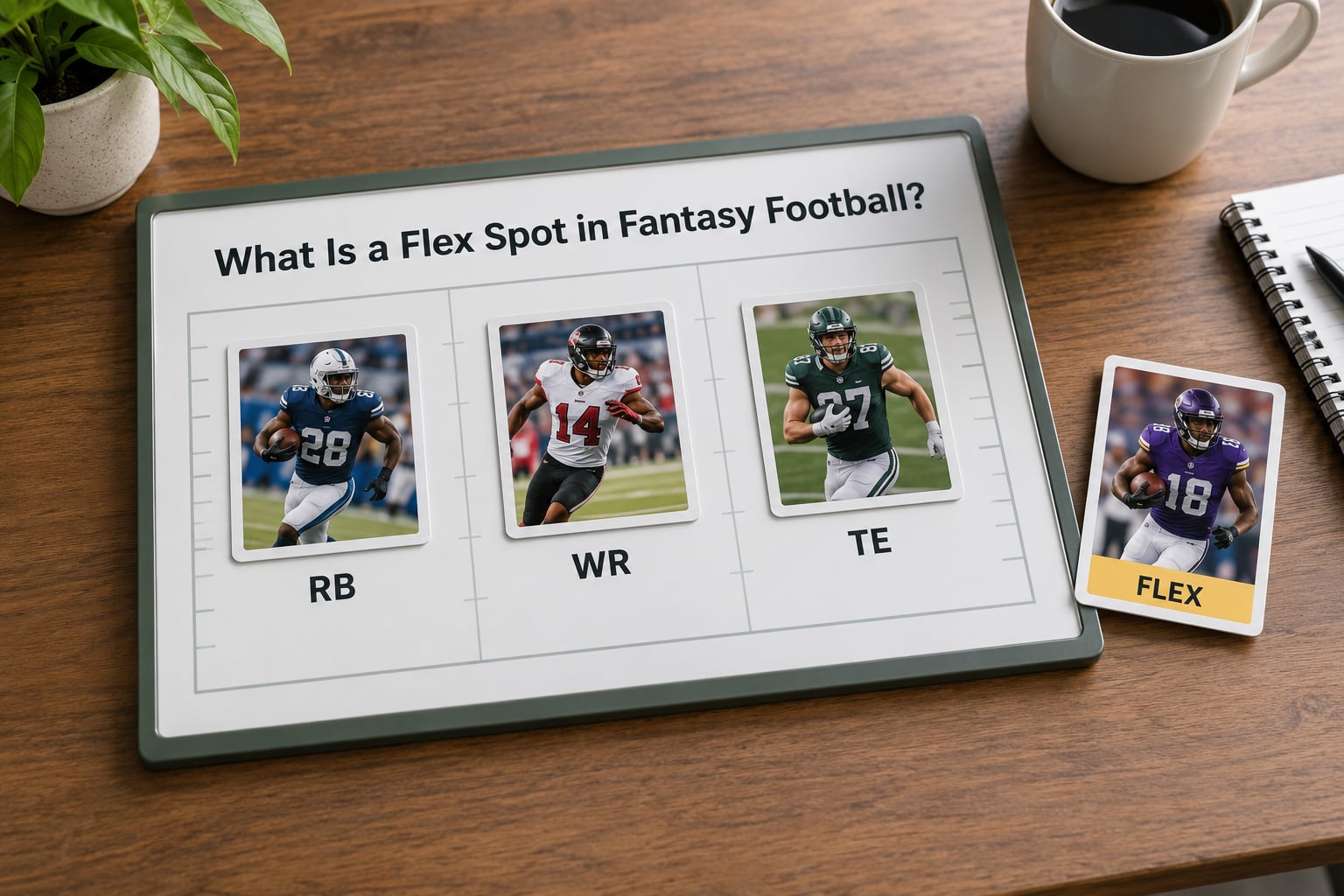
A standard flex spot accepts any running back, wide receiver, or tight end on your roster. Most redraft leagues built on ESPN, Yahoo, Sleeper, or Fantrax default to that. Some formats widen it, and the difference matters more than it sounds.
| Format | Positions accepted at flex | Quarterback allowed | What changes |
|---|---|---|---|
| Flex | RB, WR, TE | No | Runs one extra skill player, whoever has the best week |
| Superflex | RB, WR, TE, QB | Yes | Quarterbacks stay relevant all year and QBs get drafted far earlier |
| Multi-flex or two-flex | Usually RB, WR, TE, sometimes QB and kicker depending on the platform | Varies | Two or more flex slots, so a deep roster can start three receivers at once |
Flex Eligibility Rules and How Scoring Works
Eligibility comes from your league settings, not from a universal rule. MFL and Scott Fish Bowl setups can be configured to let a kicker occupy a flex slot. Big redraft platforms generally don’t.
Scoring is the part every league handles the same way. A wide receiver in your flex slot earns one point per reception in a PPR league because that’s the scoring rule for receivers in that league. He gets no bonus and no penalty for being flex-eligible.
Set-position eligibility is the mirror image. Your WR1 slot accepts only a receiver, and he still scores like a receiver. The difference is that the flex slot will always take a better-scoring player of any eligible position, while a set slot makes you eat the dud at that position.
How Does a Flex Spot Work in Fantasy Football?
Every week you get a lineup window, usually a few days before kickoff. During that window you fill each starting slot, including the flex slot, and the platform locks your lineup at the start of the first game.
Four mechanics decide whether the flex spot is actually helping you:
- Count each player once. A receiver you start at flex occupies the flex slot only. You cannot also list him at WR1, and his stats are counted a single time.
- Apply positional scarcity at lock time. Every flex-eligible roster has a best candidate. If your third receiver out-projects your second running back this week, the flex spot exists so you start the third receiver anyway.
- Check the specific rule. Some leagues require you to fill the flex slot before kickoff on a set day rather than at the start of games. Some let you swap it right up to lock.
- Know who is eligible. If you built the league on a platform that excludes kickers or quarterbacks from flex, a player in that spot simply won’t drop in.
Where you find the setting depends on the platform. In ESPN and Yahoo it sits under league settings and roster settings. In MFL and Fantrax it’s in the lineup slot configuration when you create or edit a division. Sleeper exposes it under league settings and custom scoring.
How Does a Flex Spot Affect Weekly Lineup Strategy?
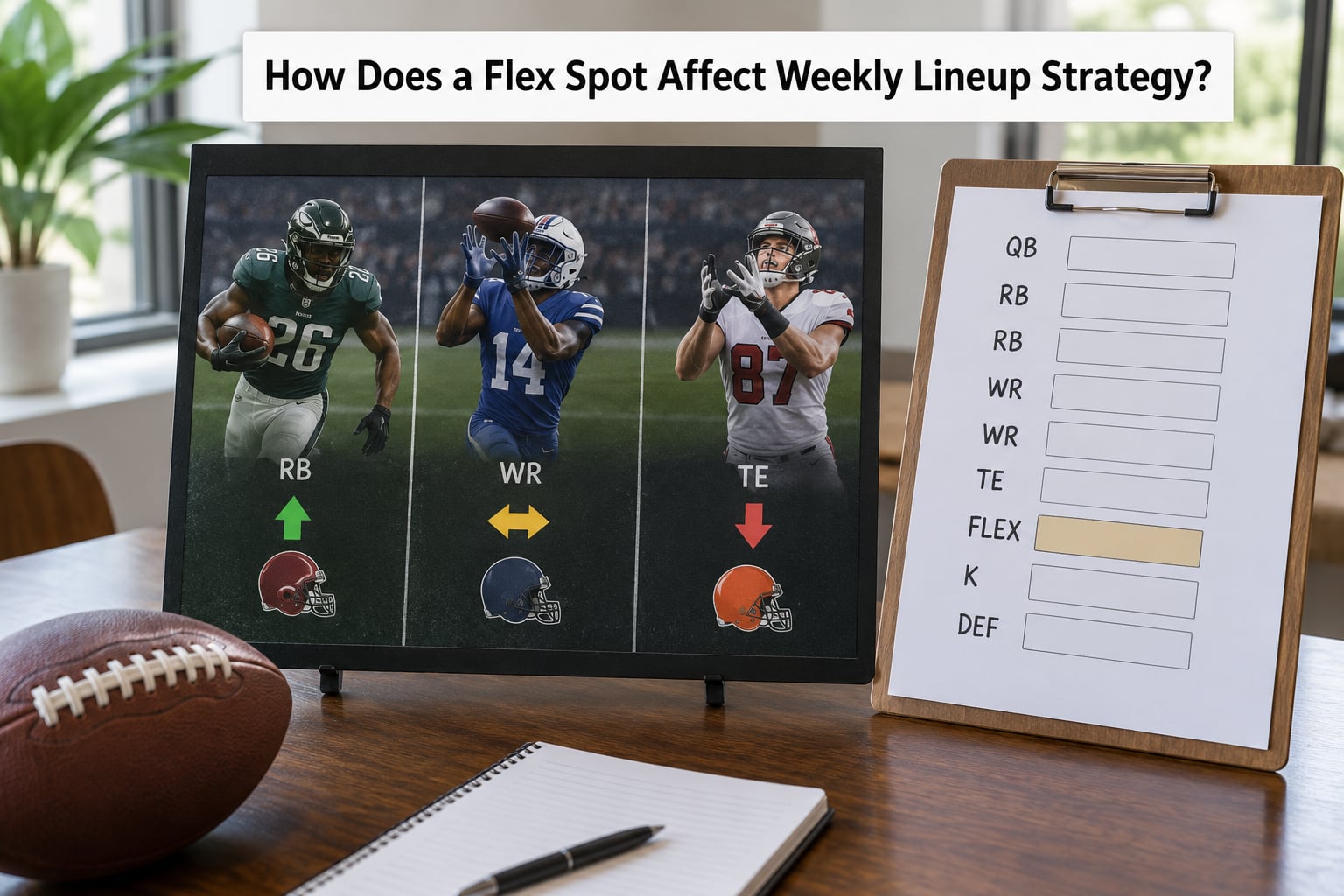
The flex decision takes under two minutes if you run it in the same order every week. Volume first, then format, then matchup, then floor versus ceiling, then your bench.
- Start with projected volume, not last week’s box score. Touches and target share predict far better than one game. A receiver who caught six balls on three targets is a different player from one with 40 percent of his team’s targets.
- Match the lean to your scoring format. The same two players can be a clear call in one league and a coin flip in another.
- Weigh the matchup. Opposing defensive schemes and coverage personnel move weekly projection totals more than talent does.
- Decide if you need a floor or a ceiling. If you’re chasing a playoff spot, the ceiling matters. If you’re protecting a lead, the floor usually wins.
- Confirm you have a legal replacement. The flex spot is a safety net only while it’s still empty. Fill it on Wednesday and a Sunday injury means an empty lineup.
The scoring format drives most of the decision:
| Scoring format | Usual flex lean | Why |
|---|---|---|
| PPR | Wide receiver | Receptions create points on their own, so a target-heavy receiver has a higher floor than a low-volume back |
| Half-PPR | Receiver or pass-catching back | The gap narrows, so role and matchup decide more weeks |
| Standard | Running back | Without reception points, a workhorse back’s carries and touchdowns dominate a typical flex week |
There’s one timing rule that community consensus treats as close to law: play your flex as late as you possibly can. That advice showed up again and again in r/fantasyfootball threads, and the reasoning is simple. A Thursday night player locked into flex on Wednesday removes your only slot for a Sunday injury replacement.
Kicker eligibility is the other structural quirk. On formats that allow it, a kicker at flex turns the slot into a full-time job, since you’d rather start your third receiver than your kicker. On formats that don’t, the kicker slot is exactly that: a starter nobody wants.
Player profile adds a risk layer you can’t see in projections alone:
| Profile | Best use in flex | Main risk |
|---|---|---|
| Pass-catching running back | PPR leagues, where the reception points matter most | Split carries reduce touches in any game the team doesn’t script the run game |
| Target-heavy wide receiver | PPR and half-PPR, especially against weak slot coverage | Volume without a touchdown ceiling in standard scoring |
| Touchdown-dependent tight end | Formats where the tight end position is thin and he’s a clear upgrade | Red-zone chances disappear without a touchdown |
| Committee back | Standard scoring, where any goal-line work has value | Split share that can halve his projection week to week |
How Does a Flex Spot Change Fantasy Football Draft Strategy?
Flex eligibility pulls value toward the middle of your draft board. A third wide receiver drafted in round seven is a starter on a flex roster and a bench player on a roster with no flex, so his real demand is higher than a basic positional need chart suggests.
Superflex stretches that further and pulls quarterbacks up. Once a QB can start anywhere outside his own slot, the top twelve or so quarterbacks are never bench players. That reshapes average draft position and it reshapes auction values, where a franchise quarterback you can flex is worth more than the same player’s straight positional slot implies.
The practical advice is to value players on the number of slots they can fill rather than the one they name. Running backs with receiving work gain ground because they start at two positions. Receivers drafted as pure fliers gain ground because a flex slot gives them somewhere to play. Pure kickers lose ground in any league where a kicker can start at flex.
Don’t overcorrect, though. Flex removes the floor on bad weeks, it doesn’t remove scarcity entirely. Tiers get deeper, but the top of each position still separates from the rest.
Is a Flex Spot Better Than a Running Back Slot?
A flex spot beats a dedicated running back slot in most standard redraft setups, because it lets you start the best available player instead of committing to one position in advance. The exception is a league where running back value is unusually compressed, which happens in PPR formats with heavy scoring at other positions.
The trade-off sits in three places: eligibility, scarcity, and bench value. Flex wins on eligibility, since one slot accepts three positions. It loses a little on scarcity, since the extra slot dilutes positional depth across the league. And it wins on bench value, since your third receiver suddenly has a starting job, which makes waiver claims and late-round targets more productive.
A dedicated running back slot is better when you want a predictable constraint. In standard scoring with a strong running back class, forcing yourself to start two backs keeps you honest about draft value and stops you from chasing receiver fliers every week. Managers who love that discipline often prefer the rigidity on purpose.
How Do Flex Spots Work in Redraft, Keeper, and Dynasty Leagues?
Redraft leagues churn weekly. Every season the flex candidate changes, so the slot is a weekly tool rather than a season-long anchor. That makes the kickoff-timing habit most valuable here, since you know a replacement will eventually be needed.
Keeper leagues add a math problem. A player you keep is a player you don’t draft, and the players you don’t draft need a reason to stay on a roster. Flex eligibility is that reason for mid-tier receivers and pass-catching backs, which is why those players can fetch a second-round keeper value.
Dynasty leagues care about the age curve underneath the spot. Flex gives a 23-year-old receiver a weekly job right away, which raises his dynasty value relative to a same-age player on a roster without flex. Over a rebuild, though, the flexibility is mostly about surviving down years, not about maximizing weekly ceilings.
Bye weeks deserve their own note. In larger leagues, a bye can push a starter to your bench and pull a bench player into flex. Check the schedule before you build your lineup, not after a starter’s season ends.
Frequently Asked Questions
What positions can go in the flex spot in fantasy football?
In most redraft leagues the flex spot accepts running backs, wide receivers, and tight ends. Superflex leagues also accept quarterbacks, and some platforms allow kickers or defensive players through custom settings. Eligibility is set in your league configuration, not by a universal rule, so check the flex eligibility setting on your specific platform before you plan a lineup.
Do flex players score more points?
No. The flex slot changes where a player lines up, not how he is scored. A receiver in your flex slot earns the same points per reception in a PPR league as he would in your WR1 slot, with no bonus or penalty attached to the flex designation. Flex helps you start more scoring, not score more per player.
Is it better to flex a WR or an RB?
It depends on your scoring format. In PPR leagues, lean on the wide receiver because every reception is worth a point and receivers have higher floors. In standard scoring, lean on the running back, since carries and touchdowns carry the value without reception points. Half-PPR leagues sit in between, so role and matchup decide most weeks.
Should you put Thursday night players in flex?
Usually not. Locking a Thursday night player into flex early removes your only open slot for a Sunday injury replacement. The advice most often repeated in r/fantasyfootball threads is to play flex as late as possible. If you do start a Thursday player in flex, make sure you have another eligible player on your bench first.
What is superflex in fantasy football?
Superflex is a flex spot that also accepts a quarterback. Because quarterbacks become starting options outside their own slot, the top passers are drafted much earlier and auction for more money. It is strictly more flexible than a standard flex spot, and it makes league settings worth checking carefully before you draft.
Can a kicker play in the flex spot?
Sometimes. MFL and Scott Fish Bowl leagues can be configured so a kicker is flex-eligible, which makes the slot a full-time job since you’d rather start a third receiver. Major redraft platforms generally exclude kickers from flex. Check your league settings rather than assuming either answer, because the configuration is what decides it.
Conclusion
The flex spot exists for one reason: it stops a bad week at one position from costing you the whole game. It widens who you can start without changing how anyone scores, and it rewards you for waiting until the last minute to fill it.
Start with the setup instead of the strategy. Open your league settings, confirm which positions your flex accepts, and note whether kickers or quarterbacks qualify. After that, the weekly habit is simple: project volume, match the lean to your scoring format, and hold the slot open until lineup lock so you can absorb an injury.