
Tight end premium scoring is a fantasy football rule that gives tight ends extra points per reception compared with every other skill position. Usually it means an additional flat bonus on each catch, so a tight end’s reception is worth 1.5 or 2 points in a full-PPR league and 1.0 or 1.5 points in a half-PPR league. That single setting changes draft boards, trade offers and how you build a roster.
I’ve run the numbers on plenty of dynasty and redraft formats over the years, and the premium is the cleanest way to make the position matter without redesigning your whole league. This guide covers what the rule actually does, how to pick the size of the bonus, and where it stops working.
Last updated: October 2026
Table of Contents
- What Is Tight End Premium Scoring?
- How Tight End Premium Scoring Works
- How the bonus gets applied
- What the label “1.5 TE premium” actually means
- Why Leagues Use Premium Scoring for Tight Ends
- What Is Tight End Premium Scoring Compared With Standard Scoring?
- How to Use Premium Scoring in Redraft, Keeper, and Dynasty Leagues
- Redraft leagues
- Keeper leagues
- Dynasty and best ball leagues
- Commissioners: setting the bonus
- Frequently Asked Questions
- Is tight end premium scoring better for every league?
- Does tight end premium scoring mean tight ends score more fantasy points?
- How should I value a tight end in a premium-scoring draft?
- Should I draft a tight end earlier in a premium-scoring league?
- What is the difference between TE premium and TE-only PPR?
- How do I set up tight end premium scoring on my league?
- The Short Version
What Is Tight End Premium Scoring?
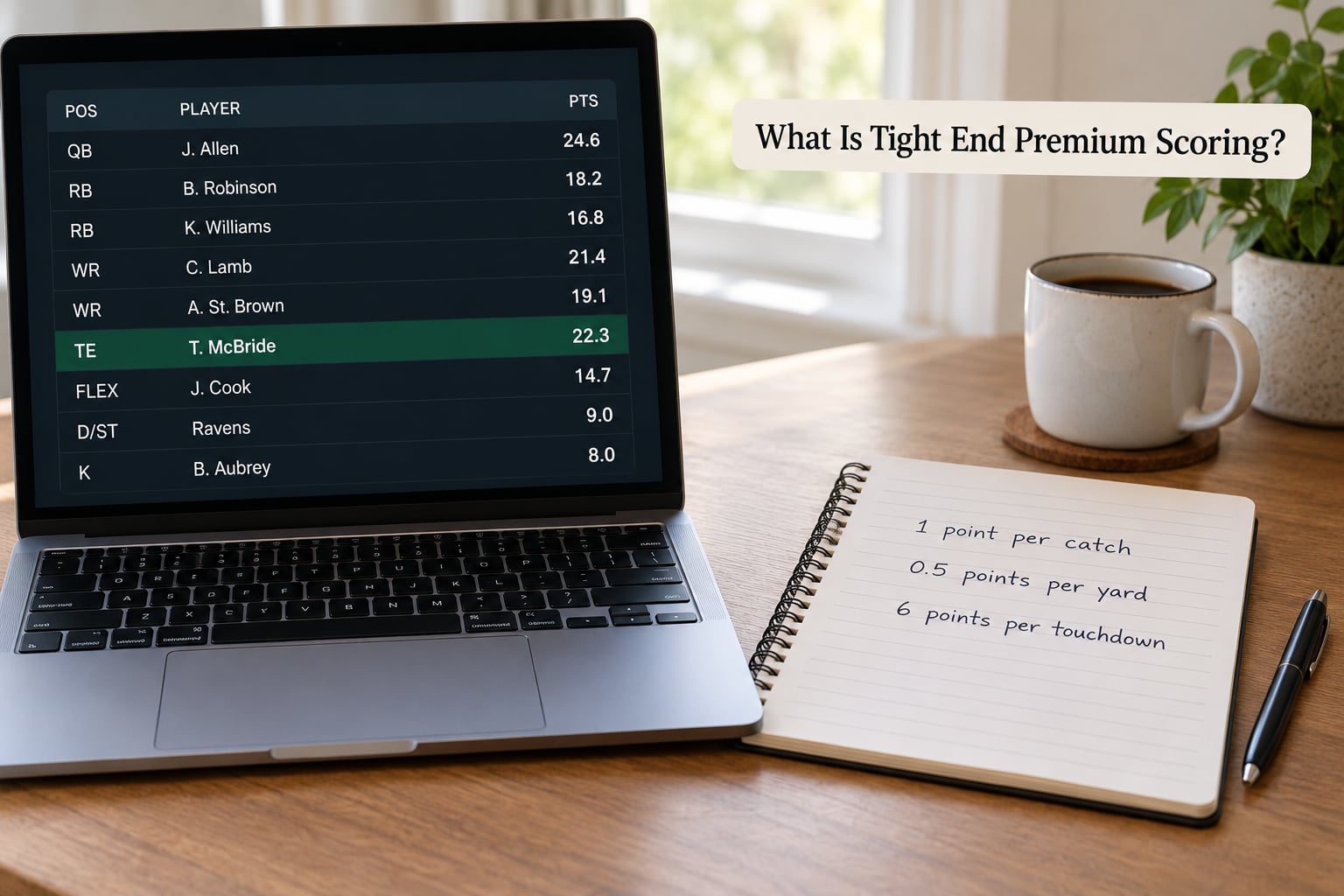
Tight end premium scoring is a league setting that adds fantasy points to receptions made by tight ends only. Every other position keeps scoring the league’s normal rate, so the premium never touches running backs, wide receivers, quarterbacks or tight ends who don’t catch the ball. It is a positional rule, not a general offensive boost, and that distinction is what makes it so surgical.
Before the numbers make sense you need the base format straight, because the premium is always added on top of it.
- Standard scoring: no points per reception. A receiving yard is worth roughly a tenth of a point, so a 60-yard, 6-catch game scores about 6 points.
- Half-PPR scoring: half a point per reception. The same game gains 3 points.
- Full PPR scoring: a full point per reception. The same game gains 6 points.
PPR is the most common base in competitive fantasy football because it rewards volume, and volume is the part of a receiving player’s game you can actually project. A player who catches seven short passes on a bad passing day scores better in PPR than a player who catches three for 40 yards on a great day, which is roughly the behaviour most drafters believe is correct.
What the premium is not: it is not a rule that gives tight ends more touchdowns, not a rule that requires two tight ends in your lineup, and not the same thing as TE-only PPR. Managers mix those up constantly, so I’ll sort them out shortly.
How Tight End Premium Scoring Works
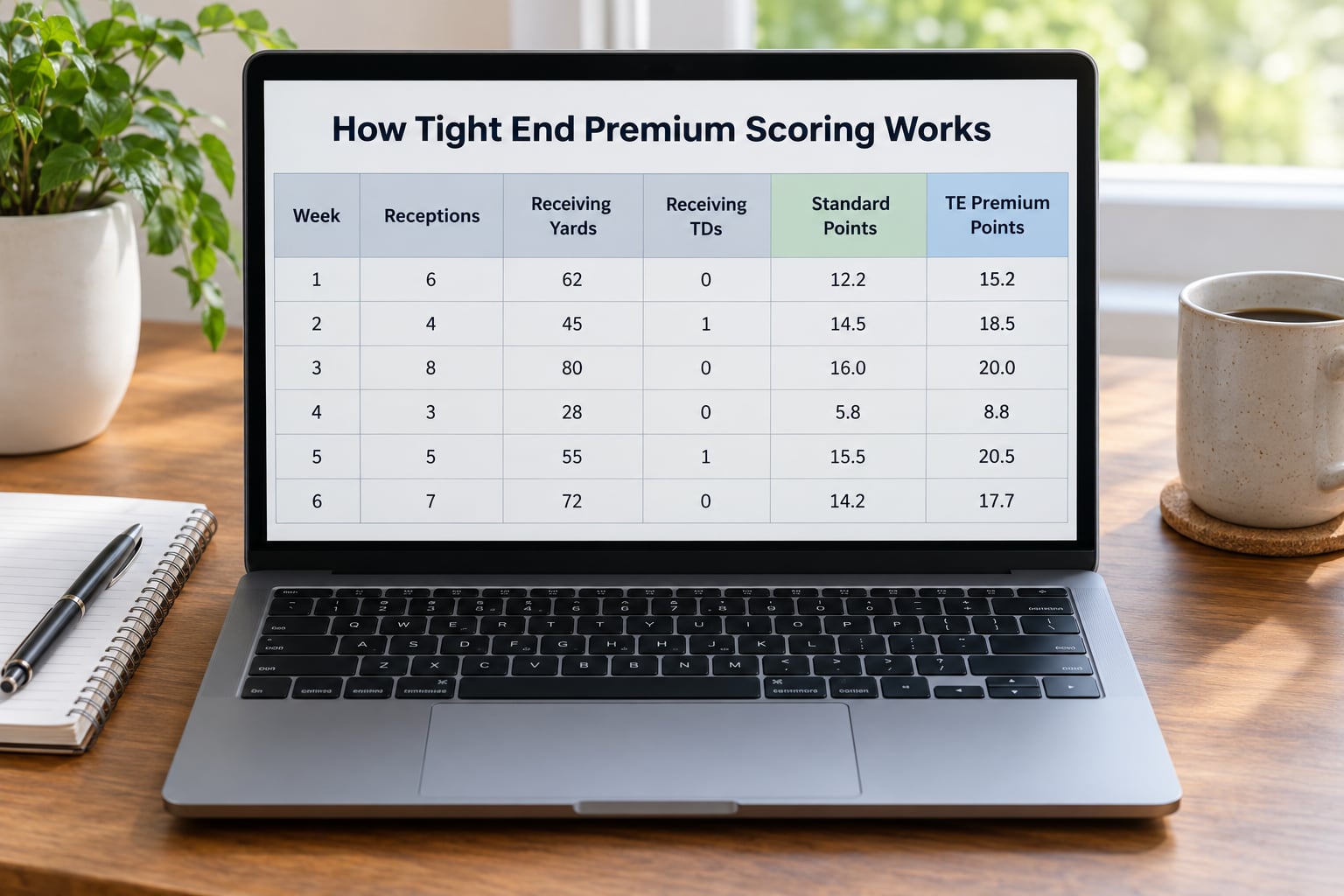
How TEP scoring works: the league applies its normal reception value to all positions, then adds a bonus to tight ends for each reception. In a half-PPR league with a +0.5 premium, running backs and wide receivers earn 0.5 points per catch while tight ends earn 1.0. In a full-PPR league with a +1.0 premium, tight ends earn 2.0 points per catch while everyone else earns 1.0.
How the bonus gets applied
Most leagues use a flat bonus, not a multiplier, and the difference matters. A +0.5 bonus adds half a point to every catch no matter how many there are. A multiplier such as 1.5x doubles the reception value on catch number one and again on catch number eight, so high-volume tight ends gain far more than low-volume ones.
Here is the same stat line, six catches for 60 yards and a touchdown, scored five different ways under a standard yardage rate of one point per 10 yards and six points per touchdown.
| Format | Per catch | 6 catches | 60 yards | 1 TD | Weekly total |
|---|---|---|---|---|---|
| Standard | 0 | 0.0 | 6.0 | 6.0 | 12.0 |
| Half-PPR | 0.5 | 3.0 | 6.0 | 6.0 | 15.0 |
| Half-PPR with +0.5 premium | 1.0 | 6.0 | 6.0 | 6.0 | 21.0 |
| Full PPR | 1.0 | 6.0 | 6.0 | 6.0 | 18.0 |
| Full PPR with +1.0 premium | 2.0 | 12.0 | 6.0 | 6.0 | 24.0 |
Run that bonus across a season and it stops looking small. A tight end averaging six catches a play over 17 games finishes with about 102 receptions, which is 51 extra points in a full-PPR league with a +1.0 premium and 25.5 extra points in a half-PPR league with a +0.5 bonus. For context, FantasyPros has put the season bump for a top-15 tight end at roughly 31 points, which lines up with a moderate bonus on a player in that target range.
What the label “1.5 TE premium” actually means
Here’s the trap that causes real arguments in real leagues. A league called “1.5 TE premium” might mean tight ends score 1.5 points per catch total, or it might mean 1.5 bonus points added on top of a 1.0 base. In the first reading a tight end with six catches earns 9 points; in the second, 15 points. Same label, wildly different leagues.
Forum posts about dynasty leagues repeatedly show the same league name attached to completely different math, and the label is almost never the fault. The bonus number is meaningless without knowing the base format and whether it is flat or multiplied. Always ask for both before you join.
Why Leagues Use Premium Scoring for Tight Ends
The reason is a structural quirk of the NFL position. A franchise rarely has one legitimate receiving option at tight end, so scoring is concentrated in the hands of two or three pass-catcher types while the fourth tight end on the wire plays a blocking role. In a normal PPR league that concentration barely shows up in the standings, because a tight end who catches four passes a game still looks like a bench filler even when he’s out-producing a starting wide receiver.
The premium is meant to fix that by creating four effects at once.
- Real positional scarcity. Tight ends become a draft investment instead of a throwaway pick, because a top receiving tight end is now worth an early round selection.
- Volume beats touchdown luck. A bonus per catch rewards a 6-catch, 0-touchdown week the same way it rewards a 6-catch, 1-touchdown week, which pushes value toward target share.
- Streaming stops paying. If your backup tight end averages 2.2 catches, the premium adds about one point a week. Nobody’s week is won by a single point, so the lazy late-round strategy quietly dies.
- A wider gap between elite and replacement. This is the honest catch, and more on it below.
The cost is that running backs and wide receivers become slightly less valuable relative to tight ends, and in a full-PPR league the premium can push a receiver’s per-catch value close to a running back’s per-carry value. Most managers discover they don’t mind, because the roster spots saved on tight end duds go straight into more receiving volume at running back and wide receiver.
What Is Tight End Premium Scoring Compared With Standard Scoring?
The cleanest comparison uses identical player profiles, because the format does not change who is good. It only changes how their production is translated into points.
| Player profile | Standard | Half-PPR | Full PPR | Full PPR + premium |
|---|---|---|---|---|
| Elite target hog, 6 catches a game | 12.0 | 15.0 | 18.0 | 24.0 |
| Volume tight end, 4 catches a game | 10.5 | 12.5 | 14.0 | 18.0 |
| Touchdown-dependent tight end, 2 catches, 1 TD | 8.0 | 9.0 | 10.0 | 12.0 |
| Streaming tight end, 2 catches, 0 TD | 2.0 | 3.0 | 4.0 | 6.0 |
| Wide receiver, 6 catches a game | 12.0 | 15.0 | 18.0 | 18.0 |
Read the last two rows together and you get the entire argument for and against the format in miniature. A wide receiver’s number is identical in the final two columns because the premium never touches them. The touchdown-dependent tight end gains 2 points, which is nice but not enough to matter, while the high-volume tight end gains 10 and becomes a genuine pick.
So the profiles that benefit are the ones you would target first anyway: high target share, lots of short passes, contested-catch volume, tight ends used as a primary outlet. The profiles that gain nothing are the ones that were already difficult to project: small-bodied tight ends who need a goal-line touchdown to produce. TE premium does not make the position consistent. It makes the top of it expensive.
How to Use Premium Scoring in Redraft, Keeper, and Dynasty Leagues
Redraft leagues
Rebuild your board around the premium before the draft, not during it. Project each tight end’s weekly catches, add the bonus, and only then compare him to the running back and wide receiver at the same draft slot. A cheap way to sanity-check the result: the third tight end off your board should be worth roughly a mid-round running back, and if he isn’t, your board was built on non-premium math.
On waivers, raise your threshold for adding a tight end by the size of the bonus. A backup with a two-catch projection is not worth a roster spot just because he plays tight end; he needs to clear the points you’d get from the running back on the same bench slot.
Keeper leagues
The premium mostly changes which players are worth keeping, not which are worth drafting. A second-year tight end who gained half a point per catch all season is now more expensive to keep than a non-premium board suggests, and dynasty-analytics sites such as KeepTradeCut expose a tight end premium toggle so you can compare values under the right math. Match that toggle to your league’s actual base before you trade anything.
Dynasty and best ball leagues
This is where the case is strongest. In dynasty you are buying years of production, and production per catch is the only receiving stat that compounds cleanly. A young receiving tight end accrues value through his route tree expanding, not through red-zone touches that may never come. The premium pulls that value forward in your valuation and makes holding through the lean years easier to justify.
Watch rookie and devy boards, though. Most are published on non-premium projections, so the same player looks like a reach until you add the bonus yourself. Do that arithmetic on every rookie tight end before you decide your draft slot.
Commissioners: setting the bonus
If you are creating a league, a moderate bonus is the safest choice. Start at half a point per catch in a half-PPR league, or one point per catch in full PPR. Sleeper and Yahoo both support the setting directly in league settings, and Yahoo has shipped TE premium as a named format; ESPN and Fantrax handle it through custom scoring on the receiving categories. Announce the exact number and base format in your league settings text, because that is the single change that prevents the most arguments.
Frequently Asked Questions
Is tight end premium scoring better for every league?
No. It suits competitive redraft, superflex, best ball and dynasty leagues where managers want the tight end position to carry real draft weight. In a casual league it mostly adds confusion, and in a very deep or low-scoring league the bonus rarely separates players. Judge it by whether your league already complains that tight ends do not matter.
Does tight end premium scoring mean tight ends score more fantasy points?
Yes, but only where the league’s rules apply it. Tight ends gain points on each reception, while every other position scores unchanged. If your league uses a flat bonus, a tight end with six catches gains six bonus points at +1.0, or three at +0.5. Nothing extra is added for touchdowns or rushing yards.
How should I value a tight end in a premium-scoring draft?
Project weekly catches first, add the bonus to the base reception value, then compare the result with the baseline output of the running backs and wide receivers available at that same draft slot. Value the player against a position-specific baseline, not against total season points, or you will keep reaching for tight ends who simply play a premium position.
Should I draft a tight end earlier in a premium-scoring league?
Only when the scoring change moves the player past the alternatives at that pick, not because the position is nominally boosted. In practice that means the top three or four receiving tight ends become early-round picks and everything below them stays a late-round dart. The premium does not make every tight end worth an early pick, and the bottom of the position remains a weekly coin flip.
What is the difference between TE premium and TE-only PPR?
TE premium is a bonus added on top of normal scoring, so wide receivers and running backs still earn full points per reception. TE-only PPR strips the reception point from those positions and reserves it for tight ends. One format raises tight end value; the other punishes everyone else to do it, which is why the labels get swapped in league ads.
How do I set up tight end premium scoring on my league?
On Sleeper and Yahoo, open league settings and look for a tight end premium or bonus-points-per-reception option, then enter the bonus and confirm the base reception value shown next to it. On ESPN and Fantrax, use the custom scoring editor and add a bonus in the receiving categories restricted to the tight end position. Write the bonus and base format into your league settings text so nobody has to ask.
The Short Version
Tight end premium scoring adds points to tight end receptions only, and the size of the bonus you choose decides whether it changes your league or just its label. If you run a competitive league where managers complain that tight ends don’t matter, add half a point per catch in half-PPR or one point in full PPR, rebuild your board under those numbers, and expect the top three or four at the position to become real picks. Everything below them stays exactly as random as it was.