You do not need to know football to handle a draft. Almost everyone who reads how to handle a draft when you know nothing about the NFL is actually asking about a fantasy league draft, so here is the short answer: know your league’s scoring and roster slots, take the best player on a consensus cheat sheet who fills a slot you need, and never reach for a famous name just because you have heard of him. That process works in a casual league with your friends, and it works in a serious one.
People who do not watch football finish in the middle of their league every season. The sport is far more complicated than fantasy scoring, and the scoring part is the piece you can actually control. You need about an hour of preparation and a repeatable decision for every pick.
One note before the steps, because this search term confuses people. There are two different drafts. The NFL Draft happens once a year, and it is how the 32 NFL teams select college players. Your fantasy league draft is a private event where managers pick players onto their own rosters, usually in late summer or early September. Everything below covers the second one.
Table of Contents
- What You Need Before Draft Day
- How to Handle a Draft Step by Step
- 1. Learn the league rules and scoring format
- 2. Build a simple list of fantasy football draft targets
- 3. Understand draft position value
- 4. Set tiered targets for each round
- 5. Draft by role and opportunity
- 6. Use a simple draft-day decision process
- Common Mistakes to Avoid in a Fantasy Football Draft
- Frequently Asked Questions
- Can you explain the NFL Draft in a simple way?
- Do I need to know football to play fantasy football?
- How many mock drafts should I do before my real draft?
- Should I follow expert rankings and ADP if I know nothing?
- How is a keeper or dynasty league different from a redraft league?
- Can AI do my fantasy draft for me?
- Conclusion
What You Need Before Draft Day
Gather these five things and you are ready. Anything beyond them is optional and mostly noise.
- League settings. The invite link or league page, showing your roster slots, scoring format and number of teams. This is the single most important item.
- A consensus cheat sheet. One page, all positions ranked, with the scoring format matched to your league. Free ones exist on every major fantasy site.
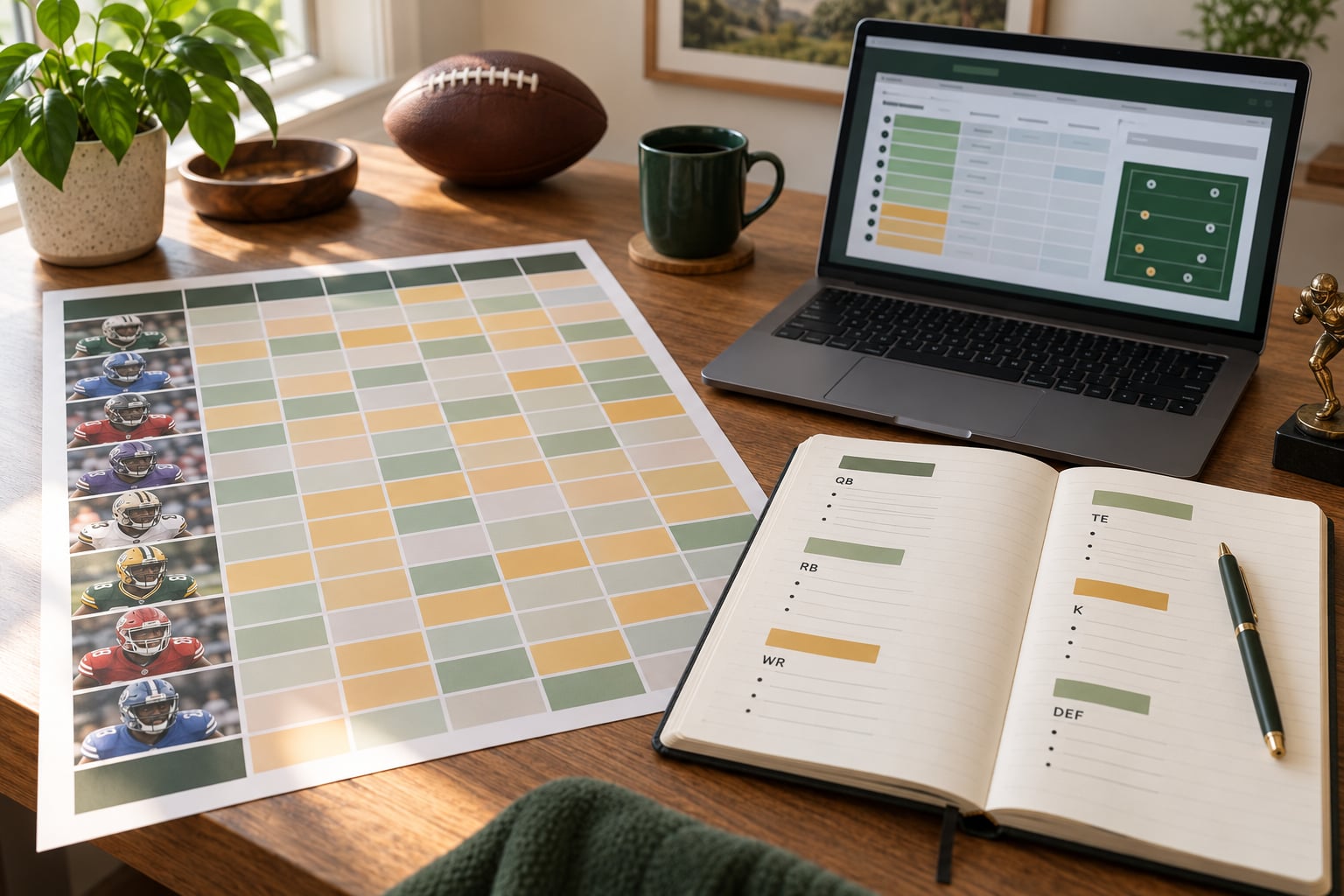
- A draft board. A grid of players by round and pick, with the positions they play in the left column. Most fantasy apps have one built in.
- A position list. Your own shortlist of roughly 15 names per skill position, split into tiers.
- One draft source and a notes file. A single news feed or newsletter you check twice a week, plus somewhere to record every pick you make live.
What you do not need: eleven different rankings, three podcasts, or an opinion from your cousin. Sorting through conflicting advice is the most common reason beginners arrive at draft day unprepared. Pick one sheet and trust it.
How to Handle a Draft Step by Step
The draft is not a test of football knowledge. It is a sequence of small comparisons, and the same comparison repeats on every pick. The six steps below are the whole process.
1. Learn the league rules and scoring format
Scoring decides who you should draft. In a points-per-reception league, catches are worth roughly a point each, so a receiver who catches six short passes on a bad day can outscore a runner who has one long run. In a standard league, a catch is worth nothing at all and yards and touchdowns carry everything, so running backs and pass-catchers gain value fast.
Typical ranges, since every league sets its own numbers:
| Format | Catch value | What it rewards |
|---|---|---|
| Standard | 0 points | Touches, yards and touchdowns; receivers need big plays |
| Half-PPR | About 0.5 points | A middle ground where volume matters more than the standard game |
| PPR | About 1 point | Volume first, so wide receivers and tight ends become safer picks |
Roster slots matter just as much. A 12-team league starting one quarterback, two running backs, three wide receivers, one tight end, one kicker and one defense needs those positions filled. A league with a flex spot will take a running back, receiver or tight end in that slot. If your league has four starting receivers instead of three, receivers are worth drafting earlier than the same chart says in another league.
Write down your starting lineup and your total roster size. If you cannot recite them from memory, you are not ready to draft.
2. Build a simple list of fantasy football draft targets
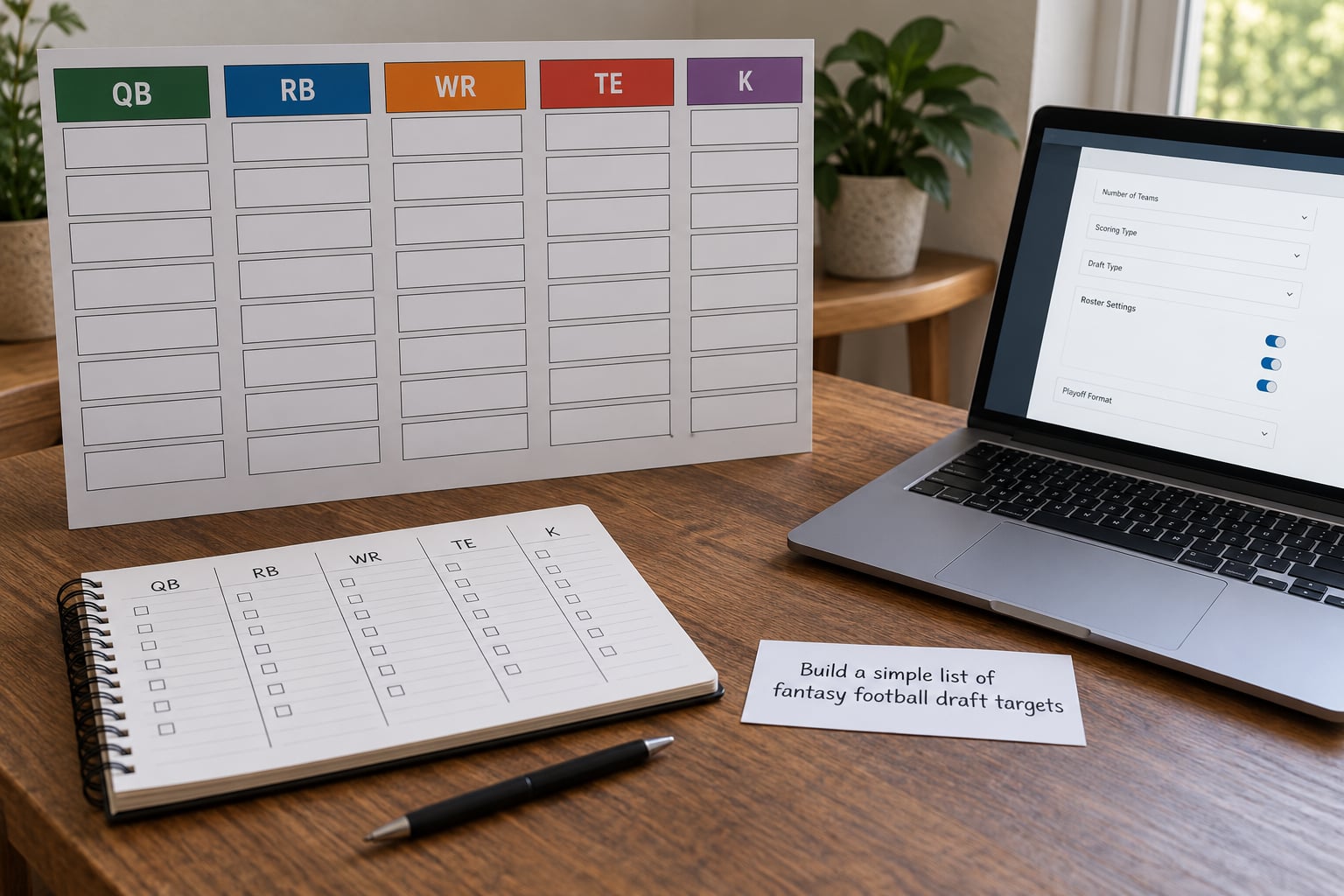
Take your cheat sheet and split each position into three tiers: round one and two names, round three to six names, and the deep list you will use late. That is your board. It takes ten minutes and it replaces all six ranking tabs.
When you look at a name, ask three plain questions. Is the player expected to play a full role, meaning they are on the field for most of the game rather than only in one situation? Are they competing for touches, targets or carries, and how much of that work is likely to be theirs rather than a teammate’s? Are they healthy, and if not, is there a reliable player behind them who would take over the job?
That third question matters more than beginners expect. Losing a starter is common in this sport, and a backup who inherits the same role is a legitimate pick rather than a desperate one. Do not wait until the season is halfway over to think about depth.
3. Understand draft position value
You will hear “replacement level” more than any other phrase in fantasy, and it has a simple meaning. In a 12-team league, several other teams also want running backs. The last running back taken on the board is your replacement, and picking him gives you roughly the same output as picking him sixth. Pick him much earlier and you have spent a first-round pick on a mid-tier player.
Replacement level also differs by position, which is why round one looks different from round three. Running backs disappear from boards fastest because every team wants two. Kickers and defenses are available in quantity and stay on the board until the final rounds. Quarterbacks are unusual: one good passer per team is enough, so a strong starter is often available in the middle rounds.
Pick 1.01 is not automatically better than pick 2.01. The difference comes down to how many teams wanted the player you took and whether you forced the pick.
4. Set tiered targets for each round
Before you go live, assign each round a plan. A workable version for a 12-team PPR league looks like this: round one takes the best player on your board, whoever it is, as long as it is a running back, wide receiver or tight end. Round two takes the best remaining player at a position you still need. Round three takes the best value left, and this is where a second wide receiver in the top ten usually sits. Rounds four through eight fill starters. Rounds nine onward fill bench slots, kicker and defense, with a priority list of players other managers left behind.
Write it on one sheet of paper. When the draft is moving fast, a page in front of you beats a spreadsheet you have to search.
Adjust as you go, but only by one rule: if your league drafted two tight ends in the first five picks, the next tight end just became more valuable than your sheet said, because fewer remain. Count what has been drafted, then set your next target.
5. Draft by role and opportunity
You can judge a player without watching games by reading what the beat reporters say about the job, not the highlights. Look for phrases such as full-time starter, three-down back, or the backup who took over the job. These tell you volume, and volume is what fantasy scoring pays for.
Two beginner shortcuts help. First, players on teams that throw a lot produce more fantasy points, because more passes means more chances at catches and yards. Second, target share, meaning the share of a team’s passes a receiver gets, is more telling than a highlight reel. A receiver catching a third of his team’s passes is usually worth more than one catching two all season.
Do not draft your favorite team’s players just because you like them. Fandom is not a projection, and the friend who makes this mistake every year drafts their starter twice.
6. Use a simple draft-day decision process
Run the same five steps on every pick. Check what your lineup still needs. Look at the board and find the best player available at a position you need. Compare that player with your ADP and your round plan, and if they are close, take them. Avoid reaching more than about one round above where your sheet has them. Record the pick before you move on, then look at the board again for your next turn.
On clock: you have a fixed window on most platforms, typically 90 seconds to a couple of minutes. Taking your full window is completely normal for a first-year manager, so let it run and use the time to read the board. Do not draft from your phone unless you have no choice; you will misclick a name on a small screen at some point, and one round of catching up is a bad trade.
Common Mistakes to Avoid in a Fantasy Football Draft
These are the errors that show up in first-year drafts every season. Each one has a fix you can apply mid-draft.
- Drafting on heart. Fix: sort the board by rank, not by team.
- Ignoring the scoring format. Fix: confirm points per reception in the league settings on the screen before you take your first pick.
- Reaching for a big name. If a player is going 6th overall in your sheet, you should not have him at pick 7 unless something changed. Fix: take the best player on the board instead.
- Waiting too long on quarterbacks. A strong starter is often there in the middle rounds. Fix: set a round ceiling for your QB and a fallback name.
- Going too thin at one position. Three tight ends in the first eight rounds leaves no room for anything else. Fix: spread early picks across positions you must start.
- Taking kickers or defenses early. Fix: save them for your final two or three rounds.
- Dismissing sleepers. A player ranked outside the top 150 who sits behind an injured starter is a fine late pick. Fix: keep two names per position on a deep list.
- Skipping the weeks after the draft. Waiver claims and lineup setting are where most of the season is decided. Fix: check waivers twice a week and set lineups before every game day.
One more that is not a mistake but a saving grace. In a casual friends’ league, expect to finish somewhere in the middle. Nobody is tracking your management decisions in July.
Frequently Asked Questions
Can you explain the NFL Draft in a simple way?
The NFL Draft is the annual event where the 32 NFL teams select college players, and it happens once a year in the spring. It has nothing to do with your fantasy league. Your fantasy draft is a separate event where the managers in your league take players onto their own rosters, usually in late summer or early September. If you were told to join a league and draft, that is a fantasy draft.
Do I need to know football to play fantasy football?
No. Fantasy scoring is arithmetic: yards, receptions, touchdowns and turnovers produce points. A consensus cheat sheet and average draft position already encode everything other managers know. You do not have to watch games, know the rules or follow a team. Reading a couple of injury updates a week is more than enough for a first season.
How many mock drafts should I do before my real draft?
Three is plenty, and five makes you feel better than it should. The purpose is not to build a perfect team, it is to learn the interface and see how quickly the board moves. Run them on the free mock draft tool inside your league app, take the best player on your sheet every time, and stop once you have gone three without panicking at the clock.
Should I follow expert rankings and ADP if I know nothing?
Yes, and this is the shortcut that makes the whole draft manageable. ADP, average draft position, is the average pick where other leagues took that player. If a running back is going 6th overall, he will probably be gone at pick 7. Use ADP as a guide and your cheat sheet as the ranking, and only override them when your league format clearly favors one position over another.
How is a keeper or dynasty league different from a redraft league?
A redraft league starts fresh every season, so you trade or drop everyone at the end. A dynasty league keeps your roster from year to year, so a good young player drafted in round four can be worth more than a veteran in round one. Keeper leagues mix the two by letting you carry a few players into the next draft. If your league keeps rosters, value youth over total points.
Can AI do my fantasy draft for me?
Autodrafters exist, but they are built to follow consensus rankings exactly, which means they have no idea what your league needs and they inflate the price of the top names. A beginner picking manually on a consensus sheet usually ends up with a more balanced roster. If you want a middle path, set your autopick delay to the maximum and make every selection yourself.
Conclusion
Do one thing before draft night: open your league settings and write down your scoring format and your starting slots on a single sheet of paper. Then take a consensus cheat sheet, split it into tiers by position, and bring a round-by-round plan to the draft. On every pick you run the same five-step check: what do I still need, who is best available, does ADP agree, am I reaching, and did I record it.
That is a complete draft strategy. It is also how to fantasy football draft when you know nothing about football, and it is enough to finish respectably in your first season of a league you enjoy.